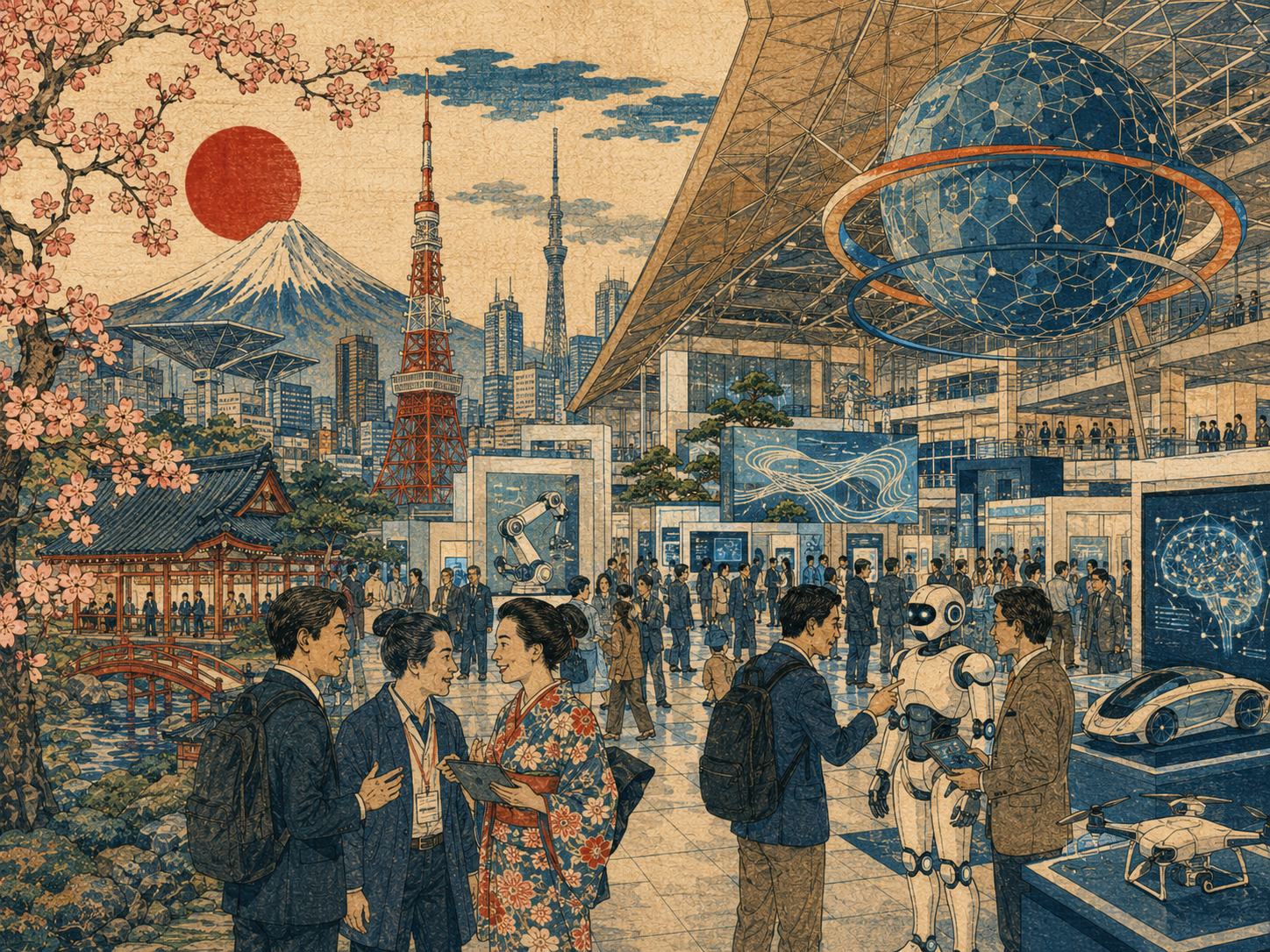
At Tokyo Big Sight, robots walk, AI systems read the city, climate-tech founders talk about water and power, and investors trade business cards under the lights. SusHi Tech Tokyo 2026 was more than a startup convention. It was a stage on which Tokyo showed how it wants to reinvent itself. In the autumn, Global Startup EXPO 2026 will pull the deep-tech story west to Osaka. Together, they mark a new phase in Japan’s innovation season: from showcasing the future to trying to implement it.
SusHi Tech Tokyo 2026 was held from April 27 to 29 at Tokyo Big Sight. The Tokyo Metropolitan Government positions the event as Asia’s largest global innovation conference, with AI, robotics, sustainable cities, urban safety and digital transformation at the center. Tokyo’s English-language release said the 2026 event brought together 770 startups and 60,000 participants.
Global Startup EXPO 2026 will take place from October 5 to 7 in Osaka Prefecture, centered on Umekita and Nakanoshima Qross. According to the official site and METI, the event focuses on deep tech: biotechnology and healthcare, quantum, fusion energy, space, AI and advanced robotics, among other strategic areas tied to Japan’s growth agenda. Spring in Tokyo, autumn in Osaka — this is not just an event calendar. It is Japan trying to move startups closer to economic policy, urban policy, industrial renewal and national strategy.
What SusHi Tech actually means
SusHi Tech does not simply mean sushi. It stands for Sustainable High City Tech Tokyo. The playful name matters, though. Tokyo describes the concept by comparing it to sushi: just as craftsmanship turns simple ingredients into a symbol of Japanese culture, technology and diverse ideas can transform urban problems into a sustainable society.
Inside that branding is Tokyo’s anxiety. The metropolis faces congestion, earthquakes, floods, aging infrastructure, population aging, housing pressure, healthcare needs, energy strain, tourism crowds and administrative complexity. The problem is also the market. AI can reduce congestion. Robots can support care. Sensors can predict flooding. Digital government can reduce paperwork. Tokyo wants to turn its own urban challenges into technologies that other cities can use.
The 2026 event had two business days and one public day. Startups, investors, large corporations, universities, cities and international delegations gathered at Tokyo Big Sight. The venue also mixed Japanese cultural staging with high-tech displays — taiko, lanterns, booths, robots and AI. That was not decoration alone. Tokyo was placing technology inside urban culture rather than presenting it as something cold and separate.
Japan’s 2026 startup season in numbers
From Tokyo to Osaka: the meaning of startup events is changing
Japan’s large events have often been about exhibition: show the product, draw the crowd, build the brand. But in 2026, a startup event cannot stop at display. Startups need capital, customers, regulatory pathways, demonstration sites, university research, government procurement, corporate partners and overseas markets.
SusHi Tech Tokyo is built around the idea that the city itself can become a demonstration field. Local governments with urban challenges meet startups with technologies. Large corporations look for innovation they cannot build quickly enough in-house. Investors search for research-based companies that can scale. Universities look for routes from lab to company.
Global Startup EXPO 2026 has a Kansai meaning. Coming after Expo 2025 Osaka, Kansai, it is designed to convert visions of future society into real implementation. Its official materials describe it as an international deep-tech event centered on startup technologies and services. Osaka, Kyoto, Kobe, Kansai business organizations and innovation groups sit behind the executive committee. That positions Kansai not only as a fairground, but as a region of research, industry and implementation.
Why deep tech is hard
Deep tech is not just another app or ad platform. It usually requires long research cycles, patents, university science, laboratories, capital equipment, regulation, manufacturing and specialist talent. Biotechnology, quantum, fusion, space, robotics, materials, energy and medical devices can change society, but they take time and money.
Japan has real advantages here. It has universities, materials science, precision manufacturing, robotics, medical technology, semiconductor equipment, space components, batteries, optics and sensors. It also has weaknesses: limited risk capital, low tolerance for failure, slow university commercialization, regulatory complexity and corporate partnerships that too often remain pilots rather than large contracts.
Japan’s startup history: late, but serious
Japan has always had entrepreneurs. Sony, Honda, Kyocera, Secom, SoftBank, Rakuten and Uniqlo all began as challengers. Many postwar giants were once startups. But from the 1990s onward, Japan’s industrial society remained dominated by large companies, banks and lifetime-employment norms, making Silicon Valley-style fast-growth startups harder to produce.
The 2000s brought internet ventures. The 2010s produced symbols such as Mercari, SmartHR, Preferred Networks, Spiber and ispace. But compared with the United States and China, Japan still lagged in unicorns, venture capital, exit markets, stock options, public procurement and university spinoffs.
The government tried to change the trajectory with its 2022 five-year startup development plan. The aim was to expand startup investment, strengthen venture capital, improve university commercialization, mobilize talent, promote open innovation and use government procurement more effectively. SusHi Tech Tokyo and Global Startup EXPO are stages built inside that policy shift.
AI, robots and cities: Tokyo’s advantage
Tokyo’s strength is the density of its urban problems. Aging public housing, commuting congestion, disaster risk, heat, energy, healthcare, foreign tourism, administrative procedures and old infrastructure all sit close together. What looks like weakness can become a startup market.
AI can read urban complexity. Robots can support services in a labor-short city. Disaster tech can be tested in a country of earthquakes and storms. Climate tech is needed in a hotter, energy-constrained metropolis. Mobility technology can mature in a city of rail, walking, delivery and dense streets. Tokyo’s problems are also the problems of Seoul, Singapore, Paris, New York, Jakarta, Mumbai and Los Angeles.
That is why SusHi Tech Tokyo matters beyond the exhibition floor. It is an attempt to turn the city into a product: urban operating systems, data links, disaster response, eldercare, mobility, administration and tourism management. Technologies that work in Tokyo can travel.
Osaka and Kansai: research, medicine, materials and industry
Global Startup EXPO has a different geography. Kansai brings Kyoto University, Osaka University, Kobe University, RIKEN networks, medicine, biotechnology, materials, batteries, pharmaceuticals, robotics and manufacturing. If Tokyo’s edge is urban demonstration, Kansai’s edge is linking research to industry.
Umekita is not just a redevelopment district. It is an effort to turn prime urban land near Osaka Station into a hub for innovation, universities, companies, medical research and international exchange. Nakanoshima Qross adds a future-medicine and research dimension. Holding GSE2026 there matters. It pulls the Expo 2025 future-society vision back into laboratories, capital and companies.
What investors are watching
Investors looking at Japanese deep tech see both promise and friction. The promise is depth: patents, materials, precision machinery, robotics, medicine, space and energy. These are not easily copied. The friction is speed and scale: strong research can lack entrepreneurial management; corporate pilots can fail to become large contracts; IPOs can arrive before companies have won global markets; English communication, overseas hiring and capital strategy remain challenges.
That means the real metric for 2026 is not attendance. It is what happens after the halls close. How many pilot projects become paid contracts? How many startups raise serious capital? How many find overseas customers? How many become acquisition targets? How many enter government procurement? Events are gateways; outcomes come later.
Japan.co.jp’s view
SusHi Tech Tokyo and Global Startup EXPO are stages for Japan’s startup ambitions. But stages do not build companies by themselves. Japan needs to turn event energy into capital, customers, procurement, regulation, university reform and global talent.
Still, the 2026 season matters. Tokyo is trying to turn urban problems into exportable technology. Osaka and Kansai are trying to turn Expo-era visions into deep-tech industry. The government is placing biotechnology, quantum, fusion, space, AI and robotics inside growth strategy.
Japan’s next industrial story may not come from a single giant corporation. It may come from bridges: between laboratories and founders, machine shops and venture capital, city halls and startups, big-company researchers and young CEOs, overseas investors and Japanese universities. In the summer of 2026, those bridges are beginning to take shape.
Reader guide
| Question | Answer |
|---|---|
| What happened? | SusHi Tech Tokyo 2026 was held in April at Tokyo Big Sight, and Global Startup EXPO 2026 will be held in Osaka in October. |
| Why does it matter? | Japan is moving startups closer to urban problem-solving, deep tech, industrial policy and global investment. |
| Tokyo’s edge | AI, robotics, disaster tech, mobility, urban data and sustainable-city solutions. |
| Kansai’s edge | Biotech, medicine, quantum, materials, university research and post-Expo implementation. |
| Japan.co.jp’s view | The success of these events will be measured by capital raised, contracts signed, pilots scaled, procurement opened and startups that go global. |
Sources and references
This article draws on public information from the SusHi Tech Tokyo official site, Tokyo Metropolitan Government releases, SusHi Tech Global, Global Startup EXPO 2026, METI, Kansai Startup Ecosystem and The Japan Times.
- SusHi Tech Tokyo 2026 official site
- Tokyo Metropolitan Government: SusHi Tech Tokyo 2026 with 770 startups and 60,000 participants
- Tokyo Metropolitan Government: SusHi Tech Tokyo 2026 recap
- SusHi Tech Global
- Global Startup EXPO 2026 official site
- METI: Announcement of selected speakers for Global Startup EXPO 2026
- METI: Global Startup EXPO to take place in Osaka in Q4 2026