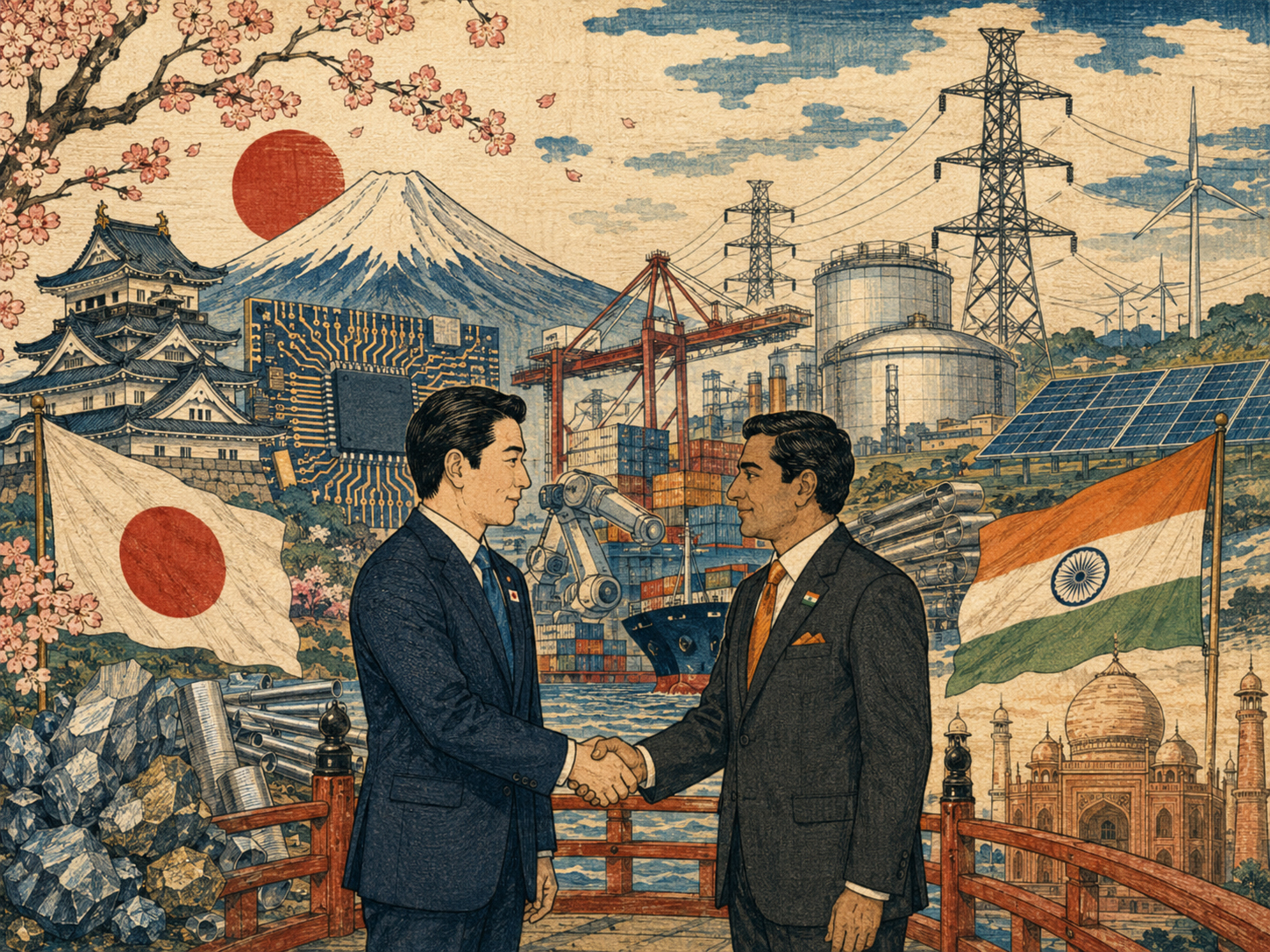
In a meeting room in New Delhi, the two flags told a larger story than the usual ceremony of summit diplomacy. On July 2, 2026, Japan and India did not merely promise warmer relations. They connected artificial intelligence, metals, energy, defence and economic security into one strategic map. For decades, the Japan-India story was told through Buddhism, culture, official development assistance, railways and factories. Now it is being rewritten through AI models, semiconductors, rare earths, power grids, ports, supply chains and the politics of resilience.
Reuters reported that Prime Minister Narendra Modi and Japanese Prime Minister Sanae Takaichi agreed to deepen cooperation in artificial intelligence, metals, energy and defence, while preparing a joint roadmap for economic security. India’s foreign ministry said the two sides adopted three landmark documents on economic security, energy resilience and AI. Modi said the convergence of Japan’s precision technology and India’s software capabilities would give new momentum to global AI development.
That could sound like summit language. But in Asia in 2026, when AI, metals and energy appear in the same sentence, the subject is not just industry policy. AI consumes electricity. Power grids require copper, aluminium, transformers, batteries and semiconductors. Electric vehicles, robots, wind turbines, precision motors, data-center cooling systems and telecom infrastructure require rare earths and critical minerals. The future AI economy is not floating in the cloud. It rests on mines, refineries, ports, transmission lines, factories and sea lanes.
The summit’s core: three documents, five strategic sectors
The heart of the agreement was not AI alone, nor minerals alone, nor energy alone. It was the decision to treat them together as economic security. Reuters said both sides adopted documents on economic security, energy resilience and AI, and also signed an agreement on their first defence co-development project.
The direction did not begin overnight. At the 18th Japan-India Foreign Ministers’ Strategic Dialogue in January 2026, Japan’s Toshimitsu Motegi and India’s S. Jaishankar agreed to deepen economic-security cooperation in five priority areas: semiconductors, critical minerals, information and communications technology, clean energy and pharmaceuticals. They also agreed to establish the Japan-India AI Strategic Dialogue, convene a Joint Working Group on Mineral Resources, and pursue a Japanese plan to invite 500 highly skilled AI professionals from India by 2030.
The July summit elevated that institutional architecture to the political level. The foreign ministers had built the frame; the prime ministers put a national-strategy label on it. Japan-India relations are shifting from infrastructure cooperation to the industrial security of the AI age.
Why Japan needs India
Japan remains a manufacturing power. Automobiles, industrial robots, precision machinery, electronic components, materials, machine tools and medical devices still matter in the AI era. But Japan’s weaknesses are equally visible: a shrinking population, a shortage of software talent, scarce domestic energy resources and deep dependence on imported critical minerals.
In July 2026, corporate Japan’s warnings became louder. Reuters reported that China’s export restrictions had reduced supplies to Japan of materials such as terbium, dysprosium oxide and yttrium oxide, while more Tokyo Stock Exchange filings were mentioning rare-earth risks. Rare earths are embedded in the supply chains for EVs, electronics, weapons, motors, sensors and AI-related equipment. China is estimated to control roughly 70% of rare-earth production and about 60% of reserves.
Japan has seen this movie before. In 2010, tensions with China around the Senkaku Islands led to a rare-earth supply scare. Japan responded with diversification, stockpiling, recycling and substitute-material research. But demand from AI, electric vehicles, defence and renewable energy has made mineral dependence a national issue again. For Japan, India is not simply a large market. It is a demographic, mineral, software and geopolitical alternative to overdependence on China.
Why India needs Japan
India brings population, digital talent, IT services, space capability, start-ups and deep connections to the English-speaking technology world. It is one of the world’s major software suppliers and a reservoir of AI talent. But turning AI into industry requires data centers, semiconductors, precision components, reliable electricity, railways, ports, urban infrastructure, manufacturing quality and long-term capital.
That is where Japan matters. Japan is one of India’s largest investors and has supported major infrastructure projects, including the Mumbai-Ahmedabad high-speed rail corridor. Reuters reported that bilateral trade reached $27.5 billion in fiscal year 2025/26, while Japanese investment in India was $3.2 billion from April to December 2025. Japanese companies increasingly see India not only as a consumer market but also as a China-plus-one manufacturing base and a source of next-generation digital talent.
For India, Japan is not simply a funding source. Japan brings quality control, long-life infrastructure, industrial discipline, robotics, battery materials, power equipment, railway safety, medical devices and precision processing. If India’s scale and speed can combine with Japan’s precision and reliability, the AI-era supply chain no longer has to run through a single dominant center.
The older bond: from Nara in 752 to diplomatic relations in 1952
Any account of Japan-India relations that begins with AI and defence starts too late. India’s bilateral brief describes the relationship as rooted in spiritual, cultural and civilizational ties, and notes that in 752 AD the Indian monk Bodhisena participated in the consecration ceremony of the Great Buddha at Todai-ji Temple in Nara. Buddhism moved from India through China and the Korean peninsula to Japan, leaving a deep imprint on Japanese thought, art, temple architecture and state ritual.
In modern times, the relationship passed through colonialism, Asianism, India’s independence movement, war and the postwar order. Diplomatic relations were established in 1952. During the Cold War the relationship had distance, but in the 21st century it became increasingly strategic. Japan’s Foreign Ministry says the relationship was elevated to a Global and Strategic Partnership in 2006 and then to a Special Strategic and Global Partnership in 2014 under Prime Minister Shinzo Abe and Prime Minister Modi.
In 2011, the Japan-India Comprehensive Economic Partnership Agreement came into effect. India’s embassy in Tokyo describes CEPA as covering goods, services, movement of natural persons, investment, intellectual property, customs procedures and other trade-related issues, with tariff abolition envisioned for 94% of traded items over ten years. Today’s AI-minerals-energy axis is not a sudden pivot. It rests on decades of culture, diplomacy, economic integration, infrastructure and defence cooperation.
AI creates power diplomacy
When people hear “AI cooperation,” they imagine research exchanges, model development, cloud services, data and start-ups. But the real foundation of generative AI is electricity. Training and running large models requires data centers, cooling systems, chips, networks and huge amounts of stable power.
Japan faces questions over electricity prices, nuclear restarts, LNG, renewable power and grid upgrades. India faces rising power demand, coal dependence, renewable integration, storage, grid investment and urbanization. That is why AI and energy resilience appear in the same summit package. The future of AI will not be determined only by model performance. It will also be determined by which countries can provide cheap, stable and politically secure power.
By placing energy resilience alongside AI, Japan and India are thinking about the physical base of the digital economy. Data centers, batteries, green hydrogen, ammonia, transmission lines, smart grids, transformers and power semiconductors are the back room of AI — and the front line of economic security.
The geopolitics of metals: rare earths as a quiet battlefield
Critical minerals rarely produce glamorous headlines. But in economic-security terms, they are the new chokepoints. “Rare earths” are not a single material; they include elements such as neodymium, praseodymium, dysprosium and terbium. They are used in high-performance magnets, motors, sensors, lasers, defence systems, medical equipment, wind turbines and EVs.
China’s power lies not only in mining but also in separation, refining and processing — the midstream stages that turn minerals into industrial inputs. This is where the Japan-India working group can matter. India has mineral potential; Japan has processing know-how, quality discipline and downstream industrial demand. The partnership must move beyond mine access to midstream processing, recycling, substitute materials, joint stockpiles and private-sector investment.
The 2026 rare-earth alarm is a warning to Japanese industry. Diversification is easy to announce and hard to execute. It requires long-term contracts, permits, environmental controls, refining technology, price guarantees, finance, insurance, logistics and purchasing commitments from real manufacturers. The test for Japan and India is whether communiqués turn into plants, contracts and supply.
Defence, AI and the quiet Quad context
Reuters reported that the July 2026 summit also produced the first India-Japan defence co-development project. Japan and India are members of the Quad with the United States and Australia. Officially, the Quad addresses an open Indo-Pacific, disaster response, maritime security, technology standards, infrastructure and public goods. In regional politics, it also inevitably reflects concern over China’s growing influence.
When AI, metals, energy and defence move together, the meaning becomes heavier. AI is dual-use. Semiconductors are dual-use. Rare earths are dual-use. Energy infrastructure becomes a lifeline in crisis. Japan-India cooperation is therefore not just a story of friendly democracies. It is an attempt to build supply chains that do not break under pressure.
There are limits. India values strategic autonomy and will not align with Japan or the United States on every question. Japan also has its own constitutional and political constraints as a postwar peace state. That is why the relationship works best as complementarity rather than alliance. Japan brings technology, capital, quality and infrastructure. India brings scale, talent, geography and growth. The overlap is the opportunity.
Japan-India axis by the numbers
Japan.co.jp view
The essence of this story is not that Japan and India are getting along. It is that Japan is recognizing that the industrial security of the AI age cannot be built alone. Japan’s precision technology is not enough without software talent and market scale. India’s software capacity is not enough without precision manufacturing, patient capital, energy equipment, quality control and materials technology. Each country’s weakness creates value for the other.
For Japanese companies, India is a difficult market. Regulation, state-level differences, taxes, land, logistics, contract culture, talent mobility and price competition can all frustrate careful corporate planners. But China dependence, population decline, AI talent shortages and rare-earth risk are making avoidance less realistic. The difficulty is precisely why the state-to-state framework matters.
For India, Japan may look slow. Decisions are cautious. Risk is carefully managed. Contracts take time. But when Japan commits, it tends to stay. The high-speed rail project is slow, but it leaves behind systems, skills and institutions. The same may be true for AI, minerals and energy: the announcement matters less than the factories, labs, grid projects, graduate programs and component makers that exist ten years from now.
Reader guide
| Question | Answer |
|---|---|
| What happened? | On July 2, 2026, Japan and India agreed to deepen cooperation in AI, metals, energy, defence and economic security. |
| Why does it matter? | The AI age will be shaped not only by models, but by electricity, chips, rare earths, skilled people and trusted supply chains. |
| What Japan wants | Less China dependence, AI talent, critical-mineral access, energy security and deeper connection to India’s market and manufacturing base. |
| What India wants | Japanese precision technology, long-term capital, quality systems, infrastructure expertise and energy/manufacturing capabilities. |
| Historical context | The relationship stretches from Buddhist exchange in 752 to diplomatic relations in 1952, strategic partnership in 2006 and Special Strategic and Global Partnership in 2014. |
The next winner in AI will not be only the country with the best model. It will be the country with reliable power, secure minerals, trusted partners and a durable flow of talent. The Japan-India agreements of July 2026 may be the quiet beginning of that future.
Sources and references
This article draws on Reuters reporting on the July 2, 2026 Modi-Takaichi summit, public materials from Japan’s Prime Minister’s Office, Japan’s Foreign Ministry and India’s External Affairs Ministry, the January 2026 Japan-India Strategic Dialogue, historical Japan-India relationship data, CEPA documents, and Reuters reporting on rare-earth supply pressure on corporate Japan.
- Reuters: India, Japan sign pacts on AI, metals and energy after Modi-Takaichi talks
- Prime Minister's Office of Japan: Japan-India Leaders' Meeting and Working Luncheon
- MOFA Japan: 18th Japan-India Foreign Ministers' Strategic Dialogue
- MOFA Japan: Japan-India Relations Basic Data
- Government of India: India-Japan Bilateral Brief
- Reuters: Corporate Japan's rare-earth warnings get louder
- Japan-India Comprehensive Economic Partnership Agreement