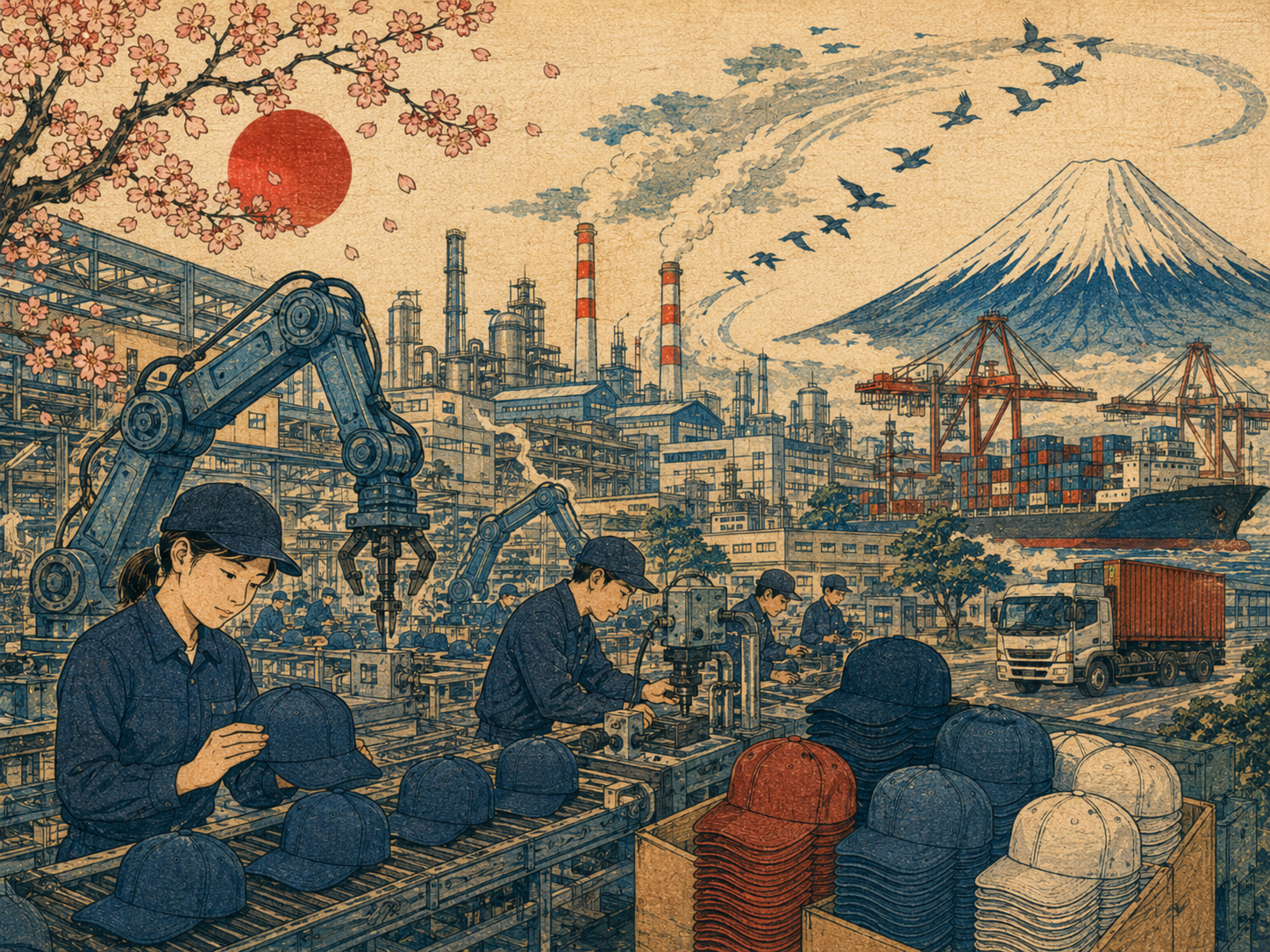
Japan’s factories are making noise again. The hum of machine tools, the movement of semiconductor equipment, the testing of auto parts, the stacking of inventory in warehouse aisles. The June 2026 manufacturing PMI looks, at first, like a quiet economic indicator. But behind it sits a larger story: the long adjustment after yen strength and offshoring, the shock of pandemic supply chains, the pressure of U.S.-China rivalry, the AI semiconductor boom, and the stockpiling instincts triggered by geopolitical risk.
The final au Jibun Bank Japan Manufacturing PMI compiled by S&P Global rose to 54.8 in June from 54.5 in May. A reading above 50 signals expansion; below 50 signals contraction. Japan’s factory sector has now expanded for six straight months. Reuters reported that the survey capped Japan’s strongest quarterly manufacturing performance since the first quarter of 2014.
This is not just a cheerful data point. It is a sign that Japan’s industrial heart is receiving orders again after years of doubt. New orders rose at the fastest pace since January 2022, supported by domestic demand and stronger buying from overseas customers. For a factory, an order is a promise about the future. It does not just fill today’s production schedule. It shapes next month’s hiring, next quarter’s investment and next year’s confidence.
What PMI actually measures
PMI stands for Purchasing Managers’ Index. It asks company purchasing managers about output, new orders, employment, delivery times, stocks and prices. It is faster than GDP and closer to the factory floor than corporate earnings. In manufacturing, the person buying materials and watching delivery times often sees the turn before the rest of the economy does.
The dividing line is 50. Above 50 means conditions improved from the previous month; below 50 means they deteriorated. A reading of 54.8 is not a boom, but it is a clear expansion. The more important point is persistence: six months above 50 and a quarterly average compared with the strongest period since early 2014.
The 2014 comparison is revealing. Early 2014 Japan was shaped by the first phase of Abenomics, yen weakness, rising stocks and front-loaded demand before the consumption tax hike. The 2026 recovery is different. This time, factories are responding to AI infrastructure, semiconductor equipment, geopolitical stockpiling, supply-chain redesign, defense and energy investment, and a weak yen that is both a blessing and a cost problem.
Japan’s June factory story in numbers
Why new orders matter
For manufacturing, the crucial detail is not only that output rose. It is that new orders rose. Production can be boosted by stockpiling. Orders mean customers are committing to future demand. They are telling suppliers to prepare parts, materials, machines and workers.
The June survey showed stronger domestic demand and more orders from overseas customers. That matters because Japanese manufacturing is not a closed domestic machine. Autos, machine tools, industrial robots, semiconductor equipment, electronic components, materials and precision machinery are all tied to global capital spending, AI data centers, hybrid and electric vehicles, energy investment, defense spending and infrastructure renewal.
The AI boom is an indirect but powerful tailwind. Japan may not dominate the largest language models, but it remains deeply embedded in the hardware stack that makes AI possible: semiconductor equipment, materials, inspection systems, precision parts, cooling, power control and industrial automation. The software frenzy returns to Japan as hardware demand.
The weak yen: friend and enemy
A weak yen supports exporters. Overseas revenue translates into more yen, and Japanese-made goods can become more competitive. But the 2026 weak yen is not a simple gift. It raises the cost of energy, food, raw materials, imported parts and logistics. It squeezes households and factories at the same time.
The June PMI data also carried a warning about costs. Middle East tensions and the Iran war’s aftershocks intensified concern about energy and raw materials. Some demand may reflect precautionary stockbuilding rather than ordinary confidence. Factories are busier partly because customers want goods — and partly because they fear shortages.
Monozukuri history: from ruins to semiconductor equipment
Japan’s manufacturing story begins in the postwar reconstruction. Textiles, steel, shipbuilding, home appliances, automobiles and electronics became the country’s growth engine. From the 1950s through the 1970s, Japan moved from cheap mass production to quality, efficiency and process discipline. Toyota’s production system, kaizen, just-in-time delivery, quality circles and supplier networks became part of the national identity.
By the 1980s, Japanese products were everywhere: cars, televisions, semiconductors, Walkmans, cameras, machine tools. Success brought friction. U.S.-Japan trade disputes, the Plaza Accord, yen appreciation and overseas production reshaped the industrial map. In the 1990s and 2000s, Japan expanded abroad while trying to preserve high-value production at home.
Then came China’s rise, Korean and Taiwanese competition, digital-electronics defeats and a shrinking domestic market. Japan’s industrial strength shifted from visible finished products to less visible but essential layers: materials, components, production equipment, factory automation, inspection and precision machinery. Japan became less of the world’s showcase and more of the world’s manufacturing foundation.
How 2026 differs from 2014
The comparison with the first quarter of 2014 is useful because it shows how different this recovery is. In 2014, the consumption tax hike pulled demand forward. Consumers bought cars, appliances and housing-related goods before the tax increase. Factories benefited, then faced a payback.
In 2026, the drivers are more complicated. AI semiconductors, supply-chain redesign, U.S.-China rivalry, Western capital expenditure, Japanese wage growth, currency weakness, inventory strategy, defense and energy investment are all intertwined. That makes the current rebound more interesting — and harder to forecast. It could fade if stockpiling reverses, or it could become the opening stage of a broader industrial restructuring.
Autos, semiconductors and machine tools
Three pillars matter. The first is autos. Japan is not only an electric-vehicle story; it is a hybrid, battery, sensor, control-system and parts story. As the global auto industry splits across electrification and geopolitical blocs, Japanese manufacturers are rethinking production across North America, Asia and Japan.
The second is semiconductors. Rapidus, TSMC in Kumamoto, materials suppliers, equipment makers, inspection systems and specialty chemicals all form part of the new industrial strategy. Japan does not control the whole leading-edge logic market, but it remains strong around the production process. AI-era fab investment feeds Japanese equipment and materials demand.
The third is machine tools and industrial machinery. When the world builds new factories, Japan often supplies the tools that make those factories possible: machine tools, robots, control devices and precision components. Investment in China, India, Southeast Asia, the United States and Europe can return to Japan as orders.
Labor shortage and automation
The biggest constraint may be people. Japan is aging and shrinking. Young workers do not automatically choose factories. Small and midsize suppliers face skilled-labor shortages, aging owners and succession problems. Orders do not become output if there is no one to run the line.
That means the 2026 manufacturing rebound is inseparable from automation, robotics, AI inspection, digital twins, predictive maintenance, foreign labor, reskilling and regional workforce policy. This is not a return to the old model of adding large numbers of workers to the line. It is a higher-value model: fewer people, more technology, tighter quality, more automation.
There is opportunity in that pressure. The systems Japanese factories build to solve their own labor shortages — robots, inspection AI, maintenance tools, workflow software — can also be sold to a world that is aging and short of skilled industrial labor.
Risks: costs, inventory and external demand
The PMI improvement should not be overread. The first risk is cost. Energy, raw materials, wages, logistics and imported parts can rise faster than output prices, leaving factories busy but margins thin. The second risk is inventory. If some orders reflect geopolitical precaution, the rebound could reverse when customers decide they have enough stock.
The third risk is external demand. A weak Chinese economy affects machine tools and materials. Higher U.S. rates affect capital investment. Sluggish Europe affects exports. Japan’s factories may stand on Japanese soil, but their demand is global.
Japan.co.jp’s view
The June 2026 PMI shows that Japan’s manufacturing story is not over. But it does not mean the Showa factory economy is simply returning. What is emerging is a new factory economy built around AI infrastructure, semiconductors, precision machinery, automation, materials, energy systems and resilient supply chains.
The challenge is to turn this rebound into wages, investment, productivity and regional employment. When orders are coming in, companies must update old equipment, digitize production, train workers and strengthen suppliers. If they do, the 2026 PMI will be remembered not as a good monthly survey, but as a signpost in Japan’s industrial renewal.
Factories rarely dominate the front page. But when factories move, ports move, rail lines move, banks move, regional employers move and household wages eventually move. The real pulse of Japan’s economy still beats somewhere on a production line.
Reader guide
| Question | Answer |
|---|---|
| What happened? | Japan’s final June manufacturing PMI rose to 54.8, marking six straight months of expansion. The second quarter was reported as the strongest since Q1 2014. |
| Why does it matter? | New orders rebounded, suggesting demand is returning to Japan’s factories from both domestic and overseas customers. |
| Tailwinds | AI semiconductor demand, weak yen export effects, capital spending, supply-chain redesign and precautionary stockbuilding. |
| Risks | Energy and raw-material costs, geopolitical shocks, inventory reversal, external-demand weakness and labor shortages. |
| Japan.co.jp’s view | This is not the old factory economy returning. It is a new industrial base shaped by AI, semiconductors, precision machinery and automation. |
Sources and references
This article draws on public information from S&P Global / au Jibun Bank Japan Manufacturing PMI reporting, Reuters, Trading Economics, Investing.com, Japan’s manufacturing white paper and government semiconductor and digital-industry strategy materials.
- Reuters: Japan manufacturing extends growth, caps best quarter since Q1 2014
- Reuters: Japan factory activity expands as new orders surge
- Trading Economics: Japan Manufacturing PMI
- Investing.com: Japan manufacturing sector grows for sixth straight month
- METI: Manufacturing White Paper
- METI: Semiconductor and Digital Industry Strategy materials