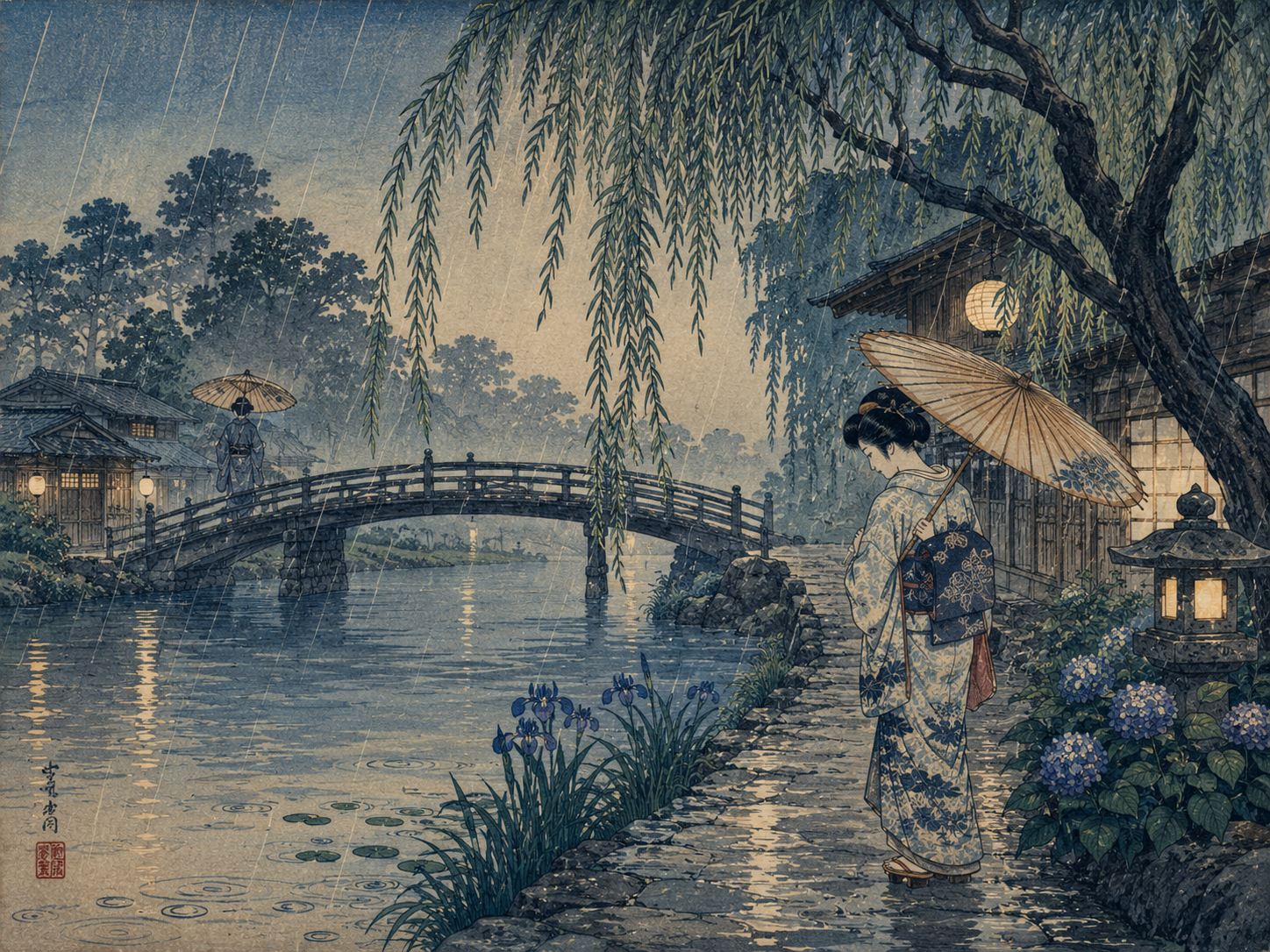
On a brutally hot day, choose a picture of rain. That is not escape. It is editing. The July 8, 2026 edition of Japan.co.jp is full of heat: tourism in the heat, ice cream, air conditioners, cooling goods, heatstroke, cities rearranging their day. For today’s art, then, the right image is not another sun. It is rain crossing a bridge, lines striking a river, people hurrying under a sudden summer shower. Put visual coolness inside the heat edition. That is today’s art choice: ukiyo-e summer rain.
The anchor is Utagawa Hiroshige’s *Sudden Shower over Shin-Ōhashi Bridge and Atake*. Published in 1857 as part of his late masterpiece series *One Hundred Famous Views of Edo*, the print shows Shin-Ōhashi Bridge over the Sumida River as an unexpected shower sweeps across the scene. The Metropolitan Museum of Art identifies the work as an Edo-period woodblock print from 1857. Fine diagonal rain lines net the image; people hurry across the bridge under umbrellas and rain coverings.
The genius of the print is that rain is not background. Rain is the subject. The sky darkens, the river cools, the bridge cuts the image diagonally and the people become small movements inside a force of weather. Hiroshige made weather into urban emotion. On a hot summer day, a sudden shower changes a city’s temperature, smell and rhythm. He trapped that change on paper.
The invention of rain lines
Rain in ukiyo-e is not just a graphic device. The Ota Memorial Museum of Art has written about the diagonal straight lines used to depict rain in ukiyo-e, especially in Hiroshige’s *Sudden Shower over Shin-Ōhashi Bridge and Atake*. In woodblock printing, rain required the skill of designer, carver and printer. If the lines were too heavy, the rain became crude. Too light, and it disappeared. Paper, block, ink and pressure shaped the weather.
Hiroshige’s rain lines make the viewer hear the rain. Their diagonal direction tells us about wind, speed, urgency, the slope of the bridge and the weight of the sky. If the rain fell straight down, the picture would be static. Because the rain cuts across the image, the whole print moves.
This is where ukiyo-e feels modern. With few lines, it shows time. With flat color, it shows humidity. With design, it shows motion. It does not reproduce the world like a camera. It extracts the core experience: the moment the rain arrives, the instant the city contracts and people hurry.
Summer rain in art history, by the numbers
Edo’s sudden shower as urban theater
In Edo summer, a sudden shower was a small drama. The day builds heat; the air thickens; clouds gather; then rain falls hard. People hurry across bridges, shelter under shop eaves, open umbrellas and wait. The rain disrupts the day, but it also cools the city. It lays the dust, changes the river smell and darkens the light.
Hiroshige’s Edo is not just a sightseeing guide. It is a city where people and weather meet. Shin-Ōhashi is a crossing, a working piece of urban life. On the bridge, everyone is small before weather. Samurai, merchants, travelers — in the rain they all hurry.
That still feels true in 2026. Heat alerts, sudden storms, crowded stations, umbrellas, underground refuges, people watching weather apps. Technology advances, but humans still run from rain and search for shade. Hiroshige’s rain is Edo, but it is also the modern city.
How the West saw Hiroshige’s rain
*Sudden Shower over Shin-Ōhashi Bridge and Atake* influenced art far beyond Japan. The Brooklyn Museum describes the print as the masterpiece of the series and notes that Vincent van Gogh copied it in oil. Van Gogh’s *Bridge in the Rain* preserved the diagonal rain, bridge structure and compositional drama of Hiroshige’s design.
In the late nineteenth century, ukiyo-e became a major source for Japonisme in Europe. Western artists were startled by unusual cropping, flat color, asymmetry, seasonal feeling and the ability to make ordinary moments monumental. Hiroshige did not paint rain as meteorological detail. He built rain as sensation.
That is why the image became global. Bridge, rain, river, people, sky. The elements are few, but the viewer feels cold water, wind and urgency. This is the reason ukiyo-e still shapes graphic design, comics, animation, cinema and advertising.
Kawase Hasui and the modern print rain
Hiroshige’s rain continued into the twentieth century through shin-hanga, or “new prints.” Kawase Hasui, born in 1883 and active until his death in 1957, became one of the movement’s central artists. The Lavenberg Collection at the University of Oregon describes Hasui as one of the early artists associated with the shin-hanga movement that arose in the 1920s.
Hasui’s rain is quieter than Hiroshige’s and often lonelier. Night streets, wet roads, reflected lamps, small figures with umbrellas. DailyArt Magazine describes Hasui as known for snow, rain and night scenes, using muted tones and atmospheric compositions to evoke calm and nostalgia. If Hiroshige’s rain is urban theater, Hasui’s rain is remembered travel.
Today’s “ukiyo-e summer rain” therefore points not only to Edo ukiyo-e, but to a larger lineage of Japanese print rain: sudden showers, night rain, wet bridges, blue rivers, black skies and the shapes of umbrellas. Japanese print art has treated rain not merely as weather, but as time and feeling.
Why choose rain on a heat day?
Japan in 2026 has entered the age of kokushobi. Nippon.com reports that the Japan Meteorological Agency will use the term for days when temperatures rise to 40°C or higher, after Japan’s record high reached 41.8°C in August 2025. The old language of summer — wind chimes, evening cool, festival nights — no longer feels sufficient.
That is why a rain image belongs inside a heat edition. Rain is relief, but also danger. A shower cools the air; a downpour can stop a city. In the climate-change era, heat and rain are not separate stories. They are two faces of the same unstable summer.
Today’s art is not chosen simply to cool the eye. Hiroshige’s rain reminds the reader that weather changes human behavior. Tourists move early. Workers seek shade. Shops change inventories. Cities reorganize time. The rain lines become lines that connect the whole edition.
Composition: diagonal bridge, diagonal rain
The power of *Sudden Shower over Shin-Ōhashi Bridge and Atake* lies partly in its composition. The bridge cuts diagonally across the picture. The rain also slants. The horizontal river, diagonal bridge, diagonal rain and small human movements work together. The image is legible in an instant, yet deep enough to hold the eye.
Modern news images can learn from this. Do not explain everything. Choose one focus. Let small figures tell the story through movement. Do not make weather a background. Make weather the protagonist. For Japan.co.jp’s heat edition, the correct image is a cool rain, not another blazing sun.
Today’s visual design
Today’s image, *todays-art-choice-ukiyo-e-summer-rain-july-8-2026.jpg*, draws on Edo rain lines, bridges, rivers, umbrellas and storm-darkened skies while interpreting them for a 2026 news edition. The point is not to copy the old print. It is to borrow the editorial power of the old print.
The rain should be fine and diagonal. The sky should be heavy, not pitch black. The people should be small, hurrying but not panicked. The river should feel cool; the bridge should carry the eye. The palette should move through indigo, gray, pale brown and white rain. Beside the day’s heat headlines, the image should let the reader breathe for a moment.
The mistake in using a ukiyo-e style for modern news is over-explanation. Too many words. Too many objects. Figures too large. The rain itself must be visible. On a hot Japanese news day, the reader needs not only information, but space.
Japan.co.jp’s view
Today’s art choice is the edition’s breath. On a day of stories about heat, tourism, cooling products, electricity and risk, a Hiroshige-like rain image cools the eye. It is not decoration. It is part of newspaper editing.
Ukiyo-e was also a news medium in Edo. Famous places, weather, actors, events, fashion, travel and seasons were carved, printed, bought and collected. Choosing art for a daily news edition is a small modern version of that tradition.
Heat can be reported in numbers: 40°C, 41.8°C, heatstroke alerts. But the feeling of summer reaches the body through images: rain lines, a wet bridge, tilted umbrellas, the color of a river. That is why today we choose rain: one summer shower before the heat breaks.
Reader guide
| Question | Answer |
|---|---|
| Today’s art | Ukiyo-e summer rain, chosen as visual relief for a heat-focused edition. |
| Historical anchor | Utagawa Hiroshige’s *Sudden Shower over Shin-Ōhashi Bridge and Atake* from 1857. |
| Technique | Diagonal rain lines, dark clouds, diagonal bridge and small figures turn weather into motion. |
| Modern meaning | The image links kokushobi heat, heatstroke risk, tourism timing and the unstable summer climate. |
| Japan.co.jp’s view | Art is not decoration. It is the breath of the edition, giving readers visual space inside hard news. |
Sources and references
This article draws on public information from the Metropolitan Museum of Art, Brooklyn Museum, Ota Memorial Museum of Art, Van Gogh Museum, Art Institute of Chicago, University of Oregon’s Lavenberg Collection, DailyArt Magazine and Nippon.com.
- The Metropolitan Museum of Art: Hiroshige, Sudden Shower over Shin-Ōhashi Bridge and Atake
- The Met: Rain lines and sudden shower subject in ukiyo-e
- Brooklyn Museum: Sudden Shower over Shin-Ohashi Bridge and Atake
- Ota Memorial Museum of Art: What color are the rain lines in Ukiyo-e?
- Van Gogh Museum: Hiroshige, Sudden Evening Shower on the Great Bridge near Atake
- Art Institute of Chicago: Utagawa Hiroshige
- University of Oregon: Kawase Hasui and shin-hanga
- Nippon.com: Japan adopts kokushobi for 40°C days