The easiest way to commemorate Toru Takemitsu is to make him large. Put the biwa and shakuhachi before an orchestra. Recall the New York Philharmonic premiere of November Steps. Enter the Tokyo Opera City hall that bears “Takemitsu Memorial” in its name. Thirty years after his death, the architecture of international stature is already in place.
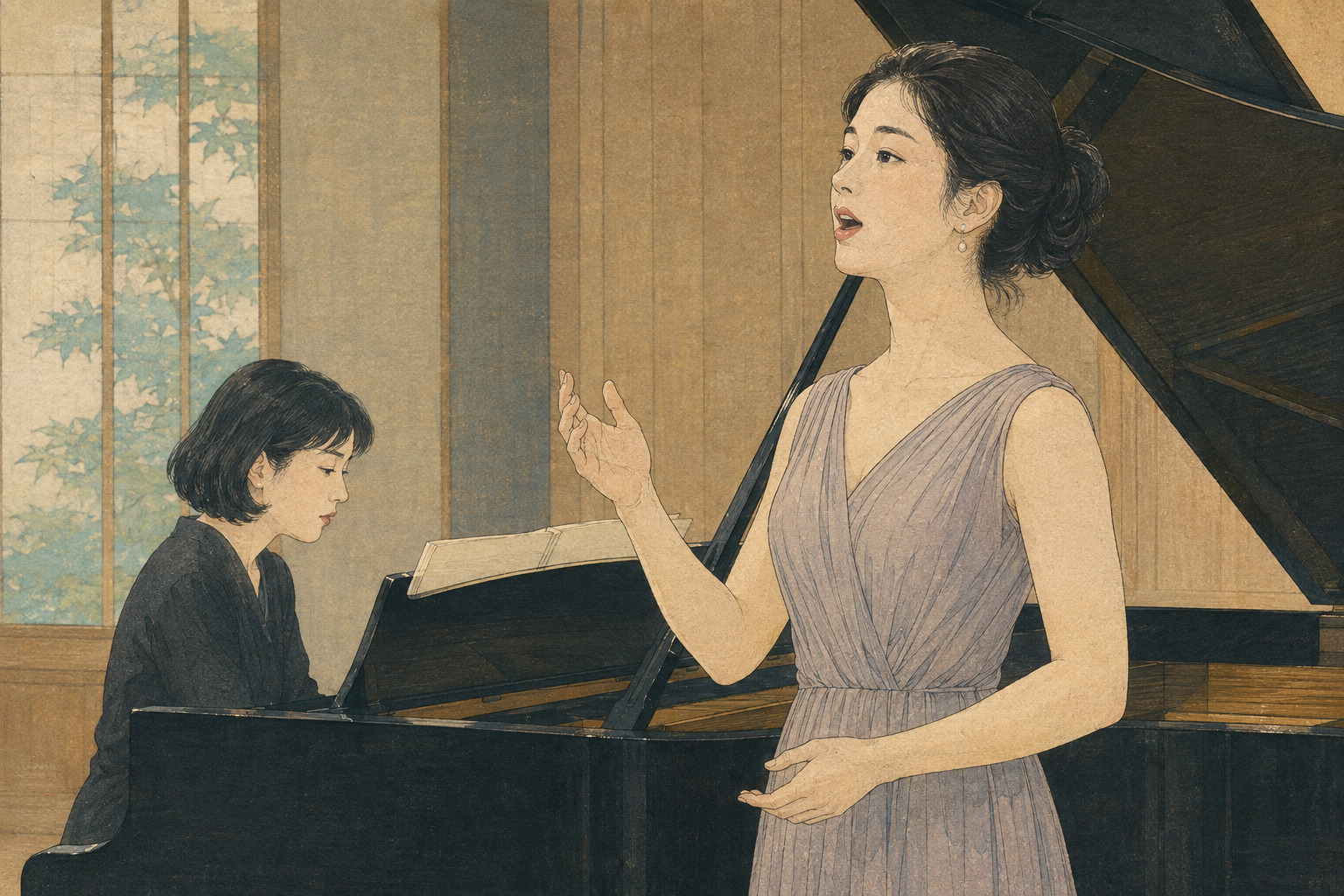
武満徹のうた SONGS of Toru Takemitsu, released by Nippon Columbia on August 26, takes the opposite route. Its basic materials are one young voice, one piano and words short enough to be held in memory. Soprano Yuma Kumaki makes her recording debut. Kazuki Yamada, known internationally as a conductor, accompanies all sixteen tracks at the keyboard.
Even that compact description needs a correction. Violinist Akira Mizutani joins them on track eight, “To the Island.” The label's official credits make this a three-person performance for one song, not an album literally confined to voice and piano.
The UHQCD, catalog number COCQ-85658, sells for ¥3,500 including tax. It was recorded over June 25–27, 2025, at Takagi Klavier's Shoto Salon in Tokyo. Columbia distributes it as a thirtieth-anniversary release: Takemitsu died on February 20, 1996, at 65.
A debut built from an old, unsettled repertory
Kumaki is not being introduced through a conventional calling card of coloratura arias. Her first disc begins with “The Encounter,” with words by singer-songwriter and actor Ichiro Araki, moves immediately to critic and composer Kuniharu Akiyama's “Sayonara,” and places Takemitsu's own “Wings” third. The sequence makes the debut singer negotiate a changing authorial voice before the listener has settled into one.
Five of the sixteen texts are by poet Shuntaro Tanikawa: “Yesterday's Spot,” “Unseen Child,” “The Game of Love,” “All That the Man Left Behind When He Died” and “I Just Sing.” Takemitsu wrote four texts himself. The remaining seven come one each from Araki, Akiyama, Fumio Nagata, Mann Izawa, Shinichi Segi, Akira Kawaji and Tatsuji Iwabuchi.
That distribution matters. These are not sixteen chapters in a song cycle conceived at one sitting. They are encounters accumulated across decades, media and working relationships. The new record asks a single voice to create continuity where the historical material supplies variety.
| Tracks | Songs | Text | What is verified |
|---|---|---|---|
| 1–4 | The Encounter; Sayonara; Wings; Yesterday's Spot | Araki; Akiyama; Takemitsu; Tanikawa | Four lyricists in the opening four tracks. |
| 5–8 | Unseen Child; The Game of Love; A Marvelous Kid; To the Island | Tanikawa; Tanikawa; Nagata; Mann Izawa | Mizutani adds violin only on track eight. |
| 9–12 | Will Tomorrow, I Wonder, Be Cloudy or Clear?; Small Sky; La Neige; In a Small Room | Takemitsu; Takemitsu; Segi; Kawaji | Two consecutive Takemitsu texts sit near the center. |
| 13–16 | Waltz; All That the Man Left Behind When He Died; I Just Sing; A Song of Circles and Triangles | Iwabuchi; Tanikawa; Tanikawa; Takemitsu | The album closes with three different relations between words and remembrance. |
Sixteen is a choice, not completeness
Columbia describes the record as sixteen songs selected from work Takemitsu continued writing throughout his life. That is accurate as far as it goes. Schott Music, his publisher, dates the collected voice-and-piano Songs from 1954 to 1994 and prints twenty titles. Four in that score do not appear on the new album: “Take off for the Clouds,” “In the Month of March,” “Glowing Autumn” and “All Alone.”
This is therefore not “the complete Takemitsu songs,” and it should not be marketed or reviewed as if a total repertory had been captured. Its editorial act is selection. The order does not follow Schott's printed table of contents, and it is not presented chronologically. Columbia's public material does not identify who devised the sequence or publish an account of its rationale.
A listener may still hear an arc. “All That the Man Left Behind When He Died” appears fourteenth; “I Just Sing” and the composer's own circles-and-triangles song follow it. The juxtaposition can lead from historical loss to the bare act of singing and then to play. That is a legitimate response to the order. It is not evidence of an intention that the producers have not documented.
The portable composer inside the modernist
Takemitsu was born in Tokyo in 1930 and learned composition largely outside the conservatory system. In 1951 he joined other musicians, poets and visual artists in the interdisciplinary group Jikken Kobo, or Experimental Workshop. His 1957 Requiem for Strings brought early recognition; November Steps, commissioned for the New York Philharmonic's 125th anniversary and premiered in 1967, made the encounter between Japanese instruments and Western orchestra an international event.
The canonical story is true but incomplete. Schott's biography places concert works beside electronic music, theater, film and pop songs. After scoring Crazed Fruit in 1956, Takemitsu composed music for more than ninety films. He was not a concert composer who occasionally descended into popular form. He worked in a culture where radio, cinema, poetry, jazz, chanson and the avant-garde could pass material among one another.
The songs are evidence of that circulation. Schott separates the voice-and-piano Songs, spanning forty years, from the twelve Songs for Mixed Chorus arranged and introduced between 1979 and 1992. “Small Sky,” “Wings,” “To the Island,” “Sayonara” and “All That the Man Left Behind When He Died” moved into collective voices and were premiered by The Philharmonic Chorus of Tokyo under conductors including Hiroyuki Iwaki and Nobuaki Tanaka.
That history alters what “intimate” means. These pieces are small enough for a singer and pianist, yet adaptable enough for a choir, a popular vocalist or another instrumental partner. Their scale is not a retreat from importance. It is what made them portable.
1951 Experimental Workshop begins its interdisciplinary activity.
1954–94 Date span Schott assigns to the collected voice-and-piano Songs.
1957 Requiem for Strings is premiered.
1967 November Steps is premiered in New York.
1979–92 Twelve mixed-chorus Songs take shape.
February 20, 1996 Takemitsu dies in Tokyo.
August 26, 2026 Kumaki's debut album is released.
What a classical soprano brings—and risks
Kumaki grew up in Nara and studied at Osaka Kyoiku University before completing graduate work at Kyoto City University of Arts. Her official record shows a quick ascent. In 2024 she sang Poulenc's Gloria with the Tokyo Symphony Orchestra under Keitaro Harada and made her opera debut as Marie in La fille du régiment at Nissay Theatre. In 2025 she sang Poulenc's Stabat Mater with the Japan Philharmonic under Yamada. In April 2026 she placed second, with no first prize awarded, at Concorso della Rosa in Milan, where she continues her studies.
Columbia calls her a coloratura soprano and recounts that Harada, impressed at an opera audition, introduced her to Yamada. That is a label-supplied origin story, not an independent critical judgment. The documented artistic decision is more interesting: her first recording does not foreground the altitude and agility that usually sell a new coloratura voice.
Takemitsu's songs create a different examination. A classical soprano is trained to project, sustain and shape a line. A song touched by chanson, jazz or everyday Japanese may depend on the edge of a consonant, an unforced syllable or a silence that should not feel grand. Too much finish can turn a familiar word into display; too little control can mistake informality for simplicity.
Columbia says this is the first full album of Takemitsu songs by a classical soprano. The claim identifies the intended novelty but cannot substitute for hearing the performance. Without auditioning the disc, this article cannot say whether Kumaki resolves the tension. It can say that the repertory makes her debut a test of verbal scale rather than vocal size.
The conductor has to share time
Yamada won the Besançon International Competition for Young Conductors in 2009 and now holds posts that range from music director of the City of Birmingham Symphony Orchestra to artistic director for music at Tokyo Metropolitan Theatre. In the 2026–27 season he is due to become chief conductor and artistic director of the Deutsches Symphonie-Orchester Berlin. He is also music director and board chair of The Philharmonic Chorus of Tokyo.
His presence at the piano could be reduced to celebrity casting: an international conductor doing something unexpected. The choral history argues otherwise. In 2012 Yamada conducted The Philharmonic Chorus of Tokyo in a program billed as Takemitsu's complete choral works, including all twelve mixed-chorus songs. He approaches the new album with experience of their collective breathing, harmony and verbal balance.
But a piano bench changes authority. A conductor can shape the time of dozens of musicians through preparation and gesture. An accompanist must let a single singer's inhalation revise that time at close range. Yamada's label says this is the first album of his career on which he accompanies every track as a pianist. The meaningful question is not whether a conductor can play piano; conductors are trained at keyboards. It is what happens when public command becomes private responsiveness.
One documentary limit remains important. Schott's published songbook credits Henning Brauel with most piano arrangements, while identifying two arrangements by Takemitsu. Columbia's public album page does not list an arranger or edition. The recording cannot be assigned to the published accompaniments solely because the titles overlap.
The word “first” has to survive history
A promotional first often expands as it travels. Here the label's wording is narrow: a first full-album recording by a classical soprano. It does not mean that the songs were unknown, unrecorded or waiting for classical musicians to legitimize them.
Columbia's own catalog preserves a useful counterhistory. Pop singer Seri Ishikawa recorded thirteen Takemitsu songs between 1993 and 1995 for the album Wings: Toru Takemitsu Pop Songs, including “Small Sky,” “To the Island,” “Wings” and “All That the Man Left Behind When He Died.” In 2007, countertenor Dominique Visse and pianist François Couturier released a twenty-song Takemitsu collection. Choirs, other solo voices and guitar partners have also carried this material for decades.
The newness is a transfer between traditions. A young classically trained soprano makes the songs her recorded self-introduction. A conductor with a choral relationship to the music takes the accompanist's position. Their institutional prestige enters a repertory carried by popular singers, choristers and recital performers before them.
That makes attribution essential. Columbia's claim may be correct, but Japan.co.jp has not established it through an exhaustive international discography. The article therefore reports it as the label's assertion. Precision does not weaken the record's premise. It prevents an anniversary campaign from erasing the musicians who kept the songs audible.
- Selection versus complete edition: Sixteen of the twenty titles in Schott's collected songbook.
- Solo song versus choral song: Shared titles do not make the scorings or performance traditions identical.
- Label claim versus verified history: “First classical-soprano album” is attributed to Columbia.
- Release analysis versus review: No judgment of the recorded performances is made without listening.
An anniversary should reopen, not finish
Takemitsu's posthumous standing does not depend on one record. Tokyo Opera City's hall opened as Takemitsu Memorial in 1997. The Toru Takemitsu Composition Award continues to ask living composers for new orchestral work. His publisher maintains detailed catalogs; orchestras and choirs keep the concert repertory active.
The danger of a thirtieth anniversary is not neglect but completion. A composer can become a set of approved masterpieces, institutional names and respectful adjectives. Songs interrupt that process. They preserve his willingness to write his own words, accept another writer's rhythm, serve a film or broadcast, borrow the emotional temperature of jazz and chanson, and let a melody exist outside specialist modern-music audiences.
Kumaki is scheduled to give a soprano recital at Hakuju Hall on January 17, 2027. Whether this album becomes an anniversary object or a living part of her repertory will be measured after the release campaign: in future programs, other singers' responses and listeners who encounter Takemitsu through a three-minute song before an orchestral score.
The monument already exists. The more consequential act is smaller: a singer beginning her recording life with words written before she was born, a conductor listening from the neighboring bench, and sixteen choices that leave four songs outside the room. Takemitsu returns not because thirty years have passed, but because the music remains unfinished in other people's voices.
- Nippon Columbia — Official album discography, track list, performers and recording details (Japanese)
- Nippon Columbia — 2026 release notice and full sixteen-track album listing (Japanese)
- Nippon Columbia — Yuma Kumaki official profile (Japanese)
- Nippon Columbia — Takemitsu back catalog and Seri Ishikawa recording (Japanese)
- Japan Arts — Kumaki recording-debut announcement (Japanese)
- Japan Arts — Yuma Kumaki profile and performance record (Japanese)
- Japan Arts — Kazuki Yamada official profile (Japanese)
- Japan Arts — Yuma Kumaki soprano recital, January 2027 (Japanese)
- Schott Music Japan — Takemitsu choral works and Songs catalog
- Schott Music Japan — Twenty-title Songs score and arrangement credits
- Schott Music Japan — Toru Takemitsu biography and chronology
- Tokyo Symphony Orchestra — August 2024 subscription concert with Kumaki (Japanese)
- Japan Philharmonic Orchestra — November 2025 subscription concert with Kumaki and Yamada (Japanese)
- Tokyo Metropolitan Theatre — Kazuki Yamada, artistic director for music (Japanese)
- Tokyo Concerts — 2012 complete Takemitsu choral program conducted by Yamada (Japanese)
- Tokyo Concerts — Official profile and English name of The Philharmonic Chorus of Tokyo
- Naxos Music Library Japan — Dominique Visse and François Couturier's 2007 twenty-song album
- Spring Festival in Tokyo — 2026 Takemitsu song program and official English credits
- Tokyo Metropolitan Symphony Orchestra — Akira Mizutani's official name, reading and profile
- Tokyo Opera City — Takemitsu Memorial concert hall (Japanese)
- Tokyo Opera City Cultural Foundation — Toru Takemitsu Composition Award
- Takagi Klavier — Official Shoto Salon information (Japanese)
- Nippon Columbia release — Japanese reading of Kumaki's name, album outline and supplied profiles
Editor's note: Nippon Columbia's description of the release as the first full Takemitsu-song album by a classical soprano is attributed to the label; it was not independently confirmed through a complete worldwide discography. The official credits identify Akira Mizutani on violin for “To the Island.” This article is based on public documentation and is not a listening review. The supplied currency timestamp—August 26 at 7:24 p.m. UTC—has been converted to August 27 at 4:24 a.m. Japan Standard Time.