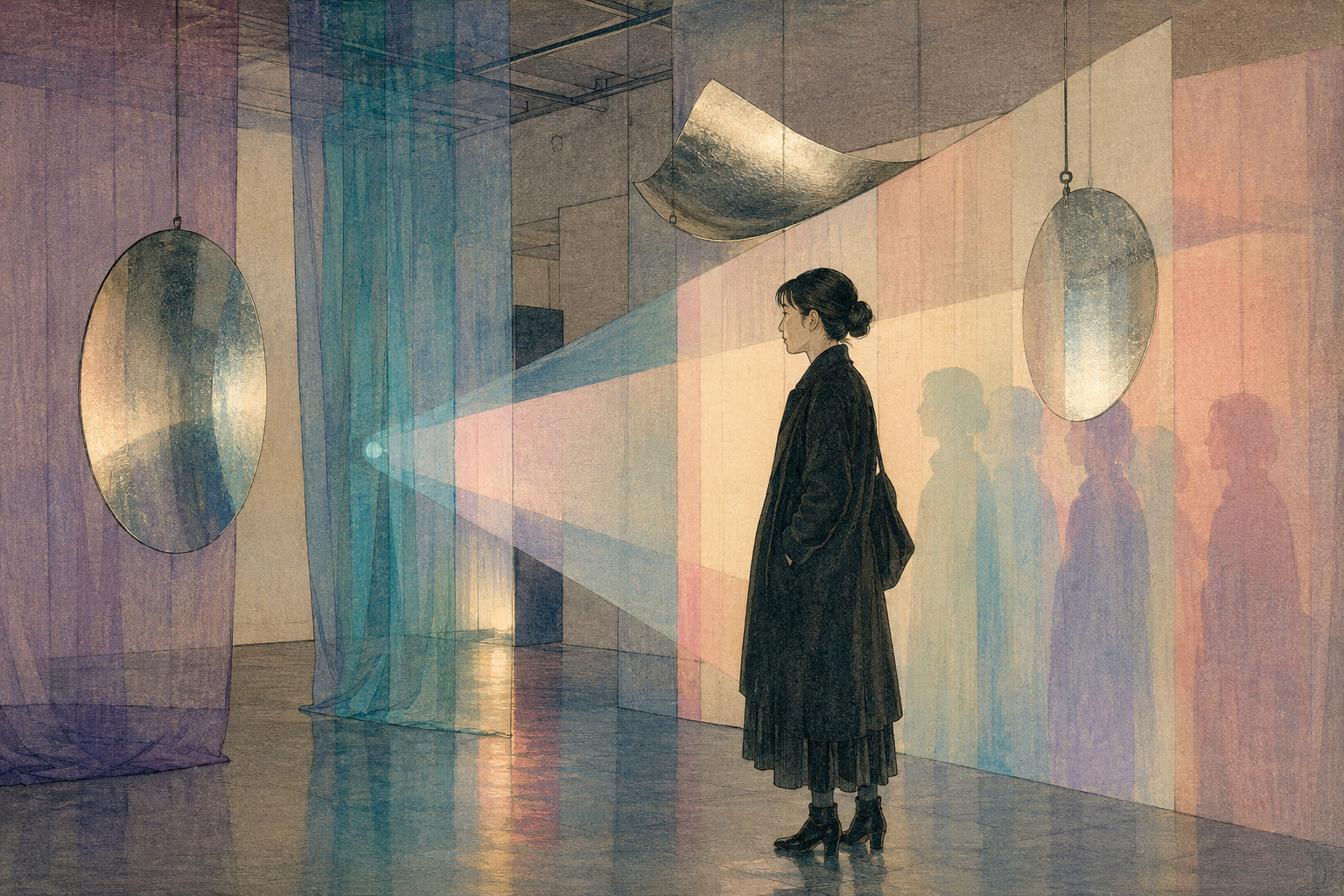
The first thing to know about After Light is that it is not yet there. Warehouse TERRADA announced the exhibition on August 26; installation at BONDED GALLERY in Tokyo's Tennoz district is due to open October 2. The public record contains a premise, three artist biographies, practical details and reference photographs. It does not contain a checklist or a room.
That distinction matters for an exhibition whose subject is perception. A preview image can tempt a writer to invent an encounter—to describe radiance falling across a relief, shadows gathering behind sculpture, or one artist answering another across the floor. None of those relationships exists publicly yet. They will depend on choices of placement and illumination that the organizer has not released.
What can be examined is the more durable architecture behind the pairing. Imanishi, Shimura and Kaneuji have spent different careers disturbing the apparently simple act of looking. One works through the physical depth and removal of oil paint. One emerged from an investigation of cinema and now uses optical materials. One treats collage as a sculptural system that can detach things from their familiar meanings.
This is not simply a show about illumination
Warehouse TERRADA says the exhibition considers what light does to perception and what follows when perception becomes recognition. Light strikes material, reflects, passes through, and makes shadow. Familiar objects, relocated into different contexts and relationships, change their outlines and meanings.
It is a useful premise precisely because it does not force the artists into one medium. Calling all three “light artists” would be wrong. Imanishi is a painter for whom light activates a worked surface. Shimura uses optical material to make seeing conditional. Kaneuji's central problem is not light as technology but the unstable connection between matter and image.
| Artist | Established method | Organizer's frame | Still undisclosed |
|---|---|---|---|
| Shinya Imanishi | Layers, cuts and peels oil paint | Light and matter through a deeply textured surface | Titles and number of exhibited works |
| Yuka Shimura | Relief using optical materials | Transmitted light and color alter spatial perception | Lighting, positions and relation to earlier duo work |
| Teppei Kaneuji | Collages found objects and existing images | Meanings and relations lose their stability | Balance of sculpture, image, video or other forms |
The press release is illustrated with Imanishi's Holiday cracker 34, Shimura's の あいだ - ミル (Magenta - White), and Kaneuji's POOOPOPOO#17. It also reproduces earlier installation views. The release does not label those images as a confirmed exhibition checklist. They indicate vocabulary, not a room-by-room promise.
Imanishi does not paint light; he excavates its surface
Shinya Imanishi was born in Nara Prefecture in 1990 and completed graduate study in painting at Kyoto University of Art and Design in 2015. He remains based in Nara. Toyota Municipal Museum of Art, which gives the official reading of his name as Imanishi Shinya, holds three oil-on-canvas works from his Glimmering series, dated 2021 and 2022.
His process complicates the old opposition between image and material. He builds oil paint into thick layers, then cuts or scrapes through them. Color below returns through removal. From a distance, a motif may gather; at close range, it separates into ridges, cavities and evidence of the hand. The painting does not contain time as a story. It stores time as thickness.
That method has supported subjects including ruins, lightning, flame and party crackers. The gallery nca's account of the Holiday cracker series says the act of firing an actual cracker and fixing its traces to the canvas enters the work itself. A festive instant is neither illustrated nor preserved intact. Its aftermath becomes a physical condition of the painting.
Imanishi won the 2020 Shell Art Award grand prize with Story - Where are we going ?. In 2025, Nara Prefectural Museum of Art presented his exhibition 吸って、吐いて (literally, “Inhale, Exhale”), and nca staged ひろがってゆくイマージュ. Awards and museum collections establish a career; they do not explain why he belongs in After Light. The better answer is his surface. Illumination does not merely reveal the picture. It makes every absence—the paint removed, the layer exposed, the action that has ended—part of what is visible.
Shimura has spent a career taking cinema apart
The exhibition announcement uses the individual name Yuka Shimura—志村諭佳, officially romanized SHIMURA Yuka in Japanese government records—and adds a consequential parenthesis: “SHIMURAbros currently on hiatus.” The organizer says she worked as Yuka of SHIMURAbros through 2025. It gives no account of when the pause began or what it means, and it should not be rewritten as a breakup.
Born in Yokohama in 1976, Shimura graduated from Tama Art University and completed graduate study at Central Saint Martins in London. With her younger brother Kentaro, she built SHIMURAbros around the machinery and grammar of moving images rather than around film as a transparent carrier of stories.
The duo's three-screen SEKILALA received an Excellence Award in the Art Division of the 13th Japan Media Arts Festival. The official record emphasizes a narrative assembled from changing combinations of fragments, leaving viewers to move among reality, memory and delusion. X-RAY TRAIN, made by imaging a locomotive with X-ray CT technology, was recommended by the next festival's jury.
Those projects belong to a longer historical argument. Cinema normally asks spectators to ignore the projector and accept a sequence of light as a world. SHIMURAbros repeatedly turned the apparatus back into an object. Their Film Without Film drew on Lev Kuleshov's experiments with montage and used three-dimensional printing to give material form to cinematic time and spatial editing. At the Pola Museum of Art in 2018–19, Silver Screen used mirrors to expose the projector, reflected image and viewers usually hidden by the direction of attention.
The method announced for Shimura's present work is quieter but structurally related. Optical materials in wall-based reliefs allow black and white to reverse gradually and colors to emerge between them. The viewer supplies the edit by moving. A work can remain fixed while its appearance changes with angle, distance and available light.
That transition gives After Light an unresolved historical question. Is this individual practice a continuation of problems developed within SHIMURAbros, a reorientation of them, or a separation? The public material does not say. The exhibition may offer evidence, but a preview cannot provide the answer in advance.
Kaneuji makes meaning lose its grip
Teppei Kaneuji was born in Kyoto Prefecture in 1978. While studying sculpture at Kyoto City University of Arts, he spent an exchange period at the Royal College of Art in London, then completed his master's degree in 2003. He joined the university's permanent faculty in 2010 and is now an associate professor in sculpture.
His work often begins with things already carrying more meaning than sculpture traditionally allows: toys, pipes, household products, magazine imagery, figures and fragments of commercial design. He cuts, masks, stacks and reconnects them. The operation resembles collage, but it leaves the page and reorganizes the room.
His 2009 museum solo exhibition, Melting City / Empty Forest at Yokohama Museum of Art, assembled about 120 works, including an installation more than ten meters long and a large video work. The museum described an exhibition moving from white space toward an environment saturated with colored objects. In 2016, Teppei Kaneuji's “ZONES” at Marugame Genichiro-Inokuma Museum of Contemporary Art extended collage beyond objects: the exhibition changed through events, collaborations and exchanges of role with other makers and audiences.
His work with theater has further weakened the boundary between object, person and setting. For Eraser Forest at the 21st Century Museum of Contemporary Art, Kanazawa, in 2020, Kaneuji and chelfitsch treated spectator, scenography, image and museum space as parts of an environment without a stable hierarchy.
This history explains why Kaneuji's place in After Light cannot be reduced to reflective surfaces. The organizer's language for him shifts away from optics: pre-existing images and objects are connected in ways that destabilize meaning and relation. Light makes the material available to sight, but rearrangement makes the sight unreliable.
The announcement's image of POOOPOPOO#17 is useful evidence of the selected vocabulary. It is not confirmation that the work will be installed. Nor does the record disclose whether sculpture, painting, video or photography will dominate Kaneuji's contribution in the roughly 130-square-meter room.
The exhibition joins three histories inside the viewer
The three practices do not form a neat chronological movement. Imanishi inherits painting's argument about flat image and material surface. Shimura comes through cinema's projected light, apparatus and controlled spectator. Kaneuji works after collage expanded from cut paper into sculpture, installation and performance.
The exhibition's coherence, if it succeeds, will happen not because those histories become the same but because the viewer experiences a repeated loss of certainty. An image turns back into paint. A white surface develops color when the body shifts. A recognizable object stops behaving like its name once attached to something else.
That is the most persuasive meaning of “after.” It need not refer to a chronological era after light, as though illumination had ended. It can mean the cognitive delay after seeing: the interval in which the eye has delivered information but recognition is still being renegotiated.
This interpretation is Japan.co.jp's analysis, not a quotation from the organizer. The official premise is broader and more cautious. Its realization will depend on installation. Three good artists do not automatically make a good group show; relations are made by spacing, sequence, scale, sightlines and the intensity of light.
- Change distance: Find where Imanishi's image returns to ridges and excavated paint.
- Move sideways: Let Shimura's optical material make the viewer, rather than a screen, control change.
- Delay naming: Read Kaneuji's fragments through their new connections before restoring their old uses.
- Look at the room: Include shadow, reflection, walls, fixtures and other bodies in the work of seeing.
The fourth participant is a bonded white cube
BONDED GALLERY is not an abstract container. Warehouse TERRADA, founded in 1950, opened TERRADA ART COMPLEX I in Tennoz in 2016 and the adjacent COMPLEX II in 2020. It launched BONDED GALLERY in 2022 after receiving authorization for a customs-bonded storage area.
The renovated warehouse space is described as an approximately 130-square-meter white cube equipped for art handling and adjustable spot lighting. Its bonded function allows artwork imported from overseas to be viewed, stored and negotiated while customs duties and taxes remain suspended. It also serves auction previews and commercial showrooms.
That institutional history does not make After Light a show “about” the art market. It does make the myth of the neutral white cube harder to sustain. The room is designed to make visual encounters appear frictionless while a large apparatus—shipping, climate control, customs law, security, insurance and sale—keeps the object available.
There is an apt tension here. The artworks ask viewers to notice what changes after reflection, transmission and rearrangement. The venue exists to manage what happens before and after an artwork crosses a border. Material vision and material circulation occupy the same white room.
Warehouse TERRADA is the organizer. Its announcement does not name an individual curator. This is a company-produced gallery exhibition, not a museum collection study, and its institutional claims should be read as the organizer's framing. That distinction neither validates nor diminishes the art; it identifies the speaking voice.
1950 Warehouse TERRADA is established.
2009 SHIMURAbros wins a Japan Media Arts Festival award; Kaneuji receives a major Yokohama museum solo show.
2016 TERRADA ART COMPLEX I opens; Kaneuji presents ZONES in Marugame.
2020 TERRADA ART COMPLEX II opens; Imanishi wins the Shell Art Award grand prize.
2022 BONDED GALLERY opens as a permanent bonded exhibition space.
Through 2025 The organizer says Shimura worked as Yuka of SHIMURAbros.
October 2, 2026 After Light is scheduled to open.
What visitors can plan—and what must wait
After Light runs from Friday, October 2, through Saturday, October 24, at BONDED GALLERY, fourth floor, TERRADA ART COMPLEX II, 1-32-8 Higashi-Shinagawa, Shinagawa Ward. Admission is free. Normal hours are noon to 6:00 p.m.; the first day is 6:00–8:00 p.m., October 9 is noon–9:00 p.m., and the final day is noon–5:00 p.m.
The gallery will be closed October 4, 5, 6, 13, 18 and 19. The complex lists the venue as about an eight-minute walk from the B exit of Tennoz Isle Station on the Rinkai Line and about eleven minutes from the central exit of the Tokyo Monorail station. Because the schedule is prospective, visitors should confirm the official page before traveling.
The unanswered editorial questions remain substantial: the final checklist; how many new works will appear; the number and scale of works by each artist; the lighting plan; whether the three reference works will be installed; loans and sales status; an individual curatorial author; and any artist talk or public program. The organizer also has not explained the duration or implications of the SHIMURAbros hiatus.
Those gaps are not reasons to ignore the exhibition. They are reasons to leave judgment open. The most compelling possibility is not a room full of optical spectacle. It is a room in which clarity repeatedly breaks down—where light reveals material but delays meaning, and the viewer discovers that seeing was never the passive part.
- Warehouse TERRADA — Official After Light announcement, schedule and artist biographies (Japanese)
- Warehouse TERRADA release via PR Times — Reference images, work titles and biographies (Japanese)
- TERRADA ART COMPLEX — Official exhibition listing (Japanese)
- TERRADA ART COMPLEX — History, tenants and access (Japanese)
- Warehouse TERRADA — BONDED GALLERY facility information (Japanese)
- Warehouse TERRADA — 2022 opening and customs-bonded function (Japanese)
- Shinya Imanishi — Official profile
- nca | nichido contemporary art — Shinya Imanishi artist page
- nca | nichido contemporary art — 2025 Seeing the Unseen exhibition text
- Toyota Municipal Museum of Art — Imanishi's official reading and Glimmering holdings
- Idemitsu Kosan — 2020 Shell Art Award grand-prize announcement (Japanese)
- SHIMURAbros — Official biography and exhibition history
- Tokyo Gallery + BTAP — SHIMURAbros artist page and work records
- Japan Media Arts Festival — Official SEKILALA award record (Japanese)
- Agency for Cultural Affairs — Film Without Film creator-support record (Japanese)
- Pola Museum of Art — SHIMURAbros: Film Without Film
- Yokohama Civic Art Gallery Azamino — 2024 SHIMURAbros exhibition (Japanese)
- Kyoto City University of Arts — Teppei Kaneuji official faculty profile (Japanese)
- Kyoto City University of Arts Art Gallery — Kaneuji's official reading and practice
- Yokohama Museum of Art — 2009 Melting City / Empty Forest exhibition (Japanese)
- Marugame Genichiro-Inokuma Museum of Contemporary Art — 2016 ZONES exhibition
- 21st Century Museum of Contemporary Art, Kanazawa — 2020 Eraser Forest (Japanese)
- Ministry of Foreign Affairs / Agency for Cultural Affairs — Official SHIMURA Yuka romanization
Editor's note: This article is a documented preview of an exhibition scheduled for October 2026, not a review of an installation. Reference works pictured by the organizer are not described as a complete or confirmed checklist. The article preserves the organizer's wording that SHIMURAbros is “currently on hiatus” and does not infer a dissolution. The supplied currency timestamp—August 26 at 7:24 p.m. UTC—has been converted to August 27 at 4:24 a.m. Japan Standard Time.