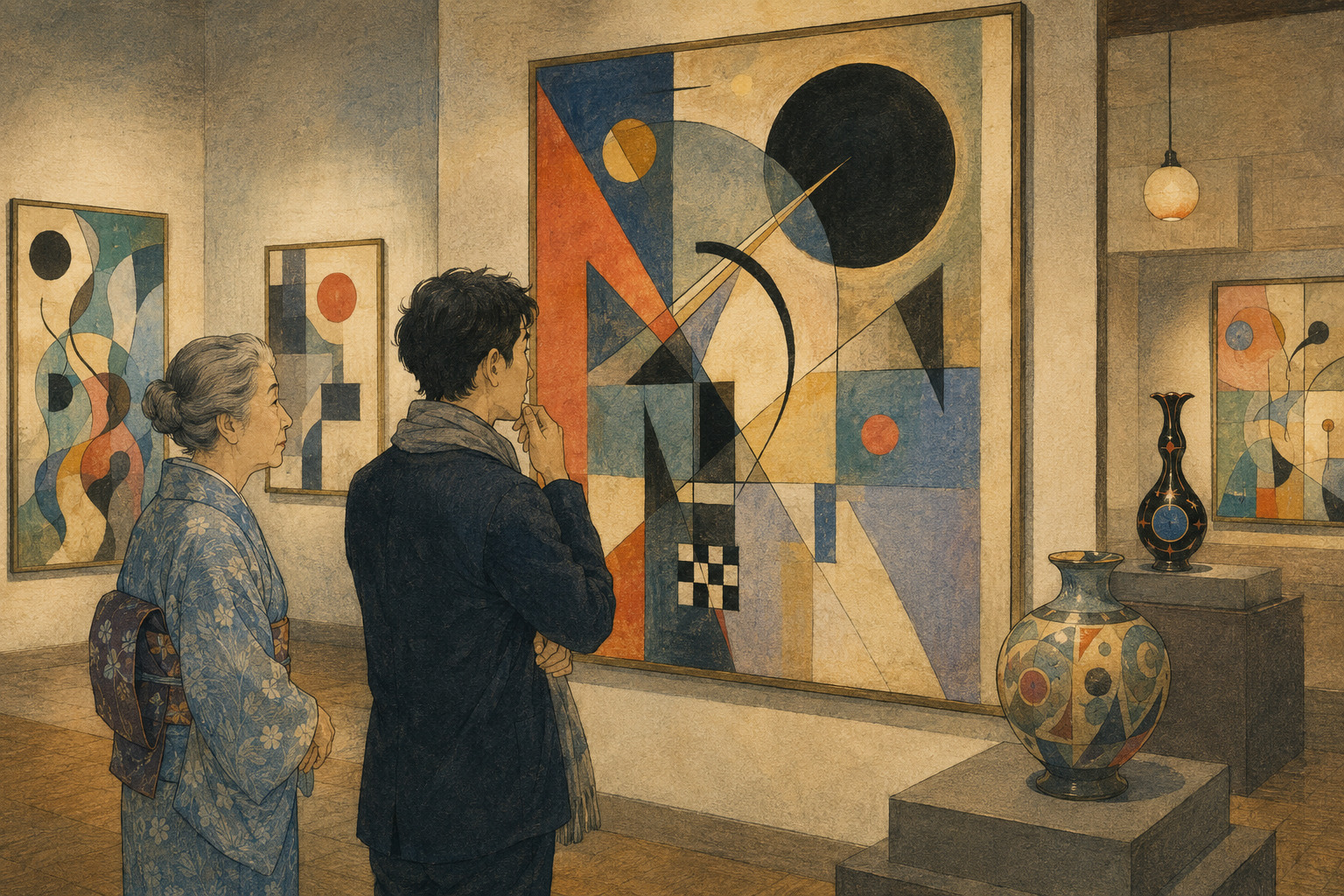
Three small letters make the exhibition's argument before a visitor sees a painting. On its official checklist, U, M and N indicate whether an object is scheduled for Utsunomiya, Miyagi or Nagano. Some entries carry all three; others travel to one or two venues. Ownership is dispersed even more widely, from Kagoshima to Ehime, Tokyo, Hakone, Nagoya, Kurashiki, Sendai and beyond.
Composed Vibration: Wassily Kandinsky from the Collections in Japan—the English title printed on that checklist—uses this geography to reconstruct a career. The Miyagi Museum of Art presents the touring exhibition from September 12 through October 28 under the Japanese title Kandinsky: Sekai wa Narihibiku—Nihon no Korekushon de Tadoru Gagyō to Hankyō. Its five sections run from Munich through the Blue Rider years, Japanese reception, the Bauhaus and late Paris.
That is already a correction to a convenient but incomplete description of the show as Kandinsky “with his contemporaries.” European peers matter, and several are present. But the more distinctive company includes Japanese painters, poets, book designers and educators who did not simply stand beside Kandinsky in time. They received fragments of his work and theory, then changed what those fragments could do.
The archive is not supporting material; it is the exhibition's engine
The organizers call this the first survey to span Kandinsky's career using works held in Japan. The wording is promotional and should be attributed, but its method is plain. Rather than treating domestic holdings as a substitute for loans from Europe and the United States, the exhibition asks what Japan's museums collectively retained.
Miyagi's announced highlights make a striking chronology. The Mirror, painted in 1907, comes from the Aichi Prefectural Museum of Art. Three Linden Trees of 1908 comes from the Artizon Museum. The Ohara Museum of Art lends Points from 1920; the Pola Museum of Art lends Without Support from 1923. Utsunomiya provides Red Across of 1931. The Museum of Art, Ehime lends Animated White of 1934, while the National Museum of Modern Art, Tokyo, supplies The Whole of 1940 and the Kagoshima City Museum of Art supplies Two Blacks of 1941.
Miyagi anchors both ends of an earlier transformation with Arrival of the Merchants (1905) and a 1914 study for Edwin R. Campbell's mural No. 4. One retains riders, ships, walls and a fairy-tale procession. The other allows color and movement to overtake description. Seeing them together does not prove that abstraction developed in a straight line. It exposes how much narrative survived inside it.
| Year | Work | Collection | What changes |
|---|---|---|---|
| 1905 | Arrival of the Merchants | Miyagi Museum of Art | Folkloric procession, flattened color and decorative rhythm |
| 1914 | Study for the Campbell mural No. 4 | Miyagi Museum of Art | Story and landscape dissolve into colored movement |
| 1923 | Without Support | Pola Museum of Art | Geometric tension inside an unstable white field |
| 1931 | Red Across | Utsunomiya Museum of Art | Line, plane and directional force organize the surface |
| 1940 | The Whole | National Museum of Modern Art, Tokyo | Organic, cellular forms spread through late Parisian space |
Before abstraction there was a law graduate, a printmaker and a storyteller
Wassily Kandinsky was born in Moscow in 1866. He studied law and economics, then moved to Munich in 1896 to train as an artist at 30. That late change of direction is often told as the preface to an inevitable invention. The exhibition's first section, “Munich: Inner Russia and Color,” makes the preface longer and stranger.
Early paintings and prints carry memories of Russia, folk imagery, mounted figures, old towns and evening landscapes. The official checklist includes posters for the Phalanx artists' association and the 1903 book of woodcuts and poems Poems without Words. Kandinsky was not waiting to abandon narrative. He was already moving it between painting, print and language.
By the second section, familiar things remain visible even as they become unstable. Mountains, riders, baptism, resurrection and judgment persist in titles and compressed motifs. “Abstract” therefore does not mean the arrival of empty form. It describes a reallocation of weight: color, line and rhythm no longer need the external object to justify their intensity.
Blue Rider was a network, an editorial project and an argument
The show would misrepresent abstraction if Kandinsky stood alone. In 1911, he and Franz Marc organized the first Blue Rider exhibition; an almanac followed in 1912. The project did not enforce a single style. It created encounters among contemporary art, folk objects, children's images, music and writing.
The touring checklist marks a substantial group of related works for Miyagi: Marc's Genesis I, August Macke's Greeting, Gabriele Münter's Abstract Composition, Heinrich Campendonk's Farmer in the Suburbs, Alfred Kubin's Fugitive and Paul Klee's Horse Racing I. Catalogues from both Blue Rider exhibitions and the almanac make the act of selection visible beside the art.
These artists are not a chorus affirming Kandinsky. They reveal competing routes out of academic representation: Marc's animals, Münter's compressed structure, Kubin's graphic unease, Klee's elastic line. The historical gain comes from seeing abstraction as a field of disagreements, not a patent awarded to one founder.
Kandinsky's own books belong to that field. On the Spiritual in Art attempted to explain why form and color could act directly; Sounds combined woodcut and prose poetry. The exhibition's language of resonance should not be reduced to a color-coded keyboard. It names an ambition to make visual art, language, stage and music work across one another.
Japan received reproductions, words and partial encounters—and made new work
The third section, “Kandinsky: Resonance in Japan,” is the exhibition's intellectual center. The organizers date Japanese responses to his work and theory to the 1910s. That does not mean Japanese artists had routine access to original canvases. Modernism often arrived as a magazine, exhibition catalogue, foreign-language essay, small woodcut, second-hand account or remembered encounter.
The checklist turns those channels into objects. It includes lyrical prints by Kōshirō Onchi; posters by Unosuke Kawai for the journal Mokushō; works by Tetsugorō Yorozu; paintings by Tomoyoshi Murayama and his 1925 book Kandinsky; Tai Kanbara's Subject from the Poem of Ecstasy by Scriabin; Kamenosuke Ogata's Makeup; and Ryōbun Yamaoka's Spannung.
The most responsible verb here is “received,” not automatically “influenced.” Similar lines and planes cannot establish a causal chain. Futurism, Expressionism, Constructivism, theater, new typography and music crossed the same period. Direct evidence lies in dates, books, exhibition records, travel and the language artists used—not in resemblance alone.
Within that boundary, the Japanese response becomes more interesting. The Iwate Museum of Art describes Yorozu as an artist who absorbed European modernism from limited information without traveling to Europe, then made it his own. Kanbara linked painting to Alexander Scriabin's music in 1922. Murayama moved through painting, performance, stage work and criticism. Each transformed an incomplete arrival rather than copying a finished European style.
- Follow the carrier: Was the encounter an original, print, book, catalogue, lesson or memory?
- Check the date: A resemblance is not evidence unless contact was possible.
- Watch the material change: An idea shifts when it moves from oil painting into woodcut, book design, Japanese pigments, embroidery or furniture.
At the Bauhaus, the canvas opened into a designed environment
World War I forced Kandinsky to leave Germany for Russia. He returned to Germany at the end of 1921 and began teaching at the Bauhaus in 1922. The Bauhaus was a school, not a decorative label. Founded in Weimar in 1919, it later moved to Dessau and Berlin before disbanding under Nazi pressure in 1933.
The exhibition's fourth section sets the 1922 portfolio Small Worlds, paintings including Without Support, the book Point and Line to Plane, Bauhaus journals and postcards beside Marcel Breuer's second-version club chair. This is the broader design history promised by the show's orbit. Analysis of point, line, plane, color and tension becomes portable across printing, furniture and teaching.
Japan's educational response appears in Renichirō Kawakita and Katsuo Takei's Manual for Teaching through Construction, documents by designer Kazō Saitō, and Yamaoka's Spannung. The National Museum of Modern Art, Kyoto, explains that the manual reproduced diagrams from Point and Line to Plane and circulated the concept of Spannung—tension—as a principle of composition. Yamaoka used that vocabulary in nonobjective work made with Japanese painting materials.
This is more consequential than decorating household goods with triangles. It is a history of method: the belief that relations among forms can be studied, taught and rebuilt in different media. The presence of a chair matters because it places painting within a room and a body, not because it turns Kandinsky into a furniture designer.
Paris replaced geometry's certainty with drifting life
When the Bauhaus closed, Kandinsky settled in France. His late paintings introduced shapes that can suggest cells, microscopic organisms or suspended creatures. The fifth section, “Paris: Serene Flight,” follows that organic turn through Animated White (1934), Animated Stability (1937), One Figure among Others (1939), The Whole (1940) and Two Blacks (1941).
The chapter title's serenity needs historical resistance. The Nazis attacked avant-garde art, the Bauhaus was disbanded in 1933, and Kandinsky worked in France through war and occupation. He died in Neuilly-sur-Seine in December 1944. The apparent buoyancy of the late forms emerged inside displacement, not outside politics.
Seen across the five sections, abstraction is not a destination he reached around 1910 and then repeated. It is a language revised by war, exile, teaching, new materials and changing intellectual climates. The shift from Bavarian landscape to geometry to biomorphic form is a record of instability.
1866 Born in Moscow.
1896 Moved to Munich to study art at 30.
1911–12 Blue Rider exhibitions and almanac.
1914 Left Germany after the outbreak of World War I.
1922 Began teaching at the Bauhaus.
1933 Settled in France after the Bauhaus closed.
1944 Died in Neuilly-sur-Seine.
Miyagi has spent 45 years making this exhibition possible
The Miyagi Museum of Art opened in November 1981 with roughly 700 works. By its 45th anniversary in 2026, the collection had grown to about 7,000. Its foreign holdings concentrate on German Expressionism and include 36 works by Kandinsky and 35 by Paul Klee. The museum calls Arrival of the Merchants one of the defining faces of its collection.
That concentration is not detached from place. Miyagi says its acquisition policy connects art associated with Miyagi and Tohoku to the wider history of modern Japanese art, while its German Expressionist holdings illuminate exchanges between Japan and Europe. A Kandinsky exhibition with a full Japanese-reception section makes that institutional logic public.
The timing also follows a physical renewal. The main building closed in June 2023 for major work on aging systems and reopened June 20, 2026. Renovations updated galleries, toilets and elevators and added a children's studio, nursing room and visible-storage area. The first summer exhibition filled the museum with collection works; the Kandinsky survey is the next major statement after reopening.
The tour itself is a form of joint curation. Utsunomiya hosts it from July 19 to September 3, Miyagi from September 12 to October 28, and the Nagano Prefectural Art Museum from November 7 to December 27. Venue symbols on the list show that the object set is related but not absolutely identical. Architecture and local collecting histories change the argument each time.
What visitors can plan—and what remains unresolved
The Miyagi presentation is scheduled for the main building's second floor. Hours are 9:30 a.m. to 5 p.m., with ticket sales ending at 4:30. The museum is closed Mondays, except September 21 and October 12; it closes instead on September 24 and October 13. Admission is ¥1,300 for adults, ¥1,100 for students and ¥650 for elementary through high-school students. Group prices apply from 20 people.
Holders of qualifying disability certificates and one caregiver receive free admission at the staffed counter. The museum is about seven minutes on foot from either International Center Station's West 1 exit or Kawauchi Station's North 1 exit on the Sendai Subway Tōzai Line. The main lot has 100 free spaces for passenger vehicles.
Programs include a September 21 lecture by the Artizon Museum's deputy director; gallery talks on September 20, October 4 and October 18; and an October 17 lecture by the exhibition's Miyagi curator on Kandinsky's impact in Japan. Separate workshops use haiku, sound and color to make the exhibition's cross-media premise participatory.
Several publication questions remain. Miyagi has not yet posted its venue checklist or flyer. The touring checklist confirms the planned M-marked works but cannot rule out conservation or installation changes. Miyagi's photography policy for this exhibition, catalogue sales arrangements and any rotation within the run are not yet stated on the exhibition page.
The final test is therefore not how many famous canvases can be counted. It is whether a story made from dispersed Japanese holdings can keep its routes visible: from folktale to abstraction, from artist circle to edited almanac, from German school to Japanese design education, and from European theory to a painting made in Kyoto materials. The farther Kandinsky is placed from the myth of solitary invention, the more precisely his achievement comes into view.
- Miyagi Museum of Art — Official exhibition page, featured works and visitor information (Japanese)
- Utsunomiya Museum of Art — Official touring checklist, venue marks and English title (PDF)
- Utsunomiya Museum of Art — Official press material, curatorial premise and work data (Japanese)
- Nagano Prefectural Art Museum — Tour schedule and exhibition summary (Japanese)
- Miyagi Museum of Art — Related lectures and workshops (Japanese)
- Miyagi Museum of Art — Collection strengths and Kandinsky/Klee holdings (Japanese)
- Miyagi Museum of Art — Institutional history (Japanese)
- Miyagi Museum of Art — 45th anniversary and collection history (Japanese)
- Miyagi Museum of Art — Renovation summary (Japanese)
- Miyagi Museum of Art — 2023–26 closure and off-site work (Japanese)
- Miyagi Museum of Art — Bauhaus New European Graphics portfolio (Japanese)
- Miyagi Museum of Art — Hours, tickets and admission waivers (Japanese)
- Miyagi Museum of Art — Access and parking (Japanese)
- Pola Museum of Art — Without Support and artist biography (Japanese)
- National Museum of Modern Art, Kyoto — Yamaoka, Spannung and construction education (Japanese)
- National Museum of Art collection database — Tai Kanbara holdings (Japanese)
- Iwate Museum of Art — Tetsugorō Yorozu and European modernism (Japanese)
- National Museum of Modern Art, Tokyo — Tai Kanbara, Tomoyoshi Murayama and Japanese avant-garde activity (Japanese)
- National Diet Library Search — Bibliographic record including Murayama's Kandinsky (Japanese)
- Hanmoto.com — Official catalogue contents and ISBN (Japanese)
- Solomon R. Guggenheim Museum — Kandinsky biography
- Bauhaus-Archiv — Official chronology, 1919–33
- Bauhaus-Archiv — Official explanation of the school, teaching and closure
Editor's note: The exhibition and official checklist use ワシリー and “Wassily Kandinsky”; a separate Miyagi collection page also uses the Japanese variant ヴァシリー. The articles follow the exhibition's own form. “First survey” and the dating of Japanese reception to the 1910s remain attributed curatorial claims. The supplied exchange-rate timestamp—August 26 at 7:24 p.m. UTC—has been converted to August 27 at 4:24 a.m. Japan Standard Time.