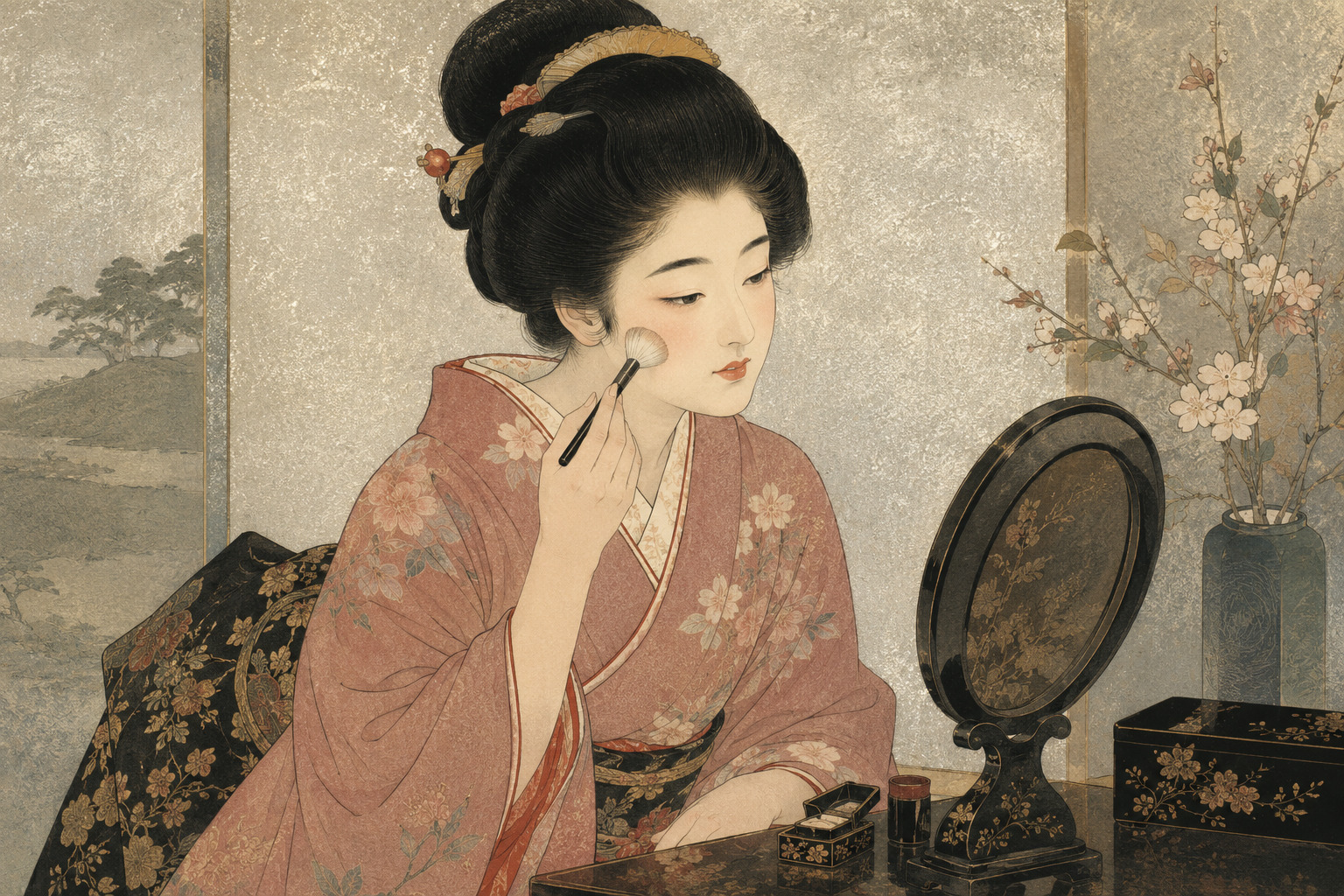
A woodblock print survives its wood. That simple fact is the hinge of Hashiguchi Goyō's afterlife. The artist died in 1921. Two years later, the Great Kantō Earthquake destroyed the blocks and print stock of his limited output, according to the Metropolitan Museum of Art. Yet sheets already sold, collected or carried away remained. The Met acquired an impression in 2024 and places its scarcity within that history.
It is Woman Applying Makeup, dated 1918 and inscribed in Japanese Hashiguchi Goyō ga—Keshō no onna. The museum catalogs it as ink, color, gold and mica on paper, measuring 54.9 by 38.7 centimeters at the image. A woman holds a small hand mirror and raises her other hand to her face. Her body is cropped at the chest; the field behind her gives almost no spatial information. Material takes the place of room.
The print is grand without being loud. Gold hardens the mirror's back. Mica makes the ground answer ambient light. The hair is both mass and a display of filament-fine carving. A soft pink block shadows the eyes, lips, nostrils, throat and chest. Parts of the floral collar and mirror cover carry no pigment at all; they are made by pressing the paper into an uninked block.
Those effects are difficult to flatten into a screen. The Met nevertheless makes a high-resolution image available under its Open Access program, and the object is in the public domain. It is not currently on view. Today's choice is therefore an encounter with a documented object, not a report from a gallery.
The image was built from additions, absences and pressure
Reproduction encourages viewers to read a print as an illustration. Goyō's sheet asks to be read as a sequence. A key block established the contour; additional blocks carried separate colors and effects. Each pass required the printer to return damp paper to the same registration points. A shift small enough to blur an eyelid or break a textile pattern could compromise the result.
The Walters Art Museum, describing Goyō's practice, notes that traditional color printing could require the paper to meet as many as 20 blocks and that the artist rejected impressions for faults in registration, uneven color or smudging. That explanation concerns his practice rather than a published block count for this specific sheet. It nevertheless restores the time concealed inside a finished impression: carving, inking, aligning, rubbing, lifting, judging and repeating.
Some of the most refined passages are made without adding color. Blind printing—karazuri—embosses the sheet with an uninked block. The Met identifies it in the floral collar of the underrobe and in the pocket-mirror cover. A photograph records those depressions only when the light happens to catch them. In person, the viewer's movement changes the relief.
Mica behaves similarly. The Kagoshima City Museum of Art describes the woman as emerging from a kirazuri, or mica-printed, ground. The background is not a neutral void; it is a light-sensitive surface. Goyō's portrait is still because the sitter pauses. Its materials are not.
Three Edo masters entered the room with her
Goyō's modernism did not begin by rejecting ukiyo-e. It began by studying particular artists closely enough to divide their strengths. The Met says he valued Suzuki Harunobu for evocative color, Torii Kiyonaga for composition and Kitagawa Utamaro for design and silvery mica grounds. A woman at her toilette was also a classic Utamaro subject.
That lineage is visible but not sufficient. Woman Applying Makeup is unusually large and closely framed. Its anatomy has the weight of sustained drawing; the pink modeling gives volume to the face and chest. The curved hand mirror belongs as readily to the international ornamental language of Art Nouveau as to an Edo dressing scene.
Kagoshima's museum brings those strands together in its collection note: Utamaro studies, a body informed by Western painting, extraordinarily precise hair and an Art Nouveau-inflected mirror. The result is neither an Edo print reissued for modern buyers nor European realism disguised in Japanese dress. It is an attempt to make two systems of looking coexist without allowing either to become background decoration.
- Hair: Look past the black silhouette to the strands the carver preserved.
- Skin: Follow the soft pink block around eyes, nose, throat and chest.
- Paper: Find the uninked relief in the collar and mirror cover.
- Light: Notice how mica and gold would answer different viewing angles.
Before he controlled a print workshop, he designed the act of reading
Japan's National Diet Library records Goyō as born in Kagoshima on December 21, 1881, and dead on February 24, 1921; it gives 清 as his birth name. He first studied Japanese painting with Hashimoto Gahō, moved toward Western painting on Kuroda Seiki's advice and graduated from the Western-style painting course of the Tokyo Fine Arts School in 1905.
That same year, while still at the beginning of his career, he designed Natsume Sōseki's first book, Wagahai wa Neko de Aru (I Am a Cat). A 2025 museum project devoted to Goyō's design work describes red-and-gold lettering, gilt page edges and uncut leaves that readers opened with a paper knife. The object made reading tactile before the first paragraph began.
Goyō went on to design 11 Sōseki books, according to the Kurume City Art Museum, as well as volumes by Izumi Kyōka, Mori Ōgai and others. Covers, endpapers, type, paper and printing had to function together. The Fuchu Art Museum argues that the collaboration with craftspeople and attention to materials visible in his bindings continued into his paintings and prints.
His 1911 design Kono Bijin won first prize in a Mitsukoshi dry-goods-store poster competition and brought a ¥1,000 award. The sequence from magazine illustration to book, poster and woodblock should not be treated as a migration from commercial work to pure art. Every stage asked how an image would survive manufacture.
Shin-hanga preserved division of labor—and Goyō took control of it
The Tokyo National Museum defines shin-hanga, or “new prints,” as a Taishō- and early Shōwa-period effort to create an art after ukiyo-e through traditional woodblock techniques. It retained collaboration among designer, carver, printer and publisher while absorbing modern, eclectic tastes. That model differed from sōsaku-hanga, whose rhetoric privileged the artist who designed, carved and printed alone.
Publisher Watanabe Shōzaburō brought Goyō into the emerging movement. Their 1915 Woman at the Bath is identified by Watanabe's still-operating print shop as the first shin-hanga made with a Japanese artist. It was also their only joint design. When Goyō returned to full-scale printmaking in 1918, he published Woman Applying Makeup and the landscape Yabakei himself.
Self-published did not mean self-made. The Met names master carver Takano Shichinosuke and printer Somekawa Kanzō as the specialists on whom Goyō relied while retaining close control. Japan's Art Platform database supplies the Japanese credits for a 1920 sheet: Goyō as designer, Takano as carver and 染川堪造 as printer. Goyō's authorship was supervisory and editorial as well as graphic.
This matters when looking at the hair. It is easy to call its fineness “Goyō's line.” The design was his; its conversion into printable ridges belonged to Takano's carving. The evenness of black, the transfer of pink and the registration of textile against body belonged to Somekawa's printing. A signature gathers those roles but should not make them disappear.
“Portrait” is powerful here—and potentially misleading
The woman appears individual enough to invite biography. The set of her mouth, the angle of her gaze and the interrupted act of applying powder feel observed rather than invented. Yet the collection records reviewed by Japan.co.jp do not name the model for Woman Applying Makeup.
The Met says Goyō's female subjects are known to have been geishas or waitresses in elite restaurants and teahouses—professional beauties whose appearance was part of paid public work. That statement describes the group. It does not license the attachment of a specific name to this sheet.
Nor should the absence of a name make her a timeless emblem of “Japanese womanhood.” The image comes from a particular economy of looking in Taishō Japan: paid models, urban entertainment work, beauty as skilled presentation, male artist, male-dominated workshop and collectors able to buy a deluxe private edition. The intimacy of the dressing scene is constructed for circulation.
There is nevertheless a subtle counterweight. Goyō does not show the mirror's reflection. The viewer sees a woman looking at herself but cannot occupy the image inside her mirror. She is an object of looking who is also engaged in her own act of inspection. That withheld view gives the print some of its psychological tension.
Seven, eight, fourteen: rarity needs a denominator
The appealing phrase “only seven” is accurate only when its noun stays attached. The Met calls Woman Applying Makeup the first of seven beauty prints published during Goyō's lifetime. It adds that his family published three more beauty designs posthumously from proof blocks carved while he was alive.
The Walters Art Museum uses a broader catalogue frame. It counts 14 different prints produced before Goyō's death, eight depicting beautiful women. Landscapes and a bird subject occupy the rest. A National Diet Library album, published across 1918–20, contains 12 sheets. That is the contents of one surviving portfolio, not a catalogue raisonné.
The figures do not cancel one another. They count different things: published beauty prints, lifetime designs across subjects, posthumous completions and sheets assembled in a particular album. The point is not to choose the smallest number. It is to preserve the publication boundary that made each number meaningful.
| Figure | What is counted | Source | Not included |
|---|---|---|---|
| 7 | Beauty prints published during Goyō's lifetime | Met object note | Landscapes, bird subject, posthumous publications |
| 3 | Beauty prints issued by the family after his death | Met object note | Other posthumous designs under different cataloguing criteria |
| 14 | Different print designs before his death | Walters Art Museum | Posthumous production |
| 12 sheets | The NDL's copy of the 1918–20 print album | National Diet Library | Anything outside that physical album |
The earthquake made the edition finite, but it did not create its value
At 11:58 a.m. on September 1, 1923, a magnitude 7.9 earthquake struck with its source region beneath the northwestern part of Sagami Bay. Japan's Cabinet Office estimates about 105,000 dead and missing and roughly 370,000 homes damaged by collapse, fire, inundation or burial. The National Archives of Japan says fires caused about nine in ten deaths and burned around 40 percent of central Tokyo.
The Met says Goyō's blocks and surviving stock were destroyed in what its English text calls the “Great Tokyo earthquake.” The broader historical name used in Japan and in this article is the Great Kantō Earthquake. The destruction is central to the scarcity of early impressions, but it should not be turned into a picturesque provenance event. The loss of printing material occurred inside a human and urban catastrophe.
Nor did disaster manufacture the print's achievement. Hair had already been carved, mica laid, gold transferred and flawed sheets rejected. The earthquake made further printing from those blocks impossible; it did not supply the discipline that made existing sheets worth preserving.
What was lost was the matrix and the option to repeat. What survived was plural: sheets that could fade, be trimmed, travel, enter albums or museums and acquire distinct histories. A woodblock image is reproducible, but no two surviving objects have lived the same century.
1881 Born in Kagoshima, according to the National Diet Library's portrait record.
1905 Graduated from the Tokyo Fine Arts School and designed I Am a Cat.
1911 Won the Mitsukoshi poster competition with Kono Bijin.
1915 Published Woman at the Bath with Watanabe Shōzaburō.
1918 Privately published Woman Applying Makeup.
1921 Died on February 24.
1923 Blocks and stock destroyed in the Great Kantō Earthquake, according to the Met.
2024 The Met acquired its impression.
The surviving impressions form an archive, not a single original
The Met is one of several public collections with the design. Kagoshima City Museum of Art, Chiba City Museum of Art, Yamanashi Prefectural Museum of Art and the Smithsonian's National Museum of Asian Art also record impressions. The Smithsonian sheet came from the Robert O. Muller Collection; the Met's has a 2024 purchase credit. Their routes into museums are part of the work's modern history.
Published measurements vary. The Met gives 54.9 by 38.7 centimeters for the image; the Smithsonian 53.3 by 38.1; Kagoshima 51.0 by 36.3; Yamanashi 50.5 by 35.5. Institutions may measure image, object or sheet differently, and the available records do not provide uniform margin and trimming data. Size alone cannot establish state, date or authenticity.
Material descriptions also differ in resolution. The Met names ink, color, gold and mica. Kagoshima says woodblock on paper; Yamanashi says woodblock; Smithsonian says ink and color on paper. An omitted material in a short database field is not proof that a particular impression lacks it. Digital catalogues are evidence, not substitutes for conservation examination.
- Use the Met's public-domain download to inspect carving and registration at high resolution.
- Remember that mica reflectance and blind-printed relief flatten on a screen.
- Check “on view” status before planning a museum visit.
- Do not infer edition, state or authenticity from a single web image or measurement.
Why this human image is today's choice
Goyō is often compressed into an epithet: the “Taishō Utamaro.” Woman Applying Makeup makes that comparison intelligible and insufficient. Utamaro is present in the toilette theme and mica field, but so are Western anatomical study, Art Nouveau ornament, bookmaking discipline and a modern artist's insistence on controlling a traditional workshop.
The image is also a lesson in attribution. Goyō conceived it and supervised its publication. Takano cut the line; Somekawa printed the color and texture. The woman supplied the observed body, although the public record does not preserve her name here. Collectors carried impressions beyond the fire zone. Museums and libraries now preserve and digitize them. Survival is collective too.
The Great Kantō Earthquake belongs in the story because it closed the blocks' future. It should not dominate the woman in front of us. She is not an emblem of disaster. She is caught in a small act of self-presentation, with a mirror whose reflected image remains inaccessible to everyone else.
That is why the print feels more human than merely exquisite. Goyō gives us the hand that looks, but not what the hand's owner sees. A century of reproduction has made her available; the mirror keeps something back.
- Metropolitan Museum of Art — Woman Applying Makeup, object record, medium, dimensions, catalogue essay and public-domain image
- Kagoshima City Museum of Art — Collection note for Keshō no Onna, technique and dimensions (Japanese)
- Kagoshima City Museum of Art — Reading guide for the Japanese title (PDF, Japanese)
- Chiba City Museum of Art — Goyō retrospective, career chronology and principal works (Japanese)
- Fuchu Art Museum — The World of Designs by Hashiguchi Goyo, book design, material and collaboration (Japanese)
- Kurume City Art Museum — Goyō's Sōseki books, poster and print work (Japanese)
- National Diet Library — Hashiguchi Goyō, official portrait biography, dates and birth name (Japanese)
- National Diet Library Image Bank — Hashiguchi Goyō Print Album (Japanese)
- National Diet Library Search — Bibliographic record for the 1918–20, 12-sheet album (Japanese)
- National Diet Library Image Bank — Illustrations and title page for Wagahai wa Neko de Aru (Japanese)
- Tokyo National Museum — Official definition and history of shin-hanga collaboration
- Watanabe Woodcut Print Shop — Company history, Woman at the Bath and the 1923 earthquake (Japanese)
- National Center for Art Research, Art Platform Japan — Credits for Goyō, Takano Shichinosuke and Somekawa Kanzō
- Yamanashi Prefectural Museum of Art — Woman Applying Makeup, artist reading and dimensions (Japanese)
- Smithsonian National Museum of Asian Art — Woman Applying Makeup, dimensions and collection credit
- Walters Art Museum — 14 lifetime designs, eight images of women and the collaborative process
- Edo-Tokyo Museum research bulletin — Goyō's late drawings, illness and death (PDF, Japanese)
- Cabinet Office of Japan — Great Kantō Earthquake time, magnitude and damage
- National Archives of Japan — Fire deaths and the burned area of central Tokyo (Japanese)
Editor's note: Japanese official sources divide between 1880 and 1881 for Goyō's birth year. The articles follow the National Diet Library portrait record—December 21, 1881—while preserving the discrepancy in the newsroom memo. The Met's count of seven means beauty prints published in his lifetime, not his entire print output. The loss of blocks and stock is attributed to the Met; this article does not assert an independently verified block total or storage location. The supplied exchange-rate timestamp—August 26 at 7:24 p.m. UTC—has been converted to August 27 at 4:24 a.m. Japan Standard Time.