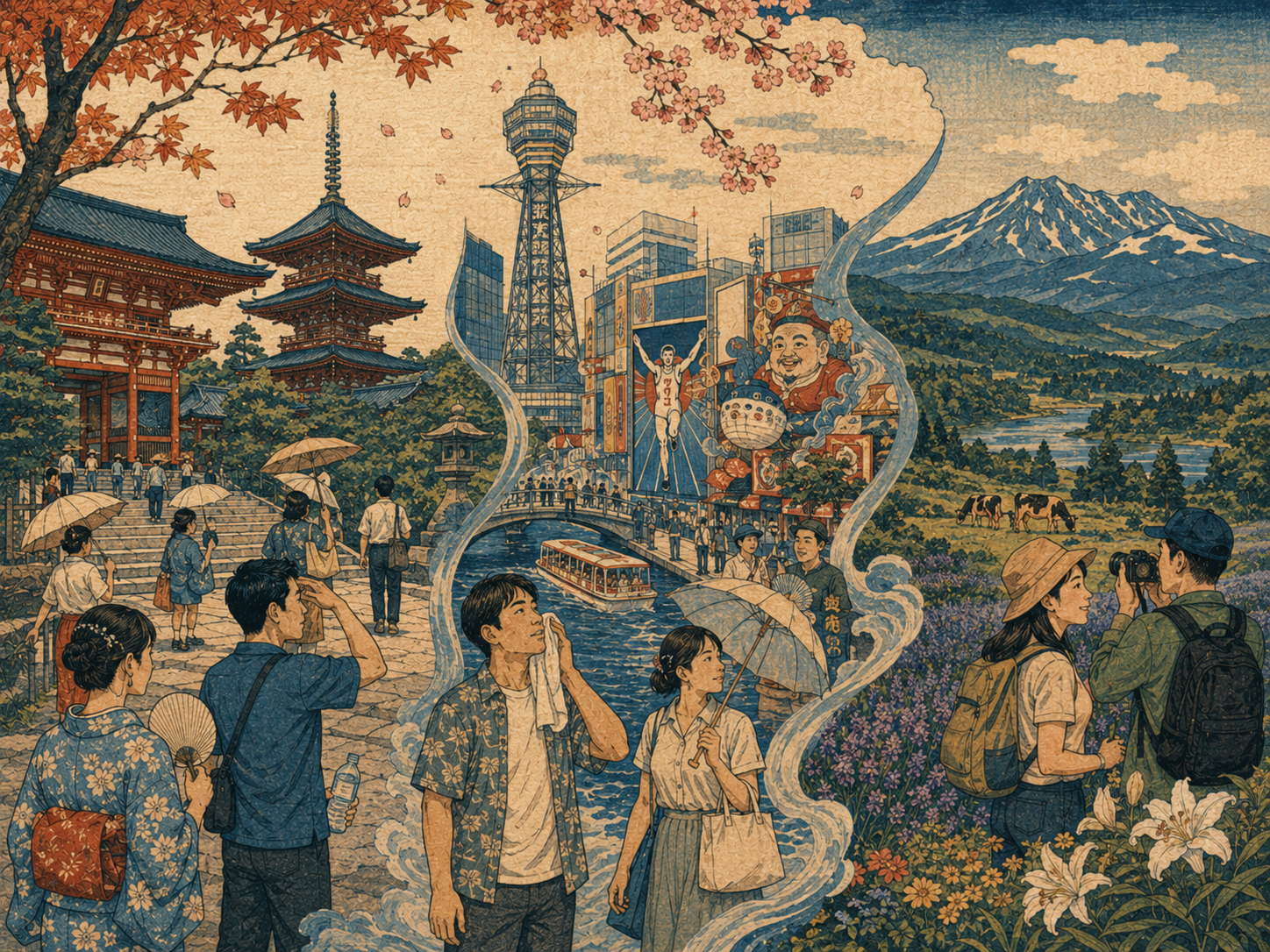
In midsummer Kyoto, tourists now begin at 6 a.m. They move toward Kiyomizu-dera before the stone paths hold heat, retreat by 9 or 10 to air-conditioned cafés and museums, rest at the hotel in the afternoon, and return to the Kamo River after sunset. In Osaka, they avoid Dotonbori at midday and move through underground malls, department stores, aquariums, food courts and neon evenings. In Hokkaido, Sapporo, Furano, Biei, Niseko and Shiretoko gain value simply because they offer a different summer. In 2026, Japan travel is no longer only about where to go. It is about when to move.
The Japan Weather Association expects above-normal temperatures across Japan in June through August 2026. The Pacific High is forecast to extend strongly toward Honshu, raising concern that extreme heat may persist. The Japan Meteorological Agency has also adopted a new term, kokushobi, for days of 40°C or higher. For tourism, that matters. Heat changes comfort, but it also changes route order, destination choice, spending, health risk and regional dispersal.
Japan welcomed a record 42.7 million international visitors in 2025, and the government still targets 60 million by 2030. But the more travelers arrive, the more summer heat becomes a core tourism-policy issue. Japan must now guide visitors through extreme heat just as seriously as it guides them through cherry blossoms and autumn leaves. In summer 2026, tourism is shifting from “where should I go?” to “what time of day can I safely go there?”
Heat redraws the tourist map
Travel guides often sell Japanese summer as fireworks, festivals, beaches, mountains, shaved ice and yukata. But in the major cities, summer is hot and humid. Tokyo, Osaka, Kyoto and Fukuoka can feel far hotter than the thermometer suggests. Matcha’s 2026 summer guide notes that Kyoto is especially challenging because its basin geography traps air and limits cooling breezes.
By contrast, Hokkaido, Tohoku, mountain areas and seaside towns gain value as summer refuges. Hokkaido can still reach 30°C, but the humidity is different. Cooler evenings, lavender fields, lakes, national parks and open skies make the north feel like a different country in the same archipelago.
This is also an opportunity. If travelers can be moved from crowded Kyoto and Osaka toward Hokkaido, Tohoku, the Japan Alps, Setouchi islands, seaside towns, forests and hot-spring areas, overtourism pressure falls and regional economies benefit. Heat is a risk, but it can also become a tool for dispersal.
Japan’s summer travel reset in numbers
Kyoto: morning tourism and afternoon refuge
Kyoto shows the travel reset most clearly. Temples, shrines, machiya streets, Gion, Arashiyama and Fushimi Inari are heavily outdoor experiences. The city has narrow streets, slopes and a basin climate that makes heat hard to escape. Visitors are moving from “walk all day” itineraries to “walk early, hide at midday, return in the evening.”
The Kyoto City Tourism Association explains that when the heat index, or WBGT, is forecast to reach 33 or higher anywhere in the prefecture, heatstroke alerts are issued at 5 p.m. the day before and 5 a.m. on the day of dangerous heat. For travelers, the lesson is that the maximum temperature is not enough. Humidity, sun exposure, wind, pavement heat, crowds and rest locations all matter.
Kyoto summer tourism is becoming a time-zone strategy: Kiyomizu-dera early, Fushimi Inari in the morning, temples before noon, Kyoto National Museum or shopping arcades during the day, hotel rest in the afternoon, Kamo River and Gion in the evening, cold matcha, kawadoko dining and late walks. Travel becomes temperature management.
Osaka: underground city, indoor city, night city
Osaka has a different advantage. Umeda, Namba, Shinsaibashi, Dotonbori, Tennoji and Universal City can be brutally hot outdoors. But Osaka has underground malls, department stores, commercial complexes, restaurants, theaters, aquariums and indoor attractions. It is easier to design a day that avoids exposed streets during the hottest hours.
Expo 2025 Osaka, Kansai gave the region a tourism boost. In 2026, Osaka is not only a pass-through point between Tokyo and Kyoto. Visitors see it as a base for food, night views, shopping, entertainment and Kansai-area travel. Heat makes Osaka’s indoor and nighttime strengths more valuable.
Dotonbori at midday can be punishing. Dotonbori at night becomes neon, food and river air. Umeda’s underground city is not just a transit corridor; it is a summer survival route. Kaiyukan and major retail complexes offer tourism and air conditioning at the same time. Osaka does not defeat the heat. It routes around it.
Hokkaido: rediscovered as a summer refuge
Hokkaido has long been associated with winter snow, skiing, drift ice and the Sapporo Snow Festival. But in summer 2026, coolness itself becomes a tourism product. Sapporo evenings, Furano lavender, Biei hills, Niseko highlands, Lake Toya, Shiretoko, Akan-Mashu and Kushiro Marsh all gain value as alternatives to Honshu heat.
If travel patterns shift north, airlines, hotels, rental cars, local buses, guides and labor markets shift too. Hokkaido is not automatically free from pressure. Summer demand can raise accommodation prices, create rental-car shortages and strain fragile natural areas. Coolness needs management.
Still, Hokkaido has a major role in summer dispersal. Moving visitors north, to mountains and to the sea can help Japan reduce pressure on Tokyo-Kyoto-Osaka while spreading tourism revenue more widely.
How travelers are changing the day
The old packed itinerary — morning to night, one attraction after another — is giving way to heat-smart travel. The new pattern looks like this: outdoor sites at dawn, walking in the morning, air-conditioned museums or retail at midday, hotel rest in the afternoon, then evening streets, festivals, riversides, illumination, food stalls and night views.
This changes tourism revenue. Breakfast demand rises. Early-access tours become attractive. Indoor attractions gain power. Hotels can sell day-use rooms, lounges and rest periods. Night dining, night tours, illumination and evening events become more valuable. Taxis, luggage delivery, parasols and cooling goods all gain relevance.
The weaker model is the long midday walking tour, the exposed queue, the outdoor attraction with little shade. Guides need rest stops. Tour operators need shorter blocks. Cities need shade, water stations, mist, benches and multilingual heat alerts.
Overtourism and heat become the same problem
Where tourism is crowded, heat becomes more dangerous. Packed buses, shade-less lines, narrow streets, limited water, toilet queues and rescue capacity all matter. The overtourism that Kyoto and Fuji-area towns have been managing becomes a health-risk issue in summer.
The Guardian reported in July 2026 that two-tier pricing and higher visitor charges are spreading across Japan as destinations try to cope with tourism pressure. Himeji Castle’s higher non-resident price and resident discount became a symbol of the debate. Heat links directly to that discussion. If destinations must pay for crowd control, cleaning, multilingual guidance, emergency response and shade, who funds it?
Heat countermeasures are one of the most understandable uses of visitor fees. Build shade. Install water stations. Provide multilingual alerts. Create indoor rest areas. Encourage morning and evening dispersal. If tourism revenue visibly returns to visitor and resident safety, higher prices are easier to defend.
Night tourism gets stronger
Heat weakens the middle of the day and strengthens the night. Japan already has a rich summer night culture: fireworks, bon dances, festivals, food stalls, river dining, beer gardens, night markets and illumination. In 2026, that culture becomes tourism strategy.
Kyoto evening temple visits, Osaka neon, Sapporo beer gardens, Otaru Canal and the night view from Mount Hakodate all gain importance. Night is cooler and often higher-spending: meals, drinks, transport, lodging and experiences. The challenge is resident life, noise, security, last trains and worker hours. Night tourism helps, but unmanaged night tourism creates new friction.
New products for tour operators and hotels
Tour operators will sell summer differently: early Kyoto, evening Osaka, cool Hokkaido, indoor museum routes, hands-free luggage plans, lunch-rest tours and heatstroke-aware guides. Hotels will sell pre-check-in lounges, cold welcome drinks, parasol rental, ice, water, shuttles, early breakfasts and afternoon rest packages.
Travelers will become more sophisticated too. They will check not only maps and weather, but heat index, crowds, shade, indoor breaks and air-conditioned routes. Travel technology is moving from booking management to body-temperature management.
Historically, Japanese travelers avoided summer heat too
Heat-avoidance travel feels new, but it is old. Edo-period people enjoyed river cooling, fireworks, evening outings and seasonal escapes. Kyoto’s kawadoko, Tokyo’s Sumida River culture, Karuizawa’s summer-resort history, Hokkaido tourism and long stays at hot-spring towns all reflect the same idea: do not fight summer head-on; change time and place.
Modern foreign visitors are rediscovering that older wisdom with smartphones and air-conditioned rail networks. The difference is scale. In a country that welcomed 42.7 million visitors in 2025, individual wisdom is not enough. Cities and the tourism industry must turn it into systems.
Japan.co.jp’s view
Heat is an enemy of Japanese tourism. But if handled well, it can also become a teacher. Move activity to morning and night. Use indoor attractions. Send visitors to Hokkaido, Tohoku, mountains and coasts. Spend tourism revenue on safety and comfort. Rebuild guided tours and hotel services around health.
Japan has succeeded in attracting visitors. The next task is to help them enjoy the country safely without exhausting residents or concentrating benefits too narrowly. Extreme heat is forcing that next stage.
Kyoto, Osaka and Hokkaido offer three answers. Kyoto moves to morning and night. Osaka moves underground, indoors and into the neon evening. Hokkaido moves visitors north, into nature and cooler air. Japan travel has become the art of reading temperature.
Reader guide
| Question | Answer |
|---|---|
| What is happening? | With above-normal summer heat expected, travelers are shifting toward early mornings, indoor afternoons, evenings, Hokkaido and higher-elevation destinations. |
| Kyoto | Early temples, midday indoor refuge, evening riverside, Gion and dining patterns. |
| Osaka | Underground malls, commercial complexes, indoor attractions and night districts become strengths. |
| Hokkaido | Sapporo, Furano, Biei, Niseko and Shiretoko gain value as summer alternatives to Honshu heat. |
| Japan.co.jp’s view | Heat is a tourism risk, but it can also mature Japanese tourism through time dispersal, regional dispersal, indoor planning and safety investment. |
Sources and references
This article draws on public information from the Japan Weather Association, JMA-related reporting via Nippon.com, the Kyoto City Tourism Association, JNTO-related tourism statistics, Reuters, The Guardian, Matcha, the World Economic Forum and Japan Travel.
- Japan Weather Association: Summer 2026 Weather Forecast for Japan
- Nippon.com: Japan adopts “kokushobi” for 40°C days
- Kyoto City Tourism Association: How to avoid heatstroke while traveling in Japan
- Nippon.com: Japan welcomes record 42.7 million international visitors in 2025
- Reuters: Japan 2024 tourism record and visitor spending
- The Guardian: Japan tourism, two-tier pricing and overtourism
- Matcha: Summer in Japan 2026 weather and travel
- JNTO: Summer in Japan guide