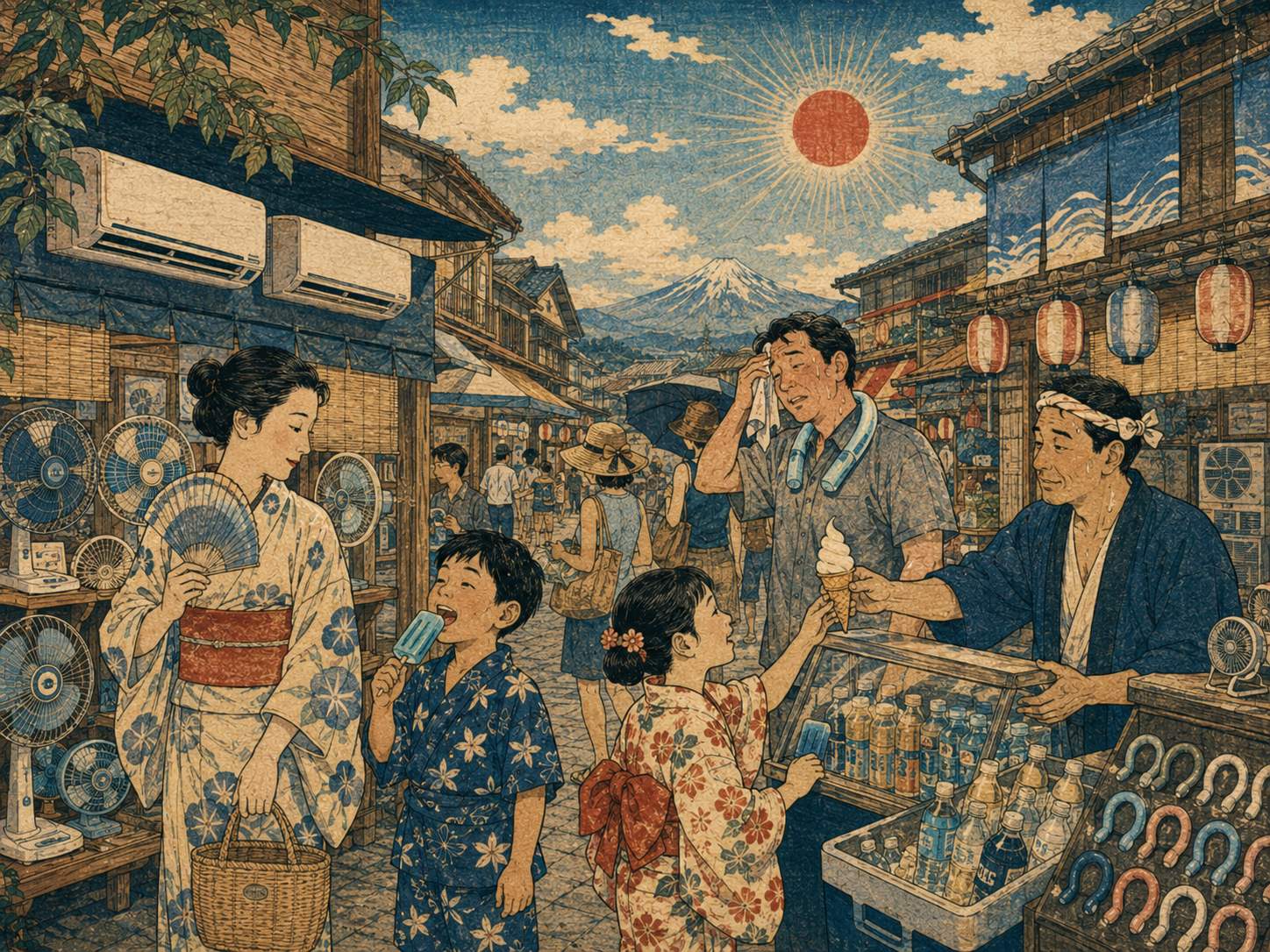
In Japan’s summer, coolness is no longer a mood. It is a product, an infrastructure layer and a form of survival technology. Ice cream in the convenience-store freezer, air conditioners stacked in electronics shops, handheld fans spinning outside stations, cooling rings around necks, tiny fans inside work jackets. In 2026, extreme heat has moved beyond the weather forecast. It is now an economic force shaping consumption, electricity, labor, healthcare and even antitrust enforcement.
The Japan Weather Association’s summer outlook for June through August 2026 points to above-normal temperatures across wide areas of the country. The Pacific High is expected to extend strongly over Honshu, potentially ending the rainy season early and lengthening the period of intense heat. In 2026, the Japan Meteorological Agency also adopted the term kokushobi for days of 40°C or higher. Forty degrees is no longer a freak number. It now has an official name.
Heat is dangerous, but it also creates markets. Ice cream sells. Air conditioners sell. Drinks, parasols, cooling bedding, cooling sprays, fan jackets, neck coolers, ice, salt tablets, oral rehydration fluids, heat-blocking curtains, refrigerated logistics, electricity, insurance and building materials all move with the thermometer. Japan’s summer is no longer only fireworks and festivals. It is a shelf of products designed to survive the day.
The age of kokushobi
In April 2026, the Japan Meteorological Agency adopted a new expression for days when the temperature reaches 40°C or higher: kokushobi. Nippon.com noted that Japan’s record temperature reached 41.8°C in August 2025. The point is simple and serious: 40°C heat is no longer so rare that it can be described only as an anomaly. It has become a weather category.
This matters for business. Above 30°C, drinks move. Above 35°C, people change plans. As temperatures approach 40°C, demand rises for heatstroke-prevention goods, delivery, indoor leisure, air-conditioner repairs and electricity. Very hot summers create winners and losers at the same time. Outdoor events, tourism, construction, farming, logistics, schools and sports must all adjust hours and practices.
The World Economic Forum has described Japan’s public-private efforts to tackle extreme heat as part of a broader climate-resilience challenge. Heat is now disaster management, urban planning, energy policy, medical policy, occupational safety and product development at once. Coolness has moved from private comfort to public policy.
Japan’s cooling economy in numbers
Ice cream becomes a heat indicator
Ice cream on a hot day is a child’s pleasure and an economic indicator. Convenience-store freezers, supermarket multipacks, soft-serve stands, station kiosks, factory break rooms. Japan’s ice cream market has grown with hotter summers, higher prices, premium products and the power of convenience-store distribution.
In June 2026, however, that sweet market met antitrust scrutiny. Reports said Japan’s Fair Trade Commission investigated six major makers — Meiji, Morinaga Milk Industry, Morinaga & Co., Lotte, Ezaki Glico and Akagi Nyugyo — over suspected coordination of ice-cream price increases. The companies said they would cooperate with the investigation.
The case drew attention because ice cream is moving closer to a summer necessity. As the heat intensifies, consumers reach for cold relief. At the same time, sugar, dairy, packaging, logistics, electricity and labor costs have risen. Companies have reasons to raise prices. But if price increases are suspected of coordination rather than competition, consumer anger rises with the temperature. The price of coolness is emotional.
Air conditioning: from luxury to lifeline
Air conditioning once carried the feeling of luxury in Japan. During the high-growth era, a cooler represented modern comfort. By the 1970s and 1980s, it entered more homes; by the 1990s and beyond, it became normal. In the 2020s, it has become something more serious: a heatstroke-prevention lifeline.
Some elderly residents still avoid using air conditioners because of electricity costs. Older homes may be poorly insulated, making indoor heat dangerous. If an air conditioner fails during a heatwave, the wait for repair or installation can matter medically. Early inspection, filter cleaning, replacement of old units, electricity subsidies and local welfare checks are no longer just appliance-business issues.
Air-conditioning demand also strains the power system. Reuters has warned that early heat in Asia is already pushing coal and gas demand as homes and businesses cool themselves. Cooling saves lives, but if the electricity comes from fossil fuel, it can intensify the climate problem that makes cooling necessary. The escape route is high-efficiency equipment, insulation, batteries, renewable energy and demand-response programs.
Japan’s wearable cooling culture
One of Japan’s most interesting heat responses is that it does not rely only on room air conditioning. Handheld fans, cooling neck rings, cooling vests, fan-cooled workwear, parasols, heat-blocking hats, cooling sprays, mist fans and wearable neck coolers all create smaller zones of personal relief.
In June 2026, 29 companies reportedly took part in a Tokyo exhibition of products designed to address extreme heat. One backpack-type product was promoted as sending air up to 14°C cooler than outside air to help control body temperature. For construction, delivery, security, farming, events and tourism, such products are not novelty gadgets. They are becoming safety equipment.
Japan’s cooling-goods market is distinctive because it adapts to small urban inconveniences: packed trains, festivals, commuting, sightseeing, outdoor work, schools and sports. Where large air conditioning cannot reach, small cooling products enter. It is a very Japanese form of invention around the body.
Heat changes retail time
Extreme heat changes when people shop. Fewer people go out at midday. Morning and evening become more important. Tourists choose indoor attractions. Restaurants add cold dishes. Convenience stores increase stocks of ice and drinks. Supermarkets push insulated bags, cold packs and frozen foods. Drugstores move sunscreen, oral rehydration fluids and cooling sheets to the front.
But heat can also stop consumption. People avoid walking outside. Delivery workers face danger. Outdoor events are cancelled. Sightseeing time shortens. Construction shifts hours. Summer sales are not simply “hotter equals better.” Pleasant heat and dangerous heat have very different economic effects.
The invisible battle of frozen logistics
Behind every ice cream sale is a cold chain. Products are made, stored in low-temperature warehouses, carried by refrigerated trucks and placed in freezers. The hotter the summer, the harder temperature control becomes. Electricity, fuel, labor, refrigerated equipment and freezer failure all become bigger risks.
Convenience stores are on the front line of Japan’s heat response. Cold drinks, ice, ice cream, cooling towels, salt candies, sunscreen, folding umbrellas, portable batteries. Residents and tourists alike step inside when heat becomes too much. The convenience store has become a small urban cooling station.
Occupational safety becomes a market
Heat changes work. Construction, logistics, agriculture, security, events, cleaning, care work, schools, tourism guides — outdoor and semi-outdoor workers face rising heatstroke risk. Companies are buying fan jackets, cooling vests, rest tents, mist systems, drinks, wearable sensors and schedule-management tools.
A new market is forming around occupational heat safety: sensors, insurance, labor management, training, apps and site analytics. Heatstroke prevention is no longer a perk. It is a core workplace-safety issue. In labor-short Japan, companies that cannot protect workers from heat will lose people.
The end of “just endure it”
Japanese summer culture has long included endurance: fans, reed screens, sprinkling water, wind chimes, yukata and barley tea. These are beautiful traditions. But in the age of 40°C heat, endurance can be dangerous. For older people, children and people with health conditions, avoiding air conditioning is not thrift; it is risk.
The difficulty is electricity cost. A weak yen and high energy prices make households hesitate. That means subsidies, efficient air conditioners, insulation upgrades, welfare outreach and better public cooling spaces matter. A society in which only people who can afford coolness are safe is not acceptable.
Japan.co.jp’s view
The 2026 heat economy reveals Japan’s future. Ice cream sells, but antitrust investigators arrive. Air conditioners sell, but the grid is stressed. Cooling gadgets evolve, but outdoor workers remain at risk. Tourists still come, but they change how they move. Coolness is a business opportunity and a social warning at the same time.
Japan’s strength is invention at the human scale: neck rings, fan jackets, cold towels, convenience-store ice, quiet air conditioners, parasols and heat-blocking materials. But products are not enough. Japan needs urban design, housing insulation, public cooling spaces, labor rules, electricity planning, medical preparedness and local welfare checks.
Summer is not the old summer anymore. Wind chimes alone cannot survive a kokushobi day. But Japan is a country that invents ways to stay cool. The question is whether it can turn those inventions into safety that everyone can access.
Reader guide
| Question | Answer |
|---|---|
| What is happening? | With a hotter-than-normal summer expected, demand is rising for ice cream, air conditioners, drinks, parasols, cooling gadgets and workplace heat-safety products. |
| Why does it matter? | Heat now shapes consumption, electricity, logistics, labor safety, healthcare, antitrust scrutiny and tourism. |
| Key themes | Kokushobi, ice-cream pricing scrutiny, air-conditioner demand, fan-cooled workwear, personal cooling devices and power load. |
| Risks | Heatstroke, energy bills, unequal access to cooling, grid strain, higher prices and outdoor-worker danger. |
| Japan.co.jp’s view | Coolness is a public-safety issue before it is a consumer product. Japan’s heat economy tests both invention and fairness. |
Sources and references
This article draws on public information from the Japan Weather Association, JMA-related reporting via Nippon.com, the World Economic Forum, Reuters, AP, The Guardian, The Japan Times, PNA and ABC News.
- Japan Weather Association: Summer 2026 weather forecast for Japan
- Nippon.com: Japan adopts “kokushobi” for 40°C days
- World Economic Forum: How Japan is preparing for the extreme heat of summer 2026
- Reuters: Asia’s early heat wave and power demand
- AP: Japanese fair trade officials raid six ice cream makers
- The Guardian: Alleged ice-cream cartel in Japan investigated
- PNA: Japanese firms launch new items to address heat wave
- The Japan Times: New cooling products launched ahead of scorching summer