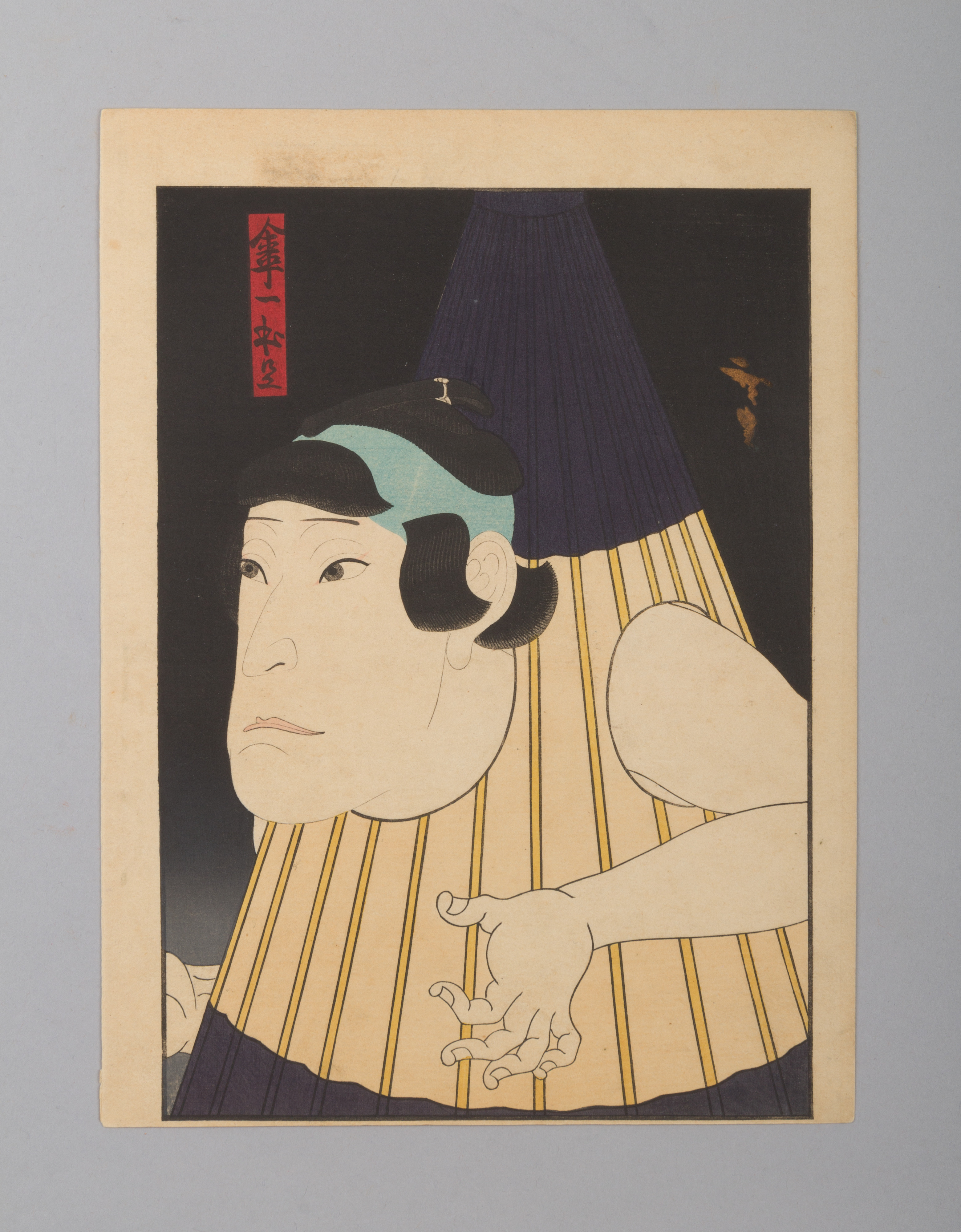
The first surprise is the face. It is not the cyclopean eye of the umbrella ghost familiar from later picture books, animation and tourist souvenirs. It is the composed face of a Kabuki actor, pale against a field of black, his gaze sliding left and his mouth held almost shut. A blue-green patch cuts across the forehead. Two hands press into the lower half of the image. Above and behind him rises a deep purple cone; yellow fabric marked by narrow black lines wraps his body like the ribs of an opened umbrella.
A red cartouche supplies the answer: Kasa ippon ashi, 傘一本足, “one-legged umbrella.” Without those characters, the transformation would remain unstable. Is the purple form a canopy or an enormous hood? Are the stripes costume, ribs or cage? Hirosada does not illustrate a monster standing on a stage. He lets a performer occupy the unresolved interval between person and object.
That distinction matters because the image is often described through the modern, standardized karakasa-kozō: one eye, one leg, long tongue, wooden clog. None of those identifying features is visible here. The Met’s print is a portrait of an actor playing an umbrella apparition, not a zoological plate of a yōkai. Its comedy and unease come from a visibly human body that has almost—but never entirely—become a household thing.
A monster made by cropping
The printed image measures only 24.1 by 18.1 centimeters. That intimate scale is not incidental. The Kamigata Ukiyo-e Museum describes chūban—roughly half the area of a standard ōban sheet—as a format characteristic of Osaka actor prints. It brought a performer close enough for recognition, comparison and possession. A theatergoer could take the remembered face of a stage favorite into the hand.
Hirosada turns that closeness into pressure. The chin swells toward the left border. An elbow and forearm strain against the right. Black removes every normal cue of theater space: no musicians, footlights, scenery or audience. The vertical stripes follow the body while denying its ordinary anatomy. The pose seems compressed inside the very object it represents.
Most importantly, the lower body is missing. A picture titled “one-legged” does not show us its one leg. The omission recruits the viewer. We have to imagine the balancing, hopping or concealed limb below the frame, and our reconstruction animates the still print. Hirosada makes absence do the work of choreography.
The Met says the performer would tie up one leg and hop around the stage. That is a vivid and plausible account of the physical trick, and later performance descriptions of umbrella roles also speak of a hidden leg and demanding balance. But no contemporaneous program or stage manual for this particular 1857 performance was located for this article. The technique is therefore attributed to the museum’s curatorial text, not presented as independently verified fact about a named production.
Osaka actor prints after a five-year silence
Hirosada worked in a print culture that had only recently recovered from official suppression. An exhibition produced by the city of Akō with Ritsumeikan University’s Art Research Center dates the interruption in actor-print publishing under the Tenpō Reforms from April 1842 to April 1847. Its record for Hirosada’s 1848 Chūshingura jūnidan tsuzuki places that series among the works made as actor prints began to return.
The prohibition helps explain the historical weight of a performer’s face. Actor prints were not neutral records. They belonged to a commercial system in which stage celebrity, fashion, fan recognition and printed likeness amplified one another—and therefore to the urban pleasures reformers tried to control. By 1857, when Kasa ippon ashi appeared, Hirosada could once again push an actor’s features toward the front of a color print. Yet this sheet withholds the performer’s written name.
The Met proposes Onoe Tamizō II (二代目尾上多見蔵), without making the identification firm. The National Theatre of Japan’s Cultural Digital Library verifies the reading Onoe Tamizō and supplies a useful chronology. The actor held that stage name from November 1820 until July 1848, briefly performed as Ōkawa Hachizō, then resumed the Tamizō name in 1850 and retained it until his death in 1886. A Tamizō II appearance in 1857 is therefore chronologically possible. Possibility is not identification, however; the Met’s record does not publish the facial-comparison evidence behind “perhaps.”
Hirosada is elusive too. The Met gives an activity range of about 1819 to 1863, while Japanese reference traditions often leave his birth, death and training unsettled and debate relationships among the names he used. It is safer to describe the oeuvre than to overbuild a biography: under the name Gosōtei Hirosada, he became one of the defining makers of late Edo-period Osaka actor prints, particularly the intense close portraits that could turn a small sheet into a private theater.
What an old tool wanted
The Met places the apparition among tsukumogami (付喪神), which it glosses as everyday objects or tools—umbrellas, brooms, lanterns, sandals and pots—that become ghosts or monsters after they are no longer used. That is a useful bridge for a modern reader. It should not be mistaken for a single timeless creed uniformly held across Japan.
The historical materials tell richer and less tidy stories. The National Diet Library describes the Tsukumogami emaki as a tale in which discarded old implements change into yōkai to take revenge on people. Kyoto University’s manuscript record adds the narrative machinery. Cast out during the year-end cleaning, the tools reject a rosary’s warning, learn transformation from the figure Kobun-sensei, gather behind Funaokayama, rampage in the capital and hold a procession. Buddhist powers eventually defeat them; they repent, practice and attain salvation. The university dates the work’s origin to the medieval Muromachi period and emphasizes its argument for the salvation of insentient things and the supremacy of Shingon esoteric Buddhism.
This is more than a caution to “treat objects kindly,” though the moral is easy to draw. It is a story about resentment after disposal, the frightening social life of things, religious discipline and the possibility that even what lacks human consciousness can enter a scheme of salvation. The objects become characters because their former service and present rejection have created a grievance.
Later scroll traditions could loosen narrative into display. The Hyogo Prefectural Museum of History’s late Edo-period Hyakki Yagyō Emaki (百鬼夜行絵巻) assembles 99 creatures, many made from personified tools, animals and marine life. Its separate Hyakki Yagyō Emaki (百器夜行絵巻)—written with the character for “utensil” rather than “demon”—presents 35 amusing beings based on ordinary and craft implements including a winnowing basket and miso strainer. The museum reads it as a visualization of familiar objects transformed by the passage of years and as something like an illustrated catalogue of things.
That long history makes an animated umbrella culturally intelligible. It does not prove that a painter, costume maker or playwright copied a particular medieval scroll to create Hirosada’s role. No direct documentary chain from the Tsukumogami emaki to this 1857 costume was found. “Tsukumogami” is best used here as a historical field of object animation, grievance and comic personification—not a label that closes the research.
| Question | Editorial status | Evidence |
|---|---|---|
| Who made it, when and in what format? | Established as a museum collection record | Met title, artist, date, medium, dimensions and accession data |
| Is the actor Onoe Tamizō II? | Candidate, not certainty | The Met says “perhaps”; Japan’s National Theatre confirms the name and chronology |
| Did the actor bind one leg and hop? | Attributed curatorial account | The Met states it; a contemporary record for this exact production was not located |
| What play and theater? | Unresolved | Not named in the public object record |
| Does the role descend directly from medieval tsukumogami scrolls? | Broad cultural relation only | Institutional scroll records support object-animation history, not a direct line to the costume |
The umbrella’s second stage life
A one-legged umbrella survived as an embodied Kabuki role, but the cleanest later evidence belongs to a different work. Japan Arts Council records document Yami no Ume Hyakumonogatari (闇梅百物語) at Tokyo’s Ichimuraza in January 1910. A surviving photograph identifies Onoe Kikugorō VI as “the apparition of the one-legged umbrella”; another identifies Bandō Mitsugorō VII as the one-legged umbrella. These records are more than half a century later than Hirosada’s print.
Shochiku’s official Kabuki site credits Yami no Ume Hyakumonogatari to Kawatake Shinshichi III and records Kabukiza revivals in 2019 and 2022. Its modern synopsis begins at a daimyo’s residence during a telling of one hundred ghost stories. When the last light goes out, an umbrella on one leg, a tanuki, kappa, snow woman and skeleton appear in sequence. The site calls it a humorous dance; in the 2022 cast, Nakamura Tanesuke played the umbrella.
It is tempting to use that vivid surviving dance to fill every gap in the 1857 image. The dates forbid it. Nothing in the Met record identifies Hirosada’s source play as Yami no Ume Hyakumonogatari, and the Japan Arts Council evidence cited here begins in 1910. The responsible connection is narrower and more interesting: the premise of an actor converting his body into a one-legged umbrella was durable enough to be restaged, revised and enjoyed in the twentieth and twenty-first centuries.
The role sits at the productive edge between fear and skill. An umbrella should open symmetrically and stand only when held. Give it one human leg and it becomes unstable by design. The performer’s task is therefore not just representation; balance itself becomes narrative. A hop can be funny, precarious and supernatural in the same beat.
1842–47 Actor-print publishing is interrupted under the Tenpō Reforms.
1848 Hirosada publishes an actor series as the genre returns.
1857 The Met dates Kasa ippon ashi.
January 1910 Ichimuraza photographs document umbrella roles in Yami no Ume Hyakumonogatari.
2011 The Met acquires the print.
2019 and 2022 Kabukiza stages modern revivals of Yami no Ume Hyakumonogatari.
The yōkai without a logo
Modern character culture rewards instant recognition. A single eye and protruding tongue can turn an umbrella ghost into an icon legible at sticker size. Hirosada’s print resists that efficiency. It asks for looking before naming. Its umbrella is a relation among title, costume and body, not a checklist of anatomical traits.
Try covering the red cartouche. The face remains emphatically human. The purple shape becomes ambiguous. The yellow-and-black lines may read as cloth before they become ribs. Now uncover the title. The same marks reorganize themselves. The title does not merely label the picture; it performs part of the transformation.
The black ground performs another part. In a theater, darkness conceals the devices that create an apparition. In the print, it removes depth and isolates pale skin, blue pigment, purple fabric and the repeated stripes. The monster has nowhere to stand. It presses forward like an actor approaching the edge of the stage—and like a collectible likeness held close to its buyer.
The image’s humor is inseparable from its restraint. The mouth does not roar. The eyes do not roll. The hand gesture is more puzzling than threatening. A household object has borrowed a celebrity face, or a celebrity has surrendered his body to a prop. Neither reading wins. Hirosada keeps the print alive by refusing to resolve the contest.
- Hide the title: decide when cloth first becomes umbrella.
- Reconstruct the missing leg: notice how a still crop generates movement.
- Forget the cartoon cyclops: attend to the actor’s human face and the costume’s material logic.
Open access, open questions
The Met marks the image Public Domain and makes its Open Access files available for unrestricted commercial and noncommercial use without permission or fee. That freedom makes the print unusually easy to reproduce. It also makes precision more important. A public-domain image can be copied into a thousand contexts while an uncertain actor becomes certain, an unidentified play acquires a title, or a later cartoon yōkai is projected backward onto an earlier stage costume.
High resolution offers a corrective. The black is not a digital void but a printed surface. Pale outlines and areas of color sit on aged paper. The blue-green forehead, restrained lips, purple canopy and narrowly spaced stripes do not fuse perfectly; they retain the tactile decisions of blocks, pigment and registration. Reproduction does not erase material history if the viewer is encouraged to see it.
The honest mysteries are part of the work. We do not yet have a secure actor name. The public museum record does not supply the play, theater or publisher. The leg-binding account has not been tied here to a contemporaneous record of this performance. The relation to medieval tsukumogami literature is powerful but not genealogically proven. None of those limits weakens the picture. They return us to what the sheet itself does with certainty.
Hirosada gives us a face, two hands, a striped body, a purple peak and a title. From those fragments, an umbrella learns to haunt a stage we cannot see. The actor never completely disappears and the object never becomes fully autonomous. For as long as the eye moves between them, the transformation is still in progress.
- The Metropolitan Museum of Art — title, artist, date, medium, format, dimensions, accession number, proposed actor, interpretation and Public Domain status
- Kamigata Ukiyo-e Museum — official exhibition account of chūban as characteristic of Osaka actor prints
- Akō City and Ritsumeikan University Art Research Center — 1842–47 interruption in actor-print publishing and Hirosada’s 1848 work
- Cultural Digital Library, Japan Arts Council — official reading and stage-name chronology for Onoe Tamizō II
- National Diet Library Image Bank — institutional summary of the Tsukumogami emaki
- Kyoto University Rare Materials Digital Archive — plot, formation and religious context of the Tsukumogami emaki
- Hyogo Prefectural Museum of History — Hyakki Yagyō scroll traditions and personified ordinary tools
- Cultural Digital Library — 1910 Ichimuraza record for the umbrella apparition in Yami no Ume Hyakumonogatari
- Kabuki-bito, Shochiku’s official Kabuki site — 2019 Kabukiza revival of Yami no Ume Hyakumonogatari
- Kabuki-bito, Shochiku’s official Kabuki site — author credit, reading, 2022 cast and official synopsis of Yami no Ume Hyakumonogatari
Editorial note: Japanese work titles, personal names and readings, play titles and readings, print terminology and performance dates were checked against Japanese-language records from public institutions, collecting museums and the official Kabuki publisher. The proposed actor, leg-binding performance account and tsukumogami classification remain attributed to the Met. The 1857 play, theater and publisher, a contemporaneous source for the hopping technique, and a direct line from medieval tsukumogami scrolls to this umbrella costume were not established in public sources. Yami no Ume Hyakumonogatari is discussed as a later performance history, not identified as the source of Hirosada’s print. The hero uses the Met’s Public Domain Open Access original. The supplied exchange-rate timestamp of Aug. 25 at 7:48 p.m. UTC converts to Aug. 26 at 4:48 a.m. JST.