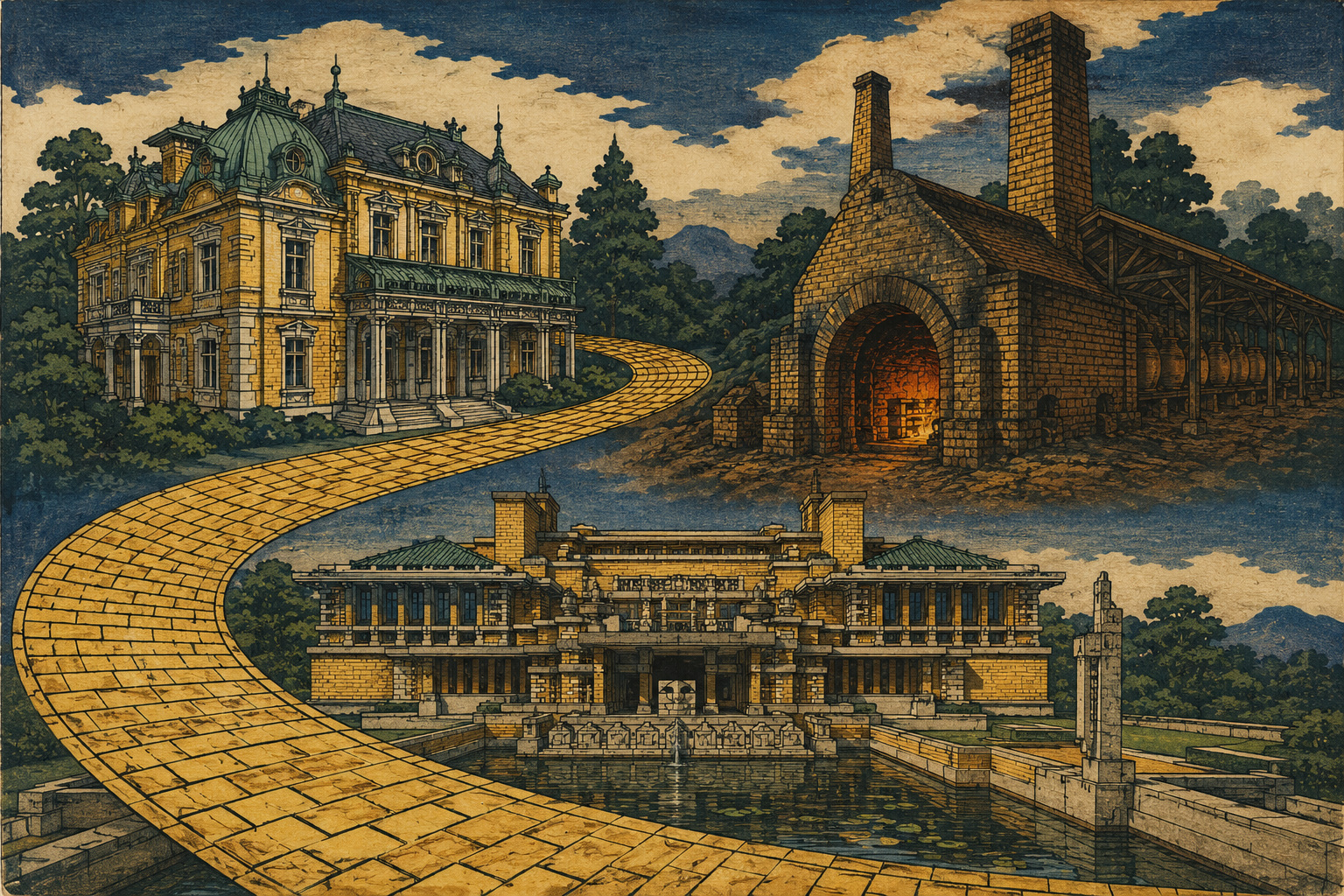
Begin at the pale upper walls of a reception house beside Kyoto’s Maruyama Park. They look almost restrained now. In 1909, when red brick was the expected face of a modern masonry building in Japan, the yellow ceramic surface of what is now Chourakukan supplied a conspicuous difference.
That difference will become the subject of a Sept. 27 conversation inside the hotel. Chourakukan’s fifth annual one-day arts festival is pairing historical novelist Midori Uematsu, author of Teikoku Hoteru Kenchiku Monogatari, with Reiko Sakata, general manager of the Imperial Hotel Kyoto. Their announced topic—“Architecture and Hospitality Culture: The Story Linking Chourakukan and the Imperial Hotel”—starts with the man who built the Kyoto house, tobacco industrialist Kichibei Murai.
Chourakukan’s official account says Murai, then an Imperial Hotel director, remembered the yellow decorative brick on his own villa when Frank Lloyd Wright’s Imperial Hotel project needed a Japanese source for an unfamiliar yellow product. The recollection pointed toward Tokoname ceramic producer Kichinosuke Hisada. A hotel-owned factory, local clay, new machinery and years of difficult production followed.
A reception house, not simply a mansion
The national cultural-property register gives Chourakukan its most exact identity. Its official name is Kyū Murai-ke Bettei (Chōrakukan), or the Former Murai Family Villa (Chourakukan). The 1909 building is a three-story brick structure over a basement, with a footprint of 437.24 square meters and a slate roof. On Dec. 9, 2024, it was designated an Important Cultural Property for outstanding design; one gate-and-wall structure and 51 pieces of furniture were included as associated properties.
American architect J.M. Gardiner designed the house. Chourakukan supplies his full name as James McDonald Gardiner. The Agency for Cultural Affairs emphasizes planning rather than ornament alone: reception rooms arranged for entertaining, half-levels that manipulate ceiling heights and a dramatically composed stair. Renaissance, Rococo, Secession, Chinese, shoin and tea-room vocabularies appear in different rooms without breaking the building into incoherent fragments.
That analysis matters because “East meets West” is too easy. Murai did not build a static catalogue of styles. He commissioned a social instrument. Guests moved through different scales and atmospheres as the house changed register around them. Two surviving guest books include signatures and comments by political figures including Hirobumi Ito and Kaoru Inoue, material evidence of the building’s reception function.
The exterior also modulates the visitor’s reading. The ground story is finished in stone; Tokoname-made yellow tiles or decorative bricks cover the second and third stories. Chourakukan’s own pages use both tile and brick for that facing, an ambiguity retained here rather than silently standardized. The material may be thin facing rather than a structural brick, but its color turns the building’s upper mass into a public signature.
The capital behind the color
Murai’s building cannot be separated from the industry that paid for it. The Tobacco and Salt Museum, drawing on company papers and historical objects, identifies him as Japan’s largest private tobacco manufacturer before the 1904 state monopoly. Born in Kyoto in 1864, he learned the trade while peddling tobacco with his adoptive father, studied cigarette production and launched the double-ended cigarette “Sunrise” in 1891. “Hero,” blending American leaf, followed in 1894, the same year he organized Murai Brothers as a formal partnership.
His contest with Matsuhei Iwaya became a school of modern promotion. Where Iwaya advertised domestic leaf, red branding and “Tengu” products, Murai used imported leaf, Western names, multicolor posters, product cards, newspapers and street bands. In 1899, he created Toyo Printing in Kyoto to make packaging with imported technology. The Tobacco and Salt Museum argues that this rivalry accelerated Japanese printing and advertising as well as cigarette sales.
There was a hard institutional break. The Tobacco Monopoly Law of 1904 forced private manufacturers out. Compensation became an international dispute because American and British investors held Murai Brothers shares; the government ultimately paid substantial sums. Murai used that capital to move into banking, mining, forestry, agriculture and trade. Chourakukan rose five years after the state had converted his tobacco empire into investment money.
It is tempting to describe the house as vanity. A better interpretation is that it extended Murai’s commercial language into architecture. Imported furnishings, novel color, rooms made for receiving influential guests and a location beside a public park made social standing spatial. Chourakukan’s 2026 release says Murai joined the Imperial Hotel Co. board in 1907. That directorship, rather than aesthetic coincidence, placed his memory of a Kyoto wall inside the hotel’s material problem.
The distance between a sample and a wall
Chourakukan’s house magazine, Regalo, says Murai told an Imperial Hotel board meeting that his Kyoto villa already used yellow decorative brick. It identifies the maker as Hisada of Tokoname, one of the early specialists in modern architectural ceramics whose products also appeared at the Nawa Insect Museum and the Kyoto Prefectural Library. LIXIL’s INAX Museums likewise places Hisada between Wright’s demand and Tokoname’s response.
This is the moment at which a neat anecdote becomes industrial history. Wright wanted ceramic units that fired yellow rather than red, carried even vertical scratches across their visible surface, could be shaped into elaborate terracotta and could be produced in extraordinary quantities. A possible maker was only a beginning.
About 20 kilometers south of Tokoname, bluish Utsumi clay contained little iron and could fire to the desired yellow-brown. Museum Meiji-Mura says Wright visited the source himself. In 1917, the Imperial Hotel created its own Imperial Hotel Brick Works in Tokoname. Production combined hand finishing with imported and adapted machinery. Meiji-Mura’s reconstruction research describes oxidation firing at 1,190 degrees Celsius as the condition that finally delivered the color.
Technical guidance came from Hatsunojo Ina and his son Chotaro, who had experience mechanizing ceramic-pipe production. A naming trap survives in later accounts: Chotaro inherited the name Chozaburo Ina VI in 1926, so sources written backward from his later career may call the son Chozaburo during the hotel project. LIXIL’s centennial history uses Chotaro for the period and records the later succession.
By 1921, the factory had delivered 2.5 million sudare bricks—often called scratch bricks or scratch tiles—plus 1.5 million hollow bricks and extensive terracotta. The four-million total therefore includes more than the yellow grooved surface units. After the commission, equipment and workers passed into an Ina enterprise that became Ina Seito in 1924, later INAX and now part of LIXIL. LIXIL’s institutional history credits the Wright Building with popularizing scratch tile and stimulating Japan’s industrial exterior-ceramics sector. That claim is made by a corporate descendant, but the transfer of equipment and people is also documented by museum sources.
| Building | Date and designer | Ceramic material | Nature of the link |
|---|---|---|---|
| Former Murai Family Villa (Chourakukan) | 1909 J.M. Gardiner | Tokoname-made yellow tiles or decorative facing bricks on the upper stories; house history attributes them to Kichinosuke Hisada | Murai reportedly cited his own wall when the Imperial Hotel sought a yellow source |
| Imperial Hotel Wright Building | 1923 Frank Lloyd Wright; completion continued after his departure by Japanese associates including Arata Endo | Utsumi-clay sudare bricks, hollow bricks and terracotta made at a dedicated hotel works | Hisada provided the lead; the Ina family and many workers supplied the production system |
| Yasaka Kaikan / Imperial Hotel Kyoto | 1936 / adaptive reuse completed 2026 Original hall by Tokusaburo Kimura | Preserved and reproduced exterior terracotta | Imperial Hotel research links its manufacture and workers to the same Tokoname lineage as the Wright Building |
Wright’s hotel was also Japanese production
The Imperial Hotel began in 1890 in Tokyo’s Hibiya district as lodging for international visitors and a private counterpart to state reception. By the 1910s its original building could no longer meet demand. A Nov. 22, 1916 extraordinary shareholders’ meeting approved a new hotel; construction of Wright’s design began in 1919.
Official chronology complicates the heroic architect narrative. Wright left Japan on July 22, 1922. The building reached completion at the end of August 1923 through an organization that included hotel manager Aisaku Hayashi, contractor and craft networks, and Wright’s Japanese associates. The finished structure combined reinforced concrete and brick concrete, rose as high as five stories over a basement, contained 270 rooms and covered 10,535 tsubo of floor area.
It opened on Sept. 1, the day the Great Kantō Earthquake devastated Tokyo and Yokohama. Both the hotel and Meiji-Mura describe the building’s damage as light. That careful wording is preferable to the later legend that it emerged wholly untouched. More consequentially, on Sept. 2 the hotel offered rooms as offices for displaced companies, newspapers, news agencies and foreign missions. Architecture intended for elite welcome became emergency civic infrastructure.
The yellow grooved masonry mattered visually because it worked with carved Oya stone and terracotta, not as a monochrome skin. High windows and perforated units admitted light; projecting ornament deepened shadow. The ceramic was part of an environmental composition as well as decoration.
The Wright Building closed in 1967. Its central entrance was dismantled, moved to Museum Meiji-Mura in Inuyama, Aichi, reconstructed and opened to visitors in 1985. What survives is not the whole hotel. Meiji-Mura gives the original building a frontage of about 100 meters, a depth of about 150 meters and more than 34,000 square meters of floor area. The relocated entrance, with some material replaced or reproduced, is a preserved argument about the whole.
- Color is not identity: Chourakukan’s yellow facing and the Imperial Hotel’s grooved scratch units were different products.
- A clue is not production: Murai’s intervention pointed to Tokoname; a dedicated factory and years of labor fulfilled Wright’s order.
- Four million is a composite: the total combines 2.5 million surface scratch bricks and 1.5 million hollow bricks, plus separately counted terracotta.
Why the story returned to Kyoto in 2026
The new Imperial Hotel Kyoto opened on March 5, 2026, inside and around part of Yasaka Kaikan on the grounds of the Gion Kobu Kaburenjo. The 55-room hotel preserves elements of a nationally registered tangible cultural property completed in 1936. Yasaka Kaikan had hosted theater, bunraku, cinema, dance and music; its hospitality history belonged to a performance district rather than a private industrialist.
The Imperial Hotel says sound terracotta reliefs were fixed in place, while damaged examples were scanned in three dimensions to create faithful reproductions. Its research found that the material had been made in the same Tokoname manufacturing lineage as Wright Building ceramics and that many craftspeople connected to the earlier hotel also worked on Yasaka Kaikan. The claim describes continuity of place, knowledge and labor, not the reuse of Wright Building pieces.
Chourakukan and the Imperial Hotel Kyoto now present two different conservation propositions within Kyoto. Chourakukan keeps a 1909 reception house, its rooms and much of its furniture active as dining, lodging and event space. The Imperial Hotel inserted a contemporary hotel into a partial preservation and reconstruction of a 1936 cultural hall. One maintains a historic whole; the other makes selective survival carry a larger new building. Both depend on continued use to fund continued care.
That makes the Sept. 27 conversation more than a centennial anecdote. Uematsu has reconstructed the Wright Building project as historical fiction. Sakata had to turn inherited institutional language into an operating Kyoto hotel. The useful question between them is not whether old buildings feel luxurious. It is how physical evidence—walls, reliefs, rooms and repaired surfaces—can remain legible while serving people whose needs the original builders did not anticipate.
1864 Kichibei Murai is born in Kyoto.
1890 The Imperial Hotel opens in Hibiya, Tokyo.
1904 The Tobacco Monopoly Law forces private tobacco manufacturers to exit production.
1907 Chourakukan’s release dates Murai’s Imperial Hotel directorship to this year.
1909 Chourakukan is completed.
1917–21 The Imperial Hotel Brick Works operates in Tokoname.
Sept. 1, 1923 The Wright Building opens as the earthquake strikes.
1967–85 The hotel closes; its central entrance is relocated and opened at Meiji-Mura.
Dec. 9, 2024 Chourakukan receives Important Cultural Property designation.
March 5, 2026 The Imperial Hotel Kyoto opens.
Sept. 27, 2026 Chourakukan hosts “Architecture and Hospitality Culture.”
A material remembers what institutions forget
The usual history of a famous building has a famous architect at its center. Following yellow ceramic produces a crowded picture instead. Tobacco monopoly compensation underwrote Murai’s post-tobacco world. A Kyoto reception house preserved the name of a Tokoname maker. Low-iron clay in southern Chita made the desired color possible. Pipe-making machinery helped scale production. Hotel finance, kiln practice, manual correction, transport and inspection turned a drawing into millions of acceptable units.
Each simplification erases someone. Say Murai “gave Wright the brick,” and the factory disappears. Say Chourakukan and the Imperial Hotel used “the same bricks,” and distinct products and techniques disappear. Say the Wright Building was “unscathed” by the earthquake, and an urban disaster becomes an architect’s publicity legend. Say the surviving Meiji-Mura entrance is the hotel, and the dimensions of what was lost become hard to imagine.
The strongest facts survive those corrections. Chourakukan retains yellow Tokoname facing. Murai’s intervention is recorded in Chourakukan and LIXIL institutional histories. The Imperial Hotel established a dedicated Tokoname works. Four million scratch and hollow bricks were delivered, and the equipment and workforce fed a company that helped define Japanese ceramic building materials. The precise words spoken in the hotel boardroom have not been independently checked against publicly accessible meeting minutes, so this article attributes that part of the chain rather than converting it into an unqualified quotation.
Yellow attracted attention because it refused the expected red. Its deeper legacy lies in the relationships required to reproduce it. A businessman remembered a wall; a region turned soil into capacity; a hotel wrapped hospitality in the resulting surface; later institutions preserved fragments and rediscovered the production lineage. The path was never made from one set of bricks. It was made from knowledge that moved.
- Date: Sunday, Sept. 27, 2026; reception 12:30 p.m., dialogue 1–2:30 p.m.
- Venue: Terrace Coral, first floor of Chourakukan’s new building
- Speakers: Midori Uematsu and Reiko Sakata
- Admission: ¥1,000 tax-inclusive arts-festival ticket required
- Advance seat reservations are available. Preschool children may not attend; details may change, so check the official notice.
- Chourakukan — official Sept. 27 dialogue schedule, venue, speakers and theme
- Chourakukan — dialogue announcement and its institutional account of Murai, the Imperial Hotel and yellow brick
- Agency for Cultural Affairs — official name, reading, structure, designation and architectural assessment of Chourakukan
- Chourakukan — designer’s full name, guest books, architecture and reception-house history
- Chourakukan — Tokoname-made yellow facing and the Imperial Hotel connection
- Chourakukan, Regalo — Kichinosuke Hisada and the reported boardroom intervention
- Tobacco and Salt Museum — Kichibei Murai, the tobacco monopoly, advertising and post-tobacco business
- Museum Meiji-Mura — Utsumi clay, factory, production totals and firing method
- INAX Museums — the Wright Building ceramics and industrial line to Ina Seito
- LIXIL — official period naming for Hatsunojo, Chotaro and the later Chozaburo Ina VI
- Imperial Hotel — founding, Wright Building decision, dimensions, opening and earthquake response
- Museum Meiji-Mura — relocation, preservation and scale of the former Imperial Hotel
- Imperial Hotel Kyoto — Yasaka Kaikan terracotta preservation and its Tokoname production lineage
Editorial note: Japanese names, readings, offices, official property names, designations, specialist material terms, quantities and dates were checked against Japanese-language government, institutional and specialist-museum records. Chourakukan’s sources alternate among “tile,” “brick” and “decorative brick” for its facing; this report preserves that uncertainty rather than forcing a single product category. Murai’s boardroom statement and 1907 directorship are attributed to Chourakukan and LIXIL institutional histories because independent publicly accessible board minutes were not located. The supplied exchange-rate timestamp, Aug. 25 at 7:48 p.m. UTC, converts to Aug. 26 at 4:48 a.m. JST.