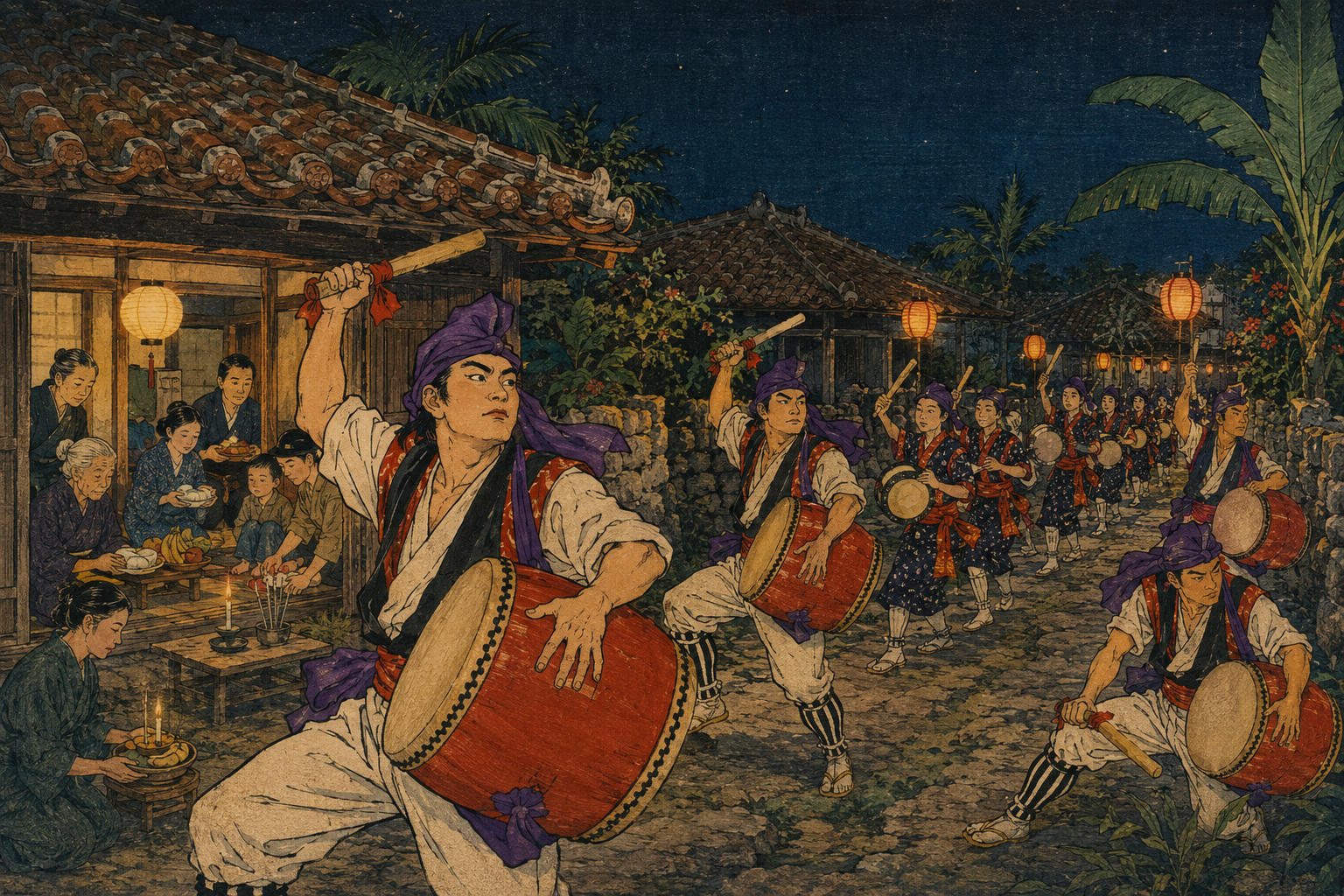
On Thursday night, the visitors go home. Aug. 27, 2026 is the 15th day of the seventh month in the old calendar and the final day of Okinawa’s Obon. It is called Uukui: the sending off.
Families gather where an ancestral altar is kept. Incense and food are offered. Relatives who may meet rarely share the responsibility of receiving the dead and returning them to the other world. In communities that continue the practice, a youth association may carry song, sanshin and drums from house to house in an Eisa procession.
The easy English label is “Okinawan Bon dance.” It helps only until it starts erasing distinctions. Obon is a household and kinship observance before it is a spectacle. Eisa is a regional performing tradition rooted in ancestral remembrance, but there is no single Okinawan choreography, uniform household script or island-wide performance schedule. The altar and the road open onto one another. They are not the same space.
Three days, named by what people do
The Okinawa Prefectural Archives defines the observance as the 13th through 15th days of the seventh lunar month. The first is Unkē, when the ancestors are welcomed. The 14th is Nakanuhī, the middle day. The 15th is Uukui, when the ancestors are sent back. The names turn a section of the calendar into a sequence of actions.
| Gregorian date | Old-calendar date | Okinawan name | Central meaning |
|---|---|---|---|
| Tuesday, Aug. 25 | 7th month, day 13 | Unkē (ウンケー) | Welcoming the ancestors |
| Wednesday, Aug. 26 | 7th month, day 14 | Nakanuhī (ナカヌヒ) | The middle day, with family visits |
| Thursday, Aug. 27 | 7th month, day 15 | Uukui (ウークイ) | Sending the ancestors away |
Romanization cannot standardize what Okinawan sources themselves vary. Public schedules also render the middle day as ナカヌヒー, Nakanuhī with an extended final sound, or ナカビ, Nakabi. This article uses the Prefectural Archives form while preserving the Japanese terms on first mention. The variation is part of the record, not a spelling defect to be silently corrected.
Public records from Okinawa City give concrete examples of the home ritual without pretending to write a rulebook for the prefecture. At an altar inside City Hall for unidentified remains held by the municipal ossuary, Unkē has included jūshī, Okinawan seasoned rice. On Uukui, officials have offered tiered boxes of food, fruit and alcohol, burned uchikabi—paper money for the dead—and joined their hands in prayer.
Households may use some of those elements and not others. Offerings, meal times and grave visits vary by island, locality, faith and family circumstance. Treating one commercial checklist as “the Okinawan way” would turn living difference into an invented orthodoxy.
An old calendar that governs modern time
Japan adopted the Gregorian solar calendar in 1873. The National Diet Library recounts the abruptness: the Meiji government announced the change in November 1872, and what would have been the third day of the 12th lunar month became Jan. 1, 1873. In ordinary Japanese usage, “old calendar” now refers broadly to the lunisolar system that preceded the reform, calculated with modern astronomical methods.
In Okinawa, that old calendar has not been reduced to a museum exhibit. It can determine school closures, municipal service notices, retail preparation, family travel and the rehearsal season of youth associations. A phone says Aug. 27; the household understands the same Thursday as the 15th day of the seventh month.
That is why Okinawa’s observance can fall well after the mid-August Bon familiar in much of mainland Japan. The difference should not be described as Okinawa living in the past. Institutions and families are continually translating between two systems. Continuity survives through current scheduling.
When remembrance leaves the house
Okinawa Prefecture’s Culture Promotion Division defines traditional Eisa as a nenbutsu dance for ancestral repose, performed on the last day of old-calendar Obon. Dancers move through a settlement to song and sanshin, beating drums. The same official description immediately adds that costume and movement vary by region.
The procession is called michi-junē, written 道ジュネー: moving and dancing through the roads of an aza, a community or settlement, and traditionally visiting homes. Local youth associations are the principal bearers. Rehearsals begin before Obon, often after school or work, so that what reaches the road is both a rite and the result of organized civic labor.
Okinawa City’s basic formation shows how many jobs can exist inside one moving body. Ōdaiko players carry the large drums and hold the beat together. Shimedaiko players use smaller, laced drums. Ikiga-mōi and inagu-mōi are men’s and women’s hand-dance roles. A hatagashira carries the association’s identifying standard. The jikata or jūtei sing and play sanshin. A sanajā—also popularly called chondarā—can work as clown, pathfinder and keeper of the line.
Even that inventory belongs most closely to central Okinawa. Eisa in the former Yonashiro and Katsuren areas often uses the small, single-headed pārankū. Northern communities preserve hand-dance forms without drums. A visitor who recognizes only the large-drum spectacle risks mistaking one powerful branch for the whole tree.
Creative Eisa is another branch. Okinawa Prefecture describes it as a newer performance form that freely rearranges music and choreography from traditional Eisa and has spread across Japan and overseas. It has helped make Eisa globally visible. Traditional and creative Eisa overlap, influence each other and sometimes share stages, but the official categories are not synonyms.
The origin story that remains a question
A familiar account begins with Taichū Shōnin, 袋中上人, a Jōdo-school Buddhist monk who reached the Ryukyu Kingdom in 1603 and remained until 1606. One theory holds that the nenbutsu dance he transmitted developed into an Okinawan form that became Eisa.
That theory is important. It is not a birth certificate. The All-Island Eisa Festival’s own historical page says the origin continues to be investigated because documentary evidence is scarce. It also records theories reaching toward a 15th-century Korean chronicle and older Ryukyuan song and dance. The word “Eisa” has likewise been connected both to old song vocabulary and to a shouted refrain; the official account says neither derivation is proven.
The uncertainty protects a deeper possibility: a long formation in which Buddhist nenbutsu, Ryukyuan understandings of ancestors, local songs, labor and youth organization accumulated rather than arriving fully assembled. Taichū is verifiably historical. The claim that one man invented modern Eisa in 1603 is not.
- Supported: Taichū Shōnin came to Ryukyu in 1603 and stayed for several years.
- Supported: Traditional Eisa is tied to old-calendar Obon and ancestral remembrance.
- Not established: A single inventor or moment of creation for today’s Eisa.
- Not established: One definitive etymology for the word “Eisa.”
A day off in the archive of occupation
In the Okinawa Prefectural Archives sits a terse order with an expansive implication. U.S. Military Government Directive No. 39, dated Aug. 20, 1947, recognized Aug. 30—the date of that year’s Obon—as a religious holiday and allowed Okinawa Civilian Administration employees to take the day off.
The military government did not create the observance. Its need to interrupt administrative work demonstrates how firmly the observance already organized society. Two years after the Battle of Okinawa, after homes, altars, tombs, communities and lives had been destroyed, the time for receiving and sending ancestors still demanded room inside the occupation’s rules.
Okinawa City’s later public Uukui for unidentified remains shows another crossing between household rite and collective memory. Municipal newsletters document officials offering food and incense and burning uchikabi at the City Hall altar. A rite usually centered on kinship becomes a means of caring for people whose kin or names could not be restored.
How a road rite became a judged performance
The modern All-Island Eisa Festival is related to Obon, but it is not Obon. Its official history begins in 1956 with the Koza City Eisa Contest, organized as Koza became a city. The festival account places the event in the economic shock caused by a U.S. off-limits order that restricted service members, civilian employees and their families from entering civilian districts. Eisa was mobilized to restore confidence and commercial life.
Nine selected groups competed before a reported 30,000 spectators at the first event. Judging rewarded formation, skill, membership and costume. That encouraged youth associations to design for an audience, helping create elements of the modern staged form. It also exposed the problem in assigning a single rank to traditions shaped by different local standards. The contest format ended; from the 22nd edition in 1977, it became the Okinawa All-Island Eisa Festival.
1603–06 Taichū Shōnin stays in Ryukyu; his relationship to Eisa is one origin theory.
1873 Japan adopts the Gregorian solar calendar.
1947 The U.S. military government recognizes that year’s Obon as a religious holiday.
1956 The Koza City Eisa Contest begins.
1977 Competition gives way to the All-Island Eisa Festival.
2007 Okinawa City declares itself the “City of Eisa.”
2026 Obon falls Aug. 25–27; the 71st festival runs Sept. 4–6.
Festivalization neither simply preserved Eisa nor emptied it of meaning. It changed costume, scale, spacing and the expectation of being watched. It also made youth associations visible to one another and to a mass audience. A local procession and a ticketed or broadcast performance can now exist in the same season, carried by some of the same bodies for different publics.
Eight days from Uukui to Koza
The 71st Okinawa All-Island Eisa Festival is scheduled for Sept. 4–6. On Friday night, nine Okinawa City youth associations will join the michi-junē around the Goya intersection. Youth associations, children’s groups and creative ensembles will also appear at two fixed performance areas. Saturday is the 48th Okinawa City Youth Festival; Sunday’s final program lists 14 groups.
The first festival night arrives eight days after Uukui. The separation matters. A procession visiting its own community during Obon and a curated route welcoming a mass audience in central Koza may look related because they are. One remains a neighborhood rite in the season of the ancestors; the other is a major civic festival built to present Eisa across communities.
That distinction changes the ethics of watching. A home observing Obon is not a tourist site. A neighborhood procession is not staged solely for cameras. Local instructions, private property, traffic control and the timing of prayer take precedence over a visitor’s photograph. At the city festival, formal viewing and media rules provide the boundary. On a community road, the community does.
Tradition is the work between returns
Old-calendar Obon is often described through return: ancestors return, relatives return, familiar food returns to the altar. Yet the practical work is about change. Families live farther apart. Altar keepers age. Work calendars do not automatically yield to Uukui. Youth associations must recruit the people who will sing, drum, carry the flag and keep the line moving.
Creative Eisa and large festivals have given new dancers an entrance and carried the form overseas. The gain is real. So is the risk that Eisa becomes visible only as percussion and athletic movement, severed from the night of ancestral departure. The opposite risk is treating every adaptation as inauthentic and leaving the tradition nowhere to grow.
Inside the house on Uukui, a family says farewell. Outside, one drumbeat makes room for the next and the procession advances. Sending away and carrying forward are not opposites. A tradition survives because each generation remakes the conditions under which something—and someone—can return.
- Okinawa City — 2026 old-calendar Obon dates in the municipal collection notice
- Tomigusuku City Board of Education — 2026 school closure for old-calendar Obon
- Okinawa Prefectural Archives — Unkē, Nakanuhī, Uukui and the 1947 military-government order
- Okinawa Prefecture Culture Promotion Division — traditional and creative Eisa
- Okinawa All-Island Eisa Festival Committee — formation, michi-junē and origin theories
- Okinawa All-Island Eisa Festival Committee — festival history from 1956
- Okinawa All-Island Eisa Festival Committee — official 2026 program
- Okinawa City tourism portal Kozaweb — the 2007 “City of Eisa” declaration
- Okinawa City newsletter — municipal Unkē and Uukui, offerings and uchikabi
- National Diet Library — Japan’s 1873 calendar reform
- Eisa Museum — regional forms and instruments
Editorial note: Dates, administrative treatment, Japanese names and local terms were checked against Okinawa Prefecture, municipal, archival and organizer sources. Household customs vary, so publicly documented examples are not presented as rules for all Okinawa. Official festival material itself treats Eisa’s origin and etymology as unsettled; this article therefore identifies the Taichū account as a theory, not fact. The illustration is conceptual and depicts no specific rite or association. The supplied currency timestamp, Aug. 25 at 7:48 p.m. UTC, converts to Aug. 26 at 4:48 a.m. JST.