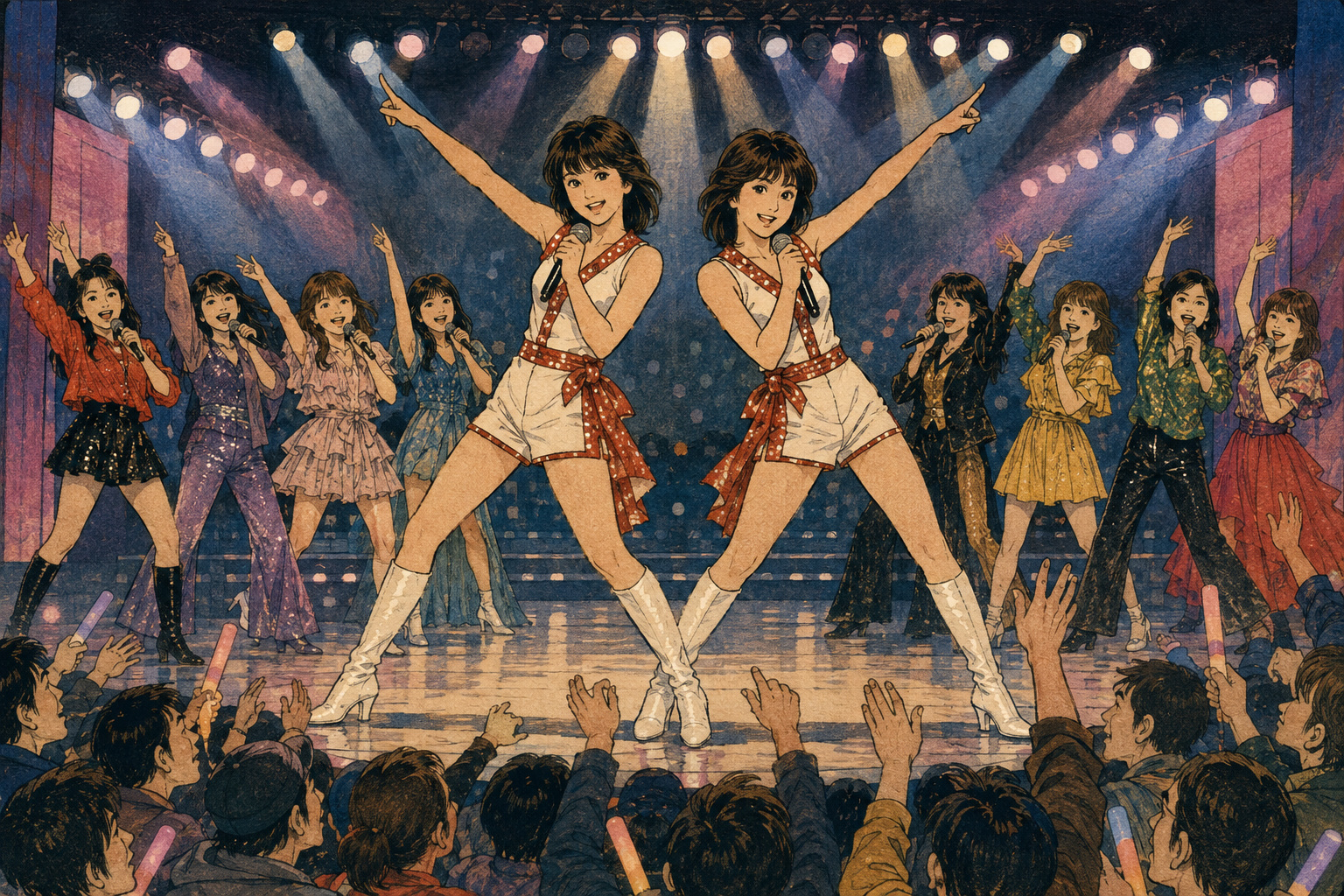
The most revealing fact about Pink Lady’s 50th-anniversary concert is who was not on the stage. The duo themselves did not perform. Victor Entertainment said so in advance, in an unusually plain note beneath a glamorous bill.
Instead, the Aug. 25 event at LINE CUBE SHIBUYA gave the repertoire to a relay of artists: AKASAKI; AKB48 members Sae Arai and Momoka Ito; H ZETTRIO; Airi Suzuki; Meimi Tamura; Yo Hitoto; Momoiro Clover Z’s Kanako Momota; Chisato Moritaka and Lindberg vocalist Maki Watase. Takashi Fujii served as master of ceremonies. An AKB48 official notice listed the advance allocation as sold out. Momota’s official site confirmed after the show that she sang “Nagisa no Sindbad” and “Southpaw.” No complete organizer-issued running order was available for this report, so the album sequence should not be mistaken for the concert set list.
The following day brought ピンク・レディー伝説 Now and Forever -50th Anniversary Tribute Album-, an 11-track record that begins with the 1976 debut single “Pepper Keibu” and reaches the end of the duo’s first run with “OH!” It is less a museum display than a controlled experiment. What happens when a female duet becomes a male-female exchange, a solo, a rock performance or a piano-trio vehicle? How far can the songs move and remain recognizable?
A pop song with a second track
A Pink Lady hit contained two synchronized tracks. One was audible: Yū Aku’s sharply drawn lyrics, Shunichi Tokura’s melody and rhythm, and two voices alternating or converging. The other ran through the eye and into muscle: hands shaping a warning, arms describing a flying object, two bodies mirroring and breaking symmetry.
Masuda supplied the most concise description in her anniversary message: the “fusion of songs and choreography.” That fusion changes the status of dance. It is not decoration added after a recording is finished. A signature motion can identify the song before a lyric does. It can divide a phrase between two performers, give the television camera a point of arrival and offer the viewer something reproducible.
The evidence is personal rather than statistical, and it should be read that way. In the album’s official notes, Moritaka says her childhood ambition was not merely to become a singer but to become Pink Lady. Watase remembers climbing onto a table with her younger sister and copying the choreography in front of the television. Kyoko Koizumi recalls singing and dancing during lunch breaks and after school. Hitoto, who spent part of her childhood in Taiwan, remembers watching Japanese programs recorded on VHS with her sister and wanting to become someone who sang and danced like the pair onscreen.
Four recollections do not measure an entire generation. They do, however, explain why artists with very different careers can enter the same tribute without treating the material as remote history. Their first contact was participatory. They had already rehearsed the songs as children.
Eleven doors into the same catalogue
The album preserves one strict rule: all 11 songs have lyrics by Aku and music by Tokura. Everything after that is open to negotiation. The first ten tracks follow Pink Lady’s first ten singles in release order, from “Pepper Keibu” through “Chameleon Army.” The closing “OH!” was their final single before the 1981 breakup.
| Song | 2026 performer | Structural change |
|---|---|---|
| Pepper Keibu | Chisato Moritaka & Maki Watase (Lindberg) | Two women from the generation that copied Pink Lady form a new pair |
| S・O・S | AKASAKI with H ZETTRIO | A young solo voice meets an athletic piano trio |
| Carmen ’77 | Yu Shirota & Meimi Tamura | The female duet becomes a male-female dialogue |
| Nagisa no Sindbad | Kanako Momota (Momoiro Clover Z) | A later-generation idol carries both sides alone |
| Wanted (Shimei Tehai) | Kazuya Yoshii | A previously released rock cover enters the sequence |
| UFO | Shin Koizumix Productions (Kyoko Koizumi, Kan Takagi, Kenji Ueda) | Singer, DJ and producer rebuild the record as a production unit |
| Southpaw | Kumi Koda | The tempo falls and the atmosphere darkens |
| Monster | UA | A previously released cover relocates the song’s vocal center |
| Tōmei Ningen | Sae Arai & Momoka Ito (AKB48) | Two current idols study the original and receive advice from Pink Lady |
| Chameleon Army | Airi Suzuki | A solo performer takes on a song associated with demanding movement |
| OH! | Yo Hitoto | The farewell is recast in a gospel arrangement |
The final column is Japan.co.jp’s synthesis of the artists’ official notes, not a ranking. Koda says she deliberately slowed “Southpaw” and brought it into a darker register. Tamura proposed singing “Carmen ’77” with Shirota instead of preserving the original gender configuration. H ZETT M describes pursuing H ZETTRIO’s own momentum beneath “S・O・S.” The tribute’s governing principle is not that fidelity requires identical sound.
The physical editions turn that principle into an unusually intelligent archive. The ¥3,500 standard disc contains the 11 new versions. The ¥5,500 limited two-CD edition adds Pink Lady’s 11 original recordings in the same order, then 11 original karaoke tracks. Reinterpretation, source and an empty vocal space sit together. A listener can compare, study and then enter.
Before the name, two 17-year-olds
Pink Lady began with 17-year-olds Mitsuyo Nemoto and Keiko Masuda, who appeared on Nippon Television’s talent competition Star Tanjō! Masuda’s official account dates their decisive contest appearance to February 1976. The names recorded there are 根本美鶴代 and 増田啓子; after debut they became Mii and Kei. Today the artists use 未唯mie and 増田惠子, rendered in English here as Mie and Keiko Masuda.
Victor Music Industries released “Pepper Keibu” on Aug. 25, 1976. The label’s chronology records nine consecutive No. 1 singles from “S・O・S” through “Chameleon Army.” Rather than repeat the label’s harder-to-compare “million hit” formulation, the more durable public marker is an award record: the Japan Composers’ Association identifies “UFO” as the winner of the 20th Japan Record Award on Dec. 31, 1978, crediting Tokura for composition and arrangement and Aku for lyrics.
The speed matters. In roughly two and a half years, the repertoire represented by the first ten tribute tracks had been created, recorded, costumed, choreographed, broadcast and imitated. A new single did not simply follow the last; it installed another miniature world—police intervention, a distress signal, Carmen, a beach rogue, a fugitive notice, an alien visitor, baseball, a monster, invisibility, an army of changing color.
Aku later became one of postwar Japan’s defining lyricists, but the anniversary messages preserve a less monumental image of the beginning. Mie recalls him deciding something had to be done with two contestants who inspired little record-company confidence, and proposing something like an overturned toy box. Masuda says the toy box had become a jewel box after 50 years. Both metaphors understand the act as abundance rather than polish alone: each record should spill out a new character, gesture and surprise.
Television made repetition productive
The term kayōkyoku is often translated as Japanese popular song, but that can conceal its institutional life. In the 1970s, a hit was repeatedly staged across variety programs, ranking shows, awards, location broadcasts and concerts. Pink Lady’s catalogue was exceptionally suited to that system because each return could preserve the recognizable movement while changing costume, set, camera and circumstance.
Victor’s 2023 six-DVD Pink Lady Chronicle TBS Special Edition makes the infrastructure visible. Its more than eight and a half hours draw from 8 Ji da yo! Zen’in Shūgō, Midokoro Gangan Daihōsō, The Best Ten, live stages, overseas location shoots and the Japan Record Award. One disc follows variety appearances; another devotes 124 minutes to The Best Ten; another gathers concert footage; the last centers awards.
That archive is not simply proof of popularity. It shows how a performance language is standardized through difference. The same song appears in enough contexts for viewers to know which movements are essential and which can change. Before streaming playlists and short-form dance challenges, broadcast recurrence created a national tutorial without calling itself one.
The 50th-anniversary publicity says elementary- and junior-high-school girls copied the routines. That is a label’s account, not a population study, and this article does not elevate its claim that Pink Lady was the first female idol unit admired by girls into settled fact. The narrower conclusion is well supported: the broadcast archive documents extraordinary repetition, and the tribute artists independently remember imitation in homes and schools.
Influence becomes a lesson, not a resemblance
“Influence” is often a vague resemblance discovered after the fact. Here it can be traced as instruction. In 2021, Nippon Television’s Nogizaka Star Tanjō! 2 paired Mie with fourth-generation Nogizaka46 members on four Pink Lady songs: “S・O・S,” “Southpaw,” “UFO” and “Nagisa no Sindbad.” The broadcaster’s official release documents exactly which performers joined each number.
For the 2026 “Tōmei Ningen,” Arai says she and Ito received valuable advice from Pink Lady before recording. Arai’s mother, a fan of the duo, cried when she heard about the assignment. Ito describes the song as foreign to the world and vocal approach of AKB48, and says she studied the original phrasing, dynamics and performance in detail. Official AKB48 profiles confirm the English forms of their names as Sae Arai and Momoka Ito.
That sequence crosses three generations in one recording session: the mother who watched, the original artists who advise, and the daughter’s generation that must solve the song anew. It also resists the comfortable idea that all Japanese idol performance belongs to one continuous style. Ito’s difficulty is evidence of distance. Inheritance requires work precisely because the forms are not interchangeable.
- Memory: children copy televised routines and later return as professional singers.
- Instruction: later performers analyze breath, dynamics and two-person timing—or receive direct advice.
- Transformation: arrangers alter tempo, instrumentation, vocal gender and the number of performers.
The breakup that did not stay final
Pink Lady’s first continuous run was brief enough to become mythic. The duo held a farewell concert at Korakuen Stadium on March 31, 1981. They then returned for four limited reunions, according to Victor’s official history. From 2003 through 2005, Masuda’s official biography says a memorial tour reached 100 locations, mounted 200 performances and drew a total audience of 400,000.
On Sept. 1, 2010, the pair declared kaisan yame!—roughly, “we’re quitting the breakup.” They released INNOVATION and toured 22 locations the following year. The phrase is comic, but it corrected a serious distortion. Pink Lady was not only an object sealed in the peak television years. Mie and Masuda repeatedly returned to the physical difficulty of their own catalogue, placing older bodies against movements built during a famously compressed early career.
February 1976 Nemoto and Masuda are scouted at the Star Tanjō! finals.
Aug. 25, 1976 Pink Lady debuts with “Pepper Keibu.”
Dec. 31, 1978 “UFO” wins the 20th Japan Record Award.
March 31, 1981 The duo holds its breakup concert at Korakuen Stadium.
2003–05 A 100-location, 200-show memorial tour.
Sept. 1, 2010 Pink Lady declares the breakup over.
2021 Mie performs four songs with Nogizaka46 members on television.
Aug. 25–26, 2026 The 50th-anniversary concert and tribute album.
Masuda wrote in 2012 that “the two together” are Pink Lady. That sentence provides an ethical boundary for anniversary culture. A pair of younger singers in matching clothes is not Mie and Kei, and the name should not be treated as an endlessly replaceable franchise. Yet songs can be opened to others without pretending the originators have been replaced. The 2026 project works because it holds those statements together.
Preserving the ability to perform
The new album ends with “OH!,” not with the tenth single at the apex of the early run. Hitoto interprets the farewell as a wish from Aku and Tokura that the two women could leave the machinery of stardom and live fully as themselves. She turns that personal reading into gospel. It is important to keep the attribution straight: this is Hitoto’s imaginative account, not documented proof of the songwriters’ intent.
Her choice nevertheless identifies what tribute can do that commemoration alone cannot. An old song becomes a place where a later singer deposits her own reading, then takes responsibility for making it audible. Fidelity lies in a serious encounter, not in the elimination of difference.
Nothing in 2026 recreates the media environment of 1978. Audiences are fragmented; choreography circulates through phones; idol groups may fill an arena with formations far larger than two. Drawing a straight evolutionary line from Pink Lady to every current dance challenge would be bad history.
But a more precise legacy is visible. A song can arrive with a physical grammar. That grammar can be recognized, copied, taught, resisted and rewritten. The limited-edition album preserves not only the new covers and the original voices but the karaoke space in which the next voice is missing. The archive is complete only when someone steps into it.
- Victor Entertainment — anniversary project, concert notice, Mie and Keiko Masuda statements, and the duo’s nonappearance
- Victor Entertainment — complete tribute track list, formats, prices and artist notes
- AKB48 official blog — final concert lineup, presale status and Arai-Ito statements
- Momoiro Clover Z official site — confirmation of the Aug. 25 concert and Kanako Momota’s songs
- AKB48 — official Japanese and English forms of Sae Arai and Momoka Ito
- Victor Entertainment — debut, chart chronology, breakup, return and TBS archive
- Japan Composers’ Association — the 20th Japan Record Award for “UFO”
- Keiko Masuda official site — name reading, career history, 2003–05 tour and 2010–11 return
- Keiko Masuda official site — the Star Tanjō! finals and her account of the duo’s identity
- Nippon Television — Mie’s four 2021 collaborations with Nogizaka46 members
- Victor Entertainment — contents of Pink Lady Chronicle TBS Special Edition
Editorial note: Japanese names, readings, titles, song credits, dates, catalogue numbers, prices, performers and attributed remarks were checked against Japanese-language label, artist, broadcaster and award-body records. The concert is confirmed by a participant’s official post, but no organizer-issued complete set list or production record was located; this report therefore does not reconstruct the entire show. Childhood memories belong to the artists who supplied them and are not presented as a survey of the Japanese public. The supplied currency timestamp, Aug. 25 at 7:48 p.m. UTC, converts to Aug. 26 at 4:48 a.m. JST.