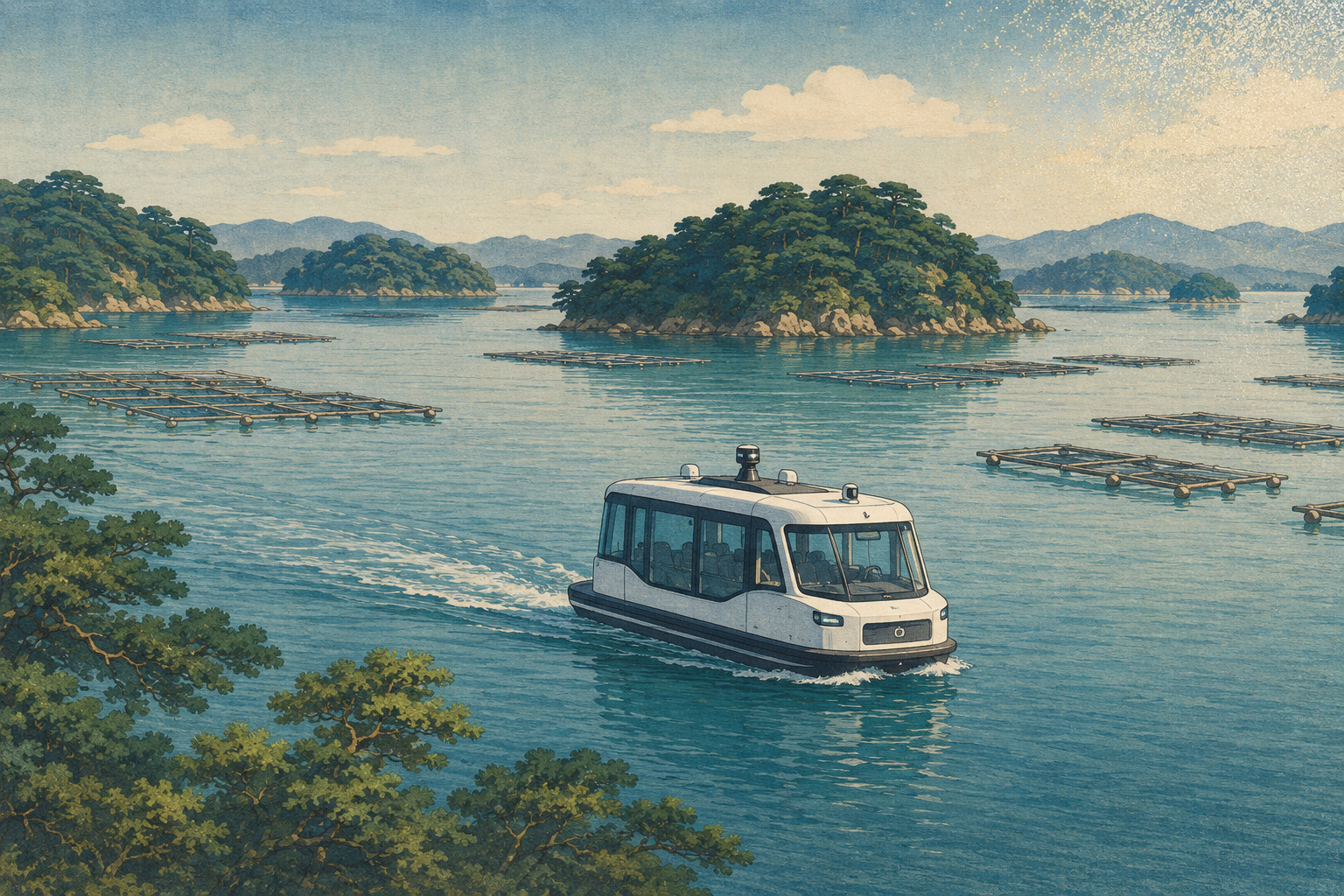
Ten minutes by scheduled boat is enough to make Masaki Island feel close to Kashikojima. It is also enough to expose the distance that remains between a promising autonomous-navigation system and a dependable public service. The short crossing runs through water that is calm in the tourist photograph but densely occupied in practice. Pearl rafts sit low on the surface. Workboats turn toward farms. Headlands interrupt sightlines. Other passengers are making an ordinary journey to school, work or home.
Shima City has chosen Ago Bay as a field for marine technology, and two companies now intend to begin with the least theatrical part of autonomy: observation. Osaka-based Eight Knot, which develops vessel-intelligence systems, said Wednesday that a proposal made with Shima-based Umilabo had been selected under the city’s new marine-technology subsidy. Using an Umilabo vessel, the companies plan to survey the bay’s navigation environment and organize baseline information for possible later demonstrations and deployment.
That description contains an important limit. The selected work is a navigation-environment survey. It is not the start of a commercial autonomous route, not a decision to place Eight Knot’s system on the existing Ago Bay ferry, and not authorization for an uncrewed passenger boat. The distinction is more than legal caution. It reveals the central problem: before software can choose a safe course, its designers must learn what this particular bay asks a navigator to notice.
A grant for learning, not a ferry launch
The city program has two tracks. Track A supports startups and consortia testing new marine products or services in Shima, including data collection and robotics. It pays up to two-thirds of eligible costs, with a ceiling of ¥2 million, and was expected to select about two projects. Track B helps local businesses adopt marine technology, with a ¥1 million ceiling. Work under Track A can run through February 28, 2027, with final reporting due March 12.
Eight Knot’s announcement identifies the survey as a Track A project. Its partner is Umilabo, a company built around a former pearl-farming site on Ago Bay. The two sides bring different forms of competence: Eight Knot has autonomous-navigation and vessel-control experience; Umilabo has a boat, a base and knowledge rooted in the working bay. The company release names regional transport as a future application, but it stops short of naming a route or promising deployment.
| Question | Publicly established | Not established |
|---|---|---|
| What will happen? | A vessel-based survey of Ago Bay’s navigation environment | A commercial autonomous service |
| Why do it? | To prepare baseline material for considering later trials and adoption | A commitment to install the system |
| What is the city offering? | Up to two-thirds of eligible costs, capped at ¥2 million for Track A | The project’s actual award amount |
| When? | The program permits work through February 28, 2027 | The dates of field operations |
Technology announcements often compress these stages into a single future-tense image: an autonomous boat gliding through the islands. Shima’s project is more useful when read in reverse. It asks whether the data, operating rules, communications and local confidence needed for that image can be assembled at all. A negative or conditional answer would be a legitimate result. So would a finding that automation is helpful only on some legs, at some times, with a qualified crew in control.
The water is not empty
Japan’s Environment Ministry describes Ago Bay as a satoumi, a coastal sea whose ecological richness and human use have developed together. Forest nutrients, the Kuroshio Current and the shelter of the surrounding peninsula help sustain its productivity. The city describes about 60 islands set inside a complex ria coast. Pearl rafts, green-laver farms and shore-side work sheds are part of the view from the water, not objects placed on top of an otherwise vacant landscape.
This matters to machine perception. Eight Knot says its AI CAPTAIN Module can combine vessel control, position estimation, real-time route generation, recognition of vessels and obstacles, and safety decisions. Those functions sound general. Their limits are local. A low structure familiar to a pearl farmer must be reliably recognized by sensors. A turn that is routine to a local skipper may hide crossing traffic from a camera until late. A route may be geometrically open yet operationally poor because it cuts through aquaculture work.
The companies have not disclosed which of these conditions they will measure. A credible survey, however, must do more than reproduce a nautical chart. It needs to establish how the bay changes with activity, light, weather, season and vessel type; where communications remain dependable; and where the system would have to return control to a person. The human geography is as consequential as the shoreline.
A short route with large stakes
Ago Bay already has a marine public-transport system. Shima Marine Leisure operates a scheduled boat linking Wagu, Masaki Island and Kashikojima. The city says Masaki is about 10 minutes from either terminus and recalls the island’s prosperity during the pearl industry’s high years, when it became known as the “jewel island.”
In March 2026, Shima published the route’s timetable and stop information as GTFS-JP open data, enabling journey planners and future mobility-as-a-service products to include the boat. The city also reimburses 30 percent of commuter-pass costs for high-school students using the route. Those two administrative measures make the transport stakes concrete. One helps a digital map recognize the ferry. The other helps a family pay for it. Neither is futuristic, but both treat the boat as infrastructure.
An autonomous assist system could eventually reduce repetitive workload, help with difficult hours or widen the pool of people able to work aboard. It cannot by itself create enough passengers, finance a route, maintain a pier or decide whether a service should run in bad weather. An autonomy project that begins with labor-saving claims and ignores those linked obligations would misunderstand the service it hopes to improve.
A bay that has absorbed technology before
Long before Shima became a city, its sea was an economic network. The municipal SDGs plan places the area within historic Shima Province, celebrated in the eighth-century Man’yōshū as a miketsukuni—a region associated with supplying marine foods to the imperial court. Five former Shima District towns merged in October 2004 to create the present city, but the water had been connecting communities and livelihoods for centuries.
The modern industrial history is inseparable from pearls, yet it is often told too neatly. Mie Prefecture’s cultural history records that Mikimoto Kōkichi achieved his 1893 breakthrough in cultivating hemispherical pearls on Ojima in Toba, today Mikimoto Pearl Island—not in Ago Bay. Later advances by Kuwahara Otokichi, Nishikawa Tōkichi, Mise Tatsuhei and others helped establish techniques for spherical cultured pearls. Ago Bay then became a major center of production and research; a former national pearl research institute operated on Kashikojima.
Correcting the geography makes the history more relevant, not less dramatic. Cultured pearls were not a gadget transferred intact from a lone inventor to an empty sea. They became an industry through biological knowledge, skilled grafting, raft work, responses to typhoons and red tides, quality control, institutions and markets. A modern autonomous vessel likewise arrives as one component in a system. Sensors, software, crew procedures, communications, ports, aquaculture and community consent all have to work together.
Eighth century The Man’yōshū associates historic Shima with the marine-food region called miketsukuni.
1893 Mikimoto Kōkichi cultivates hemispherical pearls at Ojima in Toba.
Early 20th century Spherical cultured-pearl techniques develop; Ago Bay grows into a production center.
1946 Ise-Shima National Park is designated, including the area that is now Shima City.
2004 Five towns merge to form Shima City.
2024 Shima and Umilabo sign a comprehensive Ago Bay revitalization agreement.
2026 Shima opens its marine-technology subsidy; Eight Knot announces the survey’s selection.
The numbers define a deliberately small first step
The ¥2 million subsidy ceiling should not be confused with the cost of installing an autonomous-navigation package. A January 2026 catalog issued through the Ministry of Land, Infrastructure, Transport and Tourism lists a tax-exclusive reference range of ¥15 million to ¥20 million for Eight Knot’s system on a typical passenger vessel. The amount can vary substantially with the boat and functions, and the catalog said the product was then offered only for small vessels.
That comparison clarifies the project’s scale. Even the maximum city subsidy is only a fraction of the catalog’s indicative equipment cost, and the selected work is a survey rather than a purchase. The undisclosed award cannot responsibly be presented as ¥2 million. The policy logic is to lower uncertainty: bring a company into the field, create evidence and decide whether a larger investment deserves to follow.
The policy around that grant is broader. A national regional-revitalization document for Shima’s “marine-tech attraction and clustering” program budgets ¥26.74 million over fiscal 2026–28, including ¥7.54 million in 2026. It sets targets of eight experiments, four additional located companies, five collaborations or adoptions by city businesses and 10 new jobs. These are targets, not results. Their presence makes a harder question unavoidable: will successful tests leave capability, work and useful data in Shima, or merely use the bay as scenery for demonstrations?
Hiroshima offers evidence—and a warning against copying
Eight Knot has tested island transport elsewhere. A Ministry of Land, Infrastructure, Transport and Tourism account of a fiscal 2022 project in Ōsakikamijima, Hiroshima Prefecture, says a small electric autonomous water taxi traveled more than 100 kilometers over six days without operational trouble. The trial found demand for travel outside ferry hours and strong interest in the ride. It also found that many people were uneasy about an uncrewed boat, although experience could reduce that anxiety. Commercial viability, recognition of the technology and durable partnerships remained open challenges.
A later trial used a 19-ton vessel for early-morning and nighttime passenger trips between Ōsakikamijima and Takehara and deliveries to Ikunoshima. The ministry’s 2026 catalog reports that about 70 percent of users in the first January-to-March 2025 trial were satisfied and about 80 percent expressed willingness to use a full service. The system’s stated role was to assist operation. The same catalog limited its operating record at that point to sheltered waters and said LTE or comparable communications were generally required.
These results show that the technology is more than a rendering. They do not answer Ago Bay’s questions. Different island patterns, farm structures, traffic, ports, communications and operating rules can turn an apparently similar passage into a different engineering and service problem. Local surveying is not a ceremonial prelude. It is what prevents the Hiroshima evidence from becoming a misleading shortcut.
Autonomous does not automatically mean uncrewed
Japan’s national roadmap has used “Phase II autonomous ship” for a vessel in which shore control or AI-generated proposals support seafarers who remain the final decision-makers. The transport ministry’s 2026 safety framework makes the division of responsibility explicit: safe autonomous operation depends on the system and equipment, the operating company’s safety-management structure, and safe navigation by the master and crew.
The framework turns the handoff into a central design event. A system must make its state and limits intelligible. The people aboard need time, training and authority to take over. The company needs procedures for normal and abnormal operation. An Ago Bay demonstration should therefore be judged not only by miles traveled without manual steering, but by missed detections, communications failures, interventions, minimum handover time and the system’s safe behavior when its assumptions fail.
- Publish where, when and under what weather and working conditions the bay was observed.
- Explain how fixed and moving objects are classified, and how often local data must be refreshed.
- Define communications coverage, loss-of-link behavior and the threshold for human takeover.
- Include fishers, ferry operators and island residents in the safety and service evaluation.
- Report interventions and failure conditions, not only successful distance traveled.
These are Japan.co.jp’s evaluation questions, not criteria announced by the project. They reflect what must become visible before a survey can support a public decision. A demonstration video can show that a boat moved. A transport policy needs to show why it should move, who remains responsible, what happens when it cannot continue and whether the community regards the new operating model as useful.
From a former pearl site to a marine-tech strategy
Shima’s relationship with Umilabo predates this award. In July 2024, the city and company signed an agreement covering advanced-company recruitment, reuse of former pearl-farming sites, demonstration projects, employment, digital skills and migration. Umilabo had already rebuilt a disused pearl facility as a waterfront retreat and work space. Its second act has been to position such sites as a base for marine experimentation.
The city’s urgency is demographic as much as industrial. Shima had 42,407 residents at the end of July 2026. Its new 2026–33 comprehensive plan begins from population decline and aging. The city’s SDGs plan separately identifies aging workers, a shortage of successors and a sharp fall in the number of people employed in farming and fisheries. Autonomy cannot reverse those trends by itself. It might relieve a defined operating burden or make a route more resilient; it cannot substitute for demand, funding, skills and trust.
The most promising reading of the Ago Bay project is therefore also the least sensational. A local boat will gather information. Engineers and people who work the bay will compare ways of seeing. The result may define places and conditions where automation can assist, and places where it should not. That is how a region avoids becoming a passive test site.
Ago Bay’s first autonomous route may begin as something invisible: a shared layer of knowledge linking charts, sensor observations, aquaculture work, vessel movements and human safety procedures. Only after that layer exists can Shima decide whether an intelligent boat belongs on the water, which problem it should solve and who should be aboard. The bay does not need technology that imagines it is empty. It needs technology capable of recognizing why it has long been full.
- Eight Knot — Selection for Shima’s subsidy and the Ago Bay navigation survey (August 26, 2026; company announcement)
- Shima City — Fiscal 2026 Marine Technology Demonstration and Adoption Promotion Subsidy
- Shima City — Marine-technology attraction and clustering program
- Shima City — Comprehensive agreement with Umilabo (2024)
- Shima City — Wagu–Masaki–Kashikojima route open data
- Shima City — Student commuter-pass subsidy for the Ago Bay scheduled boat
- Shima City — Masaki Island location and pearl-industry history
- Shima City — Population and households as of July 31, 2026
- Ministry of the Environment — Ago Bay landscape, geology, satoumi and aquaculture
- Shima City — Third SDGs Future City Plan, 2026–30
- Mie Prefecture — History of cultured pearls and the contributors to technical development
- Ministry of Land, Infrastructure, Transport and Tourism — Smart Island catalog entry for Eight Knot AI CAPTAIN
- Ministry of Land, Infrastructure, Transport and Tourism — Ōsakikamijima autonomous water-taxi demonstration
- Ministry of Land, Infrastructure, Transport and Tourism — Roadmap and safety guidance for autonomous ships
- Ministry of Land, Infrastructure, Transport and Tourism — 2026 autonomous-ship safety framework
Editor’s note: City records establish the subsidy terms and policy purpose; national, prefectural and city records establish the geography, transport, population, history and safety context. Because the selection and project scope were announced by Eight Knot, the article attributes them to the company and does not present them as an independent city announcement. The city’s public program page had no successful-applicant list as of August 27. Japanese terminology is preserved where it carries an official distinction: the companies use jiritsu kōkō for autonomous navigation, while the transport ministry uses jidō unkōsen in its autonomous-ship framework. The supplied exchange-rate timestamp, 7:24 p.m. UTC on August 26, converts to 4:24 a.m. JST on August 27.