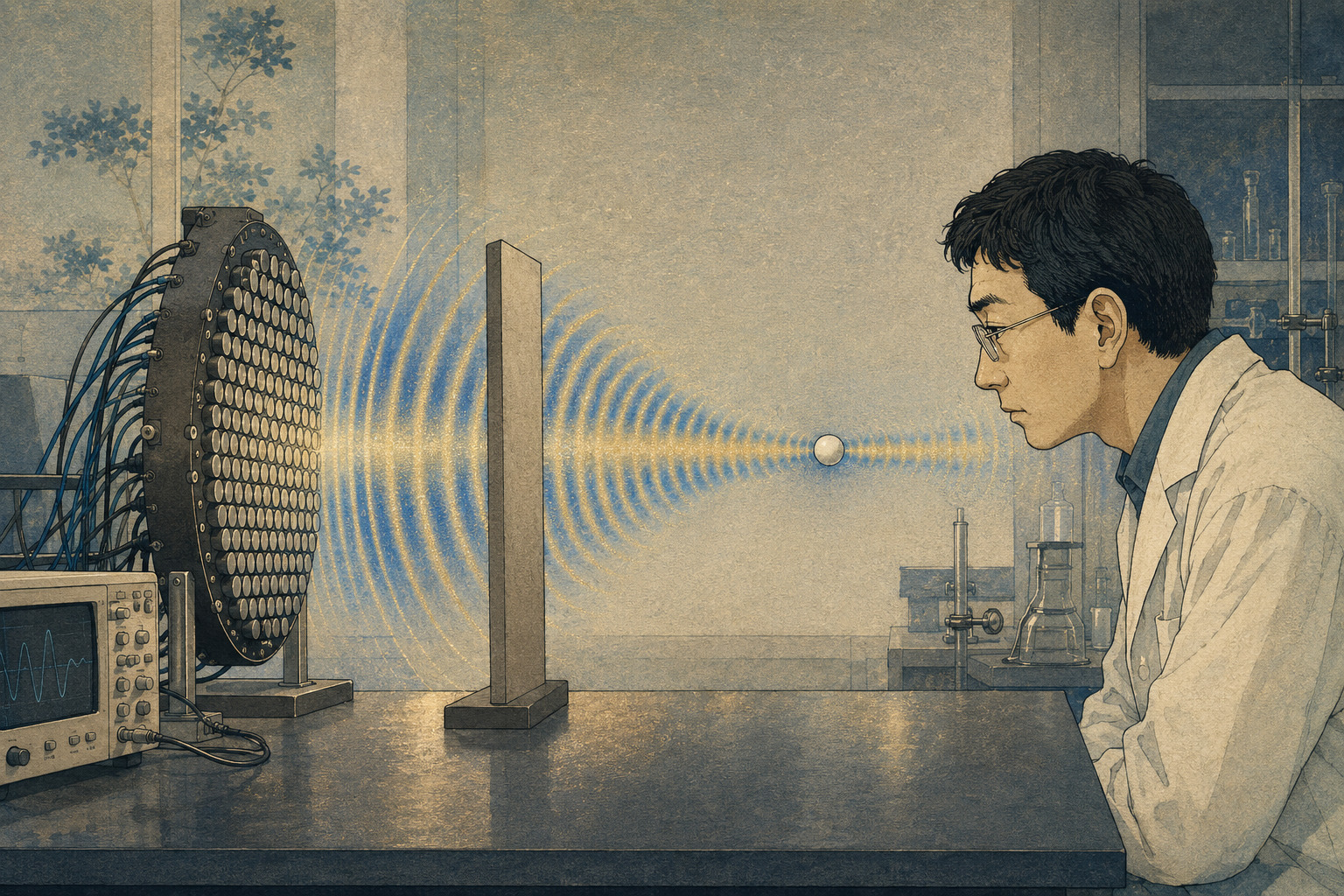
The obstacle was a cube 50 millimeters on each side, positioned 110 millimeters above a square array of ultrasonic emitters. It covered the beam’s central path. In an ordinary focused field, that would be a brutal interruption. Here, sound arriving obliquely around the cube converged again above it. At an average height of 267 millimeters, a tiny expanded-polystyrene sphere remained suspended in the reconstructed core.
“Self-healing” is the term wave physicists use for this behavior, but nothing healed in the biological sense, and the sound did not pass through the solid cube. Unblocked parts of the wave interfered downstream to rebuild the central pressure pattern. The particle was not steered around the obstruction. It levitated beyond it.
That distinction captures both the ingenuity and the limits of research published on August 24 in Physical Review Letters. Led by University of Tsukuba doctoral researcher Yusuke Koroyasu and assistant professor Tatsuki Fushimi, with collaborators at Tsukuba, the University of Bristol and Pixie Dust Technologies, the team demonstrated stable midair levitation inside the intense axial core of a zero-order Bessel beam. Conventional airborne traps put small particles in pressure minima. This one held them at a pressure maximum.
A trap in the loudest part of the beam
Acoustic levitation begins with a force too small to feel but large enough to matter to a millimeter-scale particle. Sound changes pressure as it travels. When a strong sound wave strikes and scatters from an object, the cycle does not cancel perfectly. The remaining time-averaged push is acoustic radiation force. Shape that force so its upward component balances gravity and its sideways component restores a displaced object, and the object can hang without contact.
For most of the field’s history, the reliable way to do this in air was to create a standing wave between an emitter and a reflector, or between opposed emitters. Incoming and returning waves form regularly spaced pressure nodes. Small particles with the usual acoustic contrast in air settle at those low-pressure points, enclosed by higher pressure.
The arrangement is stable, but geometrically restrictive. The sample sits inside an acoustic cavity. Change the emitter-reflector spacing carelessly and the standing-wave pattern moves or collapses. Cameras, probes and other equipment must work around the second surface. A levitator may touch neither sample nor droplet, yet the apparatus still surrounds its workspace.
Phased arrays began loosening that enclosure. By assigning a separate phase delay to many small ultrasonic sources, researchers can synthesize an acoustic hologram: a field with chosen high- and low-pressure regions. Twin traps, vortex traps and bottle traps can hold a particle from one side by surrounding a central minimum with stronger sound. But a one-sided focus weakens with distance and can push the particle away axially. In the Tsukuba team’s comparison, a conventional twin trap reached only 66.7 millimeters above the array.
A beam built from a cone of sound
A Bessel beam does not resemble the single bright spot of a conventional focus. In cross-section it has a narrow central core surrounded by concentric rings. Its wave components approach the axis along a cone. Where they overlap, they repeatedly feed the core, allowing a finite, real-world version of the beam to remain narrow over an unusually long depth.
The ideal mathematical Bessel beam would extend indefinitely and require infinite energy. No laboratory device can make that. “Diffraction-free” therefore describes an approximate property over a finite region, not a beam that defeats diffraction forever. The experiment’s 160-mm-wide array made a practical Bessel-like field long enough to use.
Each of the array’s 256 Murata transducers emitted at 40 kilohertz. With the speed of sound used in the calculations, the wavelength was about 8.52 millimeters. The researchers programmed the phase across the surface to set the beam’s cone angle and could apply a virtual rotation to tilt the beam. At a cone angle of 20 degrees, numerical calculations predicted a restoring force toward the axis for the expanded-polystyrene sphere, even though the axis was the pressure maximum.
The reason is not simply “high pressure pulls.” Two terms associated with the pressure and particle-velocity gradients compete, and their balance depends on the cone angle and the density and compressibility contrast between particle and air. For this bead, a sufficiently shallow cone made the velocity-gradient contribution dominant. Laterally, the particle was driven back toward the center. Axially, radiation pressure pushed upward strongly enough to oppose gravity.
From a 60-second hold to a 397-mm workspace
The researchers performed 15 independent trials with the main sphere, which had a radius of 0.75 millimeters and density of 40.4 kilograms per cubic meter. It remained levitated throughout every 60-second observation. Its mean equilibrium height was 220.4 millimeters, although it oscillated and sometimes jumped spontaneously between discrete heights.
Holding was only the first test. Tilting the beam by up to ten degrees moved the particle horizontally at about 5.7 centimeters per second. Varying the cone angle changed the vertical force and moved it at about 4.3 centimeters per second. Combining those controls produced a horizontal span of 97.7 millimeters and an axial range from 141 to 397 millimeters.
The “sixfold” figure compares 397 millimeters with the 66.7-mm maximum reached by a twin trap on the same hardware under identical conditions. That makes it a meaningful internal benchmark. It should not be converted into a claim about every levitator ever built: opposed arrays and resonant systems can have different geometries and distances, and other experiments have levitated larger objects by other methods.
Nor was the top of the range equivalent to the baseline stability test. The 15 one-minute trials clustered around 220 millimeters. The 397-mm value came from moving particles through the measured working envelope, averaged over five trials. A device specification would still need holding time, positional error, recovery from disturbance and payload-dependent limits at every point in that envelope.
The air itself joined the experiment
The most revealing part of the paper may be where theory did not land exactly on observation. A model using acoustic radiation force and gravity predicted an equilibrium around 192 millimeters. The sphere actually settled, on average, 28 millimeters higher. Adding upward drag from acoustic streaming—the steady airflow generated when intense sound transfers momentum to the medium—moved the predicted range to 207–249 millimeters, encompassing the measurement.
That did not close the case. The simulations predicted similar lateral stiffness for the Bessel and ordinary focused beams, while the Bessel trap was markedly more stable in the laboratory. The authors found that known streaming-related lift was too small to explain the difference. The mechanism behind the extra stability remains open.
Another anomaly appeared as discrete levitation heights separated by roughly half a wavelength, about 4.26 millimeters. The measured field still had the character of a traveling wave, not the zero-pressure nodes of a deliberate standing wave. Yet a model that added an extremely weak reflection from the laboratory ceiling—less than one percent of the incident pressure amplitude—could qualitatively reproduce the steps.
The lesson reaches beyond this apparatus. “One-sided” is a statement about the designed source, not a promise that the room disappears. Walls, ceilings, fixtures and the sample itself can scatter sound. An open-workspace levitator may be easier to access physically, but it still has to understand its acoustic surroundings.
What the cube did—and did not—prove
For the obstacle demonstration, a boundary-element simulation predicted that the Bessel core would re-form beyond the 50-mm cube. The experiment then placed a bead in that reconstructed region using a 14-volt input. It remained levitated around 267 millimeters.
Position records show why “robust to obstruction” is safer than “unaffected.” Over the 20-second measurement, the lateral fluctuation span was 6.61 millimeters and the axial span was 40.2 millimeters. The trap survived; its vertical position was not precise. A moving obstruction, changing geometry or turbulent airflow could pose a very different problem.
The team also split and reshaped the field. Two replicated Bessel beams held two spheres side by side. A modified bottle signature created two axial zones and held two particles at different heights. Non-spherical samples—a dried tea-leaf fragment about 0.8 millimeters across, a flat silica-aerogel piece with a 2.3-mm major axis, and a 1.3-mm potato-starch disk—also levitated.
Those demonstrations make the result broader than a single perfect bead, but not material-agnostic. All were lightweight, millimeter-scale objects. The radiation force depends on size, density, compressibility, shape and orientation. A steel part, a liquid droplet and a living cell are not interchangeable loads.
| Question | Established in the paper | Not established |
|---|---|---|
| How far? | A 1.5-mm EPS bead moved within an axial range of 141–397 mm | Arbitrary payloads can be held reliably at 397 mm |
| Can it transport? | Real-time horizontal and vertical translation; 97.7-mm lateral span | Complex routes, production throughput or closed-loop logistics |
| Can it handle obstacles? | The field reconstructed beyond one fixed 50-mm cube and held a bead | Steering around obstacles or dynamic collision avoidance |
| What can it hold? | EPS spheres and three light irregular solids; two particles at once | Liquids, cells, medicines, hazardous substances or useful components |
| Where does it work? | A controlled indoor laboratory with a one-sided source | Outdoor, windy, noisy, occupied or regulated industrial environments |
Ninety years of learning where to put the particle
The lineage of acoustic levitation is often traced to Karl Bücks and Hans Müller’s 1933 experiments with intense ultrasound and standing waves, with even earlier roots in the way dust collected at nodes in nineteenth-century Kundt tubes. Later theory formalized the radiation force on small particles. By the space age, contactless positioning had become valuable for studying droplets and molten materials without a container contaminating them.
A separate thread began in optics. In 1987, Johannes Durnin, J. J. Miceli Jr. and J. H. Eberly reported the first experimental investigation of what they called diffraction-free beams. The Bessel pattern’s long core and ability to reconstruct after partial obstruction migrated into microscopy, communications, medical ultrasound and particle manipulation.
Japan played a visible role in the modern airborne branch. In 2014, Yoichi Ochiai, Takayuki Hoshi and Jun Rekimoto demonstrated three-dimensional midair manipulation with opposed ultrasonic phased arrays. Their particles could be moved in a standing-wave field rather than merely parked. The work joined digital control with an old physical force.
In 2015, Asier Marzo and colleagues—including Bristol’s Bruce Drinkwater—showed holographic acoustic elements that formed twin, vortex and bottle traps from a single side. In 2019, holographic acoustic tweezers multiplied and reconfigured those traps, while Ryuji Hirayama and collaborators raced one levitated particle through space to render graphics, sound and tactile effects.
1933 Early ultrasonic standing-wave levitation is reported.
1980s Containerless processing and space research broaden the field.
1987 Durnin and colleagues experimentally demonstrate a diffraction-free optical beam.
2014 Ochiai, Hoshi and Rekimoto move particles in three dimensions with phased arrays.
2015 One-sided holographic twin, vortex and bottle traps are demonstrated.
2019 Levitated particles become reconfigurable tweezers and multimodal displays.
2026 A high-pressure Bessel core extends one-sided airborne levitation to 397 mm.
The application gap is where the engineering begins
The universities point to automated experiments, volumetric displays and the handling of fragile, contamination-sensitive or hazardous materials as possible applications. The geometry is genuinely attractive. Removing the upper reflector leaves line of sight for cameras, lasers and analytical instruments. A long working depth offers room for multiple operations. Partial-obstruction tolerance could matter on a crowded laboratory bench.
But these are prospects, not results of this experiment. Five gaps stand between the paper and a practical platform.
First is payload. The main bead was orders of magnitude lighter than many useful components. Scaling acoustic force without overheating hardware, disturbing samples or making the field unstable is not automatic. Second is precision. Centimeter-scale axial fluctuation in some demonstrations is compatible with a proof of levitation, not with every assay or assembly task.
Third is sample integrity. Forty kilohertz lies above the nominal upper limit of adult human hearing, but inaudibility is not a safety certificate. Exposure level, duration, audible artifacts, effects on animals and instruments, acoustic streaming and heating all need application-specific assessment. The paper contains no human-safety or biological-compatibility test.
Fourth is environmental control. Air currents, humidity, temperature and reflections will modify force and equilibrium. The researchers operated the array for about an hour before experiments to reach thermal equilibrium. A factory or portable system must tolerate startup drift, emitter variation, vibration and component failure.
Fifth is feedback. The experiment moved particles by prescribed beam modulation; a deployable manipulator would often need cameras or other sensors to locate the payload, estimate disturbances and correct the field in real time. “Self-healing” reduces one vulnerability. It does not remove the need to see and control.
- The measured stability advantage over an ordinary focused beam is not fully captured by the numerical model.
- Acoustic streaming materially shifts the axial equilibrium, with model-dependent estimates of the flow.
- Weak ceiling reflections may explain discrete equilibrium heights, but a complete reflection model is still needed.
- A finite Bessel beam is only quasi-nondiffracting and self-reconstructing over a limited distance.
- Long-duration operation, useful payloads, safety, energy use and performance outside a controlled room remain untested.
The significance is the empty space
It is tempting to read this work as a contest to make a speck float higher. The more consequential achievement is architectural. One surface produced a trap far from itself, leaving the other side physically open. Distance created usable space.
The experiment also offers a healthy picture of frontier engineering. A clean equation produced a surprising high-pressure trap. Real air then added streaming. A real room added a faint echo. A cube removed part of the beam, and the remaining field assembled itself again. Each complication weakened a simple story but strengthened the scientific result.
In the classic levitator, the safest address for a particle was a quiet node between louder regions. The Tsukuba-Bristol system found another address: the intense, narrow spine of a traveling wave. Whether that spine becomes a laboratory conveyor, a display engine or something less obvious will depend not on the elegance of the beam alone, but on what it can carry, how precisely it can hold it and how safely it can coexist with the world around it.
- Koroyasu et al. — Midair Single-Sided Acoustic Levitation in High-Pressure Regions of Zero-Order Bessel Beams, Physical Review Letters (2026)
- Paper DOI: 10.1103/pfkh-4x7j
- University of Tsukuba — Official Japanese research announcement
- Japan Science and Technology Agency and University of Tsukuba — Full joint release (Japanese)
- University of Tsukuba R&D Center for Digital Nature — Project page, authors, videos and data
- Author manuscript and supplementary methods
- University of Bristol — Ultrasonic beam extends acoustic levitation range sixfold
- Zenodo — Open research dataset
- Bücks and Müller — Über einige Beobachtungen an schwingenden Piezoquarzen und ihrem Schallfeld (1933)
- Andrade, Pérez and Adamowski — Review of Progress in Acoustic Levitation (2018)
- Durnin, Miceli and Eberly — Diffraction-Free Beams (1987)
- Ochiai, Hoshi and Rekimoto — Three-Dimensional Mid-Air Acoustic Manipulation by Ultrasonic Phased Arrays (2014)
- Marzo et al. — Holographic acoustic elements for manipulation of levitated objects (2015)
- Hirayama et al. — A volumetric display for visual, tactile and audio presentation using acoustic trapping (2019)
Editor’s note: Names, affiliations, titles, paper details and Japanese technical terminology were checked against the University of Tsukuba’s Japanese announcement, the research group’s official page and the paper. No direct quotations are used. “Diffraction-free” and “self-healing” are standard terms, but the article limits them to the finite operating region of a real array. The supplied foreign-exchange update—August 26 at 7:24 p.m. UTC—has been converted to August 27 at 4:24 a.m. Japan Standard Time.