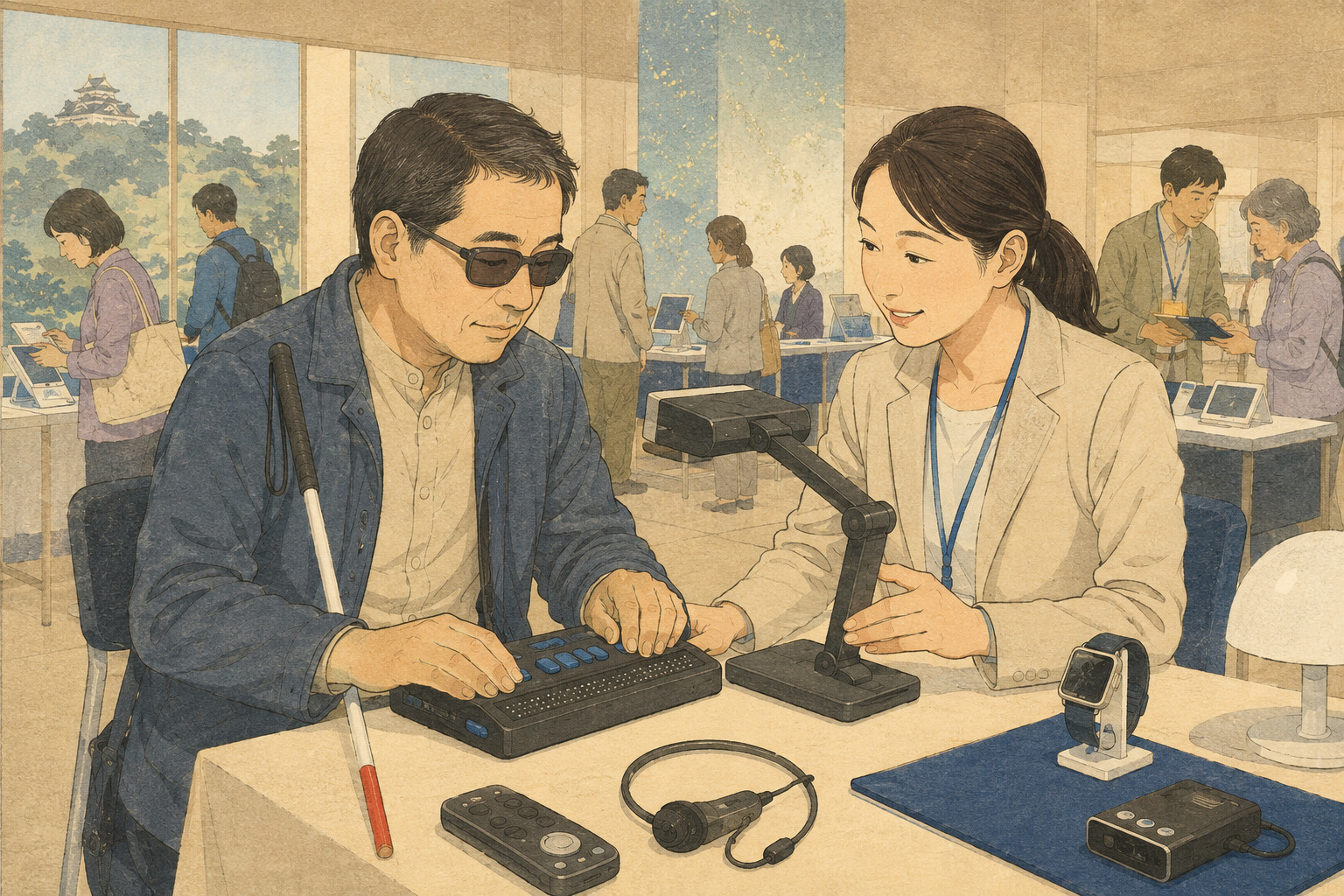
The most revealing service at Sendai’s assistive-technology fair is not on an exhibitor table. With an advance reservation, a visitor can be met at the ticket gates of Izumi-chuo subway station and guided to the venue. The city describes the building as a five-minute walk from Exit North 3. For someone who cannot reliably read signs or survey an unfamiliar intersection, “five minutes away” is geography, not access.
That escort expresses the larger purpose of the Eye Eye Welfare Equipment Fair. Accessibility is not a machine inserted between a person and a problem. It is a route, comprehensible information, training, maintenance, public funding and—when wanted—another person. A clever reader is of little use if its controls cannot be learned. A navigation app cannot clear a bicycle from tactile paving. A cane is not fully fitted because its shipping box arrived.
The event runs from 10 a.m. to 3 p.m. on Saturday, August 29, at the Sendai City Comprehensive Support Center for Persons with Disabilities in Izumi Ward. Admission is free and no general advance registration is required. Sendai says 17 companies or public exhibitors will demonstrate equipment and 14 support organizations will offer consultations and experiences. The Sendai Visual Impairment Support Center, better known locally as Eye Support Sendai, organizes it with the city.
The category “visual impairment” hides the design problem
A person may see large high-contrast type but lose it in glare. Another may read a phone at close range while missing a curb at dusk. Central vision, peripheral vision, contrast, dark adaptation, color and sensitivity to light can fail in different combinations. The Japanese Ophthalmological Society defines low vision broadly as visual function that remains insufficient after ordinary treatment or correction and interferes with daily life; it is not the same as complete blindness.
This variation is why a conventional trade-show hierarchy—newest, fastest, smartest—fails. Magnification helps only while the enlarged text remains in a usable field of view. Optical character recognition can turn a letter into speech but may misread an unusual layout, vertical Japanese or handwriting. A screen reader makes a computer operable by sound, yet the workplace application running on that computer can remain inaccessible. Braille can communicate exact spelling and punctuation without sound, but it requires literacy and, for digital use, costly hardware.
The physical details matter. Can a user locate the buttons by touch? Can speech be repeated after an interruption? Will a camera fit over a medicine label? Does the display produce glare? Is the device too heavy to move from kitchen to desk? These are not secondary matters to be solved after purchase. They are the product.
Seventeen exhibitors, four layers of daily life
The announced equipment spans information, movement, domestic tasks and civic participation. For reading, Kochi System Development will show PC-Talker Neo Plus, whose core software speaks the controls and contents of a Windows computer. Shinano Kenshi’s new PLEXTALK PTR3PLUS is a tabletop DAISY recorder-player that the manufacturer says can reach Japan’s Sapie collection of accessible books without a computer. Other vendors list video magnifiers, OCR talking readers, electronic magnifiers, Braille notetakers and portable audio players.
For movement, Kizaki will bring its white cane, while Safra Tech lists an AI walking-support device. Prime Assistance’s Eye-Co Support uses a smartphone camera and location data so a remote operator can describe visual information by voice. The Japan Blind Football Association will present meetme-X, an app used within its doko engo accompanying-support service to match a user and a qualified guide helper.
That last distinction is important. Accompanying support is a regulated disability-welfare service, not an on-demand ride-hailing product. A prospective user applies through the municipality, receives authorization and contracts with the provider before using its app. Technology can reduce the coordination burden; it does not erase the human qualification or public-service framework.
Raise the Flag. describes SYNCREO, still under development, as a device that conveys an object’s shape, size and distance through sound and vibration. The company says it is working toward a 2027 release. Its presence is a chance to ask hard questions, not proof of safe navigation: What does it miss at foot level? What happens in rain or loud traffic? How does it interact with a cane? What user data are recorded? Safra Tech’s announced AI device deserves the same scrutiny. “AI” identifies a method or marketing category, not a safety rating.
| Daily task | Options announced at the fair | Questions for a hands-on test | Support beyond hardware |
|---|---|---|---|
| Read and write | Magnification, OCR speech, screen readers, Braille, DAISY | Errors, navigation, glare, formats, exact spelling | Reading assessment, ICT instruction, municipal equipment program |
| Move through a city | White cane, coded tactile paving, AI devices, remote sighted support | Curbs, noise, weather, battery, signal, privacy | Orientation and mobility training, accompanying support |
| Manage a home | Talking clocks, liquid/color aid, glare filters, face-recognition lock | One-hand use, failure state, shared users, power loss | Daily-living training, medical and welfare advice |
| Participate publicly | Audio-guided voting, phones and tablets, sport, CPR/AED practice | Secrecy, accuracy, venue access, actual availability | Reasonable accommodation, education, employment, recreation |
The fair is also a map of people
Eye Support Sendai is not simply an event promoter. The nonprofit Eye Support Sendai operates the municipal visual-impairment support center under contract from the city. Its official material says blind and low-vision people may consult regardless of whether they hold a physical disability certificate; relatives and institutions can also ask for help. Consultations are free.
The center identifies social workers, orthoptists, orientation and mobility specialists, and care workers among its professional staff. Its rehabilitation work includes cane travel, smartphones and computers, Braille, reading and writing assessment, selection and training with assistive products, activities of daily living, and support for getting or keeping a job. The service architecture acknowledges a fact often lost in gadget coverage: choosing equipment and learning to use it are different jobs.
Announced participants include Miyagi Prefectural School for Special Needs Education (Visual Impairment), the Japan Guide Dog Association’s Sendai Training Center, the Miyagi Visual Impairment Information Center, the National Hakodate Center for Persons with Visual Disabilities, a vocational training school, employment-support services and blind-sport groups. Sendai’s release says 14 groups will participate.
A manufacturer can explain what a product is designed to do. A rehabilitation specialist can observe whether its operation fits the person. An employment adviser can ask whether it works with a company system. Another blind user can identify a failure the sales demonstration never encounters. Putting those forms of knowledge in one building is more consequential than increasing the product count.
From six raised dots to a speaking block
Assistive technology has never followed a neat replacement cycle. In 1887, teacher Kuraji Ishikawa began adapting Louis Braille’s six-dot system to Japanese at the Tokyo School for the Blind and Deaf. Teachers and students evaluated competing proposals; Ishikawa’s arrangement was selected on November 1, 1890. Japanese Braille was formally published in the official gazette in 1901. It remains writing, not a quaint predecessor to audio.
Movement acquired its own tactile language. Seiichi Miyake devised Japan’s tactile paving in 1965. On March 18, 1967, the first blocks were laid near the Okayama Prefectural School for the Blind. The formal Japanese name means “guidance blocks for visually impaired people.” Their bumps and bars became a built-environment interface recognizable far beyond Japan.
In March 2025, the Sendai center received a newer layer: coded tactile blocks. Colored patterns added to the raised dots can be recognized by a smartphone application and linked to direction-specific spoken information. Visitors are expected to be able to experience the system at the fair. The code does not supersede the tactile surface; it adds information for a device while the block continues its non-electronic job.
The same coexistence appears in reading. DAISY made recorded books navigable by headings and pages rather than a single linear tape. A current smartphone can magnify, invert colors, recognize print, speak a screen and provide location in one commercial device. But a phone can run out of power, lose a network or place an inaccessible app inside accessible hardware. Braille and a cane retain strengths precisely because they do not depend on those layers.
1890 Kuraji Ishikawa’s Japanese Braille arrangement is selected on November 1.
1901 Japanese Braille receives formal publication in the official gazette.
1967 The world’s first tactile guidance blocks are installed in Okayama.
2009 Sendai begins the Eye Eye Welfare Equipment Fair.
2019 Japan’s Reading Barrier-Free Act takes effect.
2022 The information-accessibility and communication promotion law takes effect.
2024 Reasonable accommodation becomes mandatory for private businesses.
A useful product is not the same as an accessible society
Japan ratified the Convention on the Rights of Persons with Disabilities in January 2014; it entered into force for Japan the following month. The domestic reforms around ratification drew on a social model: disability arises not only from an impairment but through barriers in objects, systems, customs and ideas.
That shift changes the meaning of an equipment fair. A talking voting machine is not merely a convenience for an individual voter. It poses a question about whether a ballot can be cast privately and independently. A screen reader does not solve a workplace barrier if an employer purchases software that exposes no usable labels. A navigation service cannot compensate for shops and bicycles occupying tactile paving.
The 2019 Reading Barrier-Free Act states an aim of equal access to the benefits of written culture. The 2022 law on information accessibility and communication makes development, dissemination and quality of relevant equipment and services part of national policy. Since April 2024, Japan’s amended disability-discrimination law has required private businesses—not only public bodies—to provide reasonable accommodation unless the burden is excessive.
None of those measures makes every document, store, election or digital service accessible. But together they move assistive technology away from charity and toward access to education, employment, information and participation. Users at a fair are therefore not passive recipients of benevolent invention. Their feedback is evidence about whether a product and the environment around it have removed a barrier.
The price tag has two public systems behind it
Sendai operates separate support tracks that are easy to collapse in casual reporting. A white cane—officially a “safety cane for a person with a visual impairment” in the city’s terminology—is a hosogu, an assistive device intended to compensate for a bodily function over long use. Video or talking readers, Braille displays, Braille writers, DAISY players and some computer or phone software appear in the city’s nichijo seikatsu yogu, or daily-living equipment, program.
The city’s current reference ceiling is ¥239,000 for a visual reading device, with an eight-year useful-life period. A DAISY recorder-player is listed at ¥85,000 and a playback-only unit at ¥48,000, with six years. The ceiling for information and communication support equipment is ¥110,000; a Braille display is ¥398,000.
Those figures are not retail-price guarantees or universal cash payments. Eligibility depends on the item, disability certificate or other status, demonstrated need, income and municipal decision. User contributions may apply. For hosogu, Sendai warns that an item already purchased is not eligible after the fact. A visitor should ask before buying whether a specific configuration can qualify, which office receives the application and what documentation is required.
The distinction also exposes a coverage gap. A valuable product may not fit an existing item category. A subscription or remote service may bring recurring fees beyond a device purchase. Software support can end before the municipal useful-life period does. A fair should make those lifecycle costs as visible as the demonstration.
How to turn a demonstration into evidence
A polished booth can make almost any assistive product appear effortless. The demonstrator knows the controls; the sample document has been chosen; the network works. A useful trial introduces reality.
- Can I test my task? Try an actual letter, package, work screen or route, not only the vendor’s sample.
- How does it fail? Ask to see recovery after an OCR error, lost network, empty battery or wrong menu.
- Where does my data go? Camera, voice and location services should explain transmission, retention and deletion.
- Who teaches and repairs it? Identify training, local support, loan equipment and update commitments.
- What is the full cost? Include connectivity, subscriptions, accessories, consumables and software renewal.
- Must I apply before purchase? Ask an adviser—not only a seller—about Sendai’s exact category and process.
- What is the fallback? Plan how a cane, Braille label, memorized route or human contact works when electronics do not.
Fit may change over time. An eye condition can progress. Hearing or dexterity can change. A workplace may replace its software. A useful assessment therefore includes whether the device can be adapted and whether skills transfer to another product.
It also includes consent. A relative may be attracted to constant tracking because it reduces the relative’s anxiety; the user may reject the surveillance. A remote camera can return immediate information while sending intimate images outside the home. More information for helpers is not automatically more autonomy for the person being helped.
Independence does not mean being left alone
Assistive-technology writing often ends with the word “independence” as though it were self-explanatory. It can quietly impose an able-bodied standard: success means performing every task without assistance. By that measure, a remote operator, guide helper or station escort looks like dependence.
A better measure is control. Did the person choose the destination? Could the person obtain information without disclosing more than intended? Could help be requested, refused or changed? Was the task completed in the person’s preferred way? Using a qualified guide for an unfamiliar route can be a more autonomous decision than accepting navigation chosen by a family member.
This is why Eye Eye’s blend matters. The event does not place humanity on one side and technology on the other. It places a cane, a talking computer, a coded pavement block, a remote voice, a rehabilitation professional and another blind athlete within the same ecology of access.
When the doors close at 3 p.m., the fair’s success will not be the number of futuristic devices photographed. It will be whether someone has found a way to read private mail, a route to continue working, a training appointment, a safer walk—or simply the knowledge that a problem previously carried alone has a name and a place to ask for help.
- Sendai City — Eye Eye Welfare Equipment Fair 2026 announcement (Aug. 25, 2026; Japanese)
- Eye Support Sendai — Event, exhibitor and support-group listings (Japanese)
- Sendai City — Sendai Visual Impairment Support Center services (Japanese)
- Sendai City — 2023 full-scale return after pandemic disruption (Japanese)
- Sendai City — Daily-living equipment program and item categories (Japanese)
- Sendai City — Equipment ceilings, criteria and useful-life periods (Japanese)
- Sendai City — Hosogu cost-support program (Japanese)
- Japanese Ophthalmological Society — Low vision (Japanese)
- Ministry of Health, Labour and Welfare — Guide to assistive-technology use (Japanese PDF)
- Japan Braille Library — History and structure of Japanese Braille (Japanese)
- Okayama Prefecture — Origin of tactile guidance blocks (Japanese)
- Sendai City — Donation of coded tactile guidance blocks (Japanese)
- Ministry of Education — Reading Barrier-Free Act (Japanese)
- Cabinet Office — Information Accessibility and Communication Policy Promotion Act (Japanese)
- Cabinet Office — Mandatory reasonable accommodation from April 2024 (Japanese)
- Ministry of Foreign Affairs — Convention on the Rights of Persons with Disabilities (Japanese)
- Kochi System Development — Official PC-Talker information (Japanese)
- Shinano Kenshi — Official PLEXTALK PTR3PLUS information (Japanese)
- Prime Assistance — Official Eye-Co Support information (Japanese)
- Japan Blind Football Association — meetme-X accompanying-support service (Japanese)
- Raise the Flag. — Official SYNCREO development page (Japanese)
Editor’s note: “Eye Eye Welfare Equipment Fair” is a descriptive rendering; the organizer has not announced an official English event title. Institutional names without published English equivalents are translated descriptively. Product spellings follow the organizer and manufacturers. Functional claims remain attributed and are not performance endorsements. The supplied exchange-rate update—August 26 at 7:24 p.m. UTC—has been converted to August 27 at 4:24 a.m. Japan Standard Time.