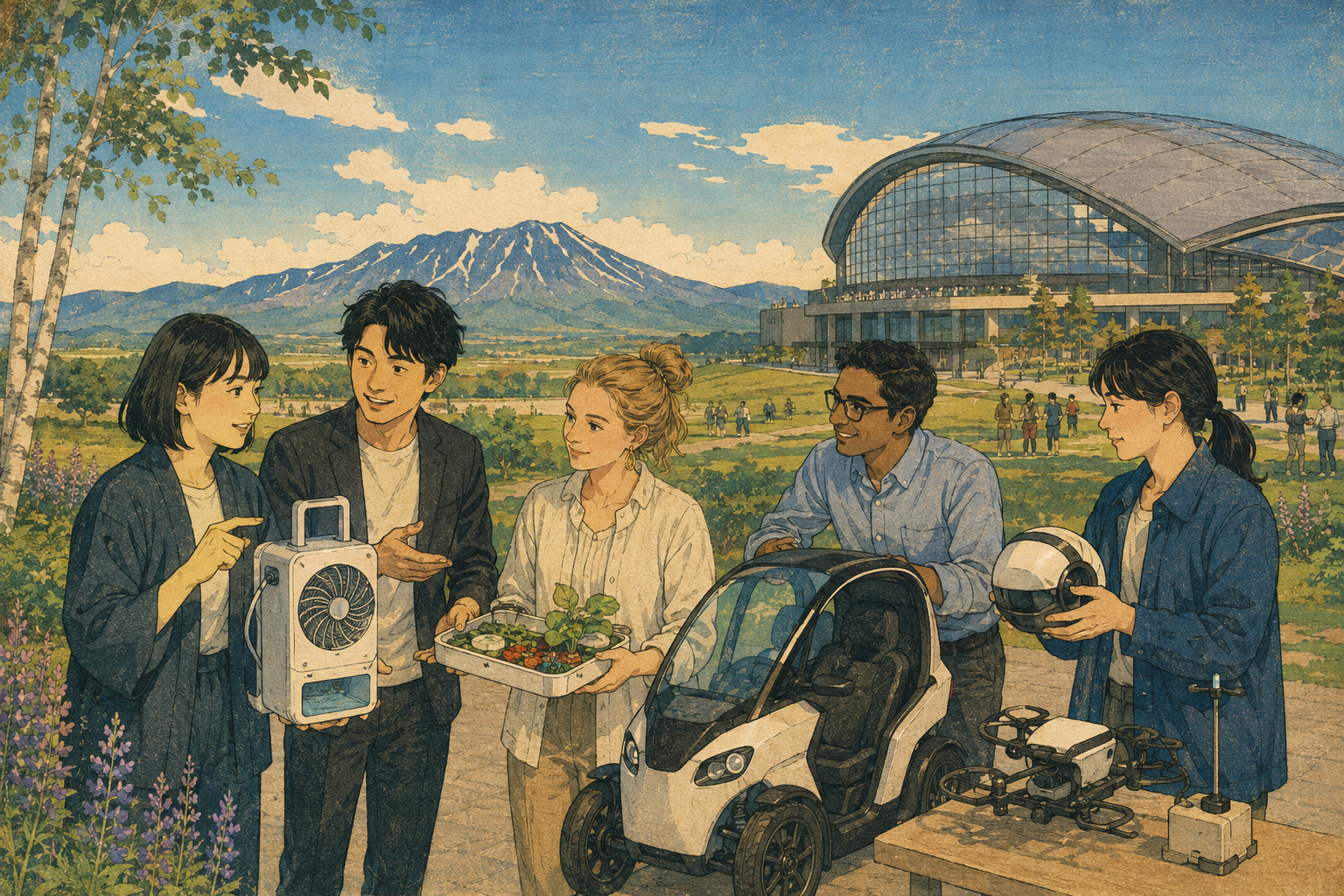
A modern ballpark is a compressed city. Thousands of people arrive through roads and railways, cross a large site, buy and consume food, shelter from weather, appear on cameras, generate waste and try to leave at nearly the same time. The crowd makes ordinary urban problems visible—and unusually measurable.
That is the practical asset behind Hokkaido F Village X, or HFX. On August 26, its operators announced the eight startups selected for the program’s second cohort. The 245 applicants came from 36 countries. HFX lists five selected companies under the United States, two under the United Kingdom and one under Hong Kong.
The cohort arrived in Hokkaido for a four-day Kickoff Week beginning August 25. Site visits and meetings with corporations and local governments are intended to produce joint projects, followed by mentoring and business development through February 2027. A Demo Day is scheduled for that month.
The announcement is consequential because of what it opens, not what it completes. It names the companies, their broad technologies and the institutional network available to them. It does not name a corporate partner for each startup, identify a test site, disclose a budget, define success metrics or announce a procurement contract. Selection is permission to begin the hard work. It is not proof that a product works in Japan.
An unusually broad eight-company portfolio
HFX recruits across five categories: sports, entertainment and stadiums; food and agriculture; mobility; sustainability; and well-being. The second cohort reaches all five. Its breadth is an advantage if partners define real problems. It becomes a weakness if the program treats unrelated technologies as interchangeable innovation theater.
| Company | Technology described by HFX | The Hokkaido test |
|---|---|---|
| GUDEA United States | AI analysis of how online narratives and public opinion form and spread, intended to support brand-risk decisions | Japanese-language accuracy, local context, explainable sources, false alerts and whether an insight produces a responsible operational decision |
| IXON Food Technology Hong Kong | Low-temperature aseptic packaging intended to preserve taste, texture and nutrition without relying on preservatives or refrigeration | Food-specific safety and shelf life, sensory quality, Japanese regulation, processing cost and energy saved from the cold chain |
| Kyomei United Kingdom | Molecular farming that uses plant leaves to produce proteins and functional food ingredients | Crop and cultivation method, yield, extraction cost, use of leftover biomass, containment and the applicable Japanese regulatory path |
| Lumana United States | An AI video platform that adds monitoring, search and operational intelligence to existing cameras | Compatibility, crowd and snow performance, false alarms, privacy, retention, access control and time saved during actual incidents |
| Sonic Fire Tech United States | Low-frequency acoustic technology designed to prevent ignition and suppress early-stage fire without water | Repeatable performance across fuels, wind and distance; detection speed; energy; certification; and integration with conventional fire protection |
| ThermoShade United States | Low-energy, water-free shade panels intended to reduce heat exposure for people, animals, facilities and equipment | Which temperature changes, by how much and for how long; wet and cold durability; nighttime energy; maintenance and user comfort |
| Tidal Metals United States | Recovery of magnesium from seawater or desalination brine at large scale | A credible local feedstock and buyer, recovery yield, electricity use, water discharge, logistics and cost against imported material |
| Transreport United Kingdom | A unified platform connecting passengers who need assistance with transport operators | Handoffs among rail, bus and venue staff; unbooked requests; disrupted-service operation; and measurable benefits for passengers and frontline workers |
Why a ballpark can become a useful test bed
F Village occupies roughly 32 hectares in Kitahiroshima, between Sapporo and New Chitose Airport. It opened in March 2023 around ES CON FIELD HOKKAIDO, the new home of the Hokkaido Nippon-Ham Fighters. The development’s stated idea was larger than baseball from the beginning: a “co-creation space” combining entertainment, food, wellness, mobility, living and community functions.
It has enough traffic to expose technology to real variation. Fighters Sports & Entertainment reported 4,187,046 visits in 2024. Slightly more than half—2,111,312—occurred outside professional baseball games. Cumulative attendance since opening reached 10 million in July 2025. Kitahiroshima’s current transport planning documents put 2025 attendance at about 4.59 million and identify access, congestion and lower-carbon travel as continuing tasks.
That combination matters. A startup can test on a bounded site while still encountering children, older people, overseas visitors, food service, logistics, live events, abrupt crowd surges and Hokkaido weather. HFX can connect it to Yamato Holdings, JTB, Tokyu Land, Hokkaido Bank, NH Foods and Hokkaido Gas. Fighters Sports & Entertainment is the operating partner; the STARTUP HOKKAIDO Executive Committee and Kitahiroshima City are municipal partners. Universities, support institutions and local companies can enter a project without every relationship having to be built from zero.
A ballpark is not, however, a representative sample of Hokkaido. Rural transport across long distances is not the same as moving a game-day crowd. Agricultural processing cannot be validated by a stadium tasting. Fire protection for a building is not automatically forestry protection. Mineral recovery needs an industrial feedstock and customer, not merely a nearby coast.
Food technology meets Japan’s largest agricultural base
Hokkaido produced ¥1.3478 trillion in agricultural output in 2023, 14.1% of Japan’s total, according to the prefectural government. Its 1.138 million hectares of cultivated land in 2024 represented close to one-quarter of the national area. Milk, beef, wheat, soybeans, potatoes, onions and sweet corn are among the products for which it is a leading supplier.
That scale gives IXON and Kyomei plausible industrial questions. IXON calls its process Advanced Sous-vide Aseptic Packaging, or ASAP. Company materials describe a sequence involving brief high-temperature treatment of a food’s surface, aseptic packaging and lower-temperature cooking. IXON says particular products can remain shelf-stable without preservatives or refrigeration while better retaining the qualities damaged by conventional high-heat retort processing.
The conditional language is essential. Shelf life is a property of a product, process, package and storage condition—not a universal feature that can be transferred from one food to another. A Hokkaido pilot would need a specified ingredient, pathogen-control plan, validated process, packaging-integrity data and sensory testing over time. It would also need to compare equipment and processing energy with the cold-chain energy it claims to avoid. A two-year claim on a company webpage is not a substitute for a Japanese product validation.
Kyomei approaches the supply chain from the field. Its molecular-farming model is designed to make high-value proteins within crop leaves and extract both the target ingredient and naturally present leaf proteins. The company describes using leaves that would otherwise be low-value or discarded, allowing a crop to generate more than one product.
That idea fits Hokkaido’s large farms, but it also raises the hardest questions in the cohort. The company would have to identify the crop, desired protein, cultivation system, expected yield and downstream separation process. If an engineered plant is involved, containment, seed control, food assessment and the route through Japanese regulation must be designed before field use. Farmers need evidence that leaf collection and identity preservation create net income after the added work. “Agricultural waste” is not free if someone must gather, separate, store and transport it.
The visible and invisible stadium
GUDEA and Lumana would operate in a less tangible layer: the information surrounding a venue and the video generated inside it.
GUDEA describes its field as narrative intelligence. Its platform monitors how claims and stories emerge online, examines who amplifies them and attempts to forecast their direction. A sports organization can see the appeal. A false rumor involving a player, a safety incident or a sponsor can move faster than a conventional communications team. Earlier context may help the organization decide whether to correct, investigate, wait or prepare for physical consequences.
Yet a system trained on broad online behavior has to prove that it understands Japanese language and fan culture rather than merely detects unusual volume. Sarcasm, nicknames, quoted criticism and intense but organic fandom can resemble coordinated activity. A defensible pilot would record why the system raised an alert, what sources it used, how often experts rejected its interpretation and whether action improved an outcome. Narrative monitoring should support judgment, not automate retaliation against criticism.
Lumana sells a hybrid video-security platform intended to work with existing IP cameras. Its software searches footage, produces alerts, coordinates response and extracts operational information. The company says its systems are used across more than 50,000 cameras; that is a company-reported deployment figure, not an independent performance result.
F Village could offer difficult visual conditions: packed concourses, snowfall, umbrellas, backlighting, team colors and rapid changes between quiet and event operations. Useful measures would include detection precision, false-alert rate, investigation time and operator workload. Just as important are boundaries: whether facial recognition is active, where processing occurs, how long footage remains, who can search it and what visitors are told. The pilot should begin with the narrowest necessary purpose and treat privacy complaints as data, not noise.
Heat, fire and a mineral hidden in water
Hokkaido’s climate identity can obscure its heat risk. Japan Meteorological Agency data show long-run increases in hot days across northern cities, including Sapporo. Outdoor queues, children’s areas, transport stops, livestock facilities and temperature-sensitive equipment give ThermoShade several potential test environments.
ThermoShade combines reflective surfaces and phase-change materials in modular shade panels. The company says the space beneath can feel up to 20°F, or about 11°C, cooler than beneath a standard awning. Its public materials also explain that some products cool passively during the hot part of the day and consume modest power at night to reset the thermal material.
“Up to” and “feel” need translation into testable variables. Is the change in air temperature, surface temperature, mean radiant temperature or a comfort index? How does performance change with humidity, cloud, wind and repeated cycles? What happens during Hokkaido’s wet shoulder seasons and freezing winter? A credible pilot should publish the sensor layout and comparison structure, not just infrared images from the best afternoon.
Sonic Fire Tech makes the cohort’s most surprising claim. The company says its infrasound system sends low-frequency waves into the area around an ignition, disrupting combustion without water or chemical suppressant. Hokkaido itself treats March through June as its period of elevated wildland-fire danger, with the largest concentration generally in April and May.
Selection by an accelerator is not fire certification. An acoustic system must define fuel, ignition source, distance, wind, enclosure, response time and failure mode. It must show how detection works and where conventional alarms, sprinklers and firefighting remain necessary. Any test near the public, animals or critical infrastructure also needs a documented safety basis. The attraction of avoiding water damage makes rigorous independent reproduction more—not less—important.
Tidal Metals proposes to extract magnesium salts from seawater or concentrated desalination brine and ultimately produce lower-carbon magnesium using electricity. Its website says no chemicals are added and no waste is generated, and presents the ocean as a vast domestic resource. Those are company claims that a pilot would need to turn into a mass-and-energy balance.
Hokkaido’s coastline makes the concept visually intuitive, but location alone does not create a project. Water intake and pretreatment, concentration, electricity price, residual-water management, a magnesium buyer and transport economics all matter. Of the eight selected companies, Tidal Metals currently has the least obvious disclosed path to an F Village demonstration. That could change when partner pairings are announced; the August 26 release does not provide one.
One member already operates in Japan
Transreport arrives with a different kind of evidence. Hankyu Railway says it introduced the British company’s staff assistance application in April 2024 to digitize coordination among stations. In April 2025, Hankyu added a web service allowing passengers—including wheelchair users and people with visual impairments—to request boarding and alighting assistance in advance. The request reaches the relevant station staff and links to the internal system they already use.
That is a live Japanese operating context, not simply a proposed proof of concept. It makes Transreport the cohort member with the clearest verified head start in Japan. It does not answer the Hokkaido question automatically.
A journey to F Village can involve a railway, shuttle or local bus, a large outdoor site, security gates and a seat inside the stadium. Each handoff is a point where information can disappear. The useful HFX project would test whether assistance requirements follow the person across organizations, whether staff can absorb last-minute or unbooked needs, and whether the system remains functional during disruption. Success would mean fewer missed handoffs and shorter waits without transferring administrative work onto the passenger.
That last point is central. Accessibility software should be measured by completed journeys, confidence and frontline workload—not downloads alone. The best technology may be the one that lets human assistance become more reliable while becoming less visible.
From a stadium bid to an innovation network
Kitahiroshima submitted its formal ballpark proposal in December 2016. The site was chosen as the preferred candidate in March 2018, and construction was formally decided that October. The city and the Fighters described a place integrating food and sports and serving as a symbol of Hokkaido. In 2020, the ballpark concept entered Kitahiroshima’s comprehensive municipal plan. F Village opened three years later.
HFX began in March 2025 as a three-year program scheduled to run through February 2028. Its first cohort drew 310 applications from 29 countries and selected 11 companies. The operators report that the roughly six-month development period produced 10 co-creation projects.
The disclosed work was tangible. A cooling material was tested with Fighters players and staff and in other local environments. An image-recognition checkout entered a Niseko restaurant. A silk-derived coating was compared on Kitahiroshima vegetables with university participation. A wood-waste black pigment was applied experimentally by an Asahikawa furniture maker. A fall-detection sensor entered a local support center. Work began on automating beer-keg movement inside ES CON FIELD. A cooking robot and a travel-luggage integration were among other announced projects.
2016 Kitahiroshima submits its ballpark proposal.
2018 The site is selected and construction formally approved.
2023 Hokkaido Ballpark F Village opens.
March 2025 Hokkaido F Village X begins.
August 2025 Eleven first-cohort companies are selected from 310 applicants.
February 2026 First Demo Day; organizers report 10 co-creation projects.
August 2026 Eight second-cohort companies are selected from 245 applicants.
February 2027 Second-cohort Demo Day is scheduled.
The first cohort matters because it demonstrates that HFX can get beyond pitch sessions. It also shows why the next layer of disclosure matters. Most of the available outcome descriptions come from the program and participating organizations. They do not yet provide a common accounting of paid conversions, long-term use, cost savings, local revenue or jobs. A pilot started is different from a business retained.
The application totals require equally careful reading. The first cohort reported 310 applications; the second reported 245. HFX now says 510 unique companies have applied across the two rounds. The gross total is 555, so the unique-company figure implies overlap between the pools, although the organizers have not published a deduplication breakdown. The frequently quoted “eight of 245” describes selectivity; it does not establish that the cohort represents the industry’s eight best technologies.
The scoreboard HFX should publish in February
The second cohort has access to a rare network: corporate decision-makers, a major venue, local government, support organizations, universities, regional businesses and possible investment from Scrum Ventures. For an overseas startup, those links can compress the slowest stage of entering Japan—the search for a first serious counterpart.
But a network can also blur accountability. Everyone may support a project while no one owns procurement, operations or the result. A useful February 2027 scoreboard should separate four stages.
- Match: Did the company gain a partner that owns a defined Hokkaido problem, a site and an operating decision?
- Test: Was there a baseline, sample, duration, failure condition and measurable result?
- Business: Did the work progress beyond a free demonstration to paid procurement, compliance, support and a repeatable economic case?
- Transfer: Can the result move from F Village to another Hokkaido community or Japanese customer without being rebuilt from scratch?
The measures should fit the technology. Video AI needs precision, false alarms and response time. Passenger assistance needs completed handoffs, waiting time and workload. Cooling needs a defined thermal metric across weather conditions. Food technology needs validated safety, shelf life, sensory quality, energy and cost. Fire defense needs repeatable third-party testing and certification. Mineral recovery needs yield, energy, water accounting and a buyer.
There is a compelling story in the lineup. Hokkaido’s crops, longer supply chains, changing summers, spring fire risk, aging transport workforce, crowded events and surrounding sea all appear somewhere in the eight pitches. But a story can be assembled before a single device is installed.
The more valuable record will be prosaic: where the technology went, who operated it, what broke, what it cost, what improved and what failed. Failure should be publishable, too. Knowing that a product could not survive snow, Japanese labeling requirements or a fragmented handoff can save other communities from repeating the same experiment.
HFX has finished reducing 245 applications to eight names. Its real work is the opposite: expanding each name into a responsible partner, a defined field test, a measurable result and—where the evidence earns it—a lasting Hokkaido business.
- Scrum Ventures and Scrum Studio — HFX second-cohort selection announcement, August 26, 2026
- Hokkaido F Village X — official program site, concept and partners
- Hokkaido F Village X — acceleration-program structure
- Scrum Ventures and Scrum Studio — first-cohort selection announcement
- Scrum Ventures and Scrum Studio — first-cohort Demo Day outcomes
- Scrum Ventures and Scrum Studio — second-cohort recruitment and first-cohort self-assessment
- Hokkaido Ballpark F Village — official English overview and 32-hectare site
- Hokkaido Nippon-Ham Fighters — 2024 F Village attendance
- Hokkaido Nippon-Ham Fighters — 10 million cumulative visits
- Kitahiroshima City — ballpark construction announcement and agreement
- Kitahiroshima City — 2026 station and F Village transport-strategy material
- Hokkaido Government — Hokkaido Data Book 2025: Agriculture
- Hokkaido Government — Transport Policy Strategy 2026–2030 reference material
- Japan Meteorological Agency — long-term changes in hot-day frequency
- Hokkaido Government — wildland-fire prevention policy
- GUDEA — official site
- IXON Food Technology — company explanation of ASAP
- Kyomei — official site
- Lumana — official site
- Sonic Fire Tech — company technology explanation
- ThermoShade — company technology explanation
- ThermoShade Solutions — 2025 Form C annual report
- Tidal Metals — official site
- Transreport — official site
- Hankyu Railway — official report on web-booked passenger assistance
Editorial note: Company names, Japanese readings, countries or regions, selection categories and short technology descriptions follow the organizers’ August 26 announcement. Technology benefits are attributed to HFX or the companies unless independently demonstrated. HFX’s first-cohort count of 10 co-creation outcomes and its participant-satisfaction measures are organizer-reported. Individual second-cohort pairings, pilot sites, budgets, contracts, success metrics and Japanese regulatory approvals had not been disclosed in the source announcement. The supplied exchange-rate timestamp, August 26 at 7:24 p.m. UTC, was converted to August 27 at 4:24 a.m. Japan Standard Time.