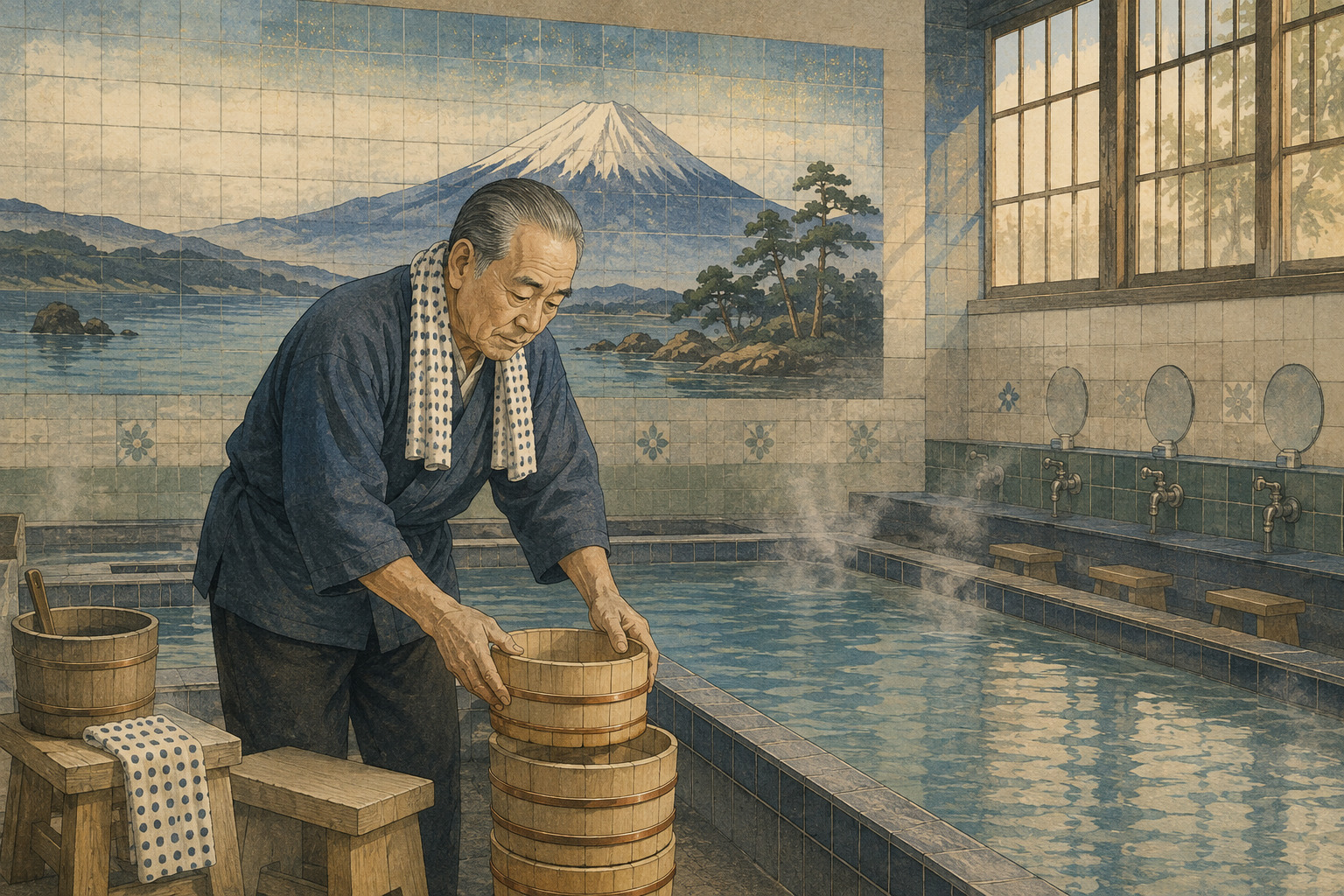
The first hour was the argument. Before the governor of Kyoto Prefecture sat down to discuss “sento culture rooted in the community,” the official schedule placed him inside the work that culture requires: cleaning the bathing area and replenishing firewood. The bath was not yet a nostalgic room. It was a plant that had to be washed, fueled and made ready for another operating day.
The August 26 event at Chōja-yu in Kyoto’s Kamigyō Ward was the 137th edition of Governor Takatoshi Nishiwaki’s “Iki-iki Talk,” a program whose wordplay promises that he will go to a site and put what he hears to use in prefectural policy. After the work demonstration, the schedule set aside fifty minutes for discussion. KBS Kyoto recorded it for the prefectural television program Attaka Kyoto!
The announced group was specific: Makoto Yoshimoto, chairman of the Kyoto Prefectural Public Bathhouse Business Environmental Sanitation Trade Association and operator of Monzen-yu; Chōja-yu operator Kenta Majima; Yu Nakamaru, a second-year Kyoto University literature student and president of the university’s sento club; Kyoto Mayor Koji Matsui; and Nishiwaki. The official list did not identify a general panel of neighborhood residents.
That correction matters because it defines what the event can establish. It brought an industry representative, a single operator, a student enthusiast and the two relevant heads of government together. It was not a representative survey of customers, workers, women bathers, disabled users, nearby households or operators who had already closed.
The old bath that keeps changing
Chōja-yu’s present business dates its founding to 1917, when Taishō-era Kyoto still treated a shared bath as ordinary urban provision. The building is older: a Kyoto City historic-landscape document dates it to 1872. The bathhouse association says the city designated it a “historic-design building” in 2002. Its age makes it an attractive stage, but the less picturesque part of its history is more instructive. A Kyoto tourism project run by a council that includes the prefecture and city reported that the bath added a cypress-lined sauna and enlarged its cold bath in a 2023 renovation. Its account said the business had moved from a third generation to a fourth.
The same report described well water under the property and wood heat, with construction offcuts cut down for fuel. It attributed an estimate of about ten remaining wood-fired bathhouses in the city to the operator. Those are details of Chōja-yu, not universal features of Kyoto sento. A shop using gas or oil, buying city water or occupying a different building faces a different cost equation.
What Chōja-yu demonstrates is not that authenticity guarantees survival. It demonstrates adaptation. A sauna can bring younger visitors; a larger cold bath can turn a fixed-price visit into a distinctive experience. A family succession can preserve operational knowledge. Every change, however, requires capital, construction and confidence that the doors will remain open long enough to recover the investment.
The ¥550 bargain
A Kyoto sento cannot simply calculate costs, add a margin and post a new price. The prefectural governor sets a controlled ceiling after receiving advice from the Kyoto Prefectural Public Bathhouse Admission Fee Council. Since April 1, 2025, that ceiling has been ¥550 for people aged 12 or older, ¥200 for ages six through eleven and ¥100 for children under six. Each category rose by ¥40 from the previous ceiling. The bathhouse association separately advertises a ¥400 middle-school rate on presentation of student identification.
The arrangement is the remnant of a public-health bargain. Japan’s Public Bath House Act, enacted in 1948, requires permission to operate and places sanitation within government supervision. A 1957 ministry ordinance directs prefectural governors to specify controlled admission ceilings. National sanitation guidance defines the ordinary neighborhood bath as a facility needed for health and hygiene in residents’ daily lives.
That language came from a housing reality in which many homes had no bath. Affordable common bathing was infrastructure, not discretionary leisure. Domestic bathrooms later removed much of the guaranteed demand, but the controlled-price framework remained. The business now carries a public-service price logic while buying labor, power, fuel, insurance, chemicals and repairs in ordinary markets.
Kyoto’s March 2025 fee council acknowledged an especially uncomfortable cost: work. Its summary said labor should be estimated at a proper wage rather than allowing the economics to depend on unpaid effort. Members also called aging equipment and realistic building-replacement costs unresolved issues. In a family-run bath, an owner’s long day can disappear inside “family help” and make a fragile business look healthier on paper.
Nishiwaki described the increase that month as a narrow judgment between a greater burden on users and the need to maintain supply. That is exactly what a ceiling can do—balance a standardized model. It cannot guarantee that a particular century-old building with a failing boiler, declining visits or no successor is viable.
| Policy | Published 2026 terms | Public purpose | Unresolved cost |
|---|---|---|---|
| Admission ceiling | ¥550 adult; ¥200 child; ¥100 preschool | Keep daily bathing affordable while reflecting modeled costs | Each building’s debt, equipment, traffic and labor differ |
| Equipment grant | 15%; ¥150,000–¥1.5 million for ordinary improvements | Boilers, filters, pipes, chimneys, sauna and related work | Owner’s share, closure during works, roofs and exterior walls |
| Free child admission | Elementary-age and younger with an adult through March 2027 | Create family visits and a future customer base | Conversion to repeat paid use and the burden on staff |
| Disaster agreement | Cooperation in providing baths and daily-use water | Support physical and mental health after a disaster | Water, backup power, fuel, seismic safety and staffing |
A collapse measured three different ways
Kyoto City’s public newspaper reported in 2017 that the city had 461 sento in 1970 and 154 at the end of 2016, attributing the long fall primarily to the spread of bathrooms at home. The prefecture’s current child-program page uses a different geographic and operational count: 187 operating baths across Kyoto Prefecture at the end of 2010 and 87 at the end of 2025. That is a loss of 100 facilities, or about 54 percent, in fifteen years.
The datasets should not be spliced into one seamless chart; they cover different territories, definitions and dates. They nevertheless describe the same structural retreat. Fewer habitual users leave fixed heating and maintenance costs to be divided among fewer admissions. A major repair becomes harder to recover. A proprietor can close at retirement even if the previous year was not technically insolvent.
The national series reinforces the point. The health ministry counted 2,847 public and private ordinary public bathhouses at the end of March 2024. In 1970, ordinary baths represented 87 percent of licensed bath businesses; in fiscal 2023 they represented 12 percent. Resort, sports, hotel and entertainment-oriented bathing grew as a category while the neighborhood hygiene facility contracted.
Kyoto still has advantages. A 2025 prefectural fee-council discussion noted comparatively favorable well-water conditions and a tendency toward student use. It saw promise in younger operators reopening closed baths and in rising merchandise sales. But the council also asked for quantitative evaluation of the bathhouse’s changing social functions. A successful sauna, a popular towel or an enthusiastic club is evidence of possibility, not proof that the network has stabilized.
From necessary hygiene to living heritage
Kyoto’s bathing history is older than the modern sento, but collapsing temple charity baths, commercial bathhouses and licensed twentieth-century businesses into one timeless custom produces sentimental history. The National Diet Library’s collaborative reference database points researchers to Kyoto no Yuya, a 1923 study of bathhouses in the city that included a chapter on their development. By Chōja-yu’s early years, the urban bath was already something to count, regulate and analyze.
The postwar public-bath law treated bathing first as sanitation. Later, as private bathrooms became normal, preservation arguments expanded: a place for health, social contact, local architecture, tourism, sauna culture and intergenerational life. In February 2026, Kyoto added a very practical role—emergency bathing and water provision.
None of those new identities cancels the old obligations. Water quality, Legionella prevention, cleaning, ventilation and temperature control still apply on an uneventful Tuesday. “Culture” is therefore not a decorative layer sitting above sanitation. It is the accumulated way a regulated hygiene business has been made social and local.
1872 Kyoto City’s historic-landscape record dates the Chōja-yu building.
1917 The present Chōja-yu business gives this as its founding year.
1923 Kyoto no Yuya records and studies the city’s bathhouses.
1948 Japan enacts the Public Bath House Act.
1957 The national ordinance on controlled admission ceilings takes effect.
1970 Kyoto City records 461 sento.
2025 Kyoto Prefecture ends the year with 87 operating sento.
2026 Prefecture, city and association sign a disaster agreement and run free child admission.
Free children, paying adults and the search for habit
Kyoto’s most visible demand policy began on April 1. A child of elementary-school age or younger can enter a participating sento free when accompanied by an adult aged 18 or older. Neither adult nor child must live in Kyoto, and there is no published limit on the number of children per adult. The program is scheduled through March 31, 2027, subject to budget availability.
The operating count and participation count are not identical. The prefecture counted 87 operating sento at the end of 2025; the free-admission program covers 84 association members—77 in Kyoto City and seven elsewhere. The prefecture described its child-use budget as approximately ¥50 million. A Kyoto City May supplemental budget added ¥15 million to support bath etiquette, history lessons and events designed to interest children. An August collaboration with the mobile game The Battle Cats supplies another invitation.
After the Chōja-yu discussion, Matsui wrote on his official social-media account that Majima had described a nearby kindergarten sending four groups of fifteen children—sixty in total—to the bath during an overnight program. It is a vivid local example. It is not an evaluation of the prefecture-wide policy.
Free entry will be economically meaningful only if the public reimbursement is prompt, accompanying adults pay, some families return and the added cleaning or crowd-management burden is manageable. The published use process asks the adult to scan a QR code and complete an online form; accessibility for people without a suitable phone is another operational question.
The eventual measures should be more ambitious than a redemption total. Did the adult come back without a campaign? Did a child learn the etiquette needed to feel comfortable? Did weekday traffic improve? What did each returning household cost to acquire? A cultural experience is a legitimate public outcome. A survival policy also needs repeat use.
Disaster infrastructure that can disappear before the disaster
On February 5, Kyoto Prefecture, Kyoto City and the bathhouse association signed an agreement for cooperation in providing bath facilities and water for daily needs after a disaster. The city says the purpose is to protect the physical and mental health of affected people. A hot bath after days in an evacuation center is not a trivial comfort.
Yet an agreement cannot make an old bath operational after an earthquake. Pumps and filters may need electricity even where the property has a well. Heating requires gas, oil or wood. A chimney and bath building must remain safe. Workers have to care for their own families before staffing a public service. Routes, privacy and accessible use matter when large numbers arrive.
If governments count these businesses as resilience assets, they need facility-level readiness information: water source, backup power, fuel inventory, seismic condition, restart time and safe capacity. They also need to pay for the improvements that turn a nominal signatory into a usable site. It is incoherent to claim a bath as public infrastructure during an emergency while treating its capital costs as entirely private in normal times.
The grant queue is a warning light
Kyoto Prefecture closed entry for its fiscal 2026 public-bath equipment-improvement grant after the requested total reached the program’s budget limit. For ordinary work, it covers 15 percent of eligible cost, from ¥150,000 to ¥1.5 million per project. Eligible examples include boilers, water heaters, filtration units, heat exchangers, tanks, pipes, air conditioning, interior ceilings and walls, chimneys and saunas. A separate accessibility category covers 50 percent, from ¥100,000 to ¥500,000.
The mathematics exposes the gap. A project reaches the ordinary grant ceiling of ¥1.5 million at roughly ¥10 million in eligible cost, leaving at least ¥8.5 million before noneligible work, financing cost and revenue lost during closure. Exterior walls and roofs are excluded from the ordinary equipment category even when deterioration threatens the wider building.
Reaching the budget cap shows demand; it does not show how much need the program met. The public page reviewed by Japan.co.jp does not give the total budget, number of entries, number approved or value left outside the queue. Those figures are necessary to judge whether the grant is preventing closures or merely rationing a small contribution among aging properties.
Association chairman Yoshimoto’s official statement identifies succession, deteriorating buildings and equipment, energy efficiency and a structure in which younger people can enter the business with confidence. These are one problem, not four. An efficient boiler may reduce monthly fuel use but needs cash today. A successor inherits the deferred maintenance as surely as the name above the door.
What “save the sento” should mean
In January, Nishiwaki described the neighborhood bath as a place for multiple generations to meet. In February, Matsui said he wanted to stop the closures. The policy intention is not hard to discern. The missing part is an accountable definition of success.
- Actual operation: Open, new, transferred, reopened, dormant and closed baths—not only licenses on file.
- Use: Visits by age and time, with first and repeat visits separated under privacy safeguards.
- Capital need: Grant applications, approvals, unmet requests, project costs and closure days.
- Work and succession: Paid hours, unpaid family labor, wages and whether a successor is identified.
- Child policy: Free admissions, accompanying adults, reimbursement, repeat use and operating burden.
- Disaster readiness: Water, backup electricity, fuel, seismic safety, drills and safe capacity.
Numbers cannot contain the whole institution. A familiar greeting at the front desk, a child learning how to share a bath and the unusual equality of neighbors undressed in the same room are real social goods. But without numbers, “culture” can become a polite way to ask an operator to donate labor and capital indefinitely.
The strongest image from the governor’s event is therefore not a speech. It is the hour before the speech: cleaning and carrying fuel. The symbolic exercise becomes policy only when Kyoto calculates how much that work costs, decides how the cost is divided and reports whether another door has closed.
Survival does not mean keeping a beautiful shell for photographs. It means the curtain is hung at opening time, the water is clean and hot, the person who prepared it is paid, and a failed boiler can be replaced. Kyoto will preserve its sento culture not when officials say they value it, but when an operator facing the next repair can still choose to reopen.
- Kyoto Prefecture — 137th Governor Iki-iki Talk announcement and participant list (Aug. 19, 2026; Japanese PDF)
- Kyoto Prefecture — Governor Iki-iki Talk program purpose (Japanese)
- Kyoto Prefecture — Governor Takatoshi Nishiwaki profile and name reading (Japanese)
- Kyoto City — Mayor Koji Matsui profile and name reading (Japanese)
- Mayor Koji Matsui official social media — Event account and Chōja-yu kindergarten example (Japanese)
- Kyoto Prefectural bathhouse association — Official Chōja-yu listing, reading, founding, city designation and renovation (Japanese)
- Kyoto City — Historic-landscape plan material listing the Chōja-yu building date and status (Japanese PDF)
- Marutto Kyoto Promotion Council — Chōja-yu history, renovation, well, wood and succession (Japanese)
- Kyoto Prefectural bathhouse association — Organization and chairman’s statement (Japanese)
- Kyoto Prefecture — Free child admission and operating-bath count (Japanese)
- Kyoto Prefecture — Fiscal 2026 budget explanation for child sento use (Japanese)
- Kyoto City — May 2026 supplemental budget for child sento support (Japanese)
- Kyoto Prefecture — 2025 controlled admission revision (Japanese)
- Kyoto Prefectural admission-fee council — March 2025 summary (Japanese PDF)
- Kyoto Prefectural admission-fee council — September 2025 summary (Japanese PDF)
- Kyoto Prefecture — Governor’s March 21, 2025 press conference (Japanese)
- Kyoto Prefecture — Fiscal 2026 bathhouse equipment grant (Japanese)
- Kyoto Prefecture — Grant rates, limits and eligible work (Japanese PDF)
- Kyoto City — Disaster bath and water-support agreement (Japanese)
- Kyoto City — City sento counts in 1970 and 2016 (Japanese)
- National Diet Library collaborative reference database — Sources for Kyoto bathhouse history (Japanese)
- e-Gov law database — Public Bath House Act (Japanese)
- e-Gov law database — Ordinance on controlled public-bath admission ceilings (Japanese)
- Ministry of Health, Labour and Welfare — Public-bath business overview and national count (Japanese)
Editor’s note: “Governor Iki-iki Talk” is a descriptive rendering of Nishiwaki Chiji to Iki-iki Tōku; no official English event title was found. “Kyoto Prefectural Public Bathhouse Business Environmental Sanitation Trade Association” and “ordinary public bathhouse” are descriptive translations of Japanese institutional and regulatory terms. Japanese spellings and readings of Chōja-yu, Takatoshi Nishiwaki, Koji Matsui, Makoto Yoshimoto, Kenta Majima and Yu Nakamaru were checked against prefectural and city primary sources. The supplied exchange-rate update—August 26 at 7:24 p.m. UTC—has been converted to August 27 at 4:24 a.m. Japan Standard Time.