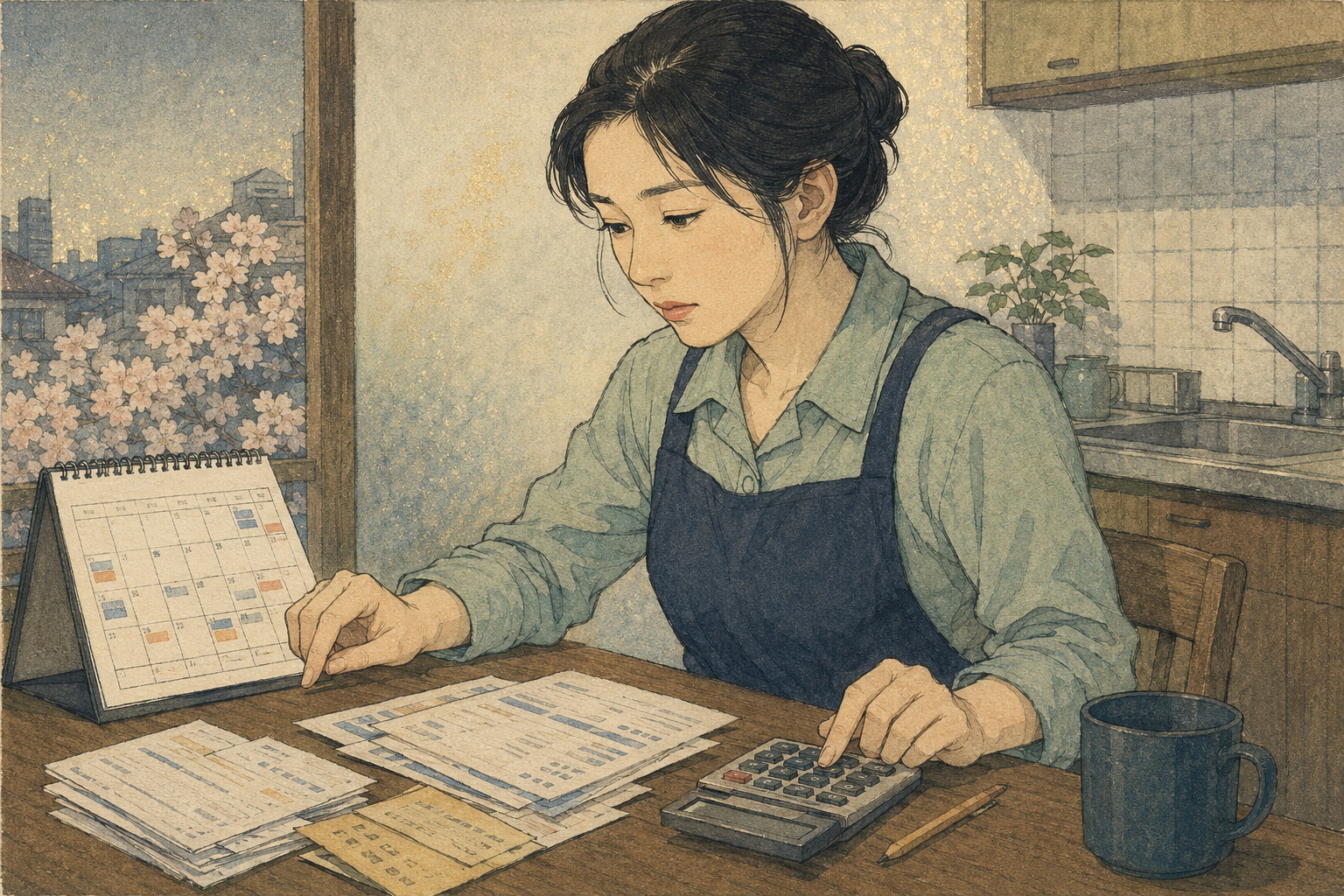
A pay raise can create a peculiarly Japanese form of arithmetic. To keep annual earnings below a household threshold, a part-time worker may need to give up hours precisely because each hour is worth more. An extra shift can affect not only income tax but health-insurance dependency, pension status and a spouse’s company allowance. The earnings line moves smoothly. The rules around it do not.
That arithmetic sits behind one of the sharper findings in Mynavi Corporation’s 2026 survey of married women in part-time and casual work. The internet survey, conducted from February 18 to March 2, received 1,630 valid responses from employed women in their 20s through 50s. A total of 35.7% said they deliberately adjusted work hours or income. Within the full sample, 23.3% said their purpose was to prevent a reduction in take-home pay.
Mynavi then asked that latter group—380 respondents—what they would do if “income walls” and similar effects disappeared and their take-home pay no longer fell. Some 40.9% said they would work longer at their current workplace. Another 10.0% would add hours elsewhere. The combined 50.9% was higher, at 62.3%, among respondents whose youngest children were in junior high or high school.
It is evidence of constrained labor supply, but a more bounded finding than the phrase “most part-time workers want more hours” would suggest. The sample excludes men, unmarried women, workers in their 60s and above, and anyone outside part-time or casual employment. The 50.9% applies only to respondents already restricting work for take-home-pay reasons. And the question bundled several systems; it cannot reveal how many people were reacting to social insurance rather than tax, spouse-related deductions, employment insurance or another rule.
The wall is a stack, not a line
Nenshū no kabe, the “annual-income wall,” is political shorthand rather than the name of a single statute. It collapses at least four decisions into one phrase: whether the worker owes tax; whether a spouse receives a tax deduction; whether the worker remains a dependent under a spouse’s health insurance and in Category III of the National Pension; and whether a private employer continues a spouse allowance.
Those decisions use different income definitions and produce different consequences. Crossing an income-tax floor does not make all previous earnings taxable. Joining employee health insurance and the Employees’ Pension creates an immediate premium but also adds pension rights and cash benefits during qualifying leave. Losing dependent status without gaining employee coverage can instead mean paying National Pension and National Health Insurance premiums without the same increase in employee-insurance benefits.
The tax numbers changed again in 2026. National Tax Agency guidance says a person with salary income only will owe no national income tax on earnings of up to ¥1.78 million for the year. The change takes effect on December 1 and applies to 2026 income. Subject to the taxpayer’s own income and other conditions, the spouse of a part-time worker can receive the full ¥380,000 spouse or special-spouse deduction when the worker’s salary is no more than ¥1.69 million. A separate resident-tax income levy may begin above ¥1.19 million, and some municipalities can impose the per-capita levy below that point.
None of those tax changes automatically moves the ¥1.3 million health-insurance dependent test. Nor do they rewrite a company’s spouse allowance. The practical household question is therefore not “What is the wall?” It is “Which rule is this number attached to, what income does it count, and what changes on the other side?”
| Threshold or rule | What it means in August 2026 | What crossing it changes |
|---|---|---|
| ¥1.78 million Own income tax | The 2026 tax-free floor for salary income only, effective December 1 | National income tax may apply to taxable income above deductions; it is not a loss of all prior income |
| ¥88,000 monthly pay and 20 hours weekly Employee insurance | For qualifying short-hours workers at companies with at least 51 Employees’ Pension members; the pay test is scheduled to end in October | Enrollment in employee health insurance and the Employees’ Pension, with worker and employer sharing premiums |
| Below ¥1.3 million Dependent status | A principal income test for a spouse who is not personally covered by employee insurance to remain a health-insurance dependent and Category III pension member | Loss of dependency and a requirement to obtain coverage personally; the destination depends on the job and circumstances |
| Employer spouse allowance | A private employment rule with company-specific income conditions | Household compensation may decline even when tax and statutory-insurance outcomes improve |
October removes ¥88,000, not the coverage boundary
Until the end of September, a worker with less than three-quarters of the hours or days of a regular employee is generally brought into employee health insurance and the Employees’ Pension under the short-hours rule when several conditions coincide. The employer must usually have at least 51 Employees’ Pension members; scheduled weekly hours must be at least 20; scheduled monthly pay must be at least ¥88,000; the worker must not be an excluded student; and employment must be expected to continue beyond two months.
The famous “¥1.06 million wall” is the annualized nickname for the ¥88,000 monthly-pay condition. It has never been a simple test of actual calendar-year cash receipts. Japan Pension Service excludes bonuses, overtime and premium pay for holidays or night work, and certain commuting and family allowances when checking that entry requirement. Yet some of those payments are included later in the remuneration used to calculate premiums. A worker can understand the headline number and still miscalculate the legal test.
Every prefecture’s fiscal 2025 minimum wage rose above ¥1,016. At that hourly rate, 20 scheduled hours a week already produce about ¥1.06 million a year. The government therefore plans to abolish the ¥88,000 requirement in October 2026. For affected workplaces, the conspicuous income number gives way to a time rule: 20 scheduled hours.
Company size will remain relevant for now. The coverage threshold is scheduled to fall to at least 36 Employees’ Pension members in October 2027, 21 in 2029 and 11 in 2032, before the company-size condition is abolished in October 2035. Smaller employers can opt into coverage with the required worker agreement. Workers who meet the ordinary three-quarters test can already be covered regardless of the short-hours thresholds.
The reform strengthens a principle: people doing employee work should increasingly receive employee insurance in their own name. It also creates a temptation. A company trying to avoid premiums could hold contracts just below 20 hours, replacing a money wall with a scheduling wall. Whether that occurs cannot be answered by Mynavi’s survey, but it is a behavior regulators, unions and employers will need to watch.
The ¥1.3 million rule survived, but its evidence changed
The second major social-insurance line applies when a worker is not personally enrolled through the job. A spouse aged 20 to 59 who is supported by an Employees’ Pension member can be a Category III National Pension member. The government’s general test requires annual income below ¥1.3 million and below half the supporting spouse’s income. Health insurers use the same ¥1.3 million benchmark for dependency, subject to detailed rules and exceptions.
On April 1, 2026, Japan changed how salary income can be forecast for this purpose. If a labor-conditions notice or employment contract shows expected annual wages below ¥1.3 million, no other income is expected, and the household-support requirements are met, the person can in principle be treated as a dependent. Contracted allowances and bonuses count. The method is unavailable when the document does not permit a reliable annual calculation—for example, a contract of less than one year, an undefined shift schedule or an allowance with no stated amount.
A separate temporary-income treatment can preserve dependent status when labor shortages cause an unexpected and limited increase in hours, supported by an employer certificate. The policy reduces the risk that a brief busy season automatically changes coverage. It does not make a permanent expansion of contractual earnings temporary.
The destination after dependency matters. A worker who enters employee health insurance and the Employees’ Pension shares premiums with the employer, earns an earnings-related pension on top of the Basic Pension, and may qualify for sickness-and-injury allowance or maternity allowance. A person who leaves dependency but cannot join through work may pay National Pension and National Health Insurance personally without receiving the same employment-linked additions. “Crossing ¥1.3 million” is not a single financial event.
One worker, opposite instructions
Mynavi’s most revealing result may be less about a threshold than about the people standing on either side of the worker. Among all 582 respondents who adjusted work for any reason, 22.1% had been told that they should work more at their current workplace. The detailed table points mainly to supervisors and co-workers. Another 11.0% had not been told so but believed people around them probably felt that way.
Meanwhile, 16.6% of the same adjustment group had been told not to earn too much or to keep income down; spouses were the principal source. A short-staffed workplace asks for another shift. A household asks whether that shift will cost dependency or a company allowance. The worker becomes the human mechanism that reconciles two systems by trimming hours.
These results do not show that employers generally withhold desired hours. Indeed, they show many workplaces asking for more. Nor do they isolate “workplace circumstances” as a reason for adjustment: Mynavi grouped workplace issues with family, childcare, study and health in its non-take-home category. The 12.4% who adjusted primarily for those other reasons cannot be separated further from the published question.
- It supports: 23.3% of the 1,630 married women surveyed adjusted work to protect take-home pay.
- It supports: 50.9% of that 380-person subgroup would work longer if the loss disappeared.
- It supports: workers adjusting hours reported pressure both to work more and to keep earnings down.
- It does not support: the same shares among all part-time workers in Japan.
- It does not support: a causal estimate for social insurance alone, or a count of workers denied additional shifts.
Time constraints are not a footnote. Of 348 respondents who had worked as regular employees before childbirth, 83.9% said childbirth influenced the decision to leave regular employment. The leading reported factors included wanting to prioritize family, feeling regular employment was difficult to reconcile with family life, and matching work to daily schedules. Removing a premium discontinuity does not create childcare, make an emergency absence easy or redistribute housework.
How the household model became a labor-market rule
Japan’s present arrangement is the accumulated result of several reforms, not a single plan to cap women’s earnings. Universal pension coverage began in 1961. The 1985 pension reform introduced the Basic Pension and, from April 1986, Category III membership for dependent spouses of employees. It guaranteed a pension in the spouse’s own name without requiring a separate individual premium; the employee-pension system as a whole financed the cost.
The dependent-income benchmark began at ¥900,000 in 1986. It rose to ¥1 million in 1987, ¥1.1 million in 1989, ¥1.2 million in 1992 and ¥1.3 million in April 1993. The ¥1.3 million figure has endured through a transformation in wages, family structure and women’s employment.
Also in 1993, Japan enacted the law commonly known as the Part-Time Work Act, recognizing short-hours employment as a significant work form and seeking better employment management. Amendments in 2007 and 2014 strengthened equal and balanced treatment, routes into regular employment and employers’ duty to explain conditions. The Part-Time and Fixed-Term Employment Act took effect in 2020 and extended to smaller companies in 2021, prohibiting unreasonable treatment differences between regular and nonregular workers.
Employee-insurance coverage moved in parallel. In October 2016 it reached qualifying short-hours workers at companies with more than 500 employees under the relevant count. The size threshold fell to 101 in 2022 and 51 in 2024. The 2025 pension law set the next decade of expansion and the removal of the wage test.
1961 Universal National Pension coverage begins.
1986 Category III pension membership starts; the dependency benchmark is ¥900,000.
1993 The benchmark reaches ¥1.3 million; the Part-Time Work Act is enacted.
2016 Employee insurance expands to qualifying short-hours workers at the largest companies.
2022 The company threshold falls to 101; the one-year expected-employment condition is removed.
2024 The company threshold falls to 51.
2026 Contract-based dependent-income assessment begins; the ¥88,000 wage condition is scheduled to end in October.
2027–35 The company-size condition is scheduled to shrink and disappear in stages.
October also changes what employers must explain
The insurance reform arrives alongside an employment-management change. From October, employers hiring or renewing a part-time or fixed-term worker must make clear that the worker can request an explanation of treatment differences from regular employees. Revised equal-pay guidance clarifies treatment of bonuses, retirement payments, allowances and benefits in light of court decisions. Employers will also need to use sufficiently complete oral explanations with materials or provide understandable documents when explaining differences.
That duty is highly relevant to an income-wall decision. A useful conversation cannot stop at “you will pay insurance” or “you will receive a larger pension.” It should put the proposed hours, wages, worker premiums, employer premiums, possible loss of company allowances, added pension accrual and leave benefits on one page. The worker needs the comparison before signing a new schedule, not after the household budget changes.
The government has tried to offset the transition. Its Short-Hours Worker Working-Time Extension Support Course, added to the Career-Up Subsidy in July 2025, can provide an employer with up to ¥750,000 per eligible worker when the worker newly enters employee insurance and hours or wages rise enough to protect income. An employer generally must file a career-up plan before enrollment and meet other conditions. A separate three-year premium-adjustment measure is intended for some lower-paid workers newly covered as the company-size rule expands.
Temporary aid cannot substitute for a durable job design. When the subsidy ends, added hours still need to produce worthwhile pay, development and security. Employers that freeze everyone at 19.5 hours may solve a premium invoice while worsening staffing and recreating the very behavior reform is supposed to reduce.
A large workforce, a deliberately narrow survey
Japan had 20.98 million nonagricultural employees working fewer than 35 hours a week in 2025—34.3% of employees—according to the Labor Ministry’s 2026 policy baseline drawing on the Statistics Bureau’s Labour Force Survey. Women made up about 60%, but the population also included older workers, young people, household heads and people who wanted regular work but did not obtain it.
Mynavi’s respondents should therefore not be made to stand in for every short-hours worker. The value of its research lies in the specificity. It shows how a historically important household-and-employment group is reacting at a moment when Japan is moving three different sets of rules: tax thresholds, dependent-income assessment and employee-insurance coverage.
The test of reform will not be whether officials can say that one wall has been abolished. It will be whether an added hour produces a result a worker can predict; whether the job offers enough hours and pay to make personal coverage worthwhile; whether care and scheduling permit those hours; and whether new insurance rights are explained as part of compensation rather than as a penalty for earning more.
By October, the ¥1.06 million label will be fading from the legal test. The kitchen-table calculation will survive. Japan will have lowered its walls only when the person choosing the next shift no longer needs to be the system’s actuary.
- Mynavi Career Research Lab — Survey of married women in part-time work, 2026
- Mynavi — Updated full report, including questionnaire wording, denominators and subgroup tables
- National Tax Agency — Family and tax guidance for 2026 part-time income
- Japan Pension Service — Employee health-insurance and pension coverage for short-hours workers
- Japan Pension Service — Guidance for part-time workers and spouses’ dependents
- Japan Pension Service — Contract-based annual-income assessment for dependents, 2026
- Ministry of Health, Labour and Welfare — Government response to the income walls
- Ministry of Health, Labour and Welfare — Expansion of employee-insurance coverage
- Ministry of Health, Labour and Welfare — History and 2025 reform of employee-insurance coverage
- Ministry of Health, Labour and Welfare — Pension reforms affecting women and historical dependent-income benchmarks
- Ministry of Health, Labour and Welfare — 2026 Basic Policy for Part-Time and Fixed-Term Workers
- Ministry of Health, Labour and Welfare — October 2026 employment-rule changes
- Ministry of Health, Labour and Welfare — Short-Hours Worker Working-Time Extension Support Course
- Statistics Bureau of Japan — 2025 annual detailed Labour Force Survey
Editor’s note: Mynavi’s published report establishes the survey title, dates, target population, question wording and denominators. Statutory terminology and current requirements follow the National Tax Agency, Ministry of Health, Labour and Welfare, Japan Pension Service and Statistics Bureau. In this article, “employee insurance” refers to Japan’s employment-based health insurance and Employees’ Pension; hiyōsha hoken is used where the ministry discusses the broader policy of extending coverage. Individual outcomes depend on the insurer, employer, income types and contract, so this report is not a personal tax or coverage determination. The supplied exchange-rate timestamp, 7:24 p.m. UTC on August 26, converts to 4:24 a.m. JST on August 27.