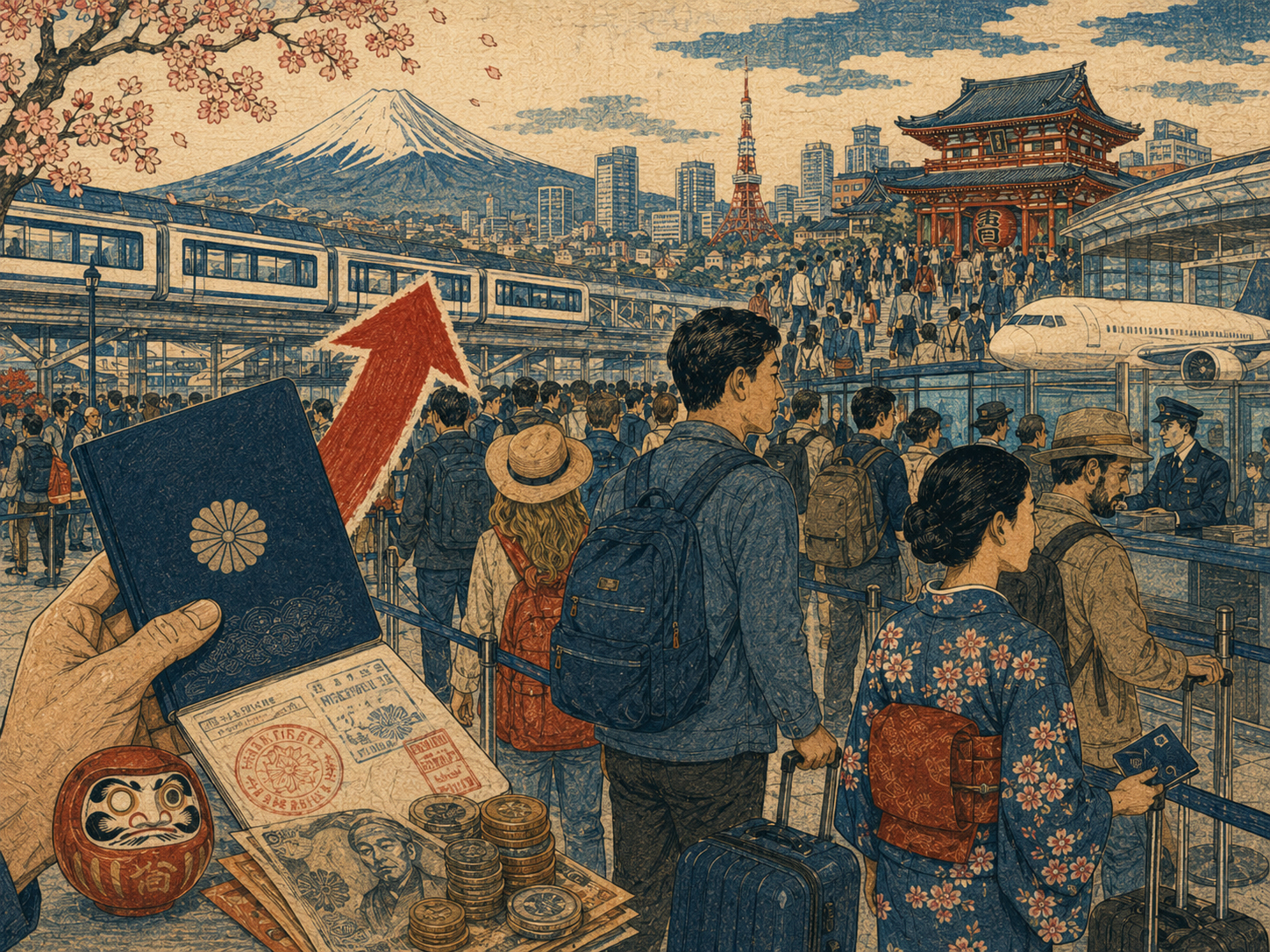
At Narita, the story begins quietly: a passport, a suitcase, a currency machine, a train ticket into Tokyo. For decades, Japan sold itself to the world as a place of order, beauty and welcome. It was never the cheapest country in Asia, but it was safe, clean, fascinating and reliable. Then the weak yen changed the calculation. Sushi, hotels, trains, castles, convenience stores, anime pilgrimages, snow resorts and Kyoto mornings all began to look like a bargain to the world.
On July 1, 2026, Japan changed the price of entry for many travelers who need a visa. The Ministry of Foreign Affairs says that for applications accepted by Japanese diplomatic missions from that date, the fee will be the local-currency equivalent of about 15,000 yen for a single-entry visa and about 30,000 yen for a multiple-entry visa. The previous standard levels had long been about 3,000 yen and 6,000 yen. In plain language: a fivefold increase.
But this is not as simple as the headline sounds. Many short-term visitors from visa-exempt countries — including the United States, the United Kingdom, Canada, Australia and much of Europe — do not normally pay these visa fees for short tourism or business stays. MOFA also notes that fees may not be required, or may differ, depending on purpose of visit and nationality. So Japan has not put a new 15,000-yen toll booth at every airport arrival gate. What it has done is more subtle and more important: it has begun to reprice the administrative gateway to the country.
From 1978 to 2026: the end of the underpriced gate
The fee increase is not just paperwork. Reports describe it as the first major revision since 1978 — the year Narita Airport opened and Japan was preparing for a more international future. That Japan was a different country. It was an exporter, a manufacturer, a rising power, a place people admired from afar. It was not yet the mass inbound tourism destination of the post-pandemic 2020s.
Since then, the story has turned many times: the bubble economy, the lost decades, the tourism nation campaign, the inbound boom of the 2010s, the shutdown of the pandemic, and then the reopening surge. Japan’s border is no longer a quiet administrative line. It is now a pressure point where diplomacy, security, digital processing, labor policy, currency movements and tourism strategy all meet.
The government’s explanation — that the old fees no longer match inflation, exchange rates or administrative costs — is not difficult to understand. Embassy and consular processing now involves identity checks, documentation, fraud prevention, systems maintenance and increasingly digital infrastructure. Higher application volumes require capacity. Low fees are friendly to applicants, but they do not answer the question of who pays to maintain the gate.
The numbers behind the new price of entry
A tourism victory that began to hurt at street level
Japan’s tourism success is real. Inbound travel has supported hotels, railways, airports, department stores, restaurants, small shops, rural inns and local guides. The weak yen made Japan feel affordable to visitors from richer-currency economies. Even as hotel prices rose in Tokyo, the country often remained attractive compared with New York, London, Singapore or Paris.
But success has produced pressure. In Kyoto, residents have complained that city buses are too crowded with tourists for daily life. Around Mount Fuji, local governments have fought congestion, litter and photo-spot chaos. Kamakura, Asakusa, Nara, Shirakawa-go, Niseko, Miyajima, Takayama and other destinations have all had to think not only about how many people come, but when they come, how they move, what they spend, where they sleep and how they behave.
The point is not to blame travelers. Most visitors love Japan, behave respectfully and support the local economy. But when volume crosses a threshold, individual goodwill cannot solve the system problem. Buses fill. Roads clog. Trash costs rise. Cultural properties need maintenance. Hotel prices squeeze domestic travelers. The local resident begins to ask: if tourism is a national export, why does my neighborhood pay the hidden bill?
Dual pricing, lodging taxes and the politics of fairness
The visa fee increase is only one part of a wider shift. Across Japan, national and local governments are reconsidering the costs of tourism: lodging taxes, entry fees, resident discounts, visitor management, transport congestion, digital authorization and crowd-control systems.
Himeji Castle has become a symbol of this new debate. Recent reporting described a two-tier approach in which non-resident admission rose to 2,500 yen while Himeji city residents retained a 1,000-yen rate. Visitor numbers reportedly fell in the first month, but revenue doubled. That is the policy problem in miniature: the number of tourists and the money needed to preserve heritage are not always the same goal.
Kyoto has faced similar questions through lodging taxes and transport policy. If visitors benefit from streets, temples, buses, toilets, signage, safety systems and cultural preservation, should only local residents pay? If the answer is no, the next question is harder: how do you charge visitors without making them feel unwelcome?
Who actually pays?
The direct impact falls on travelers from countries and regions whose nationals need visas to enter Japan, including short-term tourists, business travelers, family visitors and repeat visitors using multiple-entry visas. A 15,000-yen fee can matter to students, young travelers, family groups and budget tour markets. A 30,000-yen multiple-entry fee can matter to people who travel frequently for business or family reasons.
The indirect impact is broader. A higher visa fee changes how Japan is perceived. For some visitors, the cost is small compared with airfare and hotels. For others, especially from emerging markets, it is meaningful. For tour operators, it becomes another line item. For Japan’s regional tourism strategy, it raises a question: will the country still be competitive for the travelers it most wants to attract?
At the same time, visa-exempt short-stay visitors are often outside the direct fee increase. That nuance matters. The United States, much of Europe, Canada, Australia and other visa-exempt markets remain comparatively untouched for ordinary short visits. Japan’s travel gateway is not one door; it is many doors, shaped by nationality, reciprocity, purpose of travel, length of stay and where the application is filed.
From “more tourists” to “better tourism”
For years, Japan’s tourism policy focused on growth. More flights, easier visas, tax-free shopping, regional promotion, cruise ships, ski resorts, anime sites, cherry blossoms, autumn leaves, food and shopping. That strategy worked. It brought life to many local economies and made tourism one of Japan’s great post-pandemic growth stories.
But mature tourism policy cannot stop at counting arrivals. It must measure length of stay, regional distribution, seasonal balance, resident quality of life, heritage preservation, transport capacity, emergency response and the quality of visitor spending. If Japan still wants 60 million visitors by 2030, it needs a system that can carry 60 million people without breaking the places they came to see.
That makes the use of the money as important as the fee itself. If higher charges fund faster processing, better multilingual information, regional dispersion, cleaner tourism districts, heritage repair, transport management and support for visitors during disasters, many travelers will accept the cost. If prices rise while the experience deteriorates, Japan risks damaging the very brand that made it desirable.
A long history of managing the gate
Japan has always managed its openings to the world. In the Edo period, Dejima was a narrow official window. In the Meiji era, treaty ports, railways, hotels and expositions became part of a new international face. After the war, Japan rebuilt itself through occupation, recovery, export growth and the 1964 Tokyo Olympics. The Shinkansen and the Games announced a country ready to be seen.
Tourism nation Japan is another chapter in that history. But the modern gate is not just an airport counter. It is an online application, a passport chip, a QR code, a hotel tax, a train platform, a bus route, a social-media photo spot and a sign asking visitors not to trespass. Managing the gate means more than opening it. It means making sure the people who enter can be welcomed without damaging the life inside.
Japan.co.jp’s view
It would be too easy to describe the visa fee increase as anti-tourist. It would also be too easy to call it merely an administrative adjustment. The truth is more interesting. Japan is moving from the age of unlimited welcome to the age of managed welcome.
The challenge is tone. Japan must explain clearly who pays, who does not, why fees differ, and where the money goes. It must avoid the feeling of a foreigner surcharge while recognizing that visitors create real costs. It must protect residents without making travelers feel unwanted. That balance will define the next decade of Japanese tourism.
Tourism is a mirror of the nation. Airport lines, station signs, bus crowds, castle tickets, hotel taxes, convenience-store kindness, temple quiet. In those details, a country shows how it relates to the outside world. In the summer of 2026, Japan changed the price of entry. The next question is whether it can protect the experience beyond the gate.
Reader guide
| Question | Answer |
|---|---|
| What changed? | Visa applications accepted from July 1, 2026 face new fee levels of about ¥15,000 for single-entry visas and about ¥30,000 for multiple-entry visas. |
| Who is affected? | Travelers from countries and regions that require visas for Japan, including some short-term tourists, business travelers, family visitors and repeat visitors. |
| Who may not be affected? | Many short-stay visitors from visa-exempt countries, depending on nationality, purpose and length of stay. |
| Why now? | The old fee structure dated from another era; inflation, exchange rates, administrative costs and tourism pressure have changed the economics. |
| What is the deeper issue? | Japan is shifting from maximizing visitor numbers to managing tourism quality, resident life and infrastructure costs. |
Sources and references
This article draws on public information from Japan’s Ministry of Foreign Affairs, Japanese diplomatic missions, The Japan Times, The Guardian, Reuters, JNTO-related tourism statistics and Nippon.com.
- Ministry of Foreign Affairs of Japan: Visa Fees
- MOFA Japan: Visa fee announcement in Japanese
- The Japan Times: Japan to raise visa fees for foreign nationals
- The Guardian: Japan, dual pricing and overtourism
- Nippon.com: Japan welcomes record 42.7 million international visitors in 2025
- Reuters: 2024 visitor record and spending