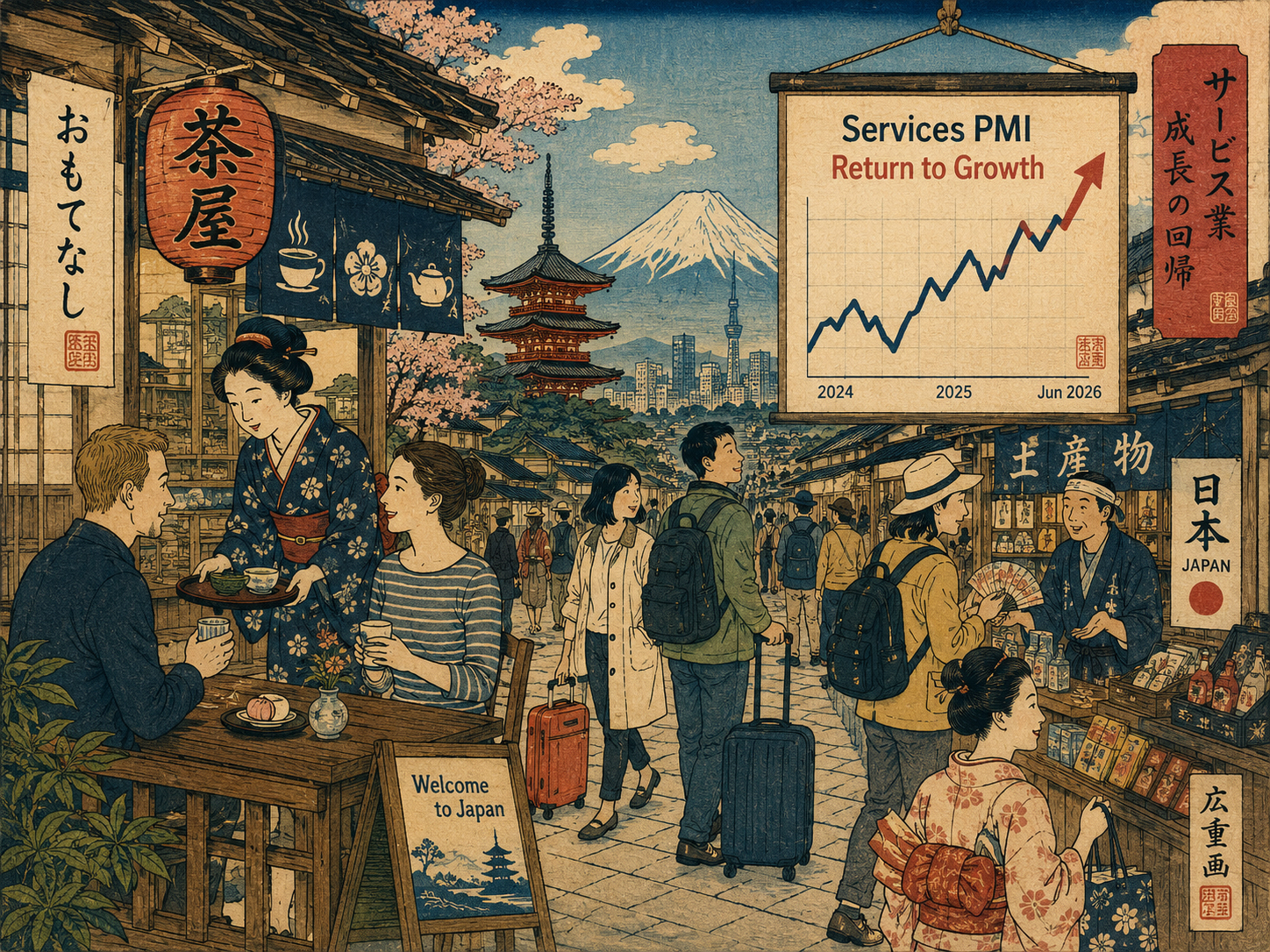
The pulse of Japan’s economy is not heard only in factories. It is also in the ticket gates, hotel check-ins, restaurant bookings, event lines, delivery trucks, tourist suitcases and air-conditioned storefronts. In June 2026, Japan’s services sector returned to growth after stalling in May. It is not a spectacular number. But in an economy facing inflation, Middle East uncertainty and heat-driven changes in consumer behavior, it is an important sign that spending and tourism are still holding up.
The final au Jibun Bank Japan Services PMI, compiled by S&P Global, rose to 52.2 in June from 50.0 in May. A PMI reading above 50 signals expansion; below 50 signals contraction. Reuters reported that Japan’s services sector returned to expansion after a pause, marking the 14th month of growth in the past 15 months. That is a story of domestic resilience.
But this is not a simple celebration. New business increased at one of the quickest rates seen over the past two years, while new export business fell for a third straight month. Cost pressure intensified sharply, with input prices rising at the fastest pace since June 2022. Oil, energy, food and wages all mattered. Japan’s services sector is growing, but it is growing under cost stress.
What the services PMI measures
The services PMI asks companies about business activity, new orders, employment, prices and expectations. If the manufacturing PMI reads the factory floor, the services PMI reads the street economy: hotels, restaurants, transport, information technology, finance, events, leisure, retail and professional services. Most of Japan’s economy is now services.
The 50 line is the threshold. June’s 52.2 is not a boom, but it is a clear expansion. May’s 50.0 was a stall. A return to the 52 range suggests that consumers and companies did not fully pull back.
Manufacturing was also strong in June. The composite PMI, combining manufacturing and services, climbed to 52.8 from 51.1, the strongest expansion in three months. June was a month when both the factory and the street economy improved at the same time.
Japan’s June services economy in numbers
Why services came back
The first reason is domestic demand. Wage growth has not fully overcome inflation, but employment remains relatively stable and consumers are still spending on travel, restaurants, events and entertainment. Even in extreme heat, the street economy does not stop. Demand shifts toward air-conditioned malls, indoor leisure, evening dining, convenience stores, delivery and transport.
The second reason is tourism. Japan welcomed 42.7 million international visitors in 2025, and demand remains high in 2026. Hotels, railways, airlines, restaurants, retail stores, events, local tours, translation, cleaning, security and payment services all benefit. Inbound tourism is no longer a side story for a few famous districts. It is fuel for the services economy.
The third reason is movement. Reuters noted that some firms linked stronger transport demand to product launches and events. When events return, people move. When people move, railways, hotels, restaurants, convenience stores, security, cleaning, advertising, streaming and merchandise move with them. Services growth spreads through human movement.
Tourism is an export
For decades, Japan’s exports meant cars, machinery, semiconductors and electronics. But inbound tourism is now an export consumed inside Japan. Reuters reported that visitor spending reached ¥8.1 trillion in 2024, making tourism an export-class sector second only to automobiles. A hotel room, a sushi meal, a subway ticket, a hot-spring stay, convenience-store ice cream: these are bought in Japan, but they bring in foreign money.
Tourism supports the services PMI, but it also creates complicated problems: higher hotel prices, crowding, labor shortages, resident burdens, two-tier pricing, lodging taxes and heat management. The bigger tourism becomes, the more services growth becomes a public-policy issue.
Summer 2026 adds another layer. Heat changes tourism services. Kyoto shifts to mornings and evenings. Osaka leans on underground malls and indoor destinations. Hokkaido gains value as a cooler refuge. Hotels and tour operators must design not only what tourists see, but when they can safely see it.
Cost pressure is the warning
The most important warning inside the PMI is cost. Input prices rose at the fastest pace since June 2022. Services businesses use people, space and energy. Hotels need cleaners and electricity. Restaurants need food and labor. Transport needs fuel and vehicles.
Middle East tensions also weigh on business sentiment. War and shipping risk affect oil, insurance, logistics and exchange rates, which then affect Japanese services firms. A Tokyo restaurant is not isolated from Middle East risk because ingredients, fuel, power, transport and travel sentiment are globally connected.
Firms want to raise prices. But consumers are already tired of inflation. Foreign tourists may still see Japan as affordable because of the weak yen, but domestic households feel the weight of higher restaurant, travel, hotel and transport prices. The next test for services firms is whether they can raise prices while maintaining value.
Jobs are coming back, but workers are scarce
The June PMI described employment growth as modest: stronger than May’s recent low but still below the average of the 10-month payroll-expansion period. This reflects a structural problem. Demand exists, but workers are short. Hotels, restaurants, care services, logistics, cleaning, retail and tourism all face labor shortages.
Some workers who left during the pandemic never returned. Long hours, low wages, customer complaints, weekend shifts and night work remain problems. Inbound demand can return faster than the workforce does. If frontline staff are missing, service quality falls.
AI and automation are part of the answer: hotel self-check-in, restaurant ordering terminals, translation apps, booking systems, demand forecasting and cleaning efficiency. But services cannot be fully automated. Human judgment, hospitality, cleanliness and reassurance remain central to value.
From post-COVID recovery to heat adaptation
Japan’s services sector was severely damaged from 2020 through 2022. Tourism disappeared, restaurants were restricted, events stopped and hotels emptied. Reopening and domestic mobility then drove a powerful rebound. The years 2023, 2024 and 2025 were the years of post-COVID reopening and weak-yen tourism.
In 2026, another condition is layered on top: extreme heat. Heat changes travel, restaurants and events. Midday outdoor demand weakens; mornings, evenings, indoor venues, northern Japan and air-conditioned places strengthen. Services are moving from post-COVID recovery into climate adaptation.
Japan’s long shift into services
Postwar Japan grew as a manufacturing nation, but its economic center gradually moved into services. Department stores, restaurants, travel, finance, telecommunications, healthcare, education, entertainment, convenience stores, delivery and IT all expanded as incomes rose.
The bubble era expanded hotels, leisure, dining and travel. Even during the post-1990 slowdown, convenience stores, delivery, mobile phones and internet services grew. In the 2010s, inbound tourism became a major engine. In the 2020s, COVID stopped the engine, then reopening restarted it.
That makes the June services PMI more than a short-term indicator. It is a snapshot of where Japan’s long services transformation now stands. A country known for factories is increasingly earning from travel, food, mobility, healthcare, finance, digital systems and experiences.
Regional spillovers
Services recovery is not only a Tokyo and Osaka story. If visitors move into regional Japan, hotels, restaurants, buses, taxis, souvenirs, guides and experience businesses benefit. Hokkaido, Tohoku, Hokuriku, Setouchi, Kyushu and Okinawa all stand to gain if tourism dispersal works.
But regional services face severe labor constraints. Language support, cashless payment, booking systems, limited transport and succession issues all matter. It is not enough to attract visitors. Regions need systems that preserve quality, protect residents and capture value.
Japan.co.jp’s view
The June services PMI is good news for Japan. A reading of 52.2 is not overheated, but it is real expansion. Manufacturing was also strong, and the composite PMI rose. In June, the factory and the street moved forward together.
The real challenge for services is sustainability. Cost pressure, labor shortages, tourism crowding, extreme heat and household fatigue are all visible. Because the sector is growing, its structural problems matter more. Japan cannot become a services powerhouse through cheap prices alone. It must win through quality, productivity, wages, regional dispersal and climate adaptation.
You can read services in people’s faces: the hotel front desk, restaurant kitchen, ticket gate, guide’s voice, cleaner’s hands, convenience-store register. That is where Japan’s current economy lives. The June PMI tells us that this street-level economy is still moving.
Reader guide
| Question | Answer |
|---|---|
| What happened? | Japan’s June services PMI rose to 52.2 from 50.0 in May, returning the sector to expansion. |
| Why does it matter? | Domestic demand, tourism, events, transport, restaurants and hotels continue to support the economy. |
| Positive signs | New business rose at one of the fastest rates in two years, and the composite PMI climbed to 52.8. |
| Concerns | Input prices rose at the fastest pace since June 2022, while foreign demand fell for a third month. |
| Japan.co.jp’s view | Japan’s services sector is recovering, but the next test is sustainable growth through cost pressure, labor shortages, heat and tourism dispersal. |
Sources and references
This article draws on public information from Reuters/S&P Global reporting on the au Jibun Bank Japan Services PMI, Trading Economics, JNTO-related statistics, Reuters reporting on visitor spending, Nippon.com and weather/tourism sources.
- Reuters via SRN News: Japan’s services activity returns to growth in June, PMI shows
- Reuters: June flash composite PMI and services rebound
- Nippon.com: Japan welcomes record 42.7 million international visitors in 2025
- Reuters: Japan 2024 tourism record and visitor spending
- Japan National Tourism Organization: Travel Japan
- Trading Economics: Japan consumer confidence, June 2026
- Japan Weather Association: Summer 2026 weather forecast for Japan