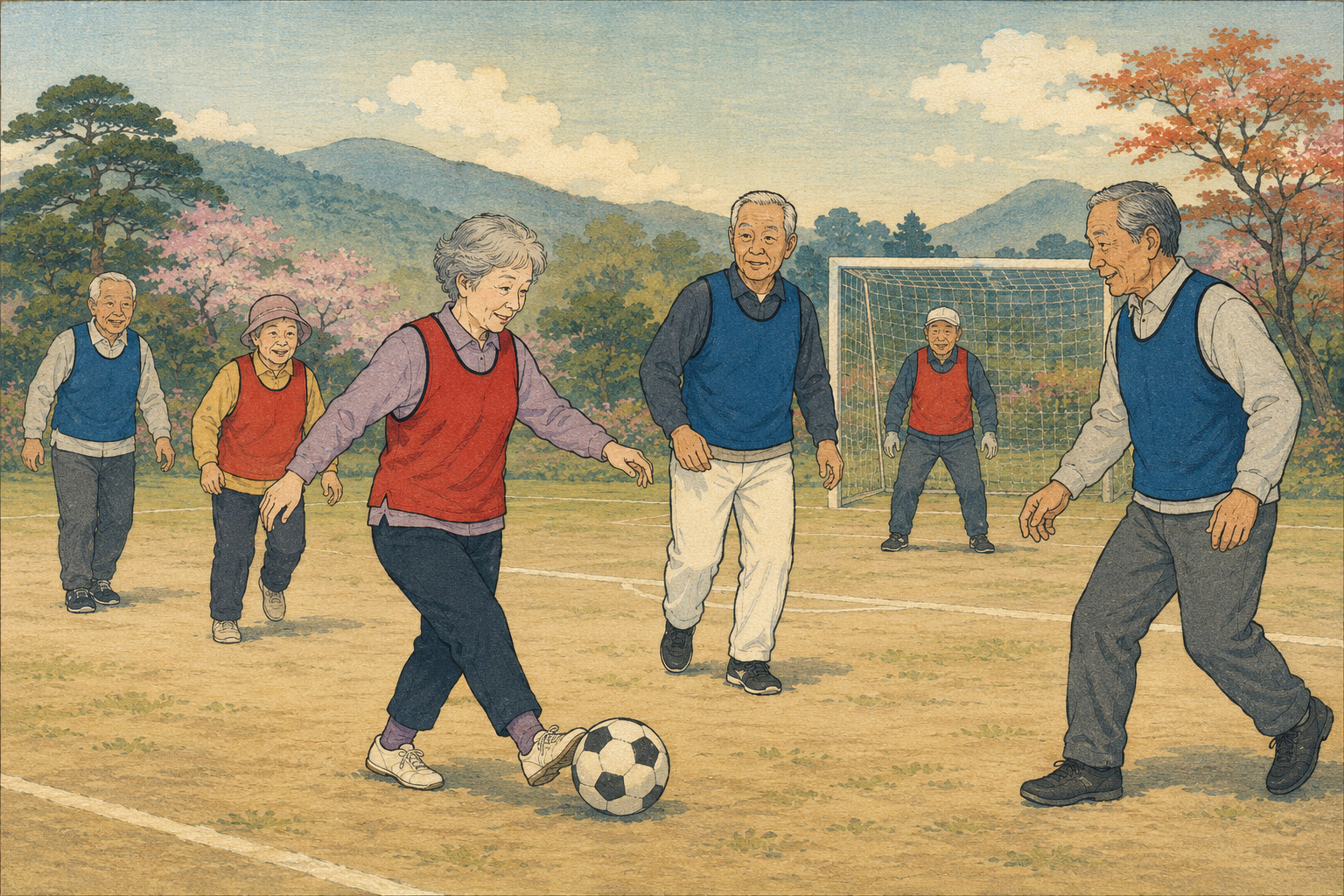
Many football careers end without anybody using the word retirement. A player skips one Sunday because the knee is sore, another because the sprint back into defense has become too expensive. The old team meets less often. Boots stay in a cupboard. Eventually the game becomes a memory that still belongs to the person but no longer fits the body.
The Japan Football Association is offering a date around which that old team can reform. Registration opened on August 26 for the JFA Senior Walking Football Cup 2026 in Shizuoka. It is scheduled for November 23 on the west natural-grass field at National Training Center Shimizu (J-STEP) in Shizuoka City.
Men must be at least 50 on event day; women must be at least 40. Teams may be men-only, women-only or mixed, with six to twelve registered players. JFA will accept no more than sixteen teams and will use a draw if applications exceed capacity. The fee is ¥11,000 per team, and entries close at noon on September 30.
JFA describes the intended player directly: someone who once raced around a football field but found that leg pain or changing fitness made the ordinary game hard to continue. The event is meant to put that person back beside teammates and inside a match. That purpose is an institutional promise, not yet an outcome. No roster, returnee count or continuing-participation result exists on August 28.
A return invitation, not a first invention
JFA's first senior cup was played on December 17, 2023 at Takamado Memorial JFA Dream Field in Chiba. Eight teams and approximately 100 people took part. The federation reported a range from 51 to 77 years old and an average age of 56. Only nine participants were women. Every team played four twenty-minute matches, and JFA said the day ended without an injury.
The 2024 announcement divided the tournament into two categories: men 50 and over with women 40 and over, and men 60 and over with women again eligible from 40. Both were six-a-side. The 2026 version lists only the first of those age combinations and moves the event to Shizuoka.
That makes the new geography more important than a false claim of novelty. A federation event held repeatedly at its own Chiba headquarters can reach an established network. Moving it to a municipal sports center tests whether walking football can travel toward players rather than always requiring players to travel toward JFA.
J-STEP is not a ceremonial backdrop. Shizuoka City describes it as a combined complex of natural and artificial turf, a gymnasium, training facilities, accommodation and other services, with roughly 180,000 annual users in the period reported in 2025. A field built to train athletes will host people trying to decide whether they can call themselves players again.
The competition removes running, not rivalry
The Shizuoka matches will be six-a-side on a 30-by-40-meter field using futsal goals and a size-five ball. Each game has two eight-minute halves separated by four minutes. Substitutions are unlimited and a substituted player may return. Shinguards are compulsory.
If all sixteen places are filled, four groups of four will play a league stage. Teams then enter placing tournaments against clubs that finished in the same position in the other groups. Every team is expected to receive five matches; the four group winners contest the championship bracket.
The short format does not make this an informal JFA taster session. The federation explicitly says the cup will use “Competition” rules based on the laws of the Federation of International Walking Football Associations, or FIWFA. It warns entrants that these are different from JFA's recommended recreational rules and tells teams to study the dedicated rulebook.
That warning prevents a tempting reporting error. Under JFA's general recommended format, everybody walks, heading and contact are prohibited, and an outfield player does not take the ball from an opponent who possesses it; the Japanese adaptation allows the defender to block the path instead. Those provisions were designed to make a first experience less frightening. They cannot simply be copied into an account of the FIWFA-based cup.
| Question | JFA recommended format | 2026 senior cup | Why it matters |
|---|---|---|---|
| Purpose | Entry, enjoyment and inclusive community play | A tournament with rankings and a champion | “Walking” does not mean noncompetitive. |
| Rules base | JFA's Japanese non-contact adaptation | FIWFA-based Competition rules | The event rulebook, not the taster-session summary, controls. |
| Published conditions | Walking, no heading or contact, no challenge for a possessed ball | Six-a-side, 30×40 m, sixteen minutes, unlimited substitutions with re-entry, shinguards | Unpublished enforcement details should not be invented. |
| Outcome | Often structured around participation and exchange | Group play and placing knockouts | Competitive pressure is part of the safety calculation. |
Walking changes which football intelligence can survive ageing. The quickest player no longer owns space merely by sprinting into it. Body orientation, the weight of a pass, anticipation and the next two angles matter more. For a former player, this is not imitation football. It is a rule change that allows old knowledge to become useful again.
The missing step between senior football and no football
Japan already has an extensive age-graded conventional game. In 2026, JFA's calendar includes the 14th national over-40 championship, the 25th over-50, the 26th over-60 and the 20th over-70 tournament. A player who can still run, turn sharply and accept the contact and fatigue of association football can remain inside a long competitive ladder.
Age categories do not themselves reduce physical demand. An over-60 match still contains acceleration, deceleration, kicking, changes of direction and challenges for possession. A replaced hip, an old ankle, cardiovascular concern or a ten-year absence does not disappear because every opponent has also passed a birthday threshold.
Walking football creates a lateral route rather than the next rung of that same ladder. It sits between ordinary senior football and withdrawal from team sport. JFA's wider program also tries to keep its entry side open to beginners, women and people with disabilities. The senior cup branches away from that open recreational model for participants who want a result again.
The gender threshold deserves scrutiny. Women can enter ten years younger than men, yet JFA's announcement does not explain why. Mixed teams are permitted, but the inaugural event had nine women among approximately 100 participants. It would be speculation to describe the age difference as a corrective policy without evidence. The 2026 report should disclose applications, starters and playing time by gender and age.
From a 2011 health session to a Japanese network
JFA's official history traces the format to a July 2011 football session for the health of people over 55 in England. The English Football Association later produced national walking-football laws and announced revised provisions in 2018 covering movement, ball height, restarts and contact.
By 2018, Japanese J.League clubs and community groups were running trial sessions. JFA adapted the English concept, adding its distinctive rule that a defender should not take an opponent's possessed ball. The point was to make participation possible for people with no football technique, limited confidence or disability—not merely to extend the careers of former players.
JFA and Kirin began family-oriented five-a-side events around the country in 2022. Coordinator courses followed, teaching rules, field setup, facilitation and safety. In 2025, JFA launched Walking Hiroba as a national name for approved local sessions and made coordinator training one route toward recognition as an organizing body.
Competition developed beside participation. FIWFA held its first World Nations Cup in England in 2023 with 26 teams from 18 countries across over-50 and over-60 categories. A Japanese team was assembled by the Japan Walking Football Federation, a JFA grassroots partner—not by JFA as a national team. FIWFA says it is an independent organization; its initials should not be mistaken for FIFA affiliation.
JFA launched its own senior cup that same year using the international tournament's rules. The Shizuoka edition therefore belongs to a layered system: low-barrier local entry, trained organizers, a domestic competition and a separate international rule network.
July 2011 JFA identifies an English health-focused session for over-55s as the format's origin.
2018 The English FA revises walking-football laws; Japanese clubs run trial events.
2022 JFA and Kirin expand family walking-football events.
2023 FIWFA stages its first World Nations Cup; JFA holds its inaugural senior cup.
2025 JFA rolls out Walking Hiroba through approved local organizers.
November 23, 2026 The senior cup is scheduled for its first Shizuoka edition.
What the health evidence can—and cannot—say
The demographic case is obvious. People aged 65 or older accounted for 29.4 percent of Japan's population in the Statistics Bureau's 2025 estimate. The health ministry recommends that older adults adjust intensity to individual capacity, work toward at least forty minutes a day of walking or equivalent activity and perform multicomponent exercise three days a week. The same guidance warns of falls when physical function has declined.
Walking football has encouraging research behind it, but the evidence is not a blank check. A 2026 systematic review and meta-analysis covered nine reports, 344 people aged 50 to 81, and interventions lasting four to sixteen weeks at one to three sessions per week. Studies showed consistent within-group improvements in cardiovascular function, fitness, functional autonomy and balance. Findings for mental health and metabolic outcomes were mixed; pooled changes in body-mass index and body-fat percentage were not statistically significant.
The unit of benefit matters. The research examined repeated participation over weeks. A full team at Shizuoka may receive five sixteen-minute matches—eighty minutes of scheduled play in one day—and individual players will rotate. That cannot establish longer life, weight loss or relief from isolation.
The best health proposition is therefore behavioral: a cup may provide a reason to resume regular activity. A 2025 cross-sectional study of 352 players at the English FA Walking Football Cup found that 99.7 percent intended to continue for another year. But the same cohort was unusually active and relatively healthy; an observational snapshot cannot prove that walking football caused those advantages.
Slower can be safer without being safe
JFA's report of no injuries at the 2023 cup is useful, but it is one organizer's account of one day. Kicking, stopping, rotating and approaching a contested ball remain physical actions. A rulebook can reduce exposure without erasing the vulnerabilities that brought some people back through the walking format.
A four-month community cohort published in 2025 recorded 6,019 training hours and 345.55 match hours. The injury rate was 5.3 per 1,000 hours in training and 37.6 in matches. The match estimate carried a wide confidence interval because there were only thirteen match injuries, so it should not be used as a precise forecast for Shizuoka. It does show that competition and training are different environments.
The same study found fewer time-loss injuries than comparison data for veteran recreational association football. Walking football was relatively safer, not risk-free. Knees were the most common location across the walking-football injuries, and strains, tears, ruptures or cramps were prominent in matches—the very concerns likely to matter to returning players.
Unlimited substitutions can be a safety instrument if teams use them before fatigue becomes a warning. Five guaranteed matches can also become cumulative exposure for someone whose last serious fixture was years ago. Warm-up, hydration, rest, medical response and consistent enforcement of walking and contact rules belong in the competition design, not in a disclaimer after it.
- The funnel: Applications, selections, first-time teams and regions represented.
- Actual participation: Registered players, starters and absences by age and gender.
- Playing opportunity: Minutes and substitutions, not just names on a list.
- Safety: Defined medical-attention cases, time-loss injuries, withdrawals and rule offenses.
- Who returned: Former players, current senior players and people new to football.
- Retention: Participation in local sessions three and six months later.
The real result comes after the final
A cup gives old teammates permission to call one another. It imposes a date, a fee, a team name and a reason to find the boots. That social mechanism may be more persuasive than generic advice to become active. The match begins before kickoff, when somebody asks a former teammate to come back.
But a one-day event is not yet a lifelong-sport system. Players need a visible route from Shizuoka into a local Walking Hiroba or club. Beginners need to know whether a session follows JFA's highly protective entry rules or a competition code. Organizers need fields, trained facilitators and equipment. People who cannot afford the trip or assemble six players need an entry point too.
The tournament champion can be decided on November 23. Program success cannot. If participants are still walking into weekly football three months later, if women receive meaningful minutes, if new players are welcomed beside former ones and if safety data improve the next edition, the event will have built something larger than nostalgia.
Walking football does not pretend the ageing body is unchanged. Its dignity lies in changing the game without asking the player to stop caring about the score. Shizuoka will test whether Japan can protect that competitive feeling, govern its risks and turn a way back for one day into a place to remain.
- Japan Football Association — JFA Senior Walking Football Cup 2026 in Shizuoka entry notice (Japanese)
- Japan Football Association — Inaugural 2023 senior-cup report (Japanese)
- Japan Football Association — 2024 senior-cup categories and event design (Japanese)
- Japan Football Association — Walking football and JFA recommended rules (Japanese)
- Japan Football Association — Walking-football FAQ, origin and Japanese adaptation (Japanese)
- Japan Football Association — National Walking Hiroba rollout (2025; Japanese)
- Japan Football Association — Coordinator course and organizer recognition (Japanese)
- Japan Football Association — Japanese club trial sessions in 2018 (Japanese)
- Japan Football Association — 2023 FIWFA World Nations Cup and Japanese teams (Japanese)
- Japan Football Association — 2026 national over-40 championship (Japanese)
- Japan Football Association — 2026 national over-50 championship (Japanese)
- Japan Football Association — 2026 national over-60 championship (Japanese)
- Japan Football Association — 2026 national over-70 championship (Japanese)
- Shizuoka City — Shimizu National Training Center facilities and use (Japanese)
- National Training Center Shimizu J-STEP — Official facility site (Japanese)
- FIWFA — World Nations Cup rules and independent organizational status
- The Football Association — 2018 revision of walking-football laws
- Statistics Bureau of Japan — Population aged 65 and older in 2025 (Japanese)
- Japan Sports Agency — Adult weekly sports participation (Japanese)
- Ministry of Health, Labour and Welfare — Physical-activity guidance for older adults (Japanese)
- Journal of Public Health — Systematic review and meta-analysis of walking football (2026)
- Sports Medicine - Open — Four-month community injury cohort (2025)
- Frontiers in Sports and Active Living — English national-cup participant cohort (2025)
Editor's note: The official Japanese event name is JFAシニアウォーキングフットボールカップ2026 in 静岡; the English rendering in this article is descriptive, not a separately verified official title. Participants, draw and results were not known on August 28. JFA explicitly states that the cup's Competition rules differ from its recommended recreational rules, so this article does not fill gaps with the recreational code. The published material reviewed does not explain the different age thresholds for men and women, fully report the 2024 field, or resolve the status of any same-named 2025 edition; those questions remain in the non-publishable verification memo. The supplied currency timestamp—August 26 at 7:24 p.m. UTC—has been converted to August 27 at 4:24 a.m. Japan Standard Time.