First, correct the count
The familiar description of EBC as 15 chambers and 23 committees is no longer reliable. As of this report’s July 18, 2026 research cutoff, EBC’s home and “About” pages say it represents 17 European national chambers of commerce and business associations and operates 24 industry committees. The live committee-chair page also contains 24 headings. A separate EBC organization page still says 22 committees, an internal inconsistency that the organization should reconcile.
The 17 stakeholders currently listed are the chambers or business associations of Austria, Belgium-Luxembourg, the Czech Republic, Denmark, Finland, France, Germany, Greece, Iceland, Ireland, Italy, the Netherlands, Poland, Spain, Sweden, Switzerland and Ukraine. Ukraine joined in May 2025. The British chamber is not on the current list, reflecting the EBC’s EU-centered mandate after Brexit.
This is more than bookkeeping. An advocacy group’s credibility rests partly on being precise about who speaks, who participates and how a position becomes “European.” This article therefore uses 17 stakeholders and 24 active committee headings, while preserving the contradictory 22 figure as a transparency note rather than silently choosing the most convenient number.
A common voice born from common friction
In 1970 the European Community took responsibility for a common commercial policy. That made it possible for Europe to negotiate trade as a bloc, but its businesses in Japan still experienced barriers as French, German, Italian, Dutch and other national companies. In 1972, chamber leaders and corporate executives created the EC Steering Committee in Tokyo to compare those experiences and turn them into shared positions.
EBC’s fiftieth-anniversary history names representatives of the French, Italian, Dutch and West German chambers among the founders and recalls Luciano Cohen of Olivetti Japan as a founding participant. The European Commission’s Delegation opened in Japan in 1974 and needed the committee’s sector-level intelligence. The early bargain was straightforward: firms supplied practical evidence from the market; European officials gained a more coherent account of Japanese trade and regulatory obstacles.
Tariffs were only part of the problem. Product classification, testing, licensing, distribution, technical standards, tax and administrative discretion could keep a foreign product out even when no border duty did. That is why the council developed by industry. A bank and a cosmetics company may both be European, but the ministries, statutes and evidence they must address are entirely different.
From liquor tax to an annual White Paper
The long dispute over Japanese liquor taxation illustrates the method. Imported whisky and brandy faced higher tax treatment while shochu was taxed more lightly. The European Community opened formal consultations in 1986; Japan revised parts of the system in 1989, and the wider dispute was ultimately resolved through the World Trade Organization in 1998. EBC was not the adjudicator and did not act alone, but its companies helped document how the system operated in the market over many years.
EBC’s history says the organization was officially registered under its present name in 1983; its current profile records a further registration with Japan’s Ministry of Economy, Trade and Industry in 2008 as the European (EU) Chamber of Commerce in Japan. It participated in Japan’s Office of Trade and Investment Ombudsman process, where foreign business groups could raise market-access problems, and added sector committees as regulation became more technical. The Aeronautics, Space, Defence and Security committee dates to 1987. A first full-time executive director arrived in 1991.
In 1995 EBC issued its first White Paper: more than 100 pages of recommendations from 24 committees. By 2000, its history records 27 committees, more than 360 committee members and access to over 3,000 firms through 13 chambers. What began as episodic complaints was becoming a repeatable policy system—state the problem, show the commercial effect, propose an implementable reform and return the following year to measure whether anything changed.
How foreign business influence actually moves
The important work occurs before a delegation walks into a ministry. A member company first identifies a recurring barrier: duplicated testing, a licensing delay, an incompatible technical standard, uncertain tax treatment or a rule that treats a foreign business model differently. Its EBC committee then compares cases across companies. If competitors describe the same obstacle, the evidence becomes harder to dismiss as one firm’s private commercial grievance.
| Stage | What EBC contributes | Where public authority remains |
|---|---|---|
| 1. Market evidence | Companies document cost, delay, inconsistent treatment and international comparisons. | Regulators can test the claim against safety, consumer, fiscal and industrial-policy objectives. |
| 2. Committee consensus | Sector specialists narrow the issue and agree on a recommendation competitors can share. | No EBC recommendation binds a company, ministry or legislature. |
| 3. European coordination | The secretariat, board, national chambers, EU Delegation and embassies align language and priority. | The EU institutions decide official EU policy; national governments retain their own competences. |
| 4. Japanese dialogue | EBC submits papers, answers consultations and meets ministries, agencies, politicians and councils. | Japan’s Diet, Cabinet, ministries, agencies and courts make and interpret Japanese rules. |
| 5. Treaty and follow-up | Issues can enter the EU–Japan Business Round Table, EPA committees or summit-level dialogue. | Treaty parties negotiate state-to-state; implementation is monitored through public institutions. |
The 24 current headings span aeronautics, airlines, asset management, automobiles, automotive components, banking, cosmetics, digital, energy, food and agriculture, government relations, human resources, insurance, intellectual property, legal services, liquor, logistics, materials, medical equipment, railways, retail, sustainability, tax and telecommunications equipment. The secretariat handles policy drafting, meetings, government and media contact, publication and liaison with the EU Delegation.
That structure gives foreign companies access, expertise and persistence. It does not give them a veto. Ministries must balance foreign-market access against safety, privacy, labour, tax revenue, consumers and domestic political choices. A regulatory change can have many parents—Japanese reformers, industry associations, court decisions, treaty commitments and technological change. EBC can credibly claim contribution where its record is clear; it should rarely claim sole causation.
The EPA: the council’s largest strategic campaign
By 2006, EBC was arguing that tariff removal alone would not unlock the relationship. It called for a binding EU–Japan economic integration agreement that also attacked non-tariff measures. Its institutional history describes EBC as the first business organization to advocate an EU–Japan economic partnership agreement. The campaign moved through the EU–Japan Business Round Table, European institutions, Japanese ministries and Keidanren.
A bilateral scoping exercise began in 2011. Political agreement came on July 6, 2017; the text was finalized that December; the agreement was signed on July 17, 2018 and entered into force on February 1, 2019. The EPA created a market of about 600 million people representing close to 30 percent of world GDP at launch. European Commission figures for its first five years—not current 2026 trade totals—show EU–Japan goods trade up 14.2 percent and services trade up 27 percent. Total goods trade was €134 billion in 2023; the Commission’s cited services total was €54.5 billion for 2022.
The framework kept evolving. A data-flows protocol entered into force on July 1, 2024, and the protected geographical-indications list reached 423 after a 2024 expansion. Yet an EPA does not decide Japanese medical reimbursement, professional licensing, labour mobility, corporate tax administration, AI oversight or every product standard. The agreement’s success therefore did not make EBC unnecessary; it shifted advocacy from opening the border to making domestic systems interoperable and predictable.
The 2026 agenda: regulation after market opening
EBC’s current digital White Paper, Reinforcing Partnerships in a Changing World, shows how far the agenda has moved beyond classic tariffs. Its live issue pages cover cross-border payments, global insurance solvency standards, flexible and digitized labour regulation, offshore-wind supply chains, medical-device and AI reimbursement, railway standards, product-safety certification, food shelf life, counterfeit advertising on social media, environmental claims, climate disclosure and global minimum-tax administration.
| Policy field | The business concern | The public-interest test |
|---|---|---|
| Digital, AI and data | Interoperable rules, cross-border data, cyber resilience, open digital trade and industry participation. | Privacy, security, competition, explainability and protection from harmful systems. |
| Health and life sciences | Faster, predictable approval and reimbursement for devices, diagnostics, software and AI. | Clinical value, patient safety, evidence quality and sustainable health spending. |
| Finance and tax | Alignment with global solvency, payment and minimum-tax systems; less duplicative administration. | Financial stability, enforcement, revenue protection and prevention of avoidance. |
| Energy and industry | Bankable offshore-wind rules, workable certification, lifecycle assessment and resilient supply chains. | Decarbonization, grid reliability, community consent, maritime safety and value for consumers. |
| Work and governance | Digital processes, talent mobility, flexible employment and internationally intelligible disclosure. | Worker protection, equality, family policy, accountability and social legitimacy. |
In a May 2026 joint statement, EBC and the Japan Business Council in Europe asked the EU–Japan Digital Partnership to move toward projects and co-investment in AI, cybersecurity and digital infrastructure while preserving open and fair digital trade. The official fourth EU–Japan Digital Partnership Council, held the next day, emphasized cooperation on data, AI, quantum technology, semiconductors, infrastructure and online platforms. The alignment is close, but the two documents are not identical: one is business advocacy; the other records government policy.
Foreign talent becomes a regulatory test
In June 2026 EBC published a survey on Japan’s evolving policies affecting foreign nationals. It reported 213 responses across a broad range of sectors, mainly from European-headquartered companies with substantial Japan experience, including many employers of foreign nationals. More than 90 percent said they were fully or partly aware of the policy changes. Most reported limited immediate operational effects, but respondents raised concerns about administrative predictability, compliance, talent mobility and Japan’s long-term attractiveness.
The survey is useful evidence of business sentiment, not a census of foreign companies. The public web summary does not publish a full sampling frame, response rate or respondent weighting. Those limits should accompany the headline. Even so, the themes match EBC’s intervention at Japan’s Council for Promotion of Foreign Direct Investment on July 3, where an EBC representative urged Japan to publicize foreign-company success stories, preserve an open and competitive visa system and simplify procedures for research-and-development tax incentives.
This is the modern regulatory bargain in miniature. Companies want speed, predictability and global talent. Government is entitled to demand compliance, public confidence and evidence that incentives produce value. A credible chamber makes the trade-off legible rather than pretending that every burden is merely “red tape.”
What has changed—and who deserves credit
EBC’s public record points to resolved or improved issues including tax treatment of liquor, anti-counterfeit enforcement, rules allowing foreign lawyers to suspend gaiben registration temporarily, corporate-law treatment of branches and joint-stock companies, and access by importers to a malt tariff quota from late 2021. The EPA itself is the most consequential result associated with its long advocacy.
Each example requires calibrated language. WTO litigation and government negotiation drove the liquor-tax outcome. Japanese officials, European institutions and other business groups shaped the EPA. The malt-quota change opened access but EBC says administrative burdens remain. Success in regulatory advocacy is usually cumulative: the chamber supplies continuity and market detail while formal authorities deliver the legal act.
Who gets heard inside the “European voice”?
EBC reaches roughly 2,500 company and individual members through its stakeholder organizations, but about 200 companies participate directly in committees. That difference matters. Committee work requires staff time, technical expertise and the ability to attend recurring meetings; large multinational companies are naturally better equipped than small firms. Current annual fees also vary by size: stakeholder-member companies are listed at ¥175,500 for groups with more than 1,000 employees worldwide, ¥130,000 above 250 and ¥65,000 below 250. Certain eligible companies outside stakeholder organizations pay ¥260,000.
Tiered fees improve access, but money is only one barrier. Meetings conducted in technical English, Tokyo-centered networks and the need to follow Japanese rulemaking can still concentrate influence. Consensus brings another filter: a recommendation that survives must work across nationalities and often across competitors, which can strengthen it but leave minority or country-specific concerns outside the final text.
Transparency is therefore part of effectiveness. EBC publishes named committee chairs, policy recommendations, stakeholder organizations and current issues. It should also make its denominators easier to audit—one authoritative committee total, clearer participation statistics, dated organizational pages and more detail on survey methods and the disposition of recommendations. The current 22-versus-24 inconsistency is small, but correcting it would model the administrative precision EBC asks of government.
Leadership in 2026
Nikolaus Boltze, thyssenkrupp’s country representative in Japan, became EBC president in January 2026. The vice-presidents listed by EBC are Karl Deppen of Archion, Jérôme Chouchan of Godiva Japan—currently represented on the board by Armel Cahierre—and Peter Roland of BBC Chartering Japan. Hans-Peter Musahl of JBG Energy is treasurer. The Board of Governors also brings together presidents of the 17 stakeholder chambers and associations.
Chief Operating Officer Valerie Moschetti runs the secretariat, while Chief Policy Director Bjorn Kongstad leads much of the policy machinery. The distinction is useful: elected corporate and chamber leadership sets direction; committee experts build positions; professional staff preserve institutional memory and carry the work between annual cycles.
Real addresses, telephones and direct websites
These details were checked on official organization pages available through July 18, 2026. Arrange an appointment before visiting. The EU Delegation handles diplomacy and EU policy, not visas; the EU–Japan Centre is a separate EU–Japanese government venture supporting industrial cooperation.
| Organization | Current address | Telephone, email and direct website |
|---|---|---|
| European Business Council in Japan | Toranomon Hills Business Tower 15F 1-17-1 Toranomon, Minato-ku Tokyo 105-6415 | General: +81 (0)3-6807-5932 Membership / COO: +81 (0)3-6807-5931 ebc@ebc-jp.com ebc-jp.com direct membership page |
| Delegation of the European Union to Japan | Europa House 4-6-28 Minami-Azabu, Minato-ku Tokyo 106-0047 | +81 (0)3-5422-6001 delegation-japan@eeas.europa.eu official office and contact page |
| EU–Japan Centre for Industrial Cooperation | Shirokane-Takanawa Station Building 4F 1-27-6 Shirokane, Minato-ku Tokyo 108-0072 | +81 (0)3-6408-0281 official Tokyo contact page eu-japan.eu |
Upcoming committee meetings found
EBC’s official July 15 newsletter listed the following meetings after publication day. They are committee sessions, not necessarily public ticketed events; participation may require EBC membership, committee approval or advance confirmation. The newsletter did not publish a public fee or a street venue for these hybrid meetings. Contact ebc@ebc-jp.com and confirm access, time and location before travelling.
| Date and time, JST | Committee meeting | Published format / access note |
|---|---|---|
| Thu, Jul 23 14:30 | Medical Equipment & Diagnostics | Hybrid; confirm eligibility and meeting details with EBC. |
| Tue, Aug 4 08:00 | Digital | Hybrid; no public ticket price or venue listed. |
| Thu, Aug 27 14:30 | Medical Equipment & Diagnostics | Hybrid; advance confirmation required. |
| Tue, Sep 1 08:00 / 10:30 / 16:00 | Digital / Sustainability & Social Responsibility / Railways | Three separate hybrid meetings. |
| Thu, Sep 3 09:30 | Human Resources | Hybrid; contact EBC for access. |
| Tue, Sep 8 12:30 / 13:30 | Government Relations / Energy | Two separate hybrid meetings. |
| Thu–Thu, Sep 10–24 | Liquor (Sep 10, 08:30); Materials (Sep 16, 17:30); Telecommunications Equipment (Sep 17, 10:00); Food & Agriculture and Medical Equipment & Diagnostics (Sep 24, 09:30 and 14:30) | Hybrid; details subject to change. |
The next test: influence that can be inspected
The EBC’s first half-century tracked Japan’s shift from tariffs and import controls toward complex domestic regulation. Its next phase will be shaped by AI governance, data, economic security, climate transition, health technology, ageing, labour shortages and subsidy competition. Those issues blur the old line between “market access” and public policy. A faster approval can benefit innovation; a weak safeguard can shift costs to patients, workers or consumers.
That makes the council’s core technique—translate operating experience into a specific, evidence-backed recommendation—more valuable, but it also raises the standard. EBC should show the evidence and disclose who participates. Japanese authorities should answer recommendations on their merits and explain rejections. European institutions should distinguish commercial preference from negotiated public policy. Readers should resist both easy stories: foreign business is neither a powerless outsider nor a hidden government.
Its real power is quieter. Seventeen national networks can identify a common problem, 24 specialist groups can turn it into language a regulator can use, and a permanent secretariat can keep returning after the diplomatic reception ends. Whether that becomes good reform depends on the quality of the evidence, the openness of the process and the judgment of the public institutions that still hold the pen.
Sources and further reading
- EBC official profile and current headline figures; organization and governance; 17 current stakeholders; 24 active committee headings and chairs.
- EBC, “Five Decades of Advocacy”; presidents and institutional history; secretariat and policy process.
- EBC Digital White Paper, Reinforcing Partnerships in a Changing World; membership, current fees and contact.
- EBC newsletter, July 15, 2026, committee calendar; EBC newsletter, July 8, 2026, FDI Council and current advocacy.
- EBC, June 2026 survey on policies affecting foreign nationals; EBC–JBCE statement on the Digital Partnership.
- European Commission, EU–Japan EPA facts and five-year trade figures; data-flows protocol; EPA Joint Committee and geographical indications.
- European Commission, fourth EU–Japan Digital Partnership Council, May 2026; Japan MOFA, sixth EU–Japan Strategic Partnership Agreement Joint Committee, March 2026.
- EU Delegation to Japan contact; EU–Japan Centre Tokyo contact.
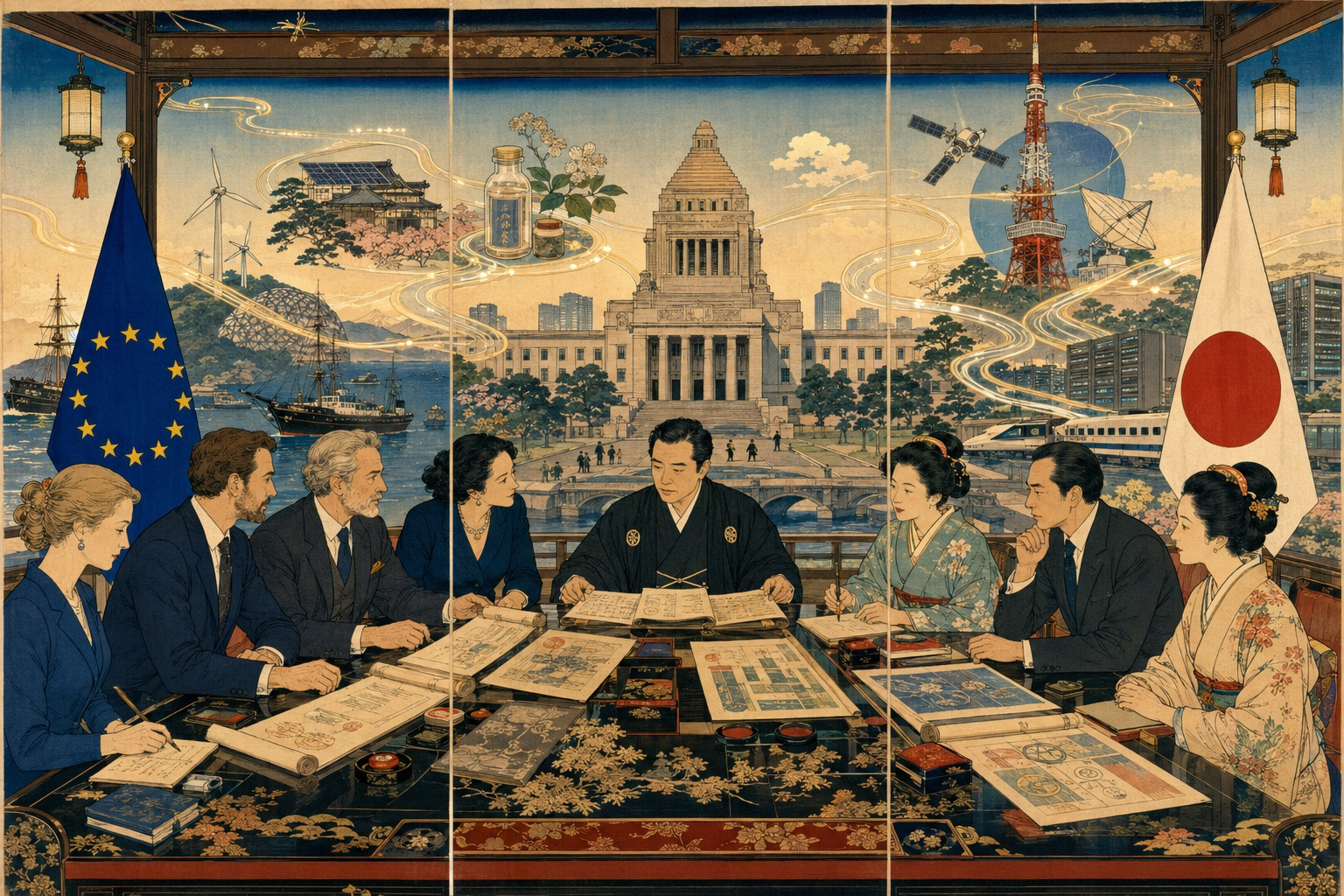
Editor’s note: Research was checked against official EBC, EU and Japanese government sources available through July 18, 2026. EBC’s current home and profile pages and its chair list support 24 active committee headings, while a separate organization page says 22; the discrepancy is disclosed rather than harmonized by assumption. The approximately 2,500 figure combines companies and individuals connected through stakeholder organizations; about 200 companies participate directly. Upcoming meetings are live information and may change. The supplied exchange-rate display is reproduced exactly—“1 US Dollar = 162.39 Japanese Yen”—and its UTC update has been converted to Japan Standard Time: July 19, 2026 at 4:07 AM JST. The hero is a contemporary digital editorial illustration, not an archival print or documentary image.