A layer of Japan that rarely appears on an organization chart
A chamber breakfast can look like ordinary networking: coffee, name cards, a short speech and questions. Yet the room may contain a foreign manufacturer trying to interpret a ministry notice, a Japanese supplier seeking an overseas customer, an embassy economic officer listening for friction, a lawyer spotting a rule that behaves differently in practice, and a policy committee preparing language that will later reach both governments. A club dinner can look purely social, while quietly supplying the relationships that help a newly arrived family find a school, a reporter find context or a local nonprofit find volunteers.
These institutions sit between formal diplomacy and private life. They do not sign treaties, issue visas or regulate markets. Their power is softer and cumulative: they convene, translate, compare, brief, introduce, publish and remember. The American Chamber of Commerce in Japan says it holds about 500 events a year and operates more than 60 committees. The European Business Council in Japan concentrates sector expertise in 24 committees. The Foreign Correspondents’ Club of Japan supplies a stage on which officials, executives, activists and artists can face questions outside their usual institutional setting. The Tokyo American Club, YC&AC and Kobe Club create communities that are not reducible to a lobbying agenda.
Before chambers came the treaty ports
The story begins before the modern nation-state had fully defined its commercial bureaucracy. Yokohama opened in 1859 after the treaties negotiated at the end of the Tokugawa period. Foreign merchants, consuls, missionaries, ship crews and journalists gathered in and around the Kannai settlement, while Yamate developed as a residential district. Kobe’s foreign settlement followed in 1868. These were controlled and unequal spaces created under the treaty-port system, not uncomplicated celebrations of cosmopolitanism. Extraterritoriality and unequal treaties limited Japanese sovereignty, even as the ports became laboratories of international trade, translation, printing, sport and urban design.
The earliest clubs answered practical needs. Residents far from home wanted places to read newspapers, dine, exercise, stage performances and maintain social trust. The Yokohama Cricket Club was established in 1868; YC&AC traces today’s institution to that foundation and to the later merging of football, cricket, athletic and baseball organizations. The Kobe Club dates its beginning to May 1, 1869, when 27 foreign residents founded the English Club, also known as the International Club. Such institutions imported exclusion as well as recreation—the class, gender and racial boundaries of nineteenth-century private clubs—but they also introduced organized cricket, rugby, rowing, football and baseball into local sporting life and became meeting grounds between Japanese and foreign residents.
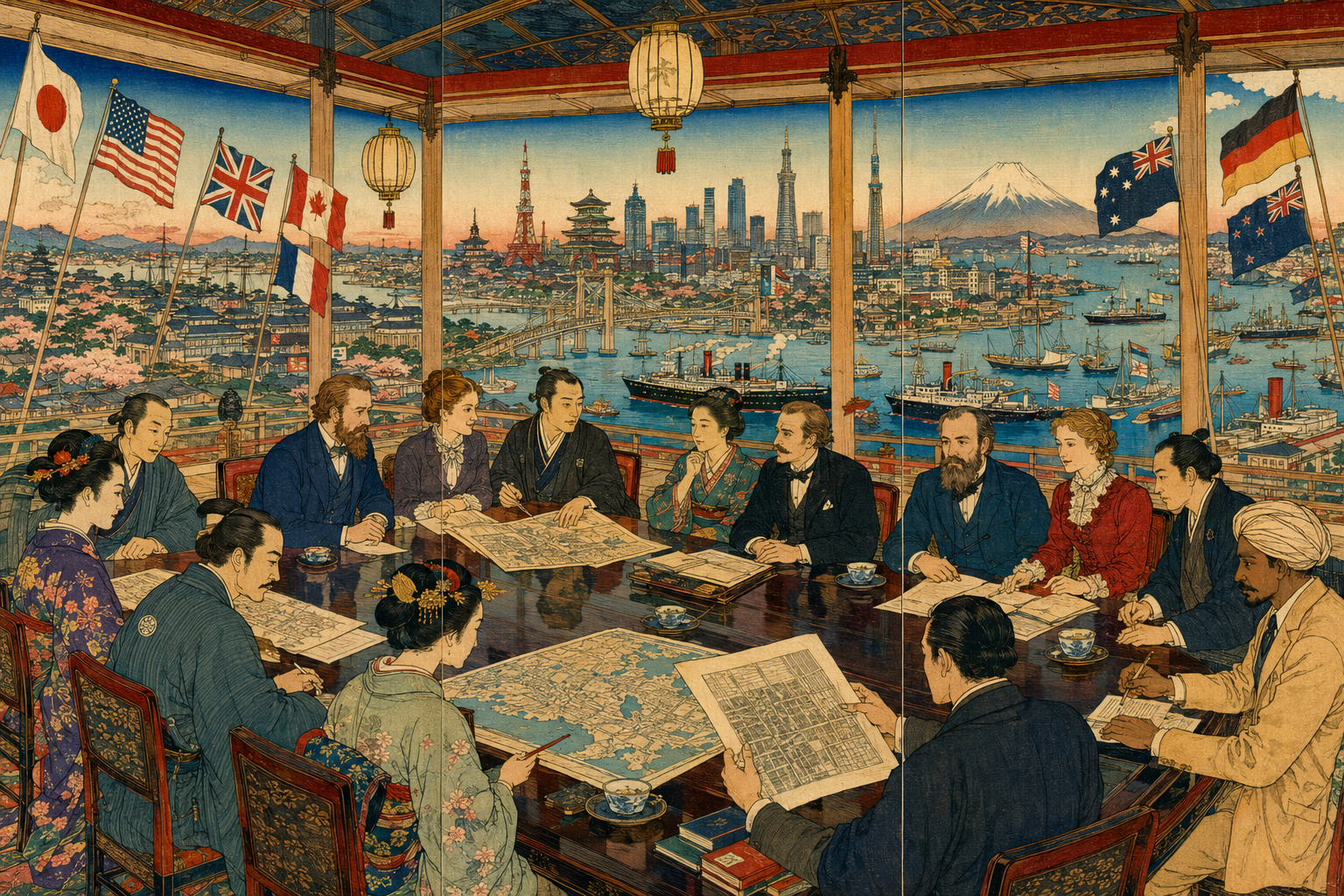
The visual culture of the same era registered the encounter. Yokohama-e artists including Utagawa Yoshitora depicted foreign dress, ships, buildings and commerce for Japanese audiences hungry to see the newly opened port. The hero image for this report borrows that crowded, outward-looking woodblock vocabulary while moving the meeting to present-day Tokyo. The historical prints are evidence of fascination and mediation, not neutral photographs of foreigners or the settlement.
Postwar Tokyo rebuilt the network for a different Japan
Defeat in 1945, Occupation and reconstruction produced a second institutional wave. Foreign journalists arriving in Japan created the FCCJ in 1945. The ACCJ and BCCJ were established in 1948 as the United States, Britain and Japan rebuilt commercial relations. These chambers were no longer treaty-port enclaves. They were membership organizations operating inside Japan’s legal and political order, designed to help firms exchange information and speak collectively.
The International House of Japan added a cultural and intellectual dimension. Incorporated in 1952, it grew from a relationship between Matsumoto Shigeharu and John D. Rockefeller 3rd, who believed international affairs could not be repaired by politics and economics alone. The present Roppongi building—designed by Maekawa Kunio, Sakakura Junzō and Yoshimura Junzō—opened in 1955. Its architecture and garden made dialogue physical: visiting scholars, writers, policy thinkers and artists could stay, meet and work in one place. In 2026 I-House joined the new International House Association as a founding member and concluded a comprehensive partnership with Kyoto, extending the old model of private cultural diplomacy into a global network and a regional Japanese city.
Later institutions reflected deeper trade integration: CCI France Japon had already been founded in 1918; AHK Japan dates to 1962; ANZCCJ to 1972; the European Business Council also to 1972; and CCCJ to 1975. Each began from a national or regional relationship, but their membership and working lives increasingly cross nationality. A Japanese company investing in Britain can belong to BCCJ. A French, German or Australian chamber event may be conducted in English and include executives from many countries. “Foreign chamber” describes an institutional lineage, not a sealed ethnic community.
What a chamber actually does in 2026
A chamber has four overlapping jobs. First, it supplies market entry: introductions, practical guidance, referrals and an early map of a business culture that is difficult to learn from regulation alone. Second, it convenes peers and policymakers. Third, it aggregates advocacy. One company complaining about a licensing delay is an anecdote; a committee comparing the same problem across firms can define a systemic issue, propose language and follow the response over years. Fourth, it creates community through awards, charity, mentoring, sports and informal gatherings.
| Network | Historical base and present scale | What it adds to international Japan |
|---|---|---|
| ACCJ | Founded 1948; more than 3,000 members from 600 companies and 40 countries; Tokyo, Kansai and Chubu. | Large committee system, US–Japan policy advocacy, executive access and approximately 500 annual events. |
| BCCJ | Founded 1948; about 3,700 members and 230-plus companies across more than 40 sectors. | UK–Japan business ties, regional and emerging-leader programs, DEI work and the British Business Awards. |
| CCCJ | Founded 1975; more than 400 member representatives across 46 sectors. | Canada–Japan market bridge, policy and trade missions, plus a growing Kansai mentoring network. |
| CCI France Japon | Founded 1918; the chamber reports more than 650 member companies and offices or representatives in Tokyo, Osaka, Fukuoka and Nagoya. | Business services, recruitment and training alongside French–Japanese commercial and cultural convening. |
| AHK Japan | Founded 1962; part of Germany’s worldwide chamber and foreign-trade promotion system. | German–Japanese industrial intelligence, technical working groups, market services and a strong manufacturing lens. |
| ANZCCJ | Founded 1972; more than 550 members across 24 industries and more than 50 events a year. | Australia–New Zealand business community spanning food, energy, resources, services and Indo-Pacific trade. |
| EBC | Founded 1972; represents 15 European national chambers and more than 2,500 affiliated companies and individuals. | EU-level regulatory advocacy through 24 sector committees and a detailed annual white paper. |
The chambers are not interchangeable. ACCJ’s size allows a broad policy machine. AHK Japan combines membership with Germany’s official foreign-trade architecture. CCI France Japon offers operational services and regional reach. ANZCCJ connects two national communities whose commercial profile in Japan includes food, resources, energy and tourism. EBC is a federation: its value is combining national chambers into a European position on technical regulation.
The 2026 agenda: productivity, people and rules that cross borders
The current agenda is less about tariff levels alone than about domestic rules whose effects cross borders. Artificial intelligence, cybersecurity, data flows, pharmaceutical approval, financial services, energy transition, tax, labor shortages and immigration all appear in chamber programs. EBC’s digital white paper asks Japan and Europe to reinforce regulatory alignment, transparency and mutual recognition under the EU–Japan Economic Partnership Agreement and newer green, connectivity and digital partnerships. Its 2026 issue tracker ranges from parental-leave uptake and gender disclosure to the professional use of surnames—an example of how a “social” rule can become a business-operational problem.
AHK Japan’s 2026 business-climate survey gives a view from industry: 91 percent of responding German companies reported profitability in Japan in 2025; 68 percent expected sales to rise in 2026 and 72 percent in 2027. That optimism coexists with concern over talent, cost and operational complexity. Its August seminar on digital and AI is framed around measurable improvements in transport, inventory and supply-chain planning, not AI as spectacle.
CCCJ’s July 30 event addresses the tension directly: an aging, shrinking population creates demand for workers, while public politics around immigration grows harder. That is precisely where a chamber can be useful—and where it must be careful. Members can contribute operational evidence, but they do not represent all workers, migrants, consumers or local communities affected by a policy. Access to decision-makers is a public-interest asset only when claims are disclosed, evidence can be challenged and the benefits are not confined to the largest firms.
Who gets a seat at the table?
Foreign business groups are often described as “the international business community,” but no membership body is the whole community. Annual dues, Tokyo travel, English-language confidence and the time required for committee work favor established companies and senior professionals. Smaller firms, technical workers, care workers, students, entrepreneurs outside Tokyo, people on precarious visas and foreign residents without corporate sponsorship may experience international Japan very differently.
The institutions themselves are changing. Young-professional forums, women’s networks, family programming, regional chapters, startup categories and non-national membership have widened participation. The July joint-chamber cocktail demonstrates cross-network density: 17 or 19 chambers, depending on the organizer’s page, advertised a gathering of more than 300 people. But a sold-out reception also illustrates scarcity. Twenty or 30 tickets allocated to an individual chamber do not make the wider community represented.
The right question is not whether chambers have influence. Collective advocacy exists to produce influence. The question is how influence is governed: Who approved a position? Which members contributed? Is the paper public? Were affected workers or consumers consulted? Can ministries, journalists and civil society test the underlying evidence? EBC’s public white paper and issue database are one accountability model. Open press conferences, public event pages and published committee recommendations are others.
Journalism: the FCCJ’s different kind of international bridge
The FCCJ is not a chamber, and that distinction matters. It was founded by journalists, and its public role rests on editorial independence and questioning rather than member-company advocacy. From postwar Tokyo, correspondents explained Japan’s political and economic transformation to audiences abroad. Its press conferences have also given opposition politicians, whistleblowers, scientists, authors, activists and visiting leaders a platform that can differ from official press-club routes.
The club is also a physical community with dining, screenings, book events, exhibitions and professional exchange. In July 2026 its calendar moves from press conferences on the yen and Japan’s stock market to a film preview, wine tasting, art exhibition and an Imperial Palace run. That breadth is not a distraction from journalism; it reflects the social infrastructure of a profession whose members often arrive without long local histories. Yet the FCCJ faces the same test as any legacy institution: it must remain useful to freelancers, digital reporters, photographers, local staff and younger journalists, not only to the era of the fully expensed foreign correspondent bureau.
Clubs: sport, family and the work of belonging
The Tokyo American Club, with 4,500 members from more than 60 nations, is a striking example of how a national label can contain a multinational community. Founded by 51 American members in 1928, it now combines recreation, dining, business meetings, cultural activities and family life at Azabudai, with a business-oriented Nihonbashi satellite opened in 2021. Its current Azabudai clubhouse, the institution’s sixth home, opened in 2011.
YC&AC carries the treaty-port sporting lineage into a Japanese public-interest organization. Its grounds at Yaguchidai support cricket, rugby, football, baseball and community festivals. The August Bon Odori is an unusually visible example of cultural exchange moving both ways: an institution born from foreign residents hosts a Japanese summer tradition for a mixed local community.
The Kobe Club, founded in 1869, says its present membership represents more than 30 countries across diplomacy, government, academia, research, medicine and business. Its historic Kitano premises are being rebuilt; the club is operating from a temporary Kaigan-dori office and plans to reopen in spring 2027. Rebuilding is more than a property project. It is a test of whether a nineteenth-century institution can make its next chapter legible and welcoming to twenty-first-century Kobe.
Culture and private diplomacy: the patient work of I-House
International House of Japan operates on a longer clock than an election, quarterly result or news cycle. Its four program domains now cover international relations and geopolitics; social systems, governance and innovation; civilization studies and philosophy; and art and design. The mix matters. A business dispute may be solved by regulation, but mutual understanding depends on histories, languages and values that cannot be compressed into a market-access request.
I-House’s founders understood cultural exchange as a relationship among people, not a decorative supplement to diplomacy. That remains relevant in 2026, when official relations may be strategically close while public opinion, online discourse and lived experience diverge. Its Roppongi building, historic garden, library, guest rooms and conference spaces make continuity tangible. At its best, private diplomacy creates a place where disagreement can continue without requiring immediate consensus.
Verified directory: addresses, telephones and direct websites
Details below were checked against the institutions’ official pages for this July 21 edition. Telephone numbers are listed only when the organization currently publishes one. Membership facilities may require an appointment, registration, invitation or member accompaniment.
| Organization | Current address | Telephone and direct website |
|---|---|---|
| ACCJ American Chamber of Commerce in Japan | Toranomon Hills Business Tower 15F, 1-17-1 Toranomon, Minato-ku, Tokyo 105-6415 | 03-6807-3655 accj.or.jp / contact |
| BCCJ British Chamber of Commerce in Japan | WORK STYLING, Midtown Tower 18F, 9-7-1 Akasaka, Minato-ku, Tokyo 107-0052 | 03-4560-4190 bccjapan.com / contact |
| CCCJ Canadian Chamber of Commerce in Japan | Toranomon Hills Business Tower 15F, 1-17-1 Toranomon, Minato-ku, Tokyo 105-6415 | No telephone currently displayed; info@cccj.or.jp cccj.or.jp / contact |
| CCI France Japon | Nihonbashi Honcho YS Building 2F, 2-2-2 Nihonbashi Honcho, Chuo-ku, Tokyo 103-0023 | Events desk: 03-4500-6531 ccifj.or.jp / department contacts |
| AHK Japan | Sanbancho KS Building 5F, 2-4 Sanbancho, Chiyoda-ku, Tokyo 102-0075 | 03-5276-9811 japan.ahk.de / contact |
| ANZCCJ | UCF635 Win Aoyama, 2-2-15 Minami Aoyama, Minato-ku, Tokyo 107-0062 | 03-4400-2972 anzccj.jp / contact |
| EBC | Toranomon Hills Business Tower 15F, 1-17-1 Toranomon, Minato-ku, Tokyo 105-6415 | 03-6807-5932 ebc-jp.com / contact |
| FCCJ | Marunouchi Nijubashi Building 5F, 3-2-3 Marunouchi, Chiyoda-ku, Tokyo 100-0005 | 03-3211-3161 fccj.or.jp / about |
| Tokyo American Club | 2-1-2 Azabudai, Minato-ku, Tokyo 106-8649 Nihonbashi: 3-2-1 Nihonbashi Muromachi 6F, Chuo-ku, Tokyo 103-0022 | Azabudai 03-4588-0381 Nihonbashi 03-6262-6976 tokyoamericanclub.org |
| YC&AC | 11-1 Yaguchidai, Naka-ku, Yokohama 231-0831 | 045-623-8121 ycac.jp / membership contact |
| Kobe Club | Temporary office: The Second Wanli Building 200, 2-2-1 Kaigan-dori, Chuo-ku, Kobe 650-0024 Club site: 4-15-1 Kitano-cho, Chuo-ku, Kobe 650-0002 | 078-958-9952 kobeclub.org / rebuilding contact |
| International House of Japan | 5-11-16 Roppongi, Minato-ku, Tokyo 106-0032 | Membership 03-3470-9115; accommodations 03-3470-4611 ihj.global / contact |
Upcoming events found on official calendars
The list is current to July 18, 2026. Capacity, prices and access can change; consult the linked organizer before traveling. “Members only,” “full” and registration deadlines are included because an event listing is not a promise of admission.
| Date and time, JST | Organizer and event | Place and access note |
|---|---|---|
| Tue, Jul 21 18:30–21:00 | CCI France Japon: Osaka French National Day Dinner | Hilton Osaka, Nara banquet room, 3F. French and Japanese; registration deadline was July 15. |
| Thu, Jul 23 16:00–18:00 | AHK Japan: Young Leaders Forum 2026 Vol. 3 | DHL Global Forwarding K.K.; AHK members only. |
| Mon, Jul 27 17:30 / 18:55 | FCCJ: Wine Tasting | FCCJ, Marunouchi; two sessions, ¥2,200, advance booking recommended. |
| Tue, Jul 28 18:00–21:00 | FCCJ: Sneak Preview Screening: “Ghost of Ueno” | FCCJ, Marunouchi; check the event page for guest eligibility. |
| Wed, Jul 29 19:00–21:30 | Joint chambers: Summer Cocktail 2026 | Beer Garden Terrace, Hilton Tokyo. More than 300 people; some chamber allocations are full or closed. CCI France Japon lists a waiting list. |
| Thu, Jul 30 17:30–20:00 | CCCJ: The Changing Landscape for Immigration in Japan | Embassy of Canada, 3-38 Akasaka 7-chome, Minato-ku; register by July 24; members ¥4,000, non-members ¥6,500. |
| Fri, Jul 31 18:30–21:00 | FCCJ: “Last Friday” Palace Run | Meet at Marunouchi Nijubashi Building; members and guests welcome, registration requested for weather notices. |
| Sat–Sun, Aug 1–2 from 17:30 | YC&AC: Bonodori Festival 2026 | YC&AC, Yaguchidai, Yokohama; confirm final hours and admission on the club calendar. |
| Mon, Aug 3 12:00–13:30 | BCCJ: Present with Impact — Emerging Leaders Workshop | Dale Carnegie Training Japan, Mochizuki Room, 5F; intended for BCCJ Emerging Leaders. |
| Fri, Aug 7 18:30–21:00 | FCCJ: Tokyo Sinfonia English Serenade Dinner-Concert | FCCJ, Marunouchi; booking details on the calendar. |
| Tue, Aug 25 16:00–19:00 | AHK Japan: Driving Operational Excellence Through Digital & AI | Interactive supply-chain seminar and reception; free for AHK Japan members, members only. |
| Thu, Sep 3 18:30–20:30 | ANZCCJ: Kiwi Aussie Mixer — Tokyo Edition | YOTEL Tokyo Ginza, 1-7-7 Shinbashi; ¥7,500; registration closes Aug 27 at 17:00. |
| Fri, Sep 11 | CCCJ: Kansai Next-Generation Leaders Mentorship Forum | 5-54 Ofukacho, Kita-ku, Osaka 530-0011; registration via CCCJ. |
| Fri, Nov 13 | BCCJ: British Business Awards 2026 | Fairmont Tokyo; early-bird pricing to Aug 7; award applications close Sep 30. |
The network’s future is more Japanese, more regional and more porous
The old model imagined a small expatriate circle interpreting Japan for itself. The more useful 2026 model is reciprocal. Japanese employees lead multinational companies; Japanese firms join foreign chambers to invest abroad; bicultural professionals carry knowledge in both directions; long-term foreign residents are not temporary guests; and regional cities want direct global relationships rather than a connection routed entirely through Tokyo.
This shift changes the measures of success. A chamber should be judged not only by access to a minister but by whether a first-time exporter can use its knowledge. A club should be judged not only by facilities but by whether spouses, children, younger members and Japanese neighbors find a place in its community. A press club should be judged by whether difficult questions reach the room. A cultural institution should be judged by the durability and diversity of the relationships it enables.
The street-level work can look modest: a seminar, a translated memo, a cricket match, a book talk, a mentoring conversation, a reporter asking one more question. Together these repeated acts make international Japan less abstract. The network is quiet because it rarely produces one decisive moment. It connects Japan to the world by making thousands of smaller crossings possible.
Sources and further reading
- ACCJ, About and contact.
- BCCJ, About, contact and events.
- CCCJ, About, contact and events.
- CCI France Japon, Our Chamber, contacts and events.
- AHK Japan, About, contact, events and 2026 survey.
- ANZCCJ, contact and events.
- EBC, history, contact and Digital White Paper.
- FCCJ, About and calendar.
- Tokyo American Club, About and access.
- YC&AC and contact.
- Kobe Club and temporary contact.
- International House of Japan, History, About and contact.
Editor’s note: Research was conducted from official institutional pages available through July 18, 2026. Membership counts are the organizations’ own current descriptions and may use different definitions. Event schedules, capacity and eligibility can change; follow the direct event link before attending. Where an official contact page did not publish a current telephone number, this article does not substitute a number from an older directory. The supplied exchange-rate display is reproduced exactly—“1 US Dollar = 162.39 Japanese Yen”—and its supplied UTC timestamp has been converted to Japan Standard Time: July 19, 2026 at 4:07 AM JST. The hero is a contemporary editorial illustration, not an archival Yokohama-e print.