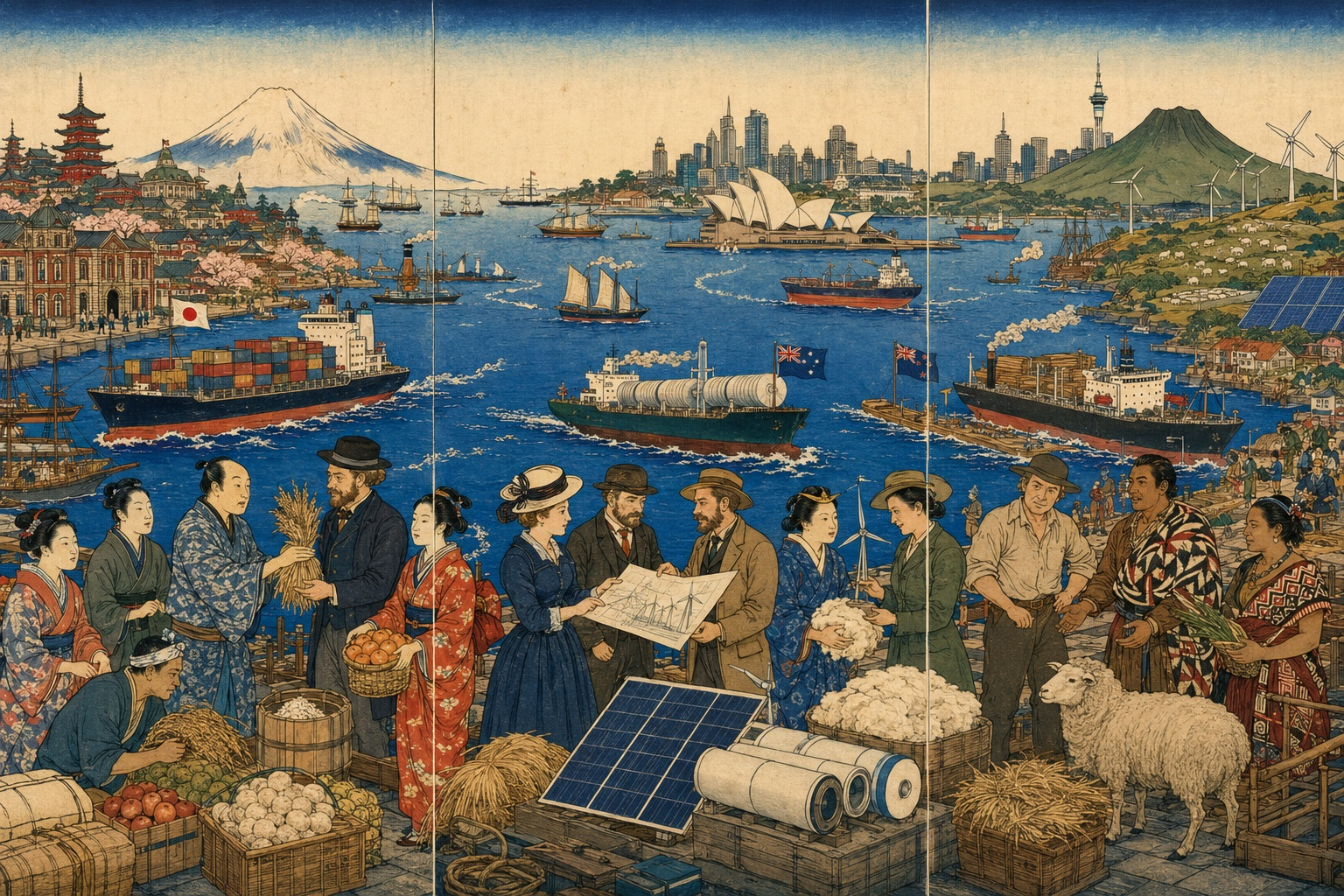
A chamber born before the “NARA Treaty”
Four years before Australia and Japan signed their Basic Treaty of Friendship and Co-operation, business people in Tokyo established what became the Australian and New Zealand Chamber of Commerce in Japan. ANZCCJ’s public history gives 1972 as its starting year. It does not name the founders, reproduce founding minutes or state the first office address, so those details should not be manufactured from institutional folklore. What can be said with confidence is that the chamber emerged from an economic relationship already large enough to need a permanent interpreter.
Australia–Japan commerce reaches back to the late nineteenth century, when Japan imported Australian coal and wool and Japanese migrants worked in Australian agriculture and pearling. By the early 1970s, the link was visible in bulk carriers: Australian iron ore and coal fed Japan’s new steel industry, while Toyota and Datsun were establishing themselves in Australia. In a June 2026 anniversary speech, Australia’s foreign minister described that relationship as thriving but largely conducted “through cargo ships.” Trade had created interdependence before diplomacy gave it a wider name.
New Zealand’s line was distinct. Japan and New Zealand established diplomatic relations in 1952; the New Zealand legation opened in Tokyo that year, and a bilateral commerce agreement followed in 1958. The Japan New Zealand Business Council dates from 1973. New Zealand’s place in a joint chamber made sense because companies from both Australasian economies faced the same Japanese questions—language, distribution, regulation, customers and trusted introductions—even when the goods and political weight differed.
1976 turned a trading relationship into a framework
Australian prime minister Gough Whitlam proposed a broader treaty after visiting Nara in October 1973, giving rise to its informal “NARA Treaty” name. Prime ministers Malcolm Fraser and Miki Takeo signed the Basic Treaty in Tokyo on June 16, 1976. It formally recognized friendship, shared interests and interdependence, and extended most-favoured-nation treatment beyond merchandise to investment and migration. It entered into force on August 20, 1977.
ANZCCJ did not negotiate or sign that treaty. Its significance is more modest and more durable: a chamber founded before the diplomatic framework could help companies use the opportunities that governments created. Over succeeding decades, resource contracts, Japanese investment in Australian projects, tourism, education and professional services thickened the relationship. The Australia–Japan Economic Partnership Agreement entered into force on January 15, 2015, reducing tariffs and improving access. ANZCCJ publicly supported that agreement and joined the business community’s advocacy around it.
New Zealand followed a different trade-policy route. Japan and New Zealand are both parties to the Comprehensive and Progressive Agreement for Trans-Pacific Partnership and the Regional Comprehensive Economic Partnership. The chamber therefore covers businesses operating under bilateral Australian rules, regional trade agreements and Japanese domestic regulation at the same time. “ANZ” is useful shorthand for a community; it is not one customs territory or a single Japan strategy.
What ANZCCJ is—and what it is not
ANZCCJ describes itself as an independent, non-profit organization. Its three missions are practical information, representation of Australian and New Zealand business interests, and commercial connections. Its approximately 550 members include Australian and New Zealand companies in Japan, Japanese companies with interests in the two countries, and international organizations maintaining relevant commercial ties.
The current profile lists 24 sectors, more than 50 events a year and over 5,500 newsletter subscribers. Committees and communities cover food, agriculture and hospitality; sports for business; technology, innovation, education and research; sustainability; and real assets. The Australian and New Zealand ambassadors are joint patrons. Members elect an Executive Council, which meets monthly; the council is the governance body, while a small secretariat operates the program.
In 2026 the chair is Byron Frost, a Baker McKenzie partner; Syn Yi Lee, Lendlease Japan country head and director of investment and asset management, is vice-chair; and Craig Usmar is executive director. The council and ex-officio seats include corporate, professional-services and government voices from both countries, among them New Zealand hotel executive Dean Daniels, former New Zealand ambassador Philip Turner, the Australian deputy ambassador and commercial minister, and New Zealand’s deputy head of mission and trade commissioner.
The boundaries matter. ANZCCJ is not either embassy, Austrade, New Zealand Trade and Enterprise, a Japanese regulator, an export-credit agency or a defence organization. It cannot issue a visa, approve an investment, certify food, award a government contract or speak for all 550 members on every policy. It can convene officials and business, identify shared problems, organize industry work and help a company find the right door.
The Australian scale: energy, minerals and capital
Australia’s economic relationship with Japan is the larger of the two by a wide margin. Australian government data put two-way goods and services trade at A$97.5 billion in 2025. Japan was Australia’s third-largest trading partner and second-largest export market. Australian exports to Japan reached A$65.1 billion; imports from Japan were A$32.4 billion.
The product list explains why energy security sits at the center. In 2025 Australia sent Japan A$19.6 billion in coal and A$19.4 billion in natural gas, followed by A$6.5 billion in iron ore, A$2.5 billion in beef and A$2.1 billion in copper. Australia says it supplies approximately one-third of Japan’s energy and that Japan is its largest liquefied-natural-gas market. Japan, in turn, sends vehicles, machinery and refined petroleum, and provides patient investment capital. At the end of 2024, total Japanese investment in Australia was A$282.9 billion, including A$159.5 billion in direct investment.
That creates both confidence and a transition problem. Long contracts and projects such as Ichthys LNG are pillars of energy security, but Japan and Australia also face decarbonization targets. The next portfolio includes hydrogen and ammonia, carbon capture and storage, lower-emission iron and steel, batteries, renewable power and critical-mineral processing. A chamber can connect engineers, financiers, off-takers and policymakers. It cannot erase the commercial uncertainty over technology costs, certification, carbon accounting or who pays for first-of-a-kind infrastructure.
May 2026 moved the relationship further into economic security. The two governments committed to stronger supply chains for energy, food and critical minerals, protection of critical technologies and consultation during economic-security contingencies. Critical minerals were described as a core economic and national-security pillar, with coordinated investment in processing, refining and advanced manufacturing. For member companies, that language can generate projects; it also brings screening, cyber, export-control and resilience obligations that ordinary networking cannot solve.
New Zealand’s smaller but highly concentrated Japan economy
New Zealand’s relationship is not an Australian appendix. In the year ended December 2025, two-way trade with Japan was NZ$9.2 billion: NZ$4.72 billion of exports and NZ$4.48 billion of imports. Japan was New Zealand’s fifth-largest trading partner and fourth-largest export market. The goods relationship is led by what Japan eats and what New Zealand can produce to exacting specifications.
For the year ended March 2026, New Zealand exported NZ$1.009 billion of dairy products to Japan, 25.9 percent of goods exports. Horticulture contributed NZ$855 million, aluminium NZ$552 million, meat NZ$461 million, forestry NZ$310 million and miscellaneous food NZ$249 million. Vehicles and machinery dominate the return flow from Japan. CPTPP and RCEP improve the rules around that commerce, but market access still depends on biosecurity, inspection, cold chains, labeling, retail channels and the reputation of each producer.
Food security is therefore not a ceremonial theme. Climate shocks, animal and plant disease, freight disruption, input costs and a weak yen can all alter supply or demand. ANZCCJ’s food, agriculture and hospitality community gives producers, importers, hotels and distributors somewhere to discuss those operational problems. The best measure is not the number of wine tastings or dinners; it is whether smaller exporters gain durable distribution and Japanese partners receive reliable supply.
| Relationship | Economic center of gravity | 2026 strategic layer |
|---|---|---|
| Australia–Japan | Energy, iron ore, critical minerals, Japanese investment, vehicles, machinery and beef. | Economic-security declaration, energy and critical-minerals statements, cyber and deep defence integration. |
| New Zealand–Japan | Dairy, horticulture, meat, aluminium, forestry, tourism, vehicles and machinery. | CPTPP/RCEP trade, Pacific cooperation, information security and defence logistics. |
| Shared chamber space | Introductions, market information, advocacy, professional services, hospitality, technology, property and community. | Cross-sector resilience, standards, talent, trusted networks and practical public-private dialogue. |
Tourism and people: recovery is uneven
People flows tell a less symmetrical story. In 2025, 1,058,300 Australians visited Japan—the first year above one million—while 423,104 Japanese short-term visitors went to Australia. Those Japanese visitors spent A$1.6 billion, and 11,627 Japanese students studied in Australia. More than 100 sister-city or sister-state relationships and education programs sustain connections outside company headquarters.
New Zealand recorded 74,812 visitors from Japan in the year ended December 2025, only 76.7 percent of the pre-pandemic level. New Zealand’s foreign ministry identifies the weak yen as a brake on Japanese overseas travel. Airlines, hotels and tourism boards therefore face a market-recovery task, not simply a promotional opportunity. Prices, air capacity, regional dispersal, working holidays and education matter as much as a destination campaign.
ANZCCJ’s social and sports activities are economically relevant when they create repeat relationships across national and industry boundaries. But access deserves scrutiny. Ticket prices, corporate sponsorship and Tokyo-centered schedules can favor large organizations and expatriate professionals. A chamber that claims a tri-national community also needs visible space for Japanese returnees, young professionals, women leaders, regional firms, New Zealand voices and small exporters.
Defence and economic security enter the business vocabulary
Australia and Japan now have a dense security architecture: the 2022 Joint Declaration on Security Cooperation, the Reciprocal Access Agreement that entered into force in 2023, a Framework for Strategic Defence Cooperation established in 2025 and a new statement in May 2026 focused on capability, integration and interoperability. Cyber cooperation and critical technologies link that government agenda directly to infrastructure operators, manufacturers, software suppliers and investors.
Japan–New Zealand defence ties are also becoming operational. Their information-security agreement entered into force on March 27, 2026. The Acquisition and Cross-Servicing Agreement signed in December 2025 will enter into force on August 15, 2026, after diplomatic notes were exchanged on July 16. It establishes procedures for reciprocal supplies and services between Japan’s Self-Defense Forces and the New Zealand Defence Force—such as refuelling, food or medical supplies during exercises, humanitarian relief or disaster response. New Zealand has also used P-8A aircraft from Kadena to monitor illicit maritime activity involving North Korea.
This does not turn ANZCCJ into a defence lobby or an arm of an alliance. It changes the context in which members operate. Companies may face security clearances, classified-information rules, supply-chain assurance, dual-use export controls and procurement integrity. The chamber’s legitimate role is to explain requirements and connect qualified participants. Government alone decides national security policy, access and contracts.
A tri-national chamber with an Australian tilt
The current organization contains genuine New Zealand representation, including council and ex-officio roles and the Kiwi Aussie Mixer. Yet its public calendar and policy agenda often lean Australian: the Basic Treaty anniversary, Australian real assets, investment and the much larger energy relationship naturally produce more events and sponsors. That is understandable, but it should be visible rather than disguised.
ANZCCJ publishes a combined membership total, not a nationality split. It would therefore be inaccurate to claim how many of the approximately 550 members are Australian, New Zealand, Japanese or other. A useful next step would be regular public reporting on member mix, event speakers, committee participation and regional reach. Transparency would let the chamber demonstrate that “New Zealand” is a working constituency and not simply the second initial in the name.
The opportunity is not to force equal scale. It is to find complementarity. Australia brings bulk energy and minerals, deep Japanese capital links and an advanced defence partnership. New Zealand brings premium food systems, renewable-energy expertise, tourism, niche technology and a close Pacific perspective. Japan contributes capital, engineering, a sophisticated consumer market and regional influence. A shared chamber can assemble combinations that none of those bilateral narratives produces alone.
Real addresses, telephones and direct websites
These details were checked on official organization pages on July 18, 2026. Arrange appointments before visiting. The phone number in ANZCCJ’s page header is incorrectly formatted with an Australian country code; the dedicated contact page and site footer publish the Tokyo number shown below.
| Organization | Current address | Telephone, email and direct website |
|---|---|---|
| Australian and New Zealand Chamber of Commerce in Japan | UCF635 Win Aoyama 2-2-15 Minami-Aoyama, Minato-ku Tokyo 107-0062 | +81 (0)3 4400 2972 info@anzccj.jp anzccj.jp official contact page Published hours: Mon–Fri, 10:00–17:00. |
| Australian Embassy Tokyo | 2-1-14 Mita, Minato-ku Tokyo 108-8361 | 03-5232-4111 official contact page Diplomatic, consular and government matters; Austrade operates as its commercial section. |
| New Zealand Embassy Tokyo | 20-40 Kamiyama-cho, Shibuya-ku Tokyo 150-0047 | +81 (0)3 3467 2271 nzemb.tky.pa@mfat.govt.nz official embassy page Published hours: Mon–Fri, 10:00–16:00. |
| New Zealand Trade and Enterprise | Tokyo services are delivered through New Zealand’s government team in Japan; confirm appointment details directly. | nzte.govt.nz official contact page Export growth and international business support, not chamber membership. |
Upcoming ANZCCJ events found
The official ANZCCJ calendar was checked on July 18, 2026. Capacity, eligibility, price, deadline and venue can change; use the official calendar before paying or travelling. The July 29 event remains scheduled, but its published registration and cancellation deadline passed on July 17.
| Date and time, JST | Event | Published venue, price and status |
|---|---|---|
| Wed, Jul 29 19:00–21:30 | Joint Chamber Networking Party — Summer Cocktails Twenty chambers and more than 300 professionals. | Beer Garden Terrace, 7F, Hilton Tokyo, 6-6-2 Nishi-Shinjuku. ¥10,500 members / ¥14,000 non-members. Published deadline passed July 17. |
| Thu, Sep 3 18:30–20:30 | Kiwi Aussie Mixer — Tokyo Edition | YOTEL Tokyo Ginza, 1-7-7 Shinbashi, Minato-ku. ¥7,500; food and free-flow drinks. Registration closes Aug 27 at 17:00. |
| Thu, Sep 17 14:30–17:30 | Australia’s Office Leasing Market 2026 Leasing, repositioning and the next investment cycle. | Conrad Tokyo, 1-9-1 Higashi-Shinbashi. Complimentary; 50-person lottery, members prioritized. RSVP Sep 10 at 17:00. |
| Fri, Oct 2 18:30–20:30 | Australia–Japan 50 Years: Celebrating the Basic Treaty | Horai Ballroom, Meiji Kinenkan, 2-2-23 Moto-Akasaka. ¥18,000 ANZCCJ/JABCC/AJBCC members / ¥20,000 non-members. RSVP Sep 25; capacity 350. |
The next chapter: make the network more useful than the gala
The chamber’s fiftieth year has passed, but the institutional test is only becoming harder. Energy security now demands simultaneous work on dependable fuel supply and credible decarbonization. Food security requires climate resilience, traceability and affordable logistics. Tourism needs two-way recovery rather than record arrivals in only one direction. Defence-adjacent business requires discipline around information, procurement and dual-use technology.
The most valuable ANZCCJ of the next decade will connect large resource groups with startups and smaller exporters; Tokyo headquarters with Kansai and other regions; Australian scale with New Zealand specialization; and diplomatic declarations with operational standards. It will publish enough data to show who has access, whose interests are represented and whether introductions become business.
That is a more demanding mission than networking, but it fits the chamber’s history. ANZCCJ was created before a landmark treaty because commerce needed an institution between official visits. In 2026, when energy cargoes, data, classified information, tourists, food and capital all travel through different rules, that middle layer is not quieter or simpler. It is where the Indo-Pacific economy becomes practical.
Sources and further reading
- ANZCCJ official profile, mission, membership, governance and team; home and current statistics; contact page; official event calendar.
- Australian Embassy, 50th anniversary of the Australia–Japan Basic Treaty; treaty text and dates; June 2026 anniversary history.
- Australian DFAT, Japan country brief, including 2025 trade, investment, tourism and education data.
- Australia–Japan economic-security declaration; energy statement; critical-minerals statement; defence statement.
- New Zealand MFAT, Japan relationship and 1952 diplomatic history; Japan MOFA, Japan–New Zealand basic data and historical timeline.
- New Zealand MFAT, May 2026 Japan Economic Update, including trade, sector and tourism data.
- New Zealand Government, December 2025 defence and information-security agreements; information-security agreement in force; ACSA entry-into-force notice.
- Australian Embassy Tokyo contact page and New Zealand Embassy Tokyo contact page.
Editor’s note: Research was checked against official chamber and government sources available through July 18, 2026. Currency denominations have deliberately not been converted: Australian and New Zealand figures use different reporting definitions and currencies. The ANZCCJ total is members, not necessarily companies, and its public site does not publish a nationality breakdown. Event information is live and may change. The supplied exchange-rate display is reproduced exactly—“1 US Dollar = 162.39 Japanese Yen”—and its UTC update has been converted to Japan Standard Time: July 19, 2026 at 4:07 AM JST. The hero is a contemporary digital editorial illustration, not an archival print or documentary image.