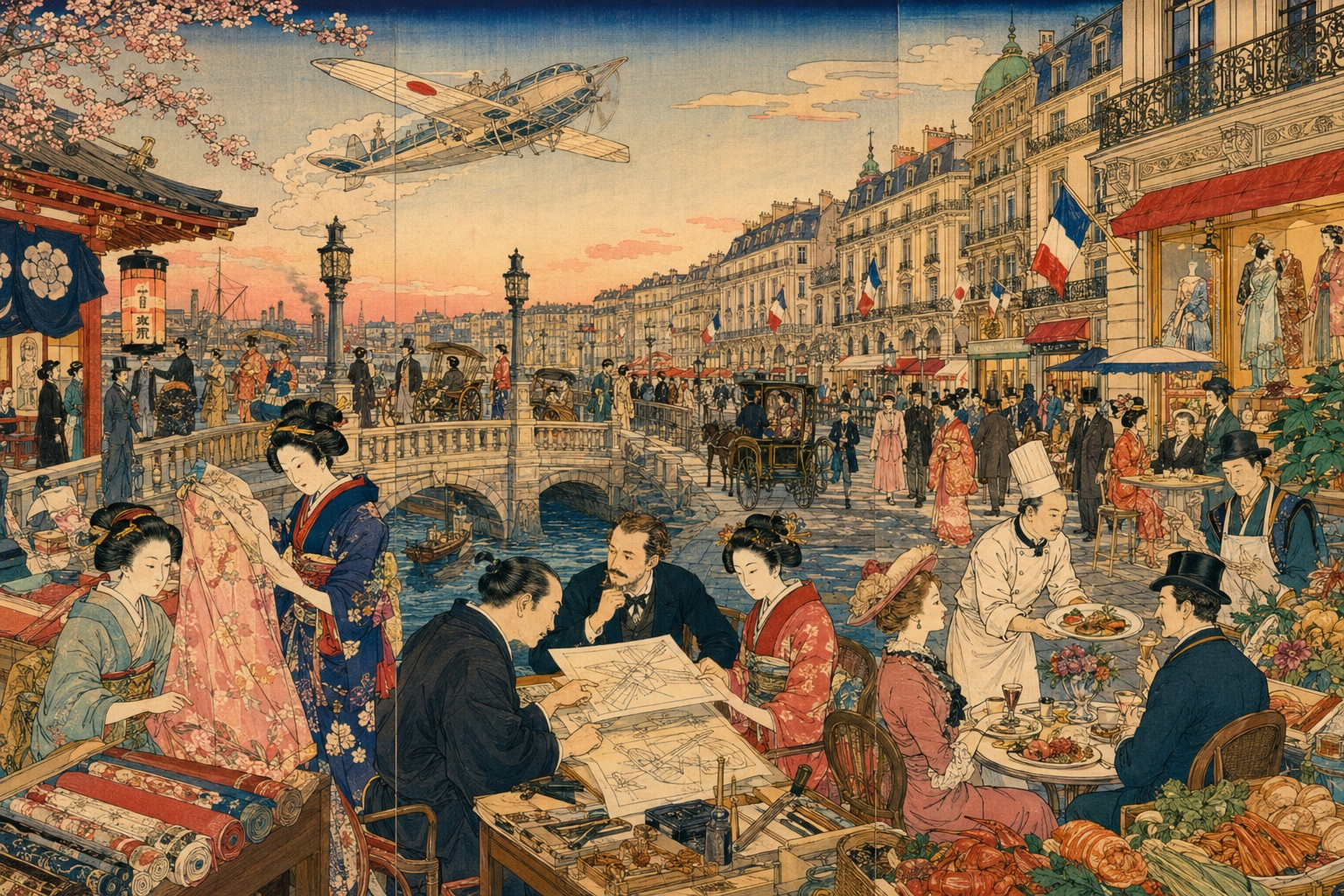
A chamber born in the silk port
The first address tells the story: No. 183 Yamashitachō, Yokohama, headquarters of the trading house L. Barmont & Co. The port opened to foreign commerce in 1859 and became the principal stage on which raw silk, finance, shipping, language and personal trust joined Japan to Europe. When French merchant Léon Barmont organized the Chambre de commerce française du Japon in 1918, the institution did not begin in a ministry or embassy. It began inside a merchant’s office.
CCI France Japon’s official centenary material confirms Yokohama, 1918 and the Barmont premises as its beginning. A detailed secondary history, drawing on the chamber’s ninetieth-anniversary booklet Échanges, records 27 founding members, a central committee in Yokohama and a second section in Kobe. Several founders, including Barmont, first secretary Charles Eymard and Joël Reynaud, worked in the silk trade. Japanese authorities authorized the chamber on October 4, 1918; the decision appeared in the official gazette on November 13, two days after the Armistice, and France recognized it in January 1919.
The wartime context was not incidental. French merchants had previously joined a broader foreign chamber in Yokohama; according to that historical account, the European conflict pushed them toward a national organization. CCI France Japon consequently describes itself as Japan’s first European chamber. That is an institutional claim, but the documented date makes its seniority clear.
Survival, interruption and reconstruction
The institution’s first decades crossed the Great Kantō Earthquake, depression and war. The surviving chronology says activity stopped from 1942 to 1948. Its Bulletin officiel de la Chambre de commerce française du Japon, first published in January 1919, likewise carried an eight-year wartime interruption before continuing until 1963. The publication was an early form of market intelligence: commercial rules, demand and business contacts made legible for firms far from Japan.
Postwar membership was still only 26 in 1950. Yet the commercial landscape was changing. CCI France Japon’s centenary image series preserves a 1953 view of Shiseido in Ginza and another of the futuristic San’ai building. These were not merely lifestyle images. They signalled the emergence of Japanese retail, advertising, design and consumer markets into which French companies would sell and with which they would partner.
Industry was equally important. In October 1961, an Alouette II SA3130 was delivered to Mitsuya Air Service—the first French helicopter in Japan, according to the chamber’s historical series. That machine is a more revealing symbol of the modern relationship than a perfume bottle alone. In 1963 the chamber replaced its old bulletin with the technical monthly Japon Économie et Marché; membership rose from 43 in 1964 to 108 in 1978. The quarterly France Japon Eco began that year and continues the tradition of interpreting Japan’s economy and society.
The 2018 centenary made the archive a strategic asset. Historian Christian Polak produced the 232-page bilingual 1918–2018: A Century of Companies’ Stories in Japan, organized around pioneers, companies and chronology and illustrated from corporate archives. The anniversary program included aerospace, energy, automotive and luxury forums, as well as missions for 100 SMEs and 100 lawyers. More than 800 people joined the concluding program. The message was deliberate: heritage was being used to widen, not narrow, the chamber’s business identity.
What the chamber is—and what it is not
CCI France Japon is a private, nonprofit membership organization. It is not the French Embassy, Business France, JETRO or a Japanese regulator. It cannot issue visas, negotiate treaties, approve a product, award a government subsidy or certify that a company is trustworthy. Its real tools are association: a member directory, events, market research, partner searches, business missions, temporary offices, recruitment, training and publications.
The distinction matters because modern “Team France” work intentionally overlaps. Business France is the French public agency for internationalization; the Embassy represents the state; Conseillers du Commerce Extérieur advise public authorities; the chamber is the enduring private network on the ground. They often cooperate, but their authority and accountability are different.
The chamber says it runs more than 100 events a year. Its most complete public operating snapshot remains 2023: 653 members, 101 benefactors, 126 events and 5,785 participants; 71 companies or organizations hosted in its business centre; 128 business-support projects, 18 trainings and 29 recruitments. These are chamber-reported activity figures, not an independent measure of contracts won or jobs created.
Two membership numbers, one fast-moving network
The main website still markets a community of “over 650 companies and 1,500 decision-makers.” The June 2025 intellectual-property partnership announcement said more than 700 companies. At the March 27, 2026 annual meeting, president Jérôme Chouchan reported a record of more than 719 members at the end of 2025. Rather than choosing one number and hiding the rest, the safest reading is that the stable public profile and the latest annual-meeting count were updated on different cycles.
About one-third of members are Japanese companies, according to the chamber. That makes the organization more than an expatriate French club. Its 25-member board and three auditors are led by Chouchan of Godiva Japan, reappointed for two years in March. First vice-president Ichiro Kashitani comes from Toyota Tsusho; other senior officers represent LVMH Japan, Nihon L’Oréal, B4F and Crédit Agricole CIB. The mix is both bilateral and revealing: consumer brands remain powerful, while trading, finance, mobility, energy, healthcare, law and technology are embedded in governance.
The 2026 annual fees also define access. Benefactor membership is ¥650,000; active ¥295,000; associate ¥210,000; startup ¥140,000; non-Kantō ¥150,000; nonresident €550; individual ¥80,000. Larger contributions bring visibility and access that a startup cannot buy at the same level. That is normal for a chamber, but it should temper claims to speak for every French business in Japan. The organization represents its members; its public value rises when smaller firms, regional companies and informed critics can enter the conversation.
The commercial relationship is still luxurious—and much more
French Treasury data put 2025 bilateral goods trade near €18 billion. France exported €8.4 billion to Japan and imported €9.4 billion, producing a French deficit of €980 million. Luxury remains impossible to dismiss: leather goods, luggage and footwear led French exports at €1.5 billion; apparel contributed €600 million; jewellery and cosmetics remained strongly surplus categories.
But the same table undermines the stereotype. Aircraft and spacecraft products were the second-largest French export at €1.2 billion. Beverages reached €750 million. General machinery exports rose 18.1 percent, miscellaneous chemicals 23.7 percent and French automotive products 103 percent. Japan’s exports to France were dominated by vehicles, machinery, electrical equipment and chemicals. The relationship is a two-way exchange between high-value consumer markets and advanced industrial systems.
The EU–Japan Economic Partnership Agreement, in force since February 2019, reduced trade friction across many sectors. Cross-border data-flow rules entered into force in July 2024, adding predictable digital-trade protections. Yet France accounted for only about 1.6 percent of Japan’s imports in 2025 and ranked fourth among European suppliers in the Treasury account. A prestigious image does not automatically translate into market share.
| Business front | Evidence in 2025–26 | Where the chamber can add value |
|---|---|---|
| Aerospace & space | €1.2bn of French exports in 2025; 27-aircraft ANA Airbus order; 2026 cooperation agenda and December forum. | Connect manufacturers, suppliers, finance, talent, defence and space specialists while keeping security and procurement boundaries clear. |
| Food & beverage | €750m in beverages; BONJOUR FRANCE reached 5,000+ AEON stores in April 2026. | Move producers from national promotion to Japanese distribution, labelling, cold chain and repeat purchasing. |
| Technology | AI, quantum, cyber, semiconductors and IP cooperation all advanced in 2025–26. | Turn delegations and introductions into pilots, licensing, procurement and protected intellectual property. |
| Energy | Nuclear cooperation renewed; September forum covers demand, flexibility, local systems and private finance. | Bring utilities, industry, regions, banks and solution providers together around cost, regulation and decarbonization. |
| Regions | Desks now span Osaka, Fukuoka, Nagoya, Gunma, Fukui and Hokkaido. | Find customers, suppliers, universities and public partners beyond the Tokyo–Paris corridor. |
Aerospace: from the Alouette to economic security
The Alouette II of 1961 began a line that now includes civil aviation, satellites, defence, finance and supply chains. Although French aerospace exports to Japan fell 20.5 percent in 2025 after an exceptional 2024, they still represented 14.1 percent of all French goods exports to Japan. The Treasury points to ANA’s early-2025 order for 27 Airbus aircraft, with deliveries scheduled for 2028–33, as support for the medium-term outlook.
During President Emmanuel Macron’s April 2026 visit, MEDEF International, Business France and JETRO signed a letter of intent on cybersecurity, the aircraft industry and energy transition. Chouchan countersigned for the chamber. The document asks Business France and CCI France Japon to use their services and networks to help French companies develop in Japan. It gives the chamber a follow-through role, not governmental authority.
The wider bilateral science agenda now includes space, nuclear energy, fusion, quantum, AI, health and agriculture. Macron and Prime Minister Takaichi also visited Astroscale, highlighting links among JAXA, CNES, Arianespace, Mitsubishi and emerging “new space” companies. CCI France Japon’s December aeronautics forum accordingly ranges from defence and satellites to civil-aviation talent, financing and critical supplies. Aerospace is no longer a product sale; it is an ecosystem shaped by sovereignty, workforce shortages and sustainability.
Food: cultural visibility becomes distribution
French food and drink are familiar to Japanese consumers, but familiarity does not solve distribution. Labels, import rules, price, shelf life, local tastes and a retailer’s logistics discipline determine whether a launch becomes a repeat order. The chamber’s BONJOUR FRANCE program sits at that practical intersection of culture and commerce.
From April 24 to 30, 2026, the AEON France Fair ran in more than 5,000 stores across Japan under French Embassy patronage. Occitanie was the featured region; the chamber says its Kyushu, Nagoya and Kansai offices helped deepen regional collaboration. Products, cooking demonstrations and performances drew attention, but the business significance was national retail reach. In 2025, French beverages retained a €716 million bilateral surplus and miscellaneous food products improved 3.8 percent.
This is where “art de vivre” can either become cliché or commercial infrastructure. A chamber adds value when a regional producer meets the correct importer, learns the actual margin structure, adapts a package and remains available after the fair. One week of visibility is a beginning, not proof of durable sales.
Technology: the chamber as a protected meeting place
In June 2025, CCI France Japon and France’s national council of industrial-property attorneys, CNCPI, signed a memorandum covering information exchange, mentoring, business partnerships and joint missions. Intellectual property is central to the chamber’s technology claim: introductions without patent, trademark, software, data and licensing discipline can destroy the value they are meant to create.
Its current menu includes Hello Tomorrow Japan for deep-tech collaboration, Data & AI training for leaders and sector forums on retail automation and healthcare AI. At the March 2026 annual meeting, LY Corporation chief Takeshi Idezawa discussed the transition from conversational AI to agents that act across systems. On March 31, the bilateral science committee added quantum, AI, health, agriculture, space, nuclear and fusion to the official research agenda.
Business France brought 40 French companies to Japan and South Korea during the presidential trip and says it supported 567 firms in Japan during 2025. The chamber’s test begins after the delegation: can a meeting produce a pilot, can a pilot survive Japanese procurement, can the parties agree on data, liability and IP, and can a bilingual team provide support? Networking is useful only when it lowers those costs.
The decisive move is away from Tokyo
The chamber’s most consequential institutional change may be geographic. Its Tokyo headquarters remains in Nihonbashi, but public access information now lists desks in Osaka, Fukuoka, Nagoya, Gunma, Fukui and Hokkaido. It also operates “Le Booster” business-centre facilities in Tokyo, Osaka, Nagoya and Fukui. These are not all equivalent full branches, and the chamber itself alternates among “office,” “branch” and “desk.” The precise label matters less than whether a local representative can sustain relationships.
Expo 2025 Osaka, Kansai accelerated the shift: the chamber connected record French delegations to members and regional partners. Fukui’s Koshino Valley office links French business to manufacturing, local innovation and an energy-transition agenda. The Hokkaido desk, opened in Sapporo on April 6, 2026, targets agriculture and food, biotechnology, IT, renewables and the semiconductor ecosystem supported by universities and research centres.
Regional expansion answers a structural problem. A Tokyo reception can expose a company to national headquarters, but Japanese customers, suppliers, laboratories, factories and public incentives are dispersed. Hokkaido food and chips, Fukui manufacturing and energy, Aichi mobility, Kansai healthcare and commerce, Kyushu food and technology require different networks. Success should be measured in active local partnerships, not the number of pins on a map.
Real offices, telephones and direct websites
The following details were checked on CCI France Japon’s official access and Hokkaido pages on July 18, 2026. The chamber publishes no separate telephone for Gunma; enquiries can be routed through Tokyo. Visit by appointment and confirm holiday hours.
| Office or desk | Current address | Telephone, email and direct website |
|---|---|---|
| Tokyo headquarters | Nihonbashi Honcho YS Building 2F 2-2-2 Nihonbashi Honcho, Chuo-ku Tokyo 103-0023 | 03-4500-6505 Fax 03-4500-6603 ccifj.or.jp/en / official access page |
| Kansai / Osaka | Dojima Avanza 6F 1-6-20 Dojima, Kita-ku Osaka 530-0003 | 06-6346-6320 Fax 06-6346-6336 regional network |
| Kyushu / Fukuoka | c/o Meeting Place Fukuoka, Fukuoka Convention & Visitors Bureau Fukuoka City Transportation Bureau 4F, 2-5-31 Daimyo, Chuo-ku Fukuoka 810-0041 | 090-1204-8838 official access page |
| Nagoya | Pola Nagoya Building, B Tower 7F 2-9-26 Sakae, Naka-ku Nagoya, Aichi 460-0008 | 052-218-2346 official access page |
| Gunma | NETSUGEN, Gunma Prefectural Government Office 32F 1-1-1 Otemachi, Maebashi Gunma 371-8570 | Contact Tokyo: 03-4500-6505 official access page |
| Fukui | Koshino Valley, FUKUMACHI BLOCK 6F 1-3-5 Chuo, Fukui Fukui 910-0006 | 03-4500-6678 official Fukui announcement |
| Hokkaido / Sapporo | 13-28-21 Kita 8 Jōnishi, Chūō-ku Sapporo, Hokkaido 060-0008 | 03-4500-6504 hokkaido-desk@ccifj.or.jp official Hokkaido desk |
Upcoming events found
The official calendar was checked on July 18, 2026. Capacity, prices, registration deadlines and venues can change. Follow the direct event page before paying or travelling. The July 29 Summer Cocktail was already fully booked and its July 17 registration deadline had passed. The chamber’s December aeronautics page currently contains a venue inconsistency—its listing gives Nagoya while the body says Tokyo/Nihonbashi Space Week—so reconfirm that location.
| Date and time, JST | Event and direct page | Published venue and access note |
|---|---|---|
| Wed, Jul 29 19:00–21:30 | Summer Cocktail 2026 | Hilton Tokyo Beer Garden Terrace, 7F, 6-6-2 Nishi-Shinjuku. Co-hosted by 17 chambers. Member ¥10,000; nonmember ¥14,000. Fully booked; deadline passed. |
| Wed, Sep 16 14:00–20:00 | Energy Conference — Business Leaders Forum | L’Espace CCI, 1F, 2-2-2 Nihonbashi Honcho. English and Japanese with interpretation. Member ¥12,000; nonmember ¥16,000. |
| Wed, Sep 30 09:00–12:00 | France–Japan: Working Successfully with French Colleagues | L’Espace CCI, Nihonbashi. Japanese. Deadline Sep 25, 18:15. Member ¥45,000; nonmember ¥55,000, excluding tax. |
| Tue, Oct 6 13:30–20:00 | Healthcare Conference — Business Leaders Forum | L’Espace CCI, Nihonbashi. Growth, resilience, AI and leadership; English and Japanese with interpretation. Member ¥12,000; nonmember ¥16,000. |
| Thu, Oct 15 14:00–20:00 | Retail Tech Conference — Business Leaders Forum | L’Espace CCI, Nihonbashi. AI, robotics, logistics, luxury retail and data; English and Japanese with interpretation. Member ¥12,000; nonmember ¥16,000. |
| Mon, Oct 19 19:00–21:00 | European Joint Chamber Networking Party | Mandarin Oriental Tokyo; 12 chambers. Doors 18:30. Registration deadline published as Oct 2 at 17:00. |
| Tue, Dec 1 09:00–18:00 | France–Japan Business Summit | Nikkei Hall, 1-3-7 Otemachi. Theme: Japan as a hub for strategic partnerships in Asia. Member pass ¥17,000; nonmember ¥25,000; VIP ¥38,000. |
| Wed, Dec 2 14:00–20:00 | Aeronautics Conference — Business Leaders Forum | Event listing currently names Nagoya Chamber of Commerce, while page copy says Tokyo/Nihonbashi Space Week. English and Japanese with interpretation; member ¥12,000, nonmember ¥16,000. Confirm venue. |
The chamber’s power is continuity
A presidential visit can set priorities. An economic partnership agreement can lower tariffs. Business France can mobilize a delegation; JETRO can open a public door. None of those institutions can replace the slow accumulation of local memory among companies, employees, advisers and regional partners. That is the chamber’s strongest claim after 108 years.
Its weakness is the mirror image of that strength. A membership network can become self-referential, sponsor-heavy and overly comfortable with Paris–Tokyo prestige. The answer is not to discard luxury, cuisine or gala culture; those are commercially significant sectors and powerful relationship builders. It is to connect them honestly to the rest of the economy and to publish the difference between an event, an introduction, a signed deal and a measured outcome.
The next century is already visible in the 2026 calendar: grid flexibility beside wine; healthcare AI beside fashion; Hokkaido semiconductors beside regional food; space sustainability beside the memory of a 1961 helicopter. CCI France Japon matters when that variety becomes working partnerships—and when a company can call a real person in Nihonbashi, Osaka, Fukuoka, Nagoya, Gunma, Fukui or Sapporo after the official ceremony is over.
Sources and further reading
- CCI France Japon, official chamber profile and 2023 indicators, executive board, and office addresses and telephones.
- 1918–2018: A Century of Companies’ Stories in Japan and official Barmont headquarters history.
- French Wikipedia institutional history, summarizing the chamber’s ninetieth-anniversary booklet Échanges; used for the detailed 1918 legal dates, founding membership and wartime interruption where the current official site provides only an outline.
- CCI France Japon 2026 annual-meeting report, including the 719-plus year-end membership count, governance, activity and fee structure.
- French Treasury, France–Japan goods trade in 2025 and European Commission, EU–Japan data-flow agreement.
- 2026 letter of intent on cyber, aircraft and energy transition, Business France, 2026 Japan–Korea mission, and Japan MOFA, 2026 science and technology committee.
- Élysée, 2026 Astroscale visit and France–Japan space cooperation and France–Japan nuclear-energy joint declaration.
- AEON France Fair — BONJOUR FRANCE 2026, CCI France Japon–CNCPI intellectual-property memorandum, and Hokkaido desk opening.
- CCI France Japon, 2026 Business Leaders Forum calendar and the direct event pages linked in the table above.
Editor’s note: Research was conducted from official chamber publications and event pages, French, Japanese and EU primary sources, and a clearly identified secondary institutional history available through July 18, 2026. Membership figures are published on different update cycles: the stable site profile says 650-plus companies and 1,500 decision-makers, while the March 2026 AGM reported more than 719 members at year-end 2025. Event details can change; one aeronautics page contains a location inconsistency and has been flagged. The supplied exchange-rate display is reproduced exactly—“1 US Dollar = 162.39 Japanese Yen”—and its UTC update has been converted to Japan Standard Time: July 19, 2026 at 4:07 AM JST. The hero is a contemporary digital editorial illustration, not an archival print or documentary image.