The number that made the headline
Ninety-one percent sounds almost too good. In the eleventh annual German Business in Japan survey, conducted by the German Chamber of Commerce and Industry in Japan—AHK Japan—with KPMG Germany, 91 percent of companies answering the profitability question said their Japanese operations generated a pre-tax profit in 2025. The comparable figure for 2024 was 82 percent. Twenty percent reported margins above 10 percent; nine percent reported a loss.
The denominator matters. AHK and KPMG invited 475 Japanese subsidiaries of German corporate groups to the main online survey between January 30 and February 12, 2026. A total of 175 responded, a 36 percent response rate. The profitability chart itself had 124 answers. These are self-reported company results, not audited accounts for every German business in Japan. Established firms with a reason to engage with the chamber may be more likely to respond. The survey is valuable because it is repeated and detailed, but it is a business-climate sample, not a national census.
Read with that discipline, the result is still notable. Profitability improved while global trade disputes, a weak and volatile yen, higher costs and war-related logistics shocks complicated planning. The report’s title—Japan as a “safe haven of stability”—does not mean nothing goes wrong. It means the rules, customers, infrastructure, workforce and political system remain comparatively dependable when other variables are moving violently.
What “stable anchor” means in company language
The survey’s strongest location advantage was not a subsidy or tax rate. Ninety-three percent selected the stability and reliability of business relations; 91 percent cited economic stability; 90 percent a highly qualified workforce. Safety and social stability scored 87 percent, infrastructure 83 percent, a stable democratic political environment 83 percent and openness to technology and innovation 76 percent.
That hierarchy explains the German experience in Japan. A supplier may spend longer earning qualification, adapting specifications and building trust than it would in a looser market. Once accepted, however, a durable customer relationship can support service revenue, replacement cycles and work with the same Japanese client abroad. Forty-one percent of relevant respondents said their group’s sales to Japanese companies outside Japan were more than three times the sales of the Japanese subsidiary inside Japan. Japan is not only a domestic market; it can be the relationship headquarters for Japanese customers worldwide.
Sales potential remains the chief reason to be present, selected by 85 percent. But the market is also an observatory. Sixty-five percent use Japan for trend scouting, 63 percent monitor Japanese competitors, 61 percent value participation in business networks, 47 percent use the country as a benchmark and 45 percent want a role in industry standards. A demanding customer can be expensive. It can also expose weaknesses early and create a reference strong enough to sell elsewhere.
Sixty-five percent see a technology leader—but in what sense?
The 65 percent figure is broader and more careful than “Japan leads all technology today.” In a multiple-choice question answered by 150 companies, respondents were asked about Japan’s future role in the world. Sixty-five percent chose leadership in technology, innovation and sustainability. Fifty-nine percent saw Japan as an active alliance builder in Asia; 57 percent as a promoter of a rules-based international order; 39 percent selected supply-chain and economic-security leadership.
The operating evidence is concrete. Digitalization of industry and services was the leading positive investment driver at 37 percent. The report highlights AI, semiconductors, automation and robotics. Twenty percent of the surveyed operations already conduct R&D in Japan, while 26 percent have production and 29 percent sourcing or procurement functions. This is not Silicon Valley-style technology alone. It is industrial technology embedded in factories, components, quality systems, healthcare, mobility and energy.
The future tense matters. Japan retains exceptional capabilities in precision manufacturing, sensors, materials, robotics and automotive systems, but faces well-known gaps in software adoption, startup scale and organizational speed. The survey records what German managers believe Japan can become and what they expect to learn—not an objective world ranking. The strongest opportunity may be complementary: German machinery, industrial software and engineering joined to Japanese production discipline, materials, components and demanding end users.
The factory story beneath the boardroom story
AHK Japan’s first dedicated manufacturing survey, released in September 2025, identified 84 German companies operating manufacturing or assembly at 132 locations across Japan. That was more than 10 percent of the roughly 730 German firms the chamber counted as active in the country. Thirty-four of 69 relevant corporate groups responded, so this too is a sample and not a universal result.
Its findings show why “anchor” is more than a metaphor. Seventy-six percent of respondents had produced in Japan for more than 20 years. Seventy-nine percent cited proximity to customers, 59 percent the specific requirements of Japanese clients, 38 percent supply-chain stability and 38 percent qualified personnel. Seventy-one percent served both Japan and export markets; ASEAN, China and North America were the principal destinations. Fifty-seven percent planned to expand Japanese capacity.
The surprise was cost. Ninety-five percent of respondents said unit labour costs were below Germany, and 47 percent estimated them at least 30 percent lower. A weak yen helped that comparison, but exchange rates move and cannot alone justify a factory. The deeper case is an established supplier base, quality, automation, customer proximity and the ability to export from a trusted location. The same survey found the biggest constraint: 82 percent struggled to recruit and retain skilled people.
| Japan advantage | 2026 survey evidence | The qualification |
|---|---|---|
| Profitable market | 91% of 124 profitability respondents reported pre-tax profit; 20% reported margins above 10%. | Self-reported sample; not audited results for all German companies. |
| Trusted relationships | 93% cited stability and reliability of business relations. | Trust often requires long qualification cycles and local service. |
| Technology platform | 65% foresee leadership in technology, innovation and sustainability. | A forward-looking opinion, not a current league table. |
| Regional hub | 21% locate an APAC headquarters in Japan; 42% report directly to Germany without an APAC intermediary. | Japan’s APAC-HQ share fell from 25% in the previous survey. |
| Manufacturing base | 84 German companies, 132 production or assembly locations in AHK’s 2025 mapping. | Labour scarcity and language remain binding constraints. |
The obstacles are as important as the optimism
Currency, fiscal and financial risks were the largest challenge, selected by 83 percent—six percentage points above the previous year. A weak yen can make Japanese production attractive in euro terms and simultaneously reduce repatriated earnings, raise imported input costs and complicate headquarters comparisons. High public debt and volatile financial markets add to the category.
Recruiting sufficiently qualified staff followed at 81 percent. The issue is not simply the number of workers. Companies need technical skill, customer-facing Japanese, communication with German headquarters and increasingly English in regional roles. Retention was a challenge for 46 percent; 43 percent cited labour-law inflexibility. Rising commodity and energy costs affected 61 percent, inflation 55 percent and higher labour costs 51 percent.
Optimism also contains a strategic retreat. Forty-four percent ranked Japan among their group’s top five markets for turnover and profit, down from 47 percent in 2025 and 54 percent in 2024. Twenty-one percent designated Japan as an Asia-Pacific headquarters, down from 25 percent. Fifty-five percent were doing third-country business with Japanese partners, eight points lower year on year. The anchor remains valuable, but companies are continuously comparing it with Singapore, China and other Asian bases.
A shock after the main survey
The main questionnaire closed before the late-February outbreak of war in Iran. AHK and KPMG therefore ran a flash survey from March 25 to 27 among 478 German companies in Japan; 153 responded, or 32 percent. Ninety-four percent expected greater global inflation risk, 92 percent an energy crisis, 91 percent higher geopolitical risk and 88 percent supply-chain disruption.
The effects were already operational. Seventy percent cited higher oil, gas or electricity prices; 60 percent transport and logistics disruption; 55 percent reduced planning certainty. Thirty-eight percent reported falling profit because higher costs could not be fully passed through, while 27 percent expected lower sales and 23 percent lower orders. The flash survey makes the article’s central paradox visible: Japan can be internally stable and still be exposed to imported energy prices and maritime chokepoints.
Stability therefore means preparation rather than insulation. Fifty-nine percent thought Germany could learn from Japan’s supply-chain diversification, 42 percent from risk management and disaster readiness, 40 percent from recycling critical raw materials, 38 percent from strong local supplier networks and 35 percent from greater independence in semiconductor production. Japan’s repeated experience with earthquakes, energy shocks and rare-earth pressure has turned resilience into an economic capability.
From an 1861 treaty to a chamber in 1962
Formal relations began with the 1861 Treaty of Amity, Commerce and Navigation between Japan and Prussia. During the Meiji period, German medicine, law, science and engineering influenced Japan’s modernization, while merchants and industrial companies built practical links. War destroyed the political relationship, but the postwar economic recovery created the need for a permanent institution that could translate rules, customers and business culture in both directions.
AHK Japan dates its work from 1962. The numbering of its 64th annual general meeting in June 2026 follows that institutional line. The organization grew alongside Japan’s high-growth era, the expansion of German chemical, machinery, electrical and automotive businesses, the oil shocks, Japan’s bubble and its long aftermath. It later had to interpret a more open but still demanding market shaped by the European single market, global supply chains and China’s rise.
The broader relationship accumulated durable infrastructure. The bilateral science and technology agreement entered into force in 1974. The Japanese-German Center Berlin was established in 1985. AHK’s German-language business magazine JAPANMARKT has appeared since 1992. In 2016, AHK and KPMG began the annual business-climate survey that reached its eleventh edition in 2026.
The EU–Japan Economic Partnership Agreement entered into force in February 2019, covering a zone representing close to 30 percent of global GDP at the time. A cross-border data-flow protocol followed in July 2024. Japan and Germany also established bilateral economic-security consultations in 2024; their second meeting in Tokyo in October 2025 covered resilient supply chains, non-market policies and the protection and promotion of critical and emerging technologies. In June 2026, senior foreign-ministry officials again placed supply-chain resilience inside the bilateral agenda.
Three functions under one roof
AHK Japan describes three distinct functions. It is an official representative of German business, co-funded by Germany’s Federal Ministry for Economic Affairs and Energy. It is a commercial service provider under the DEinternational brand, offering market intelligence, partner search, business-trip support, event management, temporary business presence, legal and tax orientation, verification and public-procurement information. And it is a voluntary membership organization.
The current profile says around 470 member companies and more than 30 trilingual staff. AHK Japan belongs to the wider network of approximately 150 German Chambers of Commerce Abroad in 93 countries. Membership is open beyond German companies; full corporate fees currently range from ¥200,000 to ¥430,000 according to revenue or employee count. Members receive networks, working groups, events, the member directory, JAPANMARKT and service discounts.
Those roles should not be blurred. AHK is not the German Embassy, a Japanese regulator, a court, an investment bank or an auditor. It does not grant visas, licenses or subsidies, and survey results are not a guarantee that a new entrant will be profitable. Its advantage is accumulated practical knowledge and access. Its conflicts must be managed precisely because it both represents members’ interests and sells services to companies.
Who leads the chamber in 2026
Members elected a new board at the 64th annual general meeting on June 16, 2026. Karl Deppen of ARCHION Corporation is president. Vice-presidents are Andrea Coscia of TÜV SÜD Japan and Andreas Dannenberg of Ad-comm Group. Ina Helm of Infineon Technologies Japan is treasurer. Marcus Schürmann is managing board member, chief executive and Delegate of German Industry and Commerce in Japan.
The board includes executives from SAP Japan, Kaeser Kompressoren, Bosch, DHL Global Forwarding, Vollmer, Evonik, Guhring and C. Illies/IRISU. JETRO chairman Norihiko Ishiguro and Keidanren chairman Yoshinobu Tsutsui serve as Japanese advisers. That composition reflects the chamber’s centre of gravity: advanced manufacturing and industrial services, with logistics, software and institutions around them.
Real addresses, telephones and direct websites
These details were checked on official organization pages on July 18, 2026. AHK’s office is closed on Japanese public holidays and designated chamber holidays; normal published hours are Monday to Friday, 9:00 to 17:30. Arrange appointments before visiting.
| Organization | Current address | Telephone, email and direct website |
|---|---|---|
| German Chamber of Commerce and Industry in Japan (AHK Japan) | Sanbancho KS Building 5F 2-4 Sanbancho, Chiyoda-ku Tokyo 102-0075 | +81 (0)3 5276 9811 info@dihkj.or.jp japan.ahk.de/en official access page |
| Embassy of the Federal Republic of Germany | 4-5-10 Minami-Azabu, Minato-ku Tokyo 106-0047 | +81 (0)3 5791 7700 official Embassy page State, consular and diplomatic matters—not chamber membership or commercial consulting. |
| JETRO Invest Japan Business Support Center, Tokyo | Ark Mori Building 7F 1-12-32 Akasaka, Minato-ku Tokyo 107-6006 | +81 (0)3 3582 4684 official IBSC page Public support for foreign companies investing in Japan. |
| EU–Japan Centre for Industrial Cooperation | Shirokane-Takanawa Station Building 4F 1-27-6 Shirokane, Minato-ku Tokyo 108-0072 | +81 (0)3 6408 0281 official contact page EU–Japan industrial, trade and investment cooperation. |
Upcoming AHK Japan events found
The official calendar was checked on July 18, 2026. Event capacity, member eligibility, language, deadlines and venues can change. Follow the direct page before paying or travelling. Summer Cocktail registration was already closed when checked. The defence forum is consistently dated September 29–30, but AHK’s Japanese calendar and English detail page publish different street addresses for the venue. The venue discrepancy is flagged below rather than silently resolved.
| Date and time, JST | Event and direct page | Published access note |
|---|---|---|
| Thu, Jul 23 16:00–18:00 | Young Leaders Forum 2026, Vol. 3 | DHL Global Forwarding K.K.; free, AHK members only. Karsten Michaelis discusses Japan business, logistics and leadership. |
| Wed, Jul 29 19:00–21:30 | Summer Cocktail 2026 | Hilton Tokyo Beer Garden Terrace, 7F; ¥10,500, AHK members only; 19 chambers and 300 participants expected. Registration closed. |
| Wed, Aug 19 & Tue, Aug 25 14:00–16:00 | Dealership Tour: Automotive Mechatronics | Koto BMW and Minami-Kanto Fuso Ichikawa. Free; principally for high-school students, guardians and teachers; 8–10 places per visit. |
| Tue, Aug 25 16:00–19:00 | Driving Operational Excellence Through Digital & AI | AHK Japan; English; free for members; deadline Aug 21. Supply-chain AI with 4flow and Schaeffler. |
| Thu, Sep 3 16:15–18:00 | Finance Working Group 2026, Vol. 2 | AHK Japan; English; free for members; deadline Sep 1. Japanese startup valuation and venture investment. |
| Sep 29–30 | 14th German–Japanese Defense and Security Technology Forum | Bellesalle Kudan, Chiyoda-ku. Free but restricted to relevant German or Japanese sectors and organizations. Confirm the street address: AHK’s Japanese listing says 1-8-10 Kudan-kita, while the English detail page displays a different address. |
The next test: turn reliability into renewal
The survey outlook is strong. Sixty-eight percent expect Japanese sales to rise in 2026 and 72 percent in 2027; 55 percent expect higher profit this year and 63 percent next year. Thirty-five percent plan investment growth in 2026 and 39 percent in 2027. Over the 2027–29 period, 26 percent of relevant respondents plan €5 million to €50 million in Japan, up 12 percentage points from the previous survey; another 7 percent plan more than €50 million.
But stability can become complacency. Japan’s value will decline if reliable relationships harden into closed procurement, if skilled workers cannot be found, if digital systems remain fragmented or if a weak yen becomes a permanent excuse for low investment. German companies likewise cannot treat the country as a showroom managed from Singapore. The successful cases are localized: engineering, service, procurement and management capable of answering Japanese customers and connecting them to the global group.
AHK Japan’s most useful task is not to sell a perfect story. It is to keep the tension visible. Japan is profitable for a high share of surveyed incumbents and punishing for newcomers who underestimate time, language and service. It can lead in robotics, materials and industrial sustainability while lagging in software diffusion. It is politically and socially stable while acutely exposed to energy and shipping shocks. That is not a contradiction to be edited away. It is the reason a sixty-four-year-old chamber still has work to do.
Sources and further reading
- AHK Japan and KPMG, German Business in Japan 2026 release and the 35-page survey report.
- AHK Japan, 2025 German manufacturing survey.
- AHK Japan, official profile, functions, membership and global network; contact and access; 2026 board.
- AHK Japan, 64th annual general meeting and 2026 board election.
- German Federal Foreign Office, bilateral relations and 2025 trade, including €21.0bn German exports to and €22.1bn imports from Japan.
- Japan MOFA, second Japan–Germany Economic Security Consultations, October 2025 and June 2026 vice-ministers’ meeting.
- European Commission, EU–Japan EPA factsheet and cross-border data-flow agreement.
- AHK Japan official event calendar and the direct event pages linked in the table above.
- German Embassy Tokyo, JETRO IBSC, and EU–Japan Centre official contact pages.
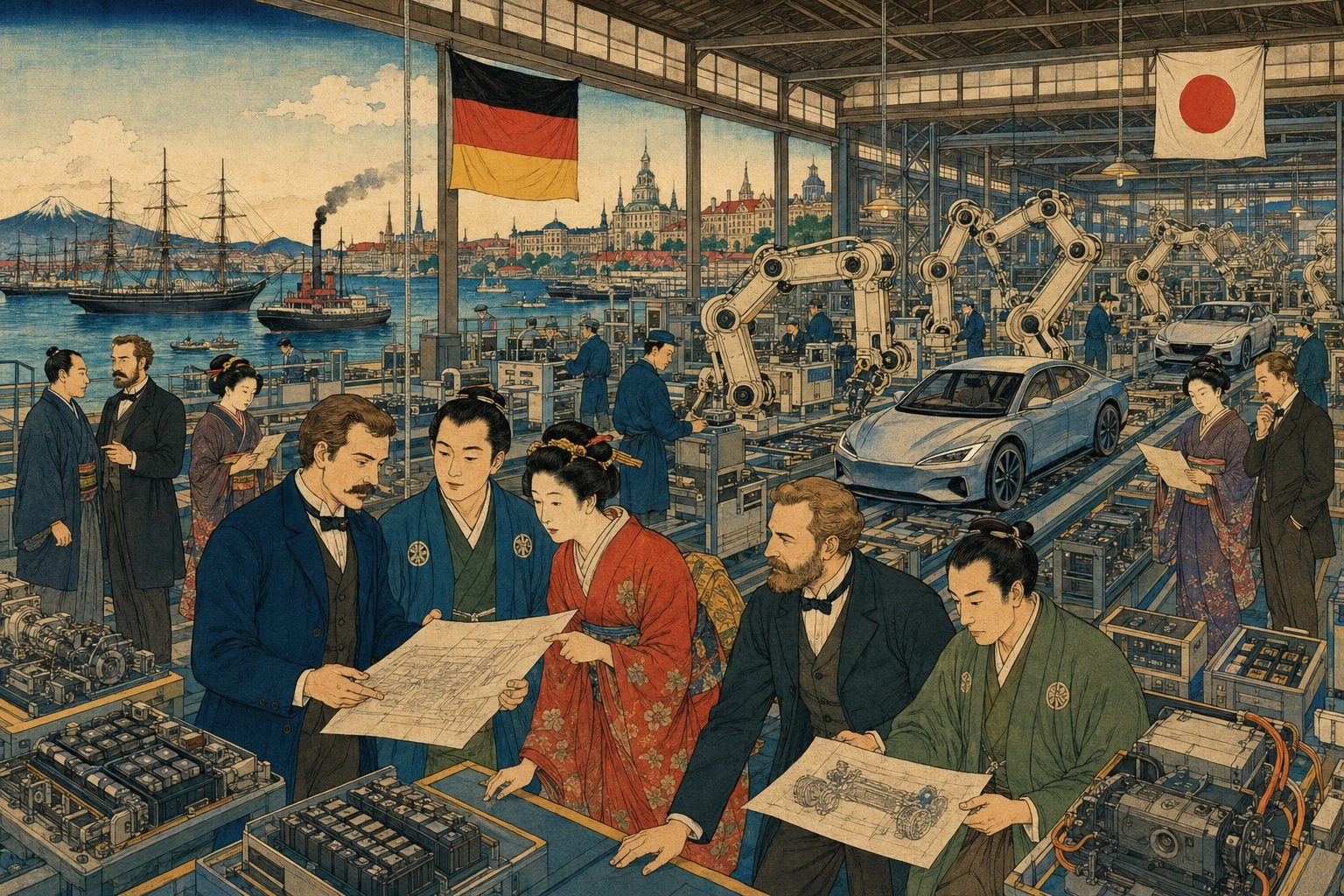
Editor’s note: Research was checked against official chamber, survey, government and institutional sources available through July 18, 2026. The 91 percent profitability figure applies to the 124 companies answering that question, within a 175-company main sample from 475 invited subsidiaries; it is not a claim about every German company in Japan. Event details are live information and may change. The defence forum’s official pages display inconsistent venue addresses, which is disclosed above. The supplied exchange-rate display is reproduced exactly—“1 US Dollar = 162.39 Japanese Yen”—and its UTC update has been converted to Japan Standard Time: July 19, 2026 at 4:07 AM JST. The hero is a contemporary digital editorial illustration, not an archival print or documentary image.