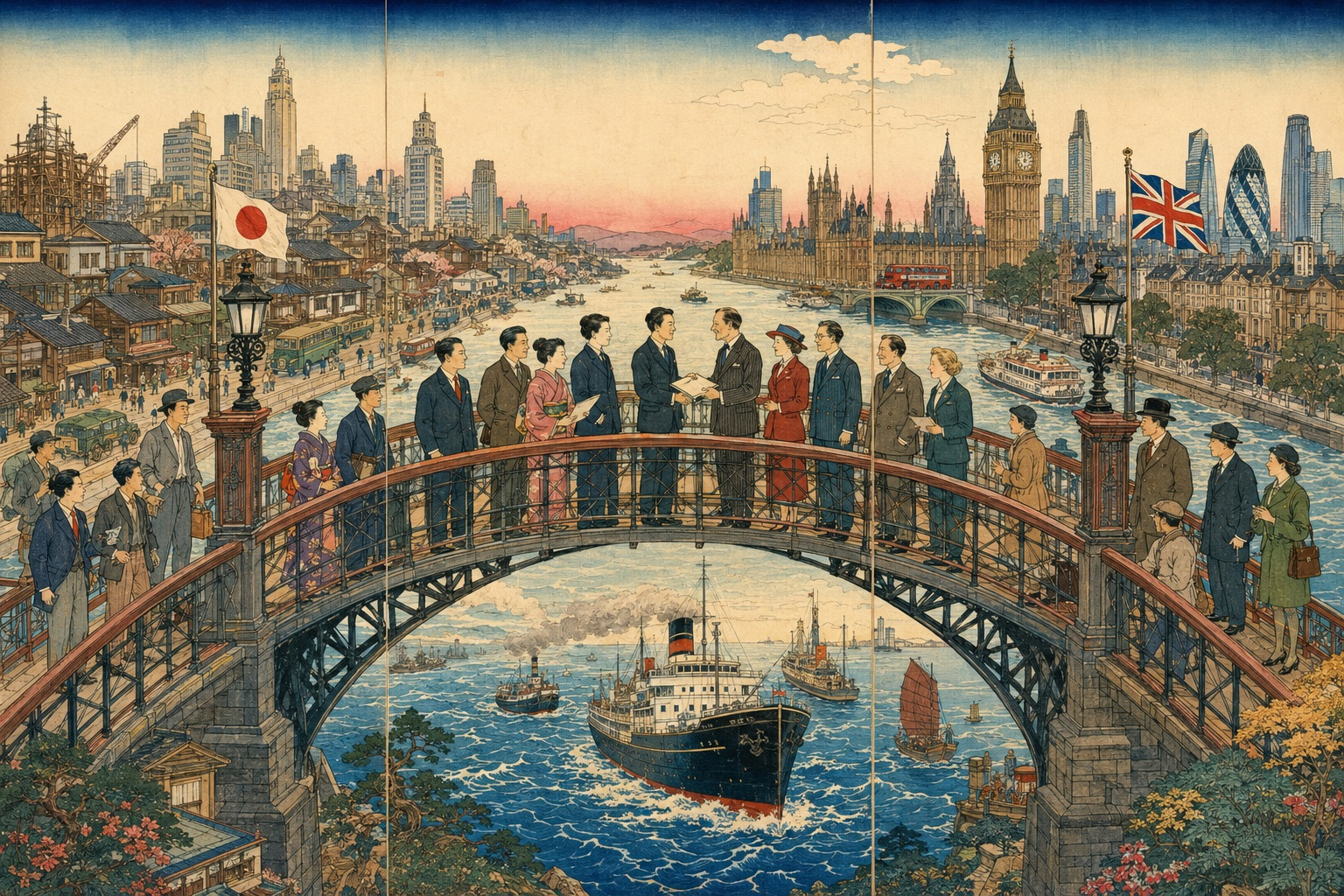
A chamber formed before normality returned
In early 1948, Tokyo was a damaged capital under Allied occupation. Britain and Japan had fought a bitter war only a few years before; sovereignty, commerce and trust had not yet returned to ordinary terms. Yet British businesspeople were already meeting to ask how they could help one another identify the opportunities created by peace and reconstruction. Retrospective BCCJ histories name William Salter and Douglas Kenrick among the principal founders.
The beginning was practical rather than ceremonial. These were postwar operators trying to exchange information in a market whose institutions, supply chains and external relationships were being rebuilt. The organization they created would eventually become the British Chamber of Commerce in Japan, but it did not immediately possess that formal name or a permanent professional office.
What the numbers mean—and what they do not
BCCJ today calls itself an active, expanding, private not-for-profit membership organization open to all nationalities. It says it serves approximately 3,700 members linked with more than 230 companies across 40 sectors. The figures describe a business community and communications network, not 3,700 separately paying corporate entities. Membership ranges from large companies to entrepreneurs, individuals, regional and international members and, since May 2026, eligible Japanese NPOs and charities.
The chamber’s mission is explicitly two-way: strengthen UK–Japan business ties, support member interests, encourage British businesses into Japan and Japanese investment into the United Kingdom. That last clause is important. The old mental model—a British club helping British exporters sell to Japan—is too narrow. Japanese capital, technology and corporate networks in Britain are now as central to the relationship as British market entry in Japan.
BCCJ is independent of the UK government. It works closely with the British Embassy, the Department for Business and Trade, the British Consulate-General in Osaka, the British Council, Japanese institutions and other chambers, but it is not an embassy department. It cannot negotiate CEPA, grant an export licence or promise government support. It can surface company experience, introduce the right people, explain policy, provide visibility and keep a relationship active between official visits.
1955 and 1963: acquiring a legal identity
BCCJ’s official magazine history records an unusually gradual institutionalization. Although the group began in 1948, the Ministry of International Trade and Industry did not permit use of the name British Chamber of Commerce in Japan until 1955. That permission brought recognition as a foreign juridical person under Article 36 of the former Civil Code. The Japan–UK Treaty of Commerce, Establishment and Navigation ratified the status in 1963. Only then did BCCJ establish a permanent secretariat, initially staffed by a volunteer.
This sequence matters because it mirrors the bilateral relationship. The chamber began in occupation, acquired a recognized name after Japan had recovered sovereignty, and secured a lasting institutional footing through a treaty between governments. It was private infrastructure built alongside public normalization.
The archival record is incomplete—BCCJ itself says much early material was lost during an office move—but surviving recollections show a close, sometimes overlapping relationship with the British Embassy’s commercial work. The proximity brought access and practical capacity; it also required the chamber to maintain a distinct role as a member organization rather than merely repeat government policy.
British Week, a rebuke and the work of market entry
Britain’s position in Japan could never be sustained by historical prestige alone. In 1968 and 1969, the Embassy and BCCJ helped organize British Week in Tokyo, a major commercial showcase held from September 26 to October 5, 1969. Retrospective accounts describe the event as successful—then record a pointed observation by Japan’s prime minister that British business was not trying hard enough in the Japanese market.
The response was institutional rather than defensive. The British Marketing Centre was established at Aoyama-itchome. Through later decades, BCCJ and Embassy commercial teams collaborated on campaigns including Opportunity Japan, Priority Japan and Action Japan. The lesson remains current: a national brand may open a door, but companies still need local staff, patient distribution, product adaptation, regulatory understanding and after-sales service.
By the late 1970s, chamber leaders were also trying to build direct links with MITI, the Foreign Ministry, Finance Ministry and other Japanese officials. BCCJ member Martin Barrow later recalled that trade and investment barriers required those relationships. This was an early shift from an expatriate information circle toward a business body able to identify practical obstacles and put them before decision-makers.
Professionalising the chamber
The 1980s transformed BCCJ’s operating capacity. Member Ray Giles helped lay foundations for what became the European Business Council, showing how a national chamber could gain leverage through coordinated European advocacy. In 1987, BCCJ hired an executive director with media and communications experience and moved to improved central premises with a large meeting room. A contemporary recollection captures the scale of the transition: there was no office personal computer, so the executive director brought one from home to compile the member directory.
Expansion in the 1990s brought publications on postings, research and development and foreign scientists, as well as a Science and Technology Action Group and a small-business initiative. The London Club—later renamed UK Kai—sought greater Japanese participation. Sukeyoshi Yamamoto of NSK became the first Japanese person invited onto the Executive Committee, a milestone in turning a nationally named chamber into a genuinely bilateral institution.
Market entry acquired a physical address in 1997 with the British Industry Centre in Yokohama. Created by BCCJ, Yokohama City and Nomura Real Estate with British government and Embassy support, it reduced setup costs and supplied bilingual assistance for British firms. Prime Minister Tony Blair formally opened it in January 1998. The model anticipated today’s incubators: subsidized premises, local guidance, public-private coordination and a trusted community around new entrants.
From representation to inclusion
Alison Pockett became BCCJ’s first female president in 2004. Her importance was not only gender. She ran a small firm rather than a major British corporation, widening the image of who could lead the chamber. The British Business Awards followed in 2007 and became the flagship public ritual through which BCCJ recognizes commercial performance, entrepreneurship, partnership, responsible business, inclusion and technology.
A dedicated diversity and inclusion program began in April 2012. In 2019, the BCCJ 5.0 project aligned three priorities—diversity and inclusion, digital and technology innovation, and responsible business—with Japan’s Society 5.0 debate. Government Relations became a fourth strategic pillar in 2022, explicitly giving the chamber a mechanism to identify business-critical issues and raise them with political decision-makers.
Inclusion remains a work rather than a label. The current DEI program reaches governance, recruitment, Executive Committee elections, award judges, suppliers, leadership training, data sharing and reverse mentorship. A 2026 NPO and charity membership tier, priced below commercial categories, is intended to bring civil society into the network. These are meaningful design choices; their effect should be judged by who gains recurring influence, not only who appears on a panel.
The new treaty architecture
The chamber’s founders dealt with the practicalities of restoring trade. Their successors operate inside a dense stack of agreements. The UK–Japan Comprehensive Economic Partnership Agreement entered into force on January 1, 2021, preserving and extending bilateral rules after the United Kingdom left the European Union. The UK’s accession to the Comprehensive and Progressive Agreement for Trans-Pacific Partnership took effect with Japan on December 15, 2024. Firms may therefore have more than one preferential route, and must understand which rules of origin, tariff treatment or service provision is most useful for a transaction.
The Hiroshima Accord of May 2023 placed commerce inside a wider global strategic partnership. The first UK–Japan Economic 2+2 in Tokyo on March 7, 2025 brought foreign and economic ministers together to discuss the point where trade, economic security and foreign policy converge. Ministers emphasized CEPA and CPTPP implementation, resilient supply chains, industrial collaboration, investment, the rules-based trading system and joint projects in third countries.
| Layer | What it does | Why business still needs a chamber |
|---|---|---|
| CEPA in force 2021 | Bilateral rules for goods, services, digital trade, investment and business mobility. | A legal preference is useful only when a company understands eligibility, paperwork and Japanese market practice. |
| CPTPP UK–Japan effect 2024 | Adds a wider Asia-Pacific rulebook and supply-chain possibilities. | Companies must compare agreements and choose the route that fits products, origin and partners. |
| Hiroshima Accord 2023 | Frames a global strategic partnership spanning security, economy, climate and technology. | Broad political ambition needs sector specialists and commercial projects. |
| Economic 2+2 launched 2025 | Connects foreign policy, trade, industrial strategy and economic security at ministerial level. | Member experience can reveal where policy design creates operational friction. |
| Frontier Technology Partnership 2026 | Targets AI, semiconductors, quantum, cyber, space, healthcare and dual-use technology. | Research links need investors, customers, standards knowledge and trusted introductions. |
| Economic Security Declaration 2026 | Deepens cooperation on supply chains, critical technologies, investment and energy security. | Security rules must be explained clearly enough for legitimate business to comply and invest. |
June 2026: partnership becomes industrial policy
The most consequential current development came on June 14, when Prime Ministers Keir Starmer and Sanae Takaichi signed a Frontier Technology Partnership and a Joint Declaration on Economic Security Cooperation in London. The technology framework combines British research and software strengths with Japanese hardware and manufacturing, covering quantum, AI, cybersecurity, space, advanced connectivity, defence and dual-use technology, civil nuclear and fusion, biological security and healthcare research.
The accompanying economic-security declaration links the Economic 2+2, financial, energy, digital and science dialogues with industrial and economic-security partnerships. A June investment package was presented by the UK government as more than £18 billion in potential gains, including more than £9 billion across infrastructure and financial services and up to £9 billion in offshore wind. Those are government-announced prospective gains and investment commitments, not a chamber audit or cash already spent; implementation, timelines and attribution require continued scrutiny.
Defence industry now sits openly inside the commercial relationship. On July 3, the United Kingdom announced a £4.6 billion contract for the next stage of the Global Combat Air Programme, funded with Japan and Italy and aimed at a next-generation aircraft for 2035. GCAP can generate engineering, software and supply-chain opportunities, but it also raises export-control, security-clearance, industrial workshare and democratic-accountability questions far beyond an ordinary trade promotion campaign.
Where BCCJ fits—and where it does not
BCCJ is smaller and organized differently from ACCJ. It does not present the same large standing-committee and white-paper machine. Its comparative advantage is a concentrated bilateral network, a professional secretariat, an elected 15-member Executive Committee, close working links with British government institutions and an events-and-communications platform that can move between major companies and entrepreneurs.
In March 2025, selected members met visiting Foreign Secretary David Lammy and Business and Trade Secretary Jonathan Reynolds during the inaugural Economic 2+2. Discussion covered CEPA and CPTPP implementation, trade distortions, resilient supply chains, investment and AI, semiconductors and quantum. This is access, but not public authority. BCCJ can report concerns and help form a business conversation; ministers remain accountable for public policy.
In 2026, Richard Lyle of Intralink continues as president for a fourth consecutive year, chairing the 78th Executive Committee elected on April 23. Sarah Backley is Executive Director. The 15 elected members include leaders from finance, defence, professional services, architecture, recruitment and independent businesses. Their election gives members a governance route, though participation is necessarily limited to those who join, stand, vote and have time to serve.
The diplomatic cast is also changing. David Taylor was appointed the UK’s Trade Envoy to Japan in March 2026. Ambassador Julia Longbottom concludes a tenure that began in 2021; Corin Robertson is scheduled to take up the Tokyo post in August. BCCJ’s August 4 farewell for Longbottom makes the transition visible. The chamber supplies continuity when ministers, ambassadors and corporate executives change.
Innovation, regions and the next entrant
BCCJ became the first international chamber to form an official partnership with Tokyo Innovation Base in February 2026. The practical promise is access: startups and scaling companies can reach Japanese corporates, investors, public programs and mentors, while established members can pursue open innovation. The test will be whether introductions progress to pilots, procurement and investment rather than ending at a well-attended event.
The chamber has no permanent regional branch, but its Regional Hub initiative and lower-priced non-Kanto memberships extend participation beyond Tokyo. It maps British business and cultural connections across Japan, has maintained engagement with Tohoku after the 2011 disaster and develops programs around tourism and regional revitalization. Osaka Expo 2025 provided a major focus for this westward work. The British Consulate-General and Department for Business and Trade presence in Osaka are important public counterparts.
Membership pricing reveals an intentional geography. A Kanto corporate membership is currently ¥250,000 a year, compared with ¥170,000 outside Kanto and ¥150,000 internationally. Entrepreneur membership is ¥100,000 in Kanto, ¥80,000 elsewhere in Japan and ¥75,000 abroad; individual membership is ¥50,000 in Kanto and ¥30,000 for domestic regional or international members. The new NPO/charity tier is ¥50,000. Differential pricing lowers distance costs, but virtual access and discounts cannot by themselves undo Tokyo’s concentration of officials, capital and senior events.
Responsible business as commercial infrastructure
BCCJ’s BCCJ 5.0 agenda treats digital innovation, DEI and responsible business as sources of resilience rather than decorative corporate values. The approach has commercial logic. A company entering Japan must recruit and retain people, use data responsibly, meet customer and investor expectations and understand the social license of its operations.
The chamber’s reverse-mentorship program pairs established leaders with emerging professionals in a two-way exchange. Its DEI working group focuses on senior-management training, data and mentorship. Responsible Business programming brings environmental and social performance into member discussion. Critics can fairly ask for measurable outcomes: leadership composition, pay and promotion data, emissions and supply-chain due diligence, not only awards entries. The public British Business Awards criteria create one place where those claims can be examined.
The limits of the bridge
BCCJ’s strengths also define its risks. Close Embassy relations can produce access, but outsiders may struggle to distinguish private member priorities from the public interest. A polished event calendar can connect people who already possess resources more easily than a first-time exporter without a Tokyo budget. An invitation to a ministerial discussion is valuable precisely because it is scarce.
The chamber represents members, not every British company, Japanese investor, worker or consumer affected by UK–Japan policy. Its current network is large by its own description, but the business population outside membership is larger. Arms cooperation, AI governance, inward-investment screening and energy security all affect groups that are not reducible to commercial stakeholders.
Legitimacy therefore rests on clear boundaries. BCCJ should say when it is conveying member experience, when it is hosting a government speaker and when it is endorsing a policy. It should widen access where feasible, publish enough evidence for claims to be tested and use its NPO, regional and emerging-leader programs to bring different knowledge into the room.
Verified addresses, telephone numbers and direct websites
BCCJ has one published office in Tokyo rather than separate chapter offices. The government trade contacts are included because their functions are distinct and frequently confused with the chamber. Details were checked against official BCCJ and GOV.UK pages for this edition. Offices require registration or an appointment; none should be treated as a walk-in public venue.
| Organization | Current address | Telephone, email and direct website |
|---|---|---|
| BCCJ British Chamber of Commerce in Japan | WORK STYLING Midtown Tower 18F 9-7-1 Akasaka, Minato-ku Tokyo 107-0052 | 03-4560-4190 info@bccjapan.com bccjapan.com / official contact page |
| Department for Business and Trade Japan Public export and investment support | British Embassy No. 1 Ichiban-cho, Chiyoda-ku Tokyo 102-8381 | 03-5211-1100 info@exporttojapan.co.uk official DBT Japan page |
| British Consulate-General Osaka UK government in Western Japan | 3-5-1 Bakuro-machi, Chuo-ku Osaka 541-0059 | 06-6120-5600 official Consulate-General page Public access by appointment. |
Upcoming BCCJ events found
The calendar was checked on July 18, 2026. Availability, eligibility, venue details and prices can change. Follow the direct event or organizer link before travelling.
| Date and time, JST | Event | Venue and access note |
|---|---|---|
| Wed, Jul 29 19:00–21:30 | Joint-Chamber Summer Cocktail 2026 | Beer Garden Terrace, Hilton Tokyo, 6-6-2 Nishi-Shinjuku. Co-hosted by 19 chambers for 300-plus professionals. BCCJ allocation was sold out; waitlist only when checked. |
| Thu, Jul 30 17:30–20:00 | The Changing Landscape for Immigration in Japan CCCJ, ACCJ and BCCJ | Embassy of Canada, 3-38 Akasaka 7-chome, Minato-ku. Register by Jul 24; members ¥4,000, nonmembers ¥6,500; government photo ID required. The co-host’s detailed page lists an 20:00 finish. |
| Mon, Aug 3 12:00–13:30 | Present with Impact — Emerging Leaders Workshop | Dale Carnegie Training Japan, Mochizuki Room, 5F. Hands-on program for BCCJ Emerging Leaders; confirm eligibility and final access details. |
| Tue, Aug 4 18:00–20:00 | An Evening with Her Excellency Julia Longbottom CMG | Daikanyama T-SITE. Members-only farewell for the outgoing British Ambassador. |
| Wed, Aug 26 18:00–19:00 | Member Benefit: Welcome Wednesday | BCCJ office, Midtown Tower. Complimentary to members, maximum two representatives per member company; a virtual option is offered for UK or regional companies by email request. |
| Fri, Nov 13 18:00–22:00 | British Business Awards 2026 — The Nineteenth Evening | Fairmont Tokyo. Members and nonmembers welcome. Early-bird pricing ends Aug 7 at 17:00; award applications run Jul 29–Sep 30; reservations close Oct 28. |
A new partnership still needs old skills
The 2026 UK–Japan agenda sounds futuristic: quantum computing, AI safety, semiconductors, fusion, cyber resilience and a sixth-generation aircraft. Yet the work required to make it real is familiar. Companies need trustworthy local partners, regulatory translation, patient market entry, staff who can operate across languages, and a place to explain when a rule does not work as intended.
BCCJ’s history is a sequence of adaptations to that need. A handful of founders exchanged information amid postwar scarcity. A volunteer secretariat acquired legal status. British Week exposed the limits of national promotion. The British Marketing Centre and Industry Centre helped companies establish themselves. Japanese members and women entered leadership. Digital, DEI, responsible business, regional participation and government relations widened the agenda.
The chamber’s 2026 challenge is not to claim ownership of the “golden era” language surrounding bilateral relations. It is to make the new architecture usable by a company smaller than a prime ministerial announcement, and accountable to people beyond a gala ballroom. If it succeeds, BCCJ will continue doing what its founders intended—helping businesses cross a difficult distance—while serving a partnership those founders could not have imagined.
Sources and further reading
- BCCJ, About, membership and current fees, contact, and events calendar.
- BCCJ Acumen, “Strength to Strength”, and Ian de Stains, “The British Chamber of Commerce (Japan), 1948–2015”.
- BCCJ, 78th Executive Committee, Executive Director Sarah Backley, and 2026 UK Trade Envoy.
- Government Relations, Regional Hub, DEI, and Responsible Business.
- BCCJ–Tokyo Innovation Base partnership and NPO/charity membership tier.
- UK government guide to CEPA and CPTPP and 2025 Economic 2+2 joint statement.
- UK–Japan Frontier Technology Partnership, Joint Declaration on Economic Security Cooperation, and June 2026 investment announcements.
- UK Ministry of Defence, July 2026 GCAP contract.
- Department for Business and Trade Japan and British Consulate-General Osaka.
Editor’s note: Research was conducted from official BCCJ pages, BCCJ’s institutional magazine history, a published scholarly chapter and primary UK and Japanese government material available through July 18, 2026. Membership figures are BCCJ’s own current description. Government investment figures are announced commitments or expected gains, not an independent JAPAN.co.jp valuation. Event schedules and access can change. The supplied exchange-rate display is reproduced exactly—“1 US Dollar = 162.39 Japanese Yen”—and its UTC timestamp has been converted to Japan Standard Time: July 19, 2026 at 4:07 AM JST. The hero is a contemporary digital editorial illustration, not an archival print or documentary image.