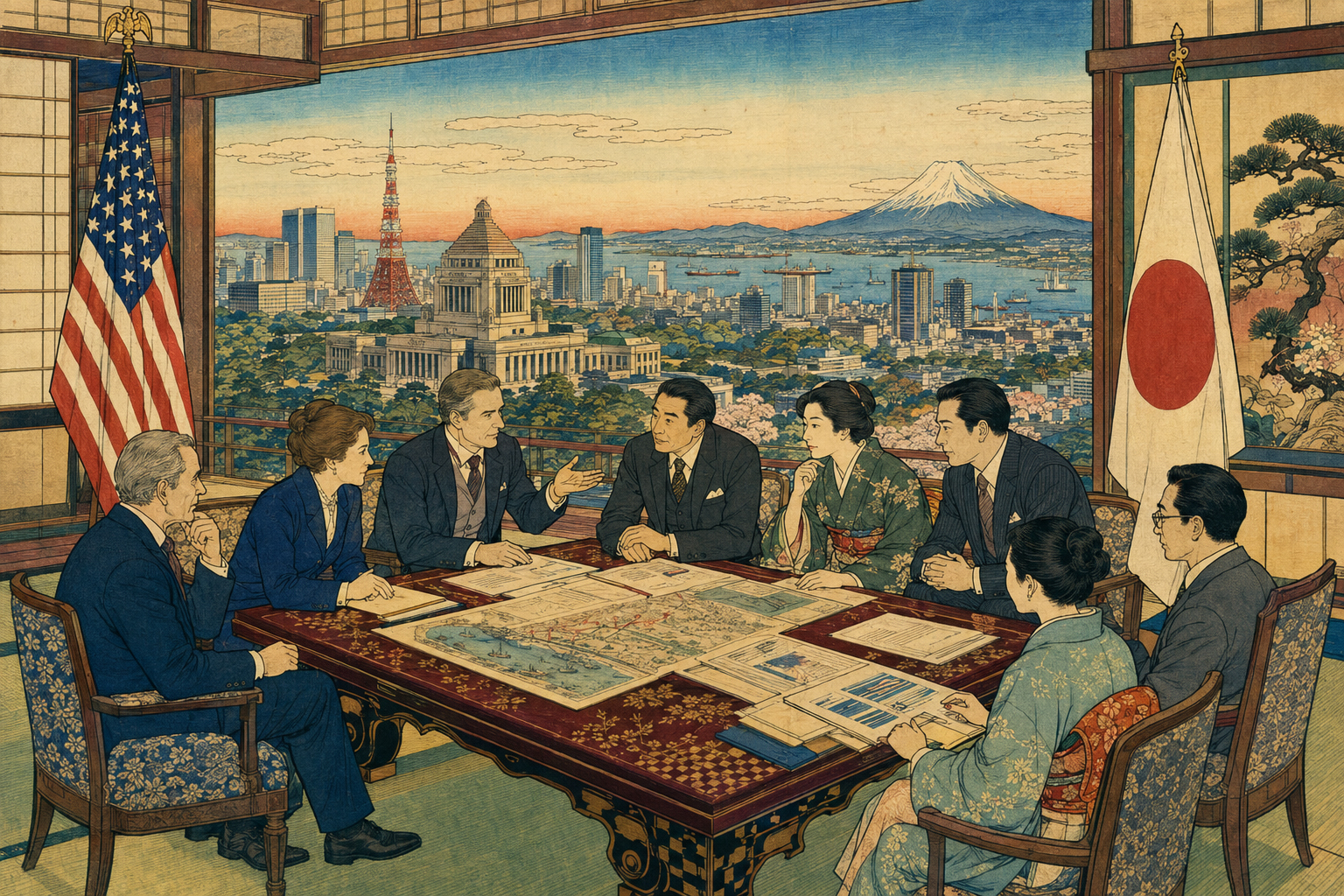
The room above Toranomon
On the 15th floor of Toranomon Hills Business Tower, the American Chamber of Commerce in Japan occupies a useful position both literally and institutionally. Below lies Tokyo’s government-and-corporate corridor. Inside the chamber, executives, lawyers, entrepreneurs, doctors, engineers and public-affairs specialists compare what Japanese policy means in practice. A licensing rule that troubles one company can be a private grievance. The same rule, documented by several firms and tested by a specialist committee, can become a public comment, a viewpoint, a white paper or a subject for a “doorknock” meeting with officials.
This conversion mechanism is the heart of ACCJ power. The chamber describes four pillars—networking, information, advocacy and community—and says it holds about 500 meetings and events a year. Its About page lists more than 60 active committees, while the current homepage uses the narrower phrase “over 50 active Committees and Forums.” The precise count shifts with structure and terminology; the larger truth does not. ACCJ has enough people, sector depth and repetition to keep a policy question alive long after a single breakfast or ministerial appointment.
“American” does not mean American-only
The name can mislead. ACCJ is a private, not-for-profit membership organization—not part of the United States government, not the U.S. Embassy and not a treaty body. Membership is open to companies and individuals of all nationalities, subject to the chamber’s application process. ACCJ’s current FAQ says approximately 55 percent of member companies are American, 30 percent Japanese and 15 percent other. By citizenship, it says 55 percent of members are Japanese, 25 percent American and 20 percent other.
That composition matters. A chamber built around the U.S.–Japan commercial relationship is now staffed, led and argued through by people whose careers cross national categories. Japanese managers at American companies, American managers at Japanese companies, lawyers advising both, and entrepreneurs selling into neither country exclusively can share one committee. “American” describes the bilateral axis and institutional inheritance. It does not describe a sealed expatriate club.
Nor does “foreign business voice” mean the voice of foreigners generally. ACCJ represents the collective interests of members. It does not automatically speak for nonmember small businesses, foreign workers, consumers, students, migrants or civil society. Current individual membership costs ¥75,000 a year plus a ¥15,000 entrance fee; a lower-cost graduate student/young professional package is ¥24,000, and company packages vary. Dues are normal for a member organization, but money, time and professional access still shape who can participate.
Born in occupation, built for normalization
ACCJ was founded on August 24, 1948, three years after Japan’s surrender and while the Allied Occupation was transforming the country’s political and economic institutions. Representatives of 40 companies created a chamber to develop commerce between the United States and Japan, advance member interests and help improve the international business environment. The timing was decisive. Japan needed capital, markets and reconstruction; American businesses needed reliable information and an organized counterpart in a country whose rules were being rewritten.
The early chamber was close to the architecture of occupation, but its durability depended on surviving the return of sovereignty. ACCJ’s official history records a Board meeting at the Imperial Hotel on May 6, 1952, days after the occupation formally ended. Public programs brought senior American figures before Japanese and international audiences: U.S. Secretary of Defense Charles E. Wilson spoke at an ACCJ luncheon in 1954, and Time Inc. president Roy E. Larsen in 1956. Joint events with the America-Japan Society indicated that the chamber’s work was not simply inward-facing.
One 1956 episode captures a broader civic role. ACCJ’s anniversary history says the chamber helped finance Japan’s Olympic team journey to Melbourne with a cheque for ¥7,769,683. The amount belongs to another economic era, but the gesture established a pattern: a business association could use its convening power for bilateral goodwill and local community support, not only for regulation.
Regionalization followed the geography of industry. By 1968, ACCJ was holding an early Kansai chapter gathering in Osaka as well as its first annual golf tournament; summer festivals and chapter activities created relationships outside formal policy meetings. Chubu later developed around Nagoya’s manufacturing economy, where aerospace, automotive, heavy industry and entrepreneurial businesses require a different mix of committees from Tokyo’s finance-and-government corridor.
From luncheon diplomacy to the doorknock
ACCJ’s history is punctuated by famous speakers, but the more consequential innovation was procedural: turn access into a repeated advocacy cycle. The chamber says its annual Diet Doorknock has operated since 1994. Delegations meet legislators, ministries and other officials in Japan; the D.C. Doorknock carries business concerns to Congress and the U.S. administration. In 1999, for example, a Washington delegation met U.S. Commerce Secretary William Daley. President Bill Clinton addressed an ACCJ town hall in Tokyo in November 1998. Such moments generate visibility, but the durable work is performed before and after the photograph—committee drafting, internal approval, briefings, follow-up and another meeting.
The chamber also broadened what counted as economic policy. Its Women in Business Summit with Prime Minister Shinzo Abe in 2015 placed workforce participation and leadership in the center of the growth debate. In 2016, ACCJ advocated for the Trans-Pacific Partnership. When the pandemic made ballrooms and meeting rooms unusable in 2020, the chamber moved hundreds of programs online. Virtual access did not eliminate the importance of Tokyo, but it made regional and overseas participation less exceptional.
Community activity became part of the institutional identity. The Chubu Walkathon, organized with Nagoya International School, celebrated its 25th anniversary in 2016 by raising more than ¥27 million for 28 local causes. The program continued through the following decade; ACCJ says more than 2,000 people attended in 2025. This is not a substitute for accountable policy advocacy. It is evidence that the chamber’s legitimacy is partly earned in the places where members live.
How an ACCJ position is made
The public often encounters lobbying only at the final stage: a recommendation, meeting or press release. ACCJ’s system begins lower down. Committees and forums are organized by industry or cross-cutting issue. Members monitor legislation, ministry consultations and market practice; compare company experience; invite officials and specialists; and identify a problem capable of a shared position. A committee may submit a public comment, publish a shorter viewpoint or develop an extended white paper, sometimes with several committees or a task force.
ACCJ’s advocacy guide stresses that official viewpoints are chamber positions, not merely the opinion of one speaker. Its stated principles include free markets, a level playing field, transparent and fair processes, global best practice, responsible corporate citizenship and solution-oriented recommendations. This distinction is essential. An event guest can express a personal view; a paper carrying ACCJ’s name passes through an internal approval path and claims collective authority.
| Source of influence | How it works | Its limit |
|---|---|---|
| Scale | More than 3,000 members can identify recurring barriers across companies and sectors. | Membership is broad but self-selecting; it is not a democratic sample of the public. |
| Expertise | Specialist committees convert technical experience into specific regulatory language. | Industry expertise can also carry commercial interest and sector bias. |
| Access | Diet and D.C. doorknocks, embassy links and policy events place proposals before decision-makers. | Access does not prove causation, and ACCJ cannot enact or enforce law. |
| Repetition | Annual delegations and standing committees sustain an issue across personnel changes. | Persistent, well-resourced voices can crowd out less organized groups. |
| Public record | Viewpoints, white papers and consultation submissions allow outsiders to inspect positions. | Member deliberations, closed forums and informal meetings are not fully visible. |
| Regional reach | Kobe and Nagoya chapters carry healthcare, manufacturing and entrepreneur concerns beyond Tokyo. | National advocacy and senior access remain heavily concentrated in the capital. |
The 2026 public-comment record shows the machinery in motion. ACCJ listed submissions on proposed Companies Act revisions on May 22; Financial Services Agency Corporate Governance Code revisions on May 14; intellectual-property and data contract guidance on April 28; enforcement rules concerning unauthorized access to critical computer systems on February 6; and a Cabinet Office principle-code on intellectual-property protection and transparency in generative AI on January 26. The subjects differ, but the method is consistent: enter a government consultation with text precise enough to be used, challenged or rejected.
The 2026 presidency: diplomacy meets aerospace
ACCJ members elected Eric John, president of Boeing Japan K.K., as the chamber’s 62nd president for 2026. His résumé connects the chamber’s two worlds. John is a former U.S. diplomat who served as ambassador to Thailand from 2007 to 2010 and later led Boeing’s business in South Korea before Japan. He joined ACCJ’s Board of Governors in 2025 and succeeded Delta Air Lines Japan president Victor Osumi.
The election came as security and commerce were increasingly intertwined. Aerospace, advanced technology, energy, critical minerals, data rules and supply chains no longer sit in separate policy boxes. John’s stated priority is deeper U.S.–Japan economic engagement during rapid technological and political change. In practice, that requires the president to give coherence to ideas produced by many committees without turning a diverse chamber into a single-company agenda.
On June 23 and 24, John led the 2026 D.C. Doorknock with Chairman Christopher LaFleur, Executive Director Laura Younger, governors and member-company chief executives. According to ACCJ’s account, the delegation discussed the bilateral trade agreement, Japan’s $550 billion U.S. investment pledge and policy across digital, healthcare, aerospace and defense, energy, finance and automotive sectors. The chamber’s framing is important; it is advocacy, not an independent audit of the agreement or investment total. The visit nevertheless demonstrates the form of power ACCJ possesses: Japanese operating experience can reach Washington through an organized, familiar channel.
Agenda one: trade after the headline agreement
For ACCJ, trade policy is no longer mainly about tariffs at the border. The current agenda reaches investment screening, standards, digital services, energy procurement, critical minerals, defense industrial cooperation and the rules by which promised projects become bankable. The 2025 U.S.–Japan trade framework—and the $550 billion Japanese investment pledge emphasized by the chamber—creates a long implementation phase. Companies care about which projects qualify, how decisions are governed, whether rules treat domestic and foreign firms fairly, and how quickly capital can move.
The chamber can be useful here because it sees friction at operating level. A treaty text may promise openness while procurement practice, licensing time, tax treatment or data rules still discourage entry. ACCJ can collect those details and carry them to both capitals. Its limitation is equally clear: the chamber advocates for commercial outcomes desired by members. Governments must also weigh national security, labor, fiscal risk, consumers and domestic political consent.
Agenda two: regulate AI without freezing it
ACCJ’s Task Force on AI Regulation issued principles in October 2024 as Japan developed its approach to artificial intelligence. The chamber groups its recommendations around six principles and summarizes their direction in three paired ideas: encourage innovation through risk-based regulation grounded in science; align global standards while simplifying compliance and promoting collaboration; and ensure multi-stakeholder involvement and safety.
That sounds consensual until a regulator must define “risk,” determine who carries liability and decide what transparency a model provider owes to users, copyright holders or the public. ACCJ’s January 2026 comment on the Cabinet Office’s proposed principle-code for generative AI, intellectual property and transparency shows the debate moving from general values to implementation. Global firms want rules compatible across markets; creators and rights-holders want meaningful protection; Japanese policymakers want investment without avoidable harm.
The chamber’s planned 2026 AI Futures Series extends the work beyond formal submissions. ACCJ describes a year-round sequence bringing together business leaders, academics and policymakers to discuss society and the future of work, with full session details to be announced. That forum can improve policy literacy, provided the conversation includes workers, creators, researchers and the people exposed to AI decisions—not only vendors and enterprise buyers.
Agenda three: finance and the household balance sheet
ACCJ’s Financial Services Forum is a closed leadership forum for senior members of the sector. Its 2024 white paper, Transforming Japan into a Global Asset and Wealth Management Leader, organizes recommendations around three pillars: accelerate corporate-governance reform; reform asset management so Japan can become a leading center; and increase individual participation in investment and asset-based income.
The themes remain current in 2026. ACCJ commented in May on both the Corporate Governance Code and Companies Act revisions. For international institutions, governance affects valuation, capital allocation and confidence that minority shareholders will be treated fairly. For Japanese households, the shift from deposits to investment raises a different set of questions: fees, advice, financial literacy, suitability and protection during losses. A pro-market reform agenda is strongest when it treats household trust as infrastructure rather than resistance to be overcome.
The closed nature of the Financial Services Forum brings candor and technical depth, but it also illustrates why published papers matter. Outsiders cannot inspect every private discussion. They can examine the eventual recommendations, assumptions and requested changes—and regulators can compare them with submissions from consumers, labor, academics and domestic industry.
Agenda four: digital healthcare as a regional test
Healthcare reveals ACCJ at its most cross-disciplinary. The chamber’s Healthcare Forum covers pharmaceuticals, medical devices and diagnostics, regenerative medicine, bioscience, genomics, supplements and digital health. It frames innovation around patient need, system sustainability and the wider economic cost of an aging population. That combination can be productive, but only if faster adoption is matched by evidence, privacy, reimbursement discipline and equitable access.
The Kansai chapter’s Healthcare x Digital initiative makes the agenda tangible. HxD brings academia, startups, nonprofits, established healthcare companies and public institutions together to help ideas move through an ecosystem. At its February 13, 2026 pitch event at Nakanoshima Qross, 12 startups presented technologies ranging from early cancer intervention and cross-border second opinions to mobility support and hospital workflow automation. Five awards went to SalivaTech, PurinoScience, Aman Wellness Solutions, Quadlytics and VisionPath.
A pitch day is not regulatory reform, and an award is not clinical validation. Yet HxD shows why a chamber can matter outside Tokyo lobbying: it can connect a startup to mentors, a hospital ecosystem, an overseas investment summit or a public agency. Kansai’s concentration of pharmaceutical, medical and research institutions gives the program a regional logic rather than making it a satellite copy of the capital.
Three chapters, three economic geographies
ACCJ calls itself one chamber, but the operating environments of Tokyo, Kansai and Chubu are distinct. Tokyo headquarters is closest to central ministries, the Diet, the U.S. Embassy, financial institutions and most multinational country offices. This is the natural center of national advocacy and large speaker events.
Kansai’s office is in Kobe. The chapter says five active committees organize roughly 25 events a year in addition to Healthcare x Digital. Pharmaceutical and medical industries, electronics, heavy industry and manufacturing shape its agenda; Osaka, Kobe and Kyoto also support a dense network of universities, startups and local government partners.
Chubu’s office in Nagoya serves Aichi, Gifu and Mie. ACCJ reports nearly 150 members there, roughly half entrepreneurs, with six committees producing about 50 events a year. Aerospace, mobility, automotive and heavy manufacturing loom larger. The chapter also engages the U.S. Consulate in Nagoya and regional officials. A national chamber that ignored these differences would miss where much of Japan’s export capacity is actually built.
Is it really the most powerful foreign business voice?
There is no neutral league table for business influence. The European Business Council aggregates 15 European national chambers; BCCJ, CCI France Japon, AHK Japan, CCCJ, ANZCCJ and others possess deep bilateral expertise; Japanese business federations are far larger in domestic political weight. “Most powerful” is therefore an argument, not a measurable title.
The argument for ACCJ is formidable. It has scale; a large committee system; a bilateral relationship central to Japan’s security and economy; routine connections with both governments; a seven-decade institutional memory; and the resources to publish, convene and return. The 2026 D.C. delegation, annual Diet contacts and public-comment record show more than social prestige. They show a machine capable of translating operational detail into language heard by decision-makers.
But influence should not be confused with policy authorship. ACCJ cannot pass a law, negotiate a treaty, issue a license or compel a ministry to accept its recommendation. Policy outcomes have many parents, and the chamber has an incentive to publicize alignment with its proposals. Attribution requires caution. Nor should executive access be mistaken for inclusive representation. Closed CEO and finance forums may improve candor, yet outsiders cannot observe whose problem became a priority or whose evidence was not present.
ACCJ’s best answer is transparency: publish positions; distinguish an event speaker’s opinion from official policy; disclose the membership base; make the case with evidence; participate in formal public consultations; and let journalists, regulators and civil society test the proposal. Power is legitimate when it is contestable.
Verified ACCJ offices and direct contacts
These details were checked against ACCJ’s official contact and chapter pages for this July 21 edition. All times and telephone numbers are in Japan. Contact the chamber before visiting; offices are not public attractions, and most events require registration, membership or a member invitation.
| Office | Current address | Telephone, email and direct website |
|---|---|---|
| Tokyo headquarters | Toranomon Hills Business Tower 15F 1-17-1 Toranomon, Minato-ku Tokyo 105-6415 | 03-6807-3655 info@accj.or.jp accj.or.jp / official contact page |
| Kansai chapter | WeWork Sannomiya Plaza East 9F 7-1-5 Isogamidori, Chuo-ku Kobe, Hyogo 651-0086 | 070-3149-9899 kansai@accj.or.jp official Kansai chapter page |
| Chubu chapter | Sakae Gas Building 13F 3-15-33 Sakae, Naka-ku Nagoya, Aichi 460-0008 | 070-6969-2069 chubu@accj.or.jp official Chubu chapter page |
Upcoming ACCJ events found
This list was checked on July 18, 2026. Event pages, capacity, eligibility and prices can change. ACCJ says event attendance is generally a membership privilege; nonmembers may attend when invited or when a co-host offers public guest registration. Follow the direct organizer page before traveling.
| Date, JST | Event | Access and status |
|---|---|---|
| Thu, Jul 30, 2026 | The Science of Sports: Data, Performance, and the Future of Athlete Optimization | Listed on ACCJ’s current homepage and event calendar. Time, venue, capacity and eligibility should be confirmed on the registration page. |
| Thu, Jul 30, 2026 17:30–20:00 | The Changing Landscape for Immigration in Japan Co-hosted by CCCJ, ACCJ and BCCJ | Embassy of Canada, 3-38 Akasaka 7-chome, Minato-ku, Tokyo 107-0052. Register by Jul 24; members ¥4,000, nonmembers ¥6,500. Government-issued photo ID required. |
| Fri, Jul 31, 2026 | Kansai Young Professionals Forum Summer Social | Listed by ACCJ as an upcoming Kansai event. Confirm time, venue, fee, guest access and the registration deadline on the live calendar. |
| Throughout 2026 dates to be announced | AI Futures Series | ACCJ describes a year-round panel series with business, academic and policy participants. Full session details were still forthcoming at publication time. |
| Thu, Dec 3, 2026 | ACCJ Year-End Networking: An Evening of Connection and Appreciation | Hilton Tokyo. Registration was marked “opening soon”; the page also offers sponsorship information. Confirm time, pricing and eligibility when booking opens. |
What to watch next
The next stage of ACCJ influence will be judged less by the number of receptions than by the quality of implementation. Can the chamber explain how the 2025 trade framework affects a manufacturer in Nagoya, a healthcare startup in Osaka and a data company in Tokyo? Can its AI proposals protect innovation and rights at the same time? Can financial reform build household trust rather than merely attract institutional assets? Can the regional chapters shape national priorities, not simply receive them?
There is also a generational question. Young-professional programs, mentoring, hybrid events and lower-cost membership can widen the pipeline, but leadership circles remain demanding in time and access. If ACCJ wants to call itself the voice of global business in Japan, it must keep bringing in Japanese professionals, women leaders, entrepreneurs, regional companies and people whose experience contradicts the prevailing committee view.
The chamber began in an exceptional postwar moment when the relationship between two countries had to be rebuilt almost from zero. Seventy-eight years later, the relationship is institutionalized but not automatic. Trade disputes return. Technology creates rules faster than governments can write them. Security policy reaches boardrooms, and demographic change reaches every workplace. ACCJ remains powerful because it supplies continuity: people, procedures and memory capable of carrying a problem from the company floor to a policy table and back again.
That is real influence. It is strongest when stated precisely: ACCJ is not the voice of everyone foreign in Japan, and not the authority that decides. It is the country’s largest, best-connected American-centered international business chamber—a private institution with unusual capacity to make governments listen. The public interest depends on what it asks them to hear.
Sources and further reading
- ACCJ, About the ACCJ, FAQ and membership composition, and current membership packages.
- ACCJ, 77th Anniversary visual history, 75th Anniversary history, and ACCJ Journal, “Bridging Nations”.
- ACCJ Advocacy Guide and advocacy papers and public comments.
- Eric John elected ACCJ president for 2026 and ACCJ press releases.
- ACCJ Journal, 2026 D.C. Doorknock.
- ACCJ Principles on AI Regulation and Task Force on AI Regulation.
- ACCJ Financial Services Forum and asset and wealth management white paper.
- ACCJ Healthcare Forum, Healthcare x Digital 2026, and 2026 HxD pitch-event report.
- ACCJ official contact page, Kansai chapter, Chubu chapter, and events calendar.
- CCCJ event page for the Jul 30 immigration seminar co-hosted with ACCJ and BCCJ.
Editor’s note: Research was conducted primarily from ACCJ’s official website, public advocacy pages, press releases and ACCJ Journal, with the co-host’s official page used for the detailed July 30 immigration event. Membership and activity counts are ACCJ’s own current descriptions; different pages use slightly different committee and country counts. Event information was checked through July 18, 2026 and can change. The supplied exchange-rate display is reproduced exactly—“1 US Dollar = 162.39 Japanese Yen”—and the supplied UTC timestamp has been converted to Japan Standard Time: July 19, 2026 at 4:07 AM JST. The hero is a contemporary digital editorial illustration, not an archival print or documentary image.