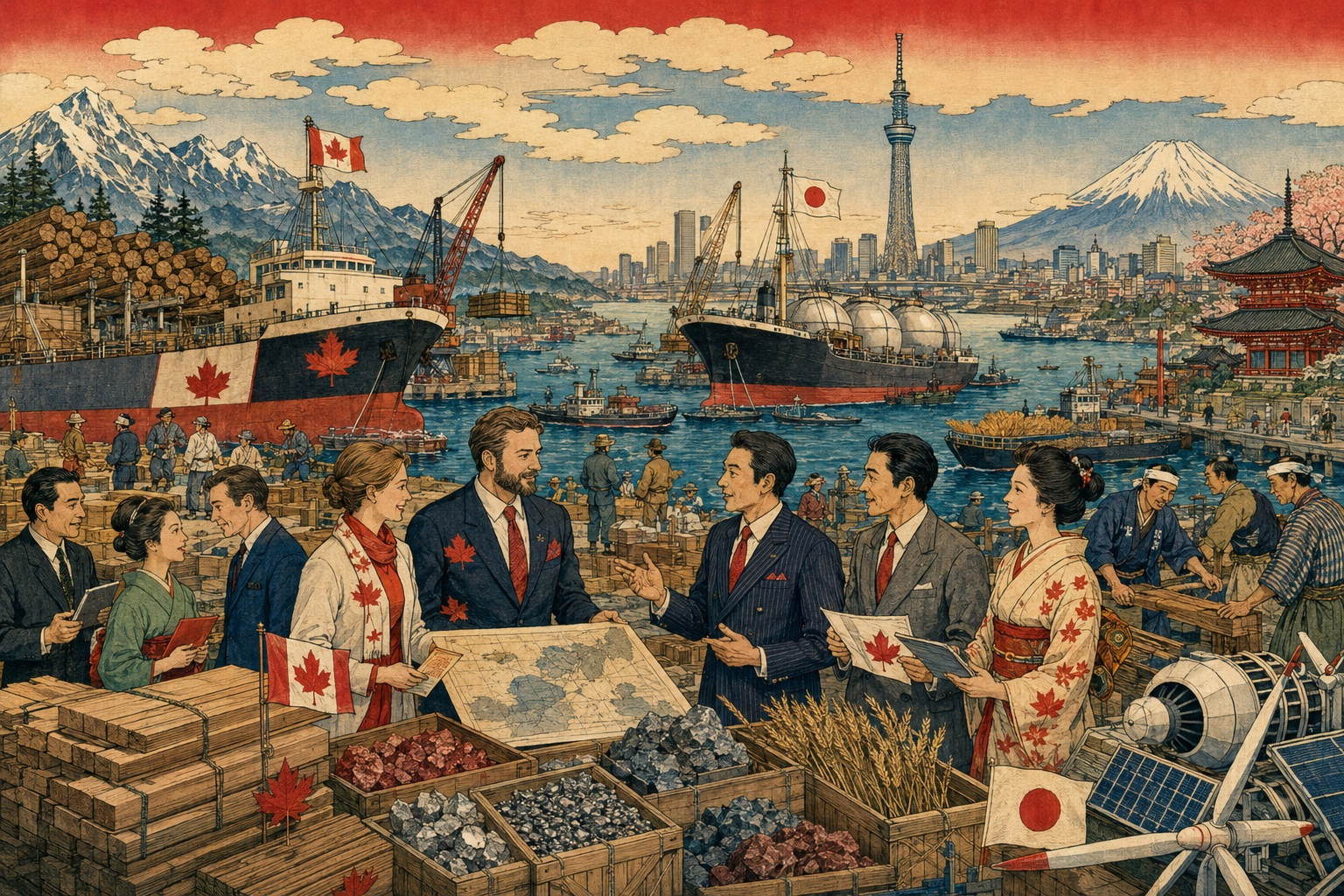
When Canada felt very far away
The founding story is less about flags than distance. In the 1970s, an overseas telephone call from Japan to Canada was expensive, a letter took at least a week, and English-language services were limited—French-language ones even scarcer. Canadians arriving on CP Air sometimes brought newspapers from home. There was no social media, no dense Canadian professional network and no easy way for a newly posted manager to discover which local problem another company had already solved.
Canada’s strong presence at Expo ’70 in Osaka had encouraged a new generation to study and teach in Japan. At the same time, fast-growing Japanese industry needed Canadian timber, minerals, energy and food. By 1975, a small group of Canadian companies had Tokyo offices, often led by expatriates with limited Japanese and little local experience. They wanted a place to exchange market knowledge and build a community that did not exist.
The result was the Canadian Businessman’s Association in Japan, founded in 1975 and renamed the Canadian Chamber of Commerce in Japan in 1981. CCCJ’s 2025 retrospective says the founding records are so incomplete that the exact month is unknown. A faded November 1976 photograph at the Hotel Okura supplies the clearest roll call: figures from CP Rail, Air Canada, Canada Transport, Bank of Montreal, Royal Bank of Canada and other companies, with an Embassy representative among those absent when the photograph was taken.
A community institution becomes a business chamber
The early association was social because social infrastructure was a business need. Its Maple Leaf Ball became a defining annual event, though CCCJ’s own archive contains a small discrepancy: the formal timeline calls 1976 the first ball, while the chamber’s fiftieth-anniversary magazine dates the enduring tradition to 1978. With surviving records acknowledged as fragmentary, the honest conclusion is that the institutional memory does not fully settle the point.
By 1985, CCCJ had hired a manager and staff, begun Chamber News and placed greater emphasis on business activity. The Canadian magazine launched in 1990; a monthly bulletin followed in 1993; Doing Business in Japan and a small-business membership category appeared in 1994; and the Connections directory began in 1995. A Kansai operation opened and the first website went live in 1997.
The sequence shows how a club became infrastructure. Publications reduced information gaps. A directory made members findable. Staff created continuity when corporate postings ended. The small-business category recognized that the relationship was no longer limited to large resource companies and banks. The old Kansai branch did not remain a permanent second office, but the current chamber revived regional work through a new Kansai Committee in 2025.
In 2001 CCCJ launched its Canada–Japan Business Awards and first golf tournament. In 2003–04 it became an official service provider for the bilateral Working Holiday Program. More than 2,600 people attended chamber events during its thirtieth-anniversary year in 2005. By the late 1980s, however, the chamber had also acquired a reputation for being more corporate than welcoming to younger Canadians. The Tokyo Canadian Club filled part of that gap for decades; more recent CCCJ mixers, university alumni events, young-professional pricing and mentorship programs are an attempt to bring the next generation inside the business network itself.
From free-trade advocacy to CPTPP
CCCJ began explicitly advocating a Canada–Japan free-trade agreement in 2007. Its 2010 paper, Capitalizing on Natural Synergies—Towards an EPA Agreement Between Japan & Canada, made economic partnership a central policy goal. In 2012, the chamber joined roundtables with Keidanren’s Canada committee and presented both governments with commercial opportunities and obstacles; in 2013, it partnered with the Canadian Chamber of Commerce and Keidanren on a Canada–Japan Trade Symposium in Toronto.
A standalone bilateral economic partnership agreement never became the endpoint. Canada and Japan instead became founding parties to the Comprehensive and Progressive Agreement for Trans-Pacific Partnership, which entered into force between them on December 30, 2018. CPTPP reduced or eliminated tariffs across many agricultural, seafood, forestry, metals and other products and established rules for services, investment and business mobility.
A treaty is not the same as market entry. Firms still need to classify products, prove origin, find distribution, meet Japanese standards, price in yen, hire locally and provide after-sales service. That gap between legal access and commercial execution is where chambers, trade commissioners, lawyers, logistics companies and experienced members remain useful.
Fifty years—and a deliberately broader identity
CCCJ describes itself as a private-sector, not-for-profit organization, the longest-serving Canadian chamber in Asia and the second-largest Canadian chamber outside Canada. Those are the chamber’s own institutional claims. Its current public description counts more than 400 member representatives across about 46 sectors. Membership includes Canadian companies and individuals with Japanese ties, Japanese companies and individuals with Canadian ties, and people of other nationalities.
The organization says it holds roughly 40 events a year, publishes the quarterly The Canadian, maintains a directory, supplies information about launching and operating a business in Japan, meets policymakers and sometimes issues advocacy statements alone or with other organizations. It has, for example, joined other Canadian chambers in defending voting access for Canadians abroad and worked with ACCJ and the European Business Council on the treatment of long-term foreign residents during pandemic border restrictions.
The fiftieth anniversary in 2025 made both continuity and change visible. A newly created Kansai Committee supported participation around Expo 2025 Osaka, Kansai. CCCJ hosted representatives from 17 Canadian chambers in the Indo-Pacific, continued Net-Zero Forums and expanded global-diversity programming. The Golden Maple Leaf Gala at Fairmont Tokyo drew 220 guests and presented a Business Legacy Award to retiring Costco Japan chief Ken Theriault.
Celebration does not itself prove influence. The more important evidence is whether a chamber can convene the people needed for actual decisions and whether those conversations survive beyond an event. That test arrived quickly in 2026.
2026 changes the scale of the relationship
On March 6, 2026, Prime Ministers Mark Carney and Takaichi Sanae announced a Canada–Japan Comprehensive Strategic Partnership and a roadmap with six priorities: security and defence; economic security, supply chains and technological resilience; trade and investment; energy and food security; Arctic, environmental and climate cooperation; and people-to-people, academic and cultural exchange.
The commercial commitments are unusually concrete. The governments plan to modernize the Canada–Japan Joint Economic Committee in its fiftieth year, seek immediate investment opportunities including pension capital, deepen battery and industrial-technology cooperation, expand work in LNG, LPG, nuclear technology, hydrogen and carbon capture, and connect innovators in semiconductors, AI, cyber, quantum, batteries and clean technology. Officials are also to launch an Economic Security Dialogue.
Three months later, International Trade Minister Maninder Sidhu led the largest Team Canada Trade Mission to the Indo-Pacific since the program began in 2023: close to 300 delegates from about 175 organizations in Tokyo from June 23 to 26. The government reported 14 commercial deals worth more than C$1.7 billion. CCCJ participated, and president Marc Bolduc moderated a corporate panel with representatives of JETRO, Mitsubishi Corporation, OpenText and Canada Wood Japan.
The distinction matters. The deals were a Government of Canada mission result, not a CCCJ sales total. The chamber’s contribution was connective: local context, speakers, corporate networks and continuity before and after the delegation left. It is most credible when it describes that role precisely.
Five commercial fronts
| Front | What changed | The practical question for CCCJ |
|---|---|---|
| Energy | LNG Canada shipped its first cargo in June 2025; the 2026 roadmap adds LNG, LPG, nuclear, hydrogen, carbon capture, storage and grid work. | Can suppliers, investors, Indigenous partners, utilities and regulators examine cost, emissions, timelines and consent in the same conversation? |
| Critical minerals | A 2023 battery-supply-chain memorandum now sits inside a wider economic-security and G7 critical-minerals agenda. | Can Canadian resources become processed, traceable and investable supply chains rather than simply another extraction promise? |
| Food security | Canada supplied Japan-reported agri-food and seafood imports worth C$5.3 billion in 2024, led by pork, wheat, canola and soybeans. | Can stable supply coexist with biosecurity, sustainability, price discipline and adaptation to Japanese customers? |
| AI and technology | Industrial-science cooperation now covers AI, quantum, semiconductors, clean technology and joint R&D. | Can introductions progress to pilots, procurement, data governance and intellectual-property agreements? |
| Investment | Japan’s direct-investment position in Canada reached C$46.7 billion at the end of 2025. | Can the network connect capital to projects while explaining screening, incentives, local partners and execution risk? |
Energy: from resource trade to system security
Energy is the most visible continuation of the relationship’s resource origins. LNG Canada’s first shipment left Kitimat, British Columbia, in June 2025. Japanese companies invested in the project, and an October 2025 joint statement by Japan’s Ministry of Economy, Trade and Industry and Natural Resources Canada placed LNG, nuclear power and battery storage at the centre of cooperation. The 2026 strategic roadmap broadened that list to LPG, small modular reactors, hydrogen and its derivatives, carbon capture, renewables and energy-efficient industrial processes.
CCCJ has made the subject one of its strongest policy-event tracks. An October 2025 roundtable examined LNG Canada’s development, British Columbia’s Pacific gateway, the project’s significance for Japan and LNG’s role in transition. In February 2026, an Energy Committee forum at the Embassy brought together First Nations leaders, project developers, lawyers and Canadian and Japanese officials to discuss Indigenous participation in major infrastructure and energy projects.
That second event points to the harder story. Canadian energy is not simply an available commodity waiting for a Japanese buyer. Projects require capital, permits, infrastructure, competitive delivered prices, credible methane and carbon performance, and meaningful relationships with affected Indigenous nations. Japan’s energy security and Canada’s export diversification may align, but alignment does not erase climate trade-offs or rights. A useful chamber creates room for those constraints before they become project failures.
Critical minerals: the middle of the chain matters
Canada and Japan signed a memorandum on battery supply chains in September 2023. It is designed to promote integrated investment across Canada’s upstream, midstream and downstream sectors and to connect governments, industry and research organizations. The point is not only access to lithium, nickel, copper or graphite. Japan wants reliable inputs for batteries and advanced manufacturing; Canada wants processing, technology, jobs and investment rather than a narrow return to exporting unprocessed resources.
The 2026 partnership adds joint work on reliable supply, value-added processing and diversified manufacturing ecosystems, including through the G7 Critical Minerals Production Alliance. This places commercial projects inside economic-security policy. Traceability, environmental performance, Indigenous partnership, project financing and dependence on single-country processing routes become boardroom issues as well as government ones.
CCCJ cannot select a mine, approve a battery plant or certify a supply chain. It can bring provincial agencies, miners, trading houses, automakers, banks, lawyers, technical specialists and officials into a trusted forum. Its record in energy gives it a base, but critical-minerals credibility will be measured by the quality and diversity of those voices—not by how often the phrase appears in an event title.
Food security: the old trade that looks newly strategic
Japan’s reported imports of Canadian agri-food and seafood totalled C$5.3 billion in 2024. Fresh or chilled pork led at C$1.17 billion, followed by wheat at C$798.8 million, canola seed at C$718.3 million and soybeans at C$392.9 million. Canada’s scale, land base and reputation for safe products make it a natural supplier to an import-dependent Japanese market.
The March 2026 roadmap elevated food security alongside energy. It calls for the bilateral Agriculture Dialogue to make trade more stable and predictable, improve resilient and sustainable production and streamline import processes. The language is significant: food is no longer treated only as a tariff chapter. Shipping disruption, climate volatility, plant and animal disease, fertilizer and fuel costs, and concentrated suppliers turn an ordinary purchase contract into a resilience question.
For the chamber, the opportunity extends beyond commodity promotion. Japanese retailers and consumers expect traceability, consistent specifications, packaging, cold-chain reliability and long-term service. Canadian provinces and producers need accurate feedback rather than a generic “Canada brand.” The bridge works when it carries that information in both directions.
AI: policy ambition meets the procurement desk
A second 2023 memorandum on industrial science and technology covers AI, advanced manufacturing, clean technology and life sciences. In February 2026, the first director-general-level policy dialogue reviewed quantum cooperation and discussed AI, semiconductors, clean technology, joint research and talent exchange. The new strategic roadmap adds responsible AI governance, safety and security standards, data, cyber resilience and stronger links among startups, accelerators, investors and research institutions.
CCCJ’s March 23 AI Management Forum, co-hosted with Nishimura & Asahi in Otemachi, brought Canadian and Japanese specialists together on policy, industrial strategy, governance and implementation. This is an appropriate chamber subject because the obstacle is rarely interest alone. A Canadian AI company entering Japan needs a local problem owner, clean access to data, procurement patience, security review, intellectual-property terms, bilingual product support and an explanation of accountability when a system fails.
AI also links back to energy. Data centres increase electricity demand; automation changes work; security rules affect cross-border research and investment. Treating AI as a standalone software opportunity would miss the system that both governments now say they are trying to build.
Investment: large numbers, local execution
Japan was Canada’s fourth-largest source of foreign direct investment in the federal government’s March 2026 description. Statistics Canada puts the year-end 2025 Japanese direct-investment position in Canada at C$46.7 billion. The trade relationship is also substantial: Canada exported C$14.6 billion in merchandise to Japan in 2025 and imported C$21.1 billion, for C$35.6 billion in two-way goods trade.
The flow is not one-directional. The Trade Commissioner Service valued Canada’s direct-investment stock in Japan at C$3.8 billion in 2024 and described Canadian activity across automotive, ICT, financial services, forestry, agri-food and energy. Canadian pension funds and financial institutions, Japanese manufacturers and trading houses, provincial investment agencies and startups each approach the relationship with different time horizons.
A chamber helps reduce search costs: Who has executed a Japanese joint venture? Which lawyer understands both jurisdictions? Which regional agency can explain incentives? Which executive can say why an earlier launch failed? But introductions are not investment outcomes. Public claims should distinguish announced commitments, signed transactions, capital deployed and jobs actually created.
Who gets a seat at the table?
CCCJ’s membership structure reveals both reach and hierarchy. Current annual fees are ¥600,000 for sustaining membership, ¥210,000 for corporate membership, ¥70,000 for small businesses and nonprofits, ¥40,000 for individuals and ¥5,000 for young professionals age 30 or under. Separate discounted categories exist for companies and people based outside Kanto.
The lower young-professional price widens entry, but the category has no voting rights and cannot supply a governor or committee chair. Sustaining and corporate memberships register more representatives and receive greater visibility. These differences are ordinary in a membership organization, yet they matter when the chamber is described as a “voice” for bilateral business.
CCCJ represents its members, not every Canadian company, Japanese investor, worker, Indigenous nation, farmer, consumer or community affected by a project. Its legitimacy comes from being transparent about that boundary, offering credible ways for smaller and regional participants to contribute, and separating evidence from sponsor recognition. The new Kansai Committee, non-Kanto pricing, diverse 2026 board and September mentorship forum are steps; the test is repeated access to decision-making rather than attendance at one event.
Chamber, Embassy and Trade Commissioner: three different doors
CCCJ is a private membership body. The Embassy represents the Government of Canada and provides diplomatic and consular services. The Trade Commissioner Service supplies public export and investment support to eligible Canadian businesses. CCCJ’s own contact page explicitly says the chamber does not provide import/export information; those enquiries should be directed to the appropriate government service or professional adviser.
The chamber’s current contact page lists its Toranomon Hills address and email. Its current events-information page also publishes the office telephone number below. Details were checked against official CCCJ and Government of Canada pages for this edition. Offices and Embassy events generally require an appointment or prior registration.
| Organization | Current address | Telephone, email and direct website |
|---|---|---|
| CCCJ Canadian Chamber of Commerce in Japan | Toranomon Hills Business Tower 15F 1-17-1 Toranomon, Minato-ku Tokyo 105-6415 | 03-6811-2391 info@cccj.or.jp cccj.or.jp / official contact page |
| Embassy of Canada / Trade Commissioner Service, Tokyo Diplomatic, consular, trade and investment services | 7-3-38 Akasaka, Minato-ku Tokyo 107-8503 | 03-5412-6200 jpn.commerce@international.gc.ca Canada in Japan / Doing business in Japan |
| Canadian Government Trade Office, Osaka Kansai and Western Japan trade support | Midosuji Grand Tower 19F 3-5-1 Bakuro-machi, Chuo-ku Osaka 541-0059 | 06-6252-0120 jpn.commerce@international.gc.ca official Japan trade-office directory |
Upcoming CCCJ events found
The public calendar was checked on July 18, 2026. Registration, capacity, fees, language and venue details may change; follow the direct event page before travelling. The July 29 event remains upcoming but registration was already closed when checked.
| Date and time, JST | Event | Venue and access note |
|---|---|---|
| Wed, Jul 29 19:00–21:30 | Joint Chamber Summer Cocktail Networking 2026 | Beer Garden Terrace, Hilton Tokyo, 7F, 6-6-2 Nishi-Shinjuku. Co-hosted by 19 chambers for more than 300 professionals. Members ¥10,500; nonmembers ¥14,000. Registration closed. |
| Thu, Jul 30 17:30–20:00 | The Changing Landscape for Immigration in Japan CCCJ, ACCJ and BCCJ | Embassy of Canada, 7-3-38 Akasaka. Register by Jul 24; members ¥4,000, nonmembers ¥6,500; government photo ID required. The program page gives 17:30–19:00 for the seminar and 20:00 as the event finish. |
| Fri, Sep 11 18:30–21:00 | Kansai Next-Generation Leaders Mentorship Forum | Waldorf Astoria Osaka, 5-54 Ofukacho, Kita-ku. Doors 18:00; capacity 60; register by Sep 3 at 17:00. Members ¥5,000, nonmembers ¥6,500. Conducted in English; Japanese mentoring can be requested. |
The bridge after the anniversary
CCCJ entered its second half-century with more favourable political conditions than its founders could have imagined. Canada and Japan now sit in the G7 and CPTPP, conduct structured dialogues on energy, agriculture, science and economic security, and have set out a strategic roadmap that connects natural resources to advanced manufacturing and AI.
But the chamber’s oldest skills remain the most valuable. A company needs someone who will answer a specific question, introduce a credible partner, explain what a government announcement does not mean, and remain in Japan after the delegation flight departs. Community and commerce were never separate in the CCCJ story; trust is the infrastructure beneath both.
The next phase should be judged by disciplined outcomes: projects that respect Indigenous partners and environmental limits, food trade that remains reliable in a crisis, critical-mineral chains with value added in Canada, technology pilots that become procurement, investment commitments that become deployed capital, and a chamber whose room is broad enough to hear informed dissent. That would make the “fifty-year bridge” more than an anniversary phrase. It would make it useful for the next fifty.
Sources and further reading
- CCCJ, About and institutional timeline, contact, events calendar, and membership categories and fees.
- The Canadian, “It all started half a century ago”, and Marc Bolduc, fiftieth-anniversary letter.
- CCCJ at the Team Canada Trade Mission 2026, LNG Canada roundtable, First Nations engagement forum, and AI Management Forum.
- Canada–Japan Comprehensive Strategic Partnership joint statement and strategic roadmap.
- Global Affairs Canada, June 2026 trade-mission results and Japan Ministry of Foreign Affairs, Sidhu–Motegi meeting.
- Trade Commissioner Service, Doing business in Japan and Statistics Canada, 2025 direct-investment positions.
- Agriculture and Agri-Food Canada, Japan trade overview.
- Canada–Japan 2023 battery and industrial-science memoranda, Canada’s critical-minerals partnerships, and METI, 2026 industrial-science policy dialogue.
- METI–Natural Resources Canada 2025 energy-resources joint statement.
- Government of Canada in Japan and official Trade Commissioner office directory.
Editor’s note: Research was conducted from official CCCJ publications and event pages, primary Canadian and Japanese government sources, and Statistics Canada material available through July 18, 2026. Membership, sector and institutional-ranking figures are CCCJ’s own current descriptions. Trade-mission deal value is the Government of Canada’s announced result; JAPAN.co.jp has not independently audited the transactions. Event schedules and access can change. The supplied exchange-rate display is reproduced exactly—“1 US Dollar = 162.39 Japanese Yen”—and its UTC timestamp has been converted to Japan Standard Time: July 19, 2026 at 4:07 AM JST. The hero is a contemporary digital editorial illustration, not an archival print or documentary image.