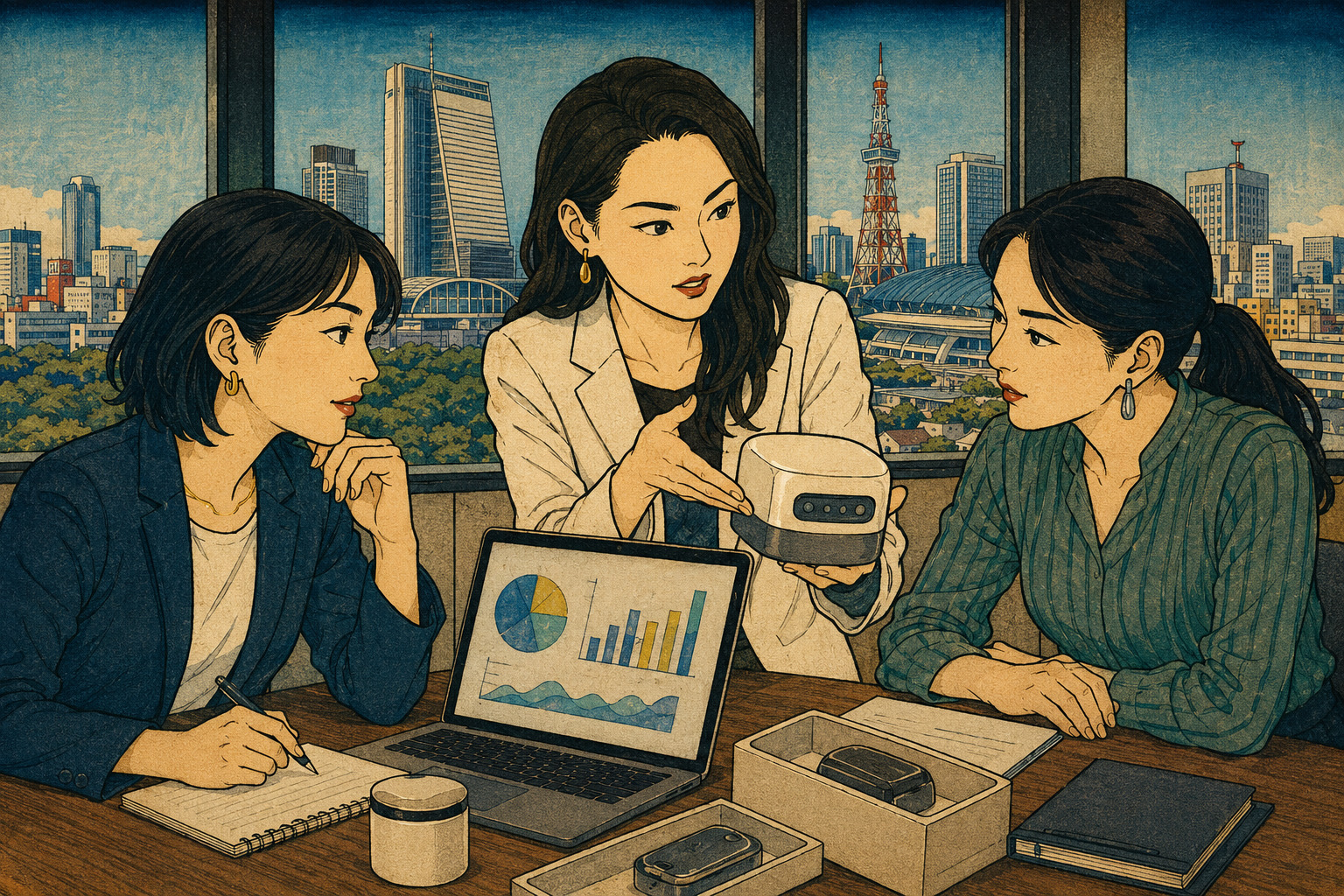
Aichi is not short of industrial assets. It has factories, engineering talent, supply chains, lenders, global exporters and, since 2024, the vast STATION Ai startup hub in Nagoya. The harder question is who can gain practical access to those assets. FLARE AICHI, whose second cohort opened for applications on August 25, is the prefecture’s attempt to make that access less dependent on the founder networks that already exist.
The name stands for Female Leaders of Aichi Revolutionizing Enterprise. Its Japanese-language materials repeatedly use the phrase “scale-oriented” (スケール志向). That choice matters. This is not advertised as a general seminar for turning a hobby into self-employment. It asks candidates to show an intention to build a significantly larger business and to create a meaningful connection with Aichi.
Applications close September 25. Aichi Prefecture’s news release says approximately 10 participants will be selected; the detailed program rules are narrower, saying six to 10 are planned. Both documents describe a paper screening followed by an online interview. The second class is due to begin in late October and conclude with a final presentation in late March 2027.
One program, three starting lines
FLARE AICHI deliberately mixes three stages of entrepreneurship. The first is pre-launch: women preparing to incorporate or turn an idea into a business plan or minimum viable product. The second is for founders less than 10 years from establishment who already have an investable plan or MVP, have begun testing their assumptions and intend to raise capital or scale further.
The third category is new and unusually relevant to Aichi. It covers women before a business succession or within 10 years after one, including executives and successors who plan an innovative new business, productivity improvements, outside fundraising or a larger use of existing corporate assets. In Japanese policy language this is 事業承継・第二創業: business succession and “second founding.”
The program is open to women aged 18 and over, including all people whose gender identity is female, according to the official FAQ. A participant need not live in Aichi or place her headquarters there. A woman co-founding with a man may participate when she holds representative authority. There is no prescribed industry. But the selection criteria explicitly favor affinity with Aichi alongside innovation, scalability, growth strategy, a global perspective and personal potential.
Those rules reveal a useful tension. Geography is not a gate at the application stage, yet regional value is a gate at selection. A strong candidate is therefore not simply a woman with a business; she must be able to explain why Aichi’s customers, research base, manufacturers, capital providers or social needs make the venture stronger—and why the venture returns value to the region.
The offer: concentration, instruction and continuity
The curriculum has three layers. Two in-person intensive sessions create concentrated working time. The first, scheduled for October 30–31 at STATION Ai, covers entrepreneurial mindset, business-plan refinement and individual scale strategy. The second, on December 14–15, is linked to the global event TechGALA Japan 2026: BEYOND and is meant to place participants among investors and other supporters.
Five practical seminars address venture design, market and competitor analysis, fundraising, hiring and organization, and pitch development. Four are online. Continuous one-to-one mentoring is planned for at least 15 hours per team, supplemented by monthly access to lead, guest and administrative mentors. A final presentation is expected in late March.
The institutional map is broader than the cohort. FLARE AICHI sits inside CoLORS, Aichi’s startup-diversity initiative. Aichi Prefecture sponsors the project and FabCafe Nagoya operates CoLORS. WizGroup and Yazawa Ventures provide the FLARE program. The Aichi Credit Guarantee Corporation, Aichi Industry Promotion Organization and Japan Finance Corporation are listed as cooperating organizations.
Hiromi Okuda, representative director of WizGroup, is named as program director; Mariko Yazawa, representative partner of Yazawa Ventures, is the planning partner. The published roster spans founders, venture investors, accounting, manufacturing support, organization building and public administration. The breadth is promising, but the metric that matters is not the number of impressive biographies. It is whether a participant reaches the right person at the right time and leaves with a decision she could not have made alone.
A founder does not scale because a curriculum tells her to think bigger. She scales when customers, capital, talent and authority become reachable at the same time.
Why the successor category changes the story
Business succession makes FLARE AICHI more than another startup course. Aichi says its 2024 manufactured-goods shipments reached ¥59.3144 trillion, about 15.5% of Japan’s total, keeping the prefecture first nationally for the 48th consecutive year. That scale reflects not only large automakers but dense layers of suppliers and firms in aerospace, machinery, robotics, textiles, ceramics and other fields.
Many of those companies already possess what a conventional startup struggles to obtain: machinery, skilled employees, quality systems, long customer relationships and credit history. Their risk is different. A mature asset base can become a constraint when a successor is expected to preserve every practice that created it.
Bringing successors into an accelerator treats inheritance as a platform for invention rather than a transfer of shares and titles. A daughter preparing to lead a supplier, for example, may not need a lesson in how to register a corporation. She may need a way to separate a new product line from the legacy business, test it with unfamiliar customers, finance it without weakening the parent company and build credibility with employees who knew the prior president.
The fit is not automatic. Venture investors tend to prize speed and a sharply defined growth curve. Succession requires negotiation with workers, family owners, banks and long-standing clients. A 15-minute selection interview and a final pitch can illuminate a strategy, but they cannot capture every form of durable progress. How the judges interpret “scalability” will determine whether the new category genuinely welcomes industrial renewal or merely favors businesses that already look like venture-capital portfolios.
A decade of policy, not a one-year campaign
Aichi’s support for women entrepreneurs began well before FLARE. Governor Hideaki Omura set out the sequence in a September 2025 press conference. The target has gradually moved from starting a socially useful business to expanding an existing one, while the prefecture built a much larger startup strategy around it.
FY2016–2018 A social-business plan competition served women before launch or within five years of founding.
October 2018 Aichi adopted its Aichi-Startup Strategy, later revised in March 2024.
FY2019–2021 Aichi COMPASS paired experts with women preparing to launch or in their earliest years.
FY2022–2024 The Hitohana program shifted toward women several years into business expansion and added community-building events.
October 31, 2024 STATION Ai opened in Nagoya’s Showa Ward.
FY2025 The first FLARE AICHI cohort focused explicitly on high-growth women founders.
FY2026 The second cohort adds succession and second-foundation candidates.
STATION Ai changed the scale of the surrounding ecosystem. Before opening, Aichi expected about 500 startup members and roughly 200 partners including corporations, financial institutions and educational bodies. In January 2026, Omura reported approximately 620 startups, around 360 partner companies and more than 1,400 events since the opening.
Physical concentration does not guarantee representative access. At the 2025 press conference, Omura said women represented 12% of startup chief executives in STATION Ai’s membership. In March 2026, a prefectural assembly committee recorded a new target: raise the female-representative share from 12.0% in FY2025 to 20% by FY2029. FLARE is one mechanism for moving that number, but its cohort alone is too small to do so.
The national trend is better—and still unequal
Japan Finance Corporation’s 2025 New Business Start-up Survey found that women accounted for 25.7% of new business owners, the highest share since the survey began in fiscal 1991 and the fourth consecutive record. The direction is encouraging. The level still means roughly three of every four respondents were men.
The denominator needs care. This was not a census of every Japanese founder. JFC surveyed 8,517 businesses that had been operating for no more than one year when they received JFC financing; 2,165 responded, a 25.4% response rate. The result is a consistent and important measure of new borrowers, not an all-market gender count.
National policy documents identify a related problem: women entrepreneurs often have less access to founder networks and greater difficulty raising capital. The Cabinet Office and the Ministry of Economy, Trade and Industry have called for regional networks connecting founders to financial institutions and anchor companies. FLARE’s mentoring, in-person cohort and finance partners closely match that diagnosis.
But there is a trap in the language of “mindset.” Confidence and ambition matter to any founder; the first intensive session explicitly works on them. If the intervention stops there, however, the burden of structural exclusion moves back onto the participant. A public program succeeds when the surrounding institutions change their behavior too—when buyers open procurement channels, investors broaden sourcing, lenders understand unfamiliar models and established companies share technical assets.
What the first eight founders proved—and did not prove
Aichi’s March 2026 CoLORS results event listed eight first-cohort FLARE participants. Their ventures addressed sanitation at building entrances, data-driven sexual care, mobility for people with weak legs, an AI system linking agriculture and disability employment, exercise prescriptions connecting hospitals and gyms, global development of wagashi, a circular organic-products business, and an HR tool for visualizing life events.
The range is significant. Women founders are too often treated as a market category expected to build only “products for women.” The first class worked across property, health, mobility, agriculture, artificial intelligence, food, circular production and human resources—precisely the kinds of operating problems found across Aichi’s economy.
A pitch, however, is an output, not an outcome. It does not by itself establish revenue, customer adoption, employment, financing or survival. In the 2026 recruitment materials reviewed by Japan.co.jp through August 26, the program specifies mentoring hours and a final presentation but does not publish aggregate targets for follow-on funding, sales, hires, pilots or partnerships.
- Validation: completed prototypes, paid pilots and evidence that core assumptions changed.
- Customers: new contracts, repeat use and procurement by Aichi companies.
- Capital: equity, loans, grants and founder capital—measured for fitness, not just size.
- Organization: key hires, co-founders and durable expert relationships.
- Network effects: alumni mentoring later cohorts and partnerships continuing after the fiscal year.
Public reporting need not expose confidential company data. Aggregated results at six, 12 and 24 months would show whether the program creates durable movement. Tracking unsuccessful experiments would be valuable too. A founder who discovers early that a market will not pay may have gained more than one who delivers a polished presentation without testing it.
Free admission still has a price
The FAQ lowers several barriers: no residency restriction, no industry restriction, inclusion of transgender women, and some online access. Yet participation demands remain substantial. Candidates must attend both two-day in-person sessions in principle, communicate through Slack, join monthly mentoring and agree to publication of their names, companies and program photographs.
Participants arrange and pay for accommodation. Children may accompany a participant on the trip, but the FAQ asks that they not sit in the program sessions. Those terms are understandable for an intensive accelerator, yet they may filter out caregivers, cash-constrained pre-founders and successors who cannot leave a production site for two days. A diversity program should therefore measure not only who is selected, but who applies, who declines and who leaves early—and why.
That is especially important because the program’s scale is intentionally small. A cohort of six to 10 can receive serious attention. It cannot, on its own, transform the composition of a hub with hundreds of startup members. Its leverage must come from institutional learning: a lender adopting better review practices, a manufacturer creating a pilot pathway, an alumna becoming an investor or mentor, a family firm recognizing a daughter as a growth leader rather than a caretaker.
The standard should be access that outlives the program
FLARE AICHI’s second cohort is compelling because it joins three kinds of transition that public programs often separate: the decision to start, the struggle to scale and the reinvention of an inherited company. In Aichi, those transitions can meet an unusually rich industrial base. The program’s opportunity is to make that base legible and usable to founders who have not traditionally occupied the center of its networks.
The risk is familiar. Accelerators can become calendars of seminars ending in a theatrical demo day. Community can become a warm word for a temporary group chat. “Global” can become a selection aesthetic rather than a customer strategy. A small public program should be judged harshly on whether introductions lead to transactions, advice leads to changed decisions and alumni access continues when the event budget ends.
When applications close on September 25, Aichi will be evaluating more than a handful of business plans. It will be choosing which forms of entrepreneurship count: a company not yet born, a young venture seeking capital, a successor turning a mature factory toward a new market. If those candidates can share one network without being forced into one model of growth, FLARE AICHI may offer something more valuable than a class on how to pitch. It may change who is allowed to use Aichi’s accumulated economic power to build what comes next.
- Aichi Prefecture — “Recruitment for the FLARE AICHI Women Entrepreneur Support Program” (Japanese, Aug. 25, 2026)
- FLARE AICHI — FY2026 application rules and FAQ (Japanese)
- FLARE AICHI — FY2026 schedule (Japanese)
- FLARE AICHI — Organizers, instructors and mentors (Japanese)
- Aichi Prefecture — CoLORS results event and first FLARE cohort (Japanese)
- Aichi Prefecture — Governor’s press conference on the history of women-founder support (Japanese, Sept. 10, 2025)
- Aichi Prefecture — STATION Ai membership and facility overview (Japanese, Oct. 1, 2024)
- Aichi Prefectural Assembly — Committee record on the female-representative target (Japanese, March 13, 2026)
- Aichi Prefecture — Industrial structure and business environment (Japanese)
- Japan Finance Corporation Research Institute — 2025 New Business Start-up Survey summary (Japanese PDF)
- Cabinet Office Gender Equality Bureau — 2024 policy on women entrepreneurs (Japanese)
Editor’s note: Aichi Prefecture’s August 25 release says “about 10” participants, while the detailed program rules say “six to 10 planned”; this article preserves both. A typographical error in the prefectural release’s Japanese rendering of “acceleration program” has been silently corrected using the official program site and standard terminology. Japanese names, official titles, readings, dates and eligibility language were checked against the linked Japanese primary sources. The displayed foreign-exchange timestamp—7:48 p.m. UTC on August 25, 2026—has been converted to 4:48 a.m. JST on August 26. The rate is a reader reference and is not used in any calculation in this article.