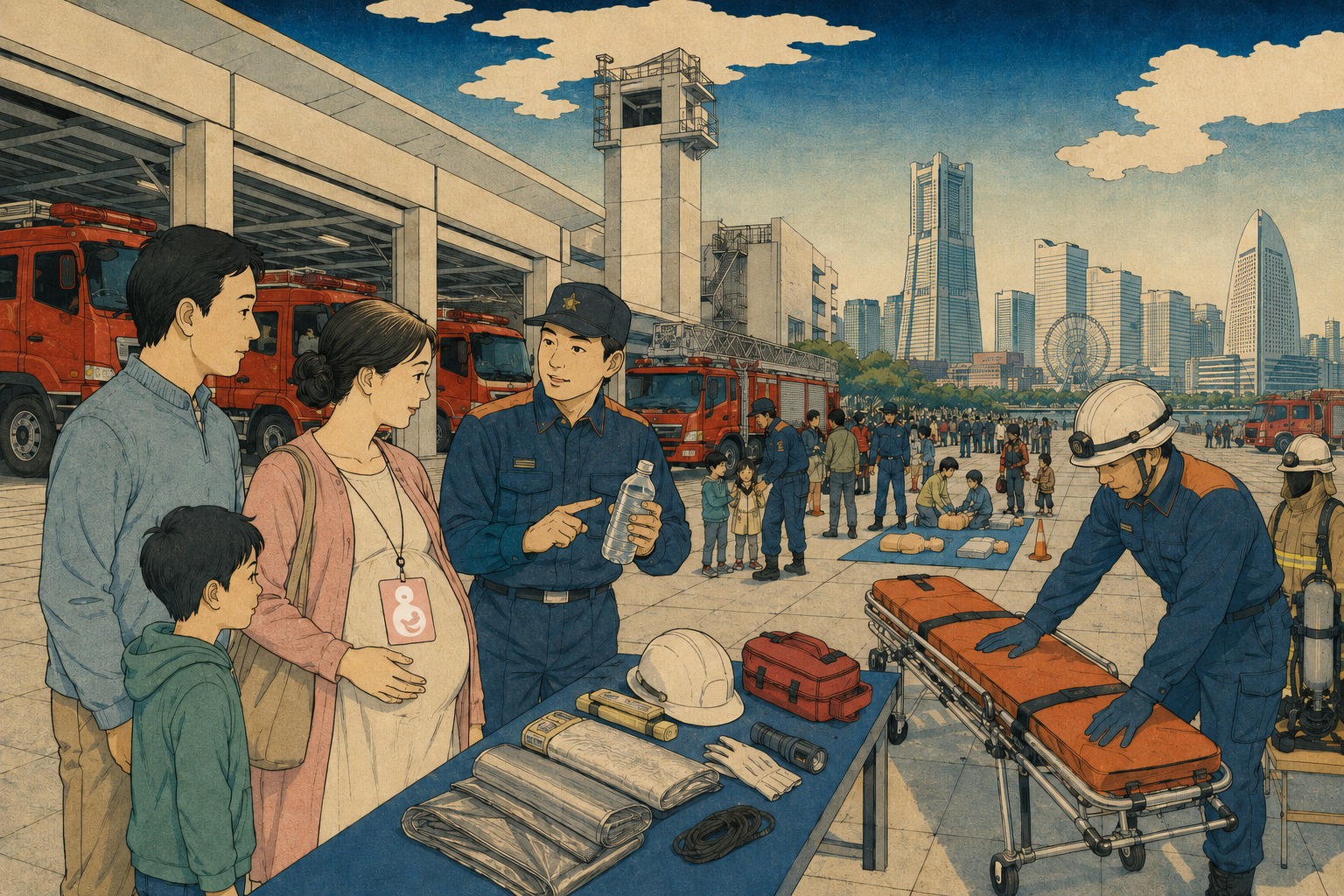
Imagine the minutes after a powerful earthquake. The station plaza is dark. Mobile networks are congested. A person on the ground cannot answer, and no relative is present. Pregnancy is not visible through a coat. Paramedics assess consciousness, breathing, bleeding and injury while choosing the next useful question. If a small marker on a bag or emergency kit catches the light, it may prompt them to ask earlier: Is this patient pregnant? How many weeks? Which maternity hospital is responsible for her care?
That is all a marker can do. In emergency communication, however, generating the first correct question matters. The original maternity marker developed by Yokohama's Asahi Fire Station is directed at that narrow but consequential task. Under the program outline, it is intended for emergencies and disasters, and its distribution will be accompanied by teaching about pregnancy-related danger, injuries to infants and children, household disaster preparation, and decisions about ambulance use.
This is not a souvenir campaign. The fire station is treating prevention before an ambulance is needed, calling at the moment danger arrives, information transfer after crews reach the scene, and support during evacuation as one continuous chain. The marker is an entrance to that chain.
How a national symbol was born
Japan's familiar national Maternity Mark did not appear overnight. A 2000 report from Healthy Parents and Children 21, the country's national maternal and child health campaign, said that spreading a pregnancy badge could be a meaningful way to encourage consideration for people in early pregnancy, when physical changes may not be outwardly visible. In 2005, a review committee decided to create one unified mark and opened a public design competition.
It received 1,661 entries. In February 2006, the committee selected a design submitted through the Saitama branch of the Imperial Gift Foundation Boshi-Aiiku-Kai. The health ministry announced the result on March 10, a date the current official site calls the mark's birthday. Responding to users' requests, official twin and triplet versions were added in November 2024.
To understand the symbol only as a request for a train seat is to miss half its purpose. The official definition pairs consideration on public transport with a second function: making it easier to communicate pregnancy during an emergency. The maternal-health information published with the national Maternal and Child Health Handbook also says the mark can help convey that a person is pregnant or recently postpartum during emergencies and disasters.
1948 Japan begins using a combined maternal and child handbook, joining previously separate records.
2000 Healthy Parents and Children 21 proposes a badge to encourage consideration for early pregnancy.
2006 A national Maternity Mark is chosen from 1,661 entries and formally announced.
2011 After the Great East Japan Earthquake, the government calls for specialized, long-term support for affected pregnant and postpartum people and infants.
2024 Twin and triplet marks are introduced; the Noto Peninsula earthquake produces examples of shelters specifically serving pregnant people.
2026 Yokohama establishes its first mother-and-infant welfare shelter and Asahi Fire Station develops a local emergency and disaster marker.
Asahi's emblem should not be understood as replacing the national system. It is a local line drawn from a widely recognized symbol toward specific emergency and disaster education. Too many similar marks can create confusion rather than recognition. Distribution therefore needs to explain how the local and national marks relate, when each may be used and what firefighters, shelter staff and residents should do when they see one.
What the marker says—and what it does not
Calling the marker “medical information” gives it too much authority. More precisely, it is evidence that relevant medical information may exist. A responder who sees it can confirm pregnancy or postpartum status and ask about gestational age, due date, onset of symptoms, regular maternity facility, complications, medicines and allergies. If the patient cannot speak, the Maternal and Child Health Handbook, clinic card and medication information can supply additional pieces.
| What a marker can do | What a marker alone cannot do |
|---|---|
| Draw early attention to possible pregnancy or postpartum needs | Prove pregnancy, gestational age or medical condition |
| Prompt responders and shelter staff to ask relevant questions | Determine diagnosis, treatment, destination or triage category |
| Provide a supplementary signal when a patient cannot speak | Replace the Maternal and Child Health Handbook, clinic records or medicine list |
| Start a household conversation about preparation | Guarantee admission to a welfare shelter or priority transport |
| Tell others that consideration may be needed | Compel display or require private medical details to be made public |
Emergency usefulness does not justify compulsory display. Some people have not disclosed a pregnancy at work or to family. Some have experienced pregnancy loss. Others fear harassment or are unsure how long to use a marker after birth. The individual should decide whether and where to display it. A visible emblem should contain minimal information; gestational age, clinic details and other sensitive facts are better kept on a card inside an emergency bag, in a protected phone record or in the Maternal and Child Health Handbook.
The 1948 handbook, the 2006 mark and local preparedness in 2026
Following the history back leads to one of Japan's distinctive public-health tools. According to the Japan International Cooperation Agency, the modern maternal and child handbook began in 1948 by integrating the maternal handbook and infant health record then in use. The book creates a continuous record across prenatal checkups, delivery, child examinations and vaccination. Families and clinicians can consult the same chronology.
The handbook carries detailed memory. The marker tells others to look for that memory. Their functions are different. A paper handbook needs no battery in a powerless shelter. It can also be destroyed by fire or flood. A protected photograph or disaster copy can be useful, but these records contain personal data. Families need to decide in advance where a copy is stored and who should be able to reach it.
Yokohama Fire Bureau added another link in 2026. All of its ambulance teams began operating an information-sharing system that can send symptoms, vital signs and images to receiving hospitals. At the entrance, a marker raises the possibility of pregnancy. At the scene, responders verify facts. During transport, accurate information reaches the hospital. The small symbol gains value only by joining that sequence.
Pregnancy concerns: do not confuse 119, the maternity unit and #7119
The Japanese phrase commonly translated as “appropriate ambulance use” can be dangerous when explained poorly. It does not mean that a person with apparently mild symptoms should simply endure them. The Fire and Disaster Management Agency increasingly uses language closer to “timely and appropriate use”: call immediately for a high-acuity emergency and use a professional consultation route when the decision is uncertain.
The latest national Maternal and Child Health Handbook information tells pregnant patients to contact their regular maternity facility immediately for bleeding, rupture of membranes, strong abdominal tightening or pain, or decreased fetal movement. Persistent severe headache and flashing or flickering vision are also identified as signs requiring attention in the context of hypertensive disorders of pregnancy. None of this means “never call an ambulance.” Unresponsiveness, inability to respond, severe breathing difficulty, major bleeding or serious trauma are emergencies for 119. The caller should state that the patient is pregnant and, if known, give the gestational age, main symptoms and exact location.
- 119: an obviously urgent illness or injury. Dispatchers ask for the location and symptoms; when urgency is high, the ambulance can be sent before every question has been completed.
- The patient's maternity facility: pregnancy-specific changes such as bleeding, rupture of membranes, strong tightening or pain, and reduced fetal movement. Follow any individual thresholds given by the patient's maternity team.
- Kanagawa Emergency Consultation Center, #7119: when uncertain whether an ambulance or immediate examination is needed. Call #7119, 045-232-7119 or 045-523-7119, 24 hours a day throughout the year. Yokohama's guidance for foreign residents describes the telephone consultation as Japanese-only.
- Kanagawa pediatric emergency line, #8000: nurse and specialist advice about a child's acute change at night. It operates from 6 p.m. to 8 a.m. on ordinary weekdays and from 8 a.m. to 8 a.m. the next day on weekends and holidays. Some phones should use 045-345-8865.
Do not delay 119 by calling a consultation line first when the emergency is obvious. Households concerned about Japanese-language access should plan a support route in advance. Official hours and access conditions can change; confirm current public guidance.
The marker cannot automate any of these decisions. A pregnant patient without one deserves the same assessment. A patient wearing one still needs symptoms and severity evaluated. The central lesson at distribution should therefore be more demanding than “show the marker and you will be safe.” Families need to rehearse who to contact, in what order and what to say for different kinds of change.
After recognition, a disaster response still needs somewhere to go
Following the Great East Japan Earthquake in 2011, the health ministry told local governments and support workers that affected pregnant and postpartum people and infants required specialized, long-term help. The disaster disrupted more than hospitals. It broke the connections that normally allow prenatal checkup vouchers to work, receiving facilities to plan a delivery, municipalities to continue records and public-health staff to find people in shelters.
The 2024 Noto Peninsula earthquake included examples of shelters established for pregnant people. Citing that experience, Yokohama signed agreements in January 2026 with Tsurumi University, Tsurumi Junior College and the Yokohama Midwives Association for the city's first mother-and-infant welfare shelter. It is intended for pregnant or postpartum people and infants who cannot continue living at an ordinary local disaster base. Supplies include liquid infant formula, and midwives are to make rounds to support physical and psychological health.
The sequence matters. Yokohama's mother-and-infant facility is not a place someone automatically enters by showing a marker. The city's model begins with sheltering at home where possible. A person unable to remain at home may go to a local disaster base. If continuing there is also unworkable, a secondary welfare shelter may be arranged. Eligibility and opening depend on the disaster. Asahi's marker is not a pass around that process; it is a signal intended to reduce the chance that a need is missed within it.
Yokohama's earthquake strategy sets goals of nine improved locations for pregnant people and young children by fiscal 2029 and roughly one in every ward by fiscal 2033. If local recognition campaigns and an expanding network of specialist shelters move together, the city can reduce the most damaging break in the chain: identifying vulnerability without having a service able to respond.
Why childhood injury prevention belongs in the same lesson
It is sensible for Asahi Fire Station to teach child injury prevention alongside pregnancy and disaster response. After birth, household hazards change with development. National guidance updated in late 2025 says unintentional injuries remain among the leading causes of death for children in Japan and that many can be prevented by changing the surrounding environment.
For newborns, soft bedding and objects near the face can contribute to suffocation. From one to six months, falls from adult beds, sofas, carriers and strollers join scalds from hot drinks. From seven to 12 months, stairs, bathtubs, kettles, medicines, button batteries, magnets and choking hazards come within reach. Once a child walks, open windows and balconies, toothbrush injuries, hot pots, drowning and running into traffic add new risks.
Yokohama's March 2026 injury-prevention material makes the same hazards concrete: swallowed household products, suffocation in and around cribs, drowning in the bath, scalds from soup or tea, falls from beds and baby carriers, and vehicle injuries when restraints are not used. The common principle is not to rely only on an exhausted caregiver's attention. Put medicine, batteries and magnets beyond reach. Do not leave bathwater standing. Remove climbable objects from windows. Move hot liquid and dangling cords away from edges. The environment continues protecting a child during a momentary lapse.
Preventing one injury prevents a child's pain and one possible emergency dispatch. Changing the entry point is both kinder and more effective than scolding families at the exit for calling an ambulance. Teaching before birth gives a household time to change before an infant begins to move.
Yokohama's dispatch count fell, but pressure did not disappear
Yokohama recorded 256,481 emergency dispatches in 2024, a third consecutive annual record. In 2025, dispatches fell 4.4 percent to 245,321, the first decline in five years. The first half of 2026 brought 115,598 dispatches, 4.0 percent below the same period in 2025. Two successive declines matter, but they do not mean the system now has abundant capacity. The time from dispatch order to handover to a physician has lengthened in recent years, and the city expects demand to remain high.
The figures should not be turned into a morality tale about patients “wasting” ambulances. A symptom that appears mild can be the beginning of serious disease, and pregnancy and infancy can change quickly. Social failures also accumulate at 119: a person may not know where to obtain care, may have no one to consult at night or may lack transportation. Condemning callers without strengthening consultation and accessible medical care does not solve those problems.
Yokohama's Anshin Kyukyu initiative combines prevention, recognition of high-acuity symptoms and awareness of services such as #7119. Asahi's distribution should live within the same framework. Do not cause hesitation in a true emergency. Do not force an uncertain family to decide alone. Prevent the injuries that can be prevented. Only when all three are present does “appropriate use” become a safe public-health message.
Five outcomes matter more than the number distributed
A local emblem is not complete when it leaves the printer. Its success should be judged by more than a count of items handed out.
- Recognition: Do fire, ambulance, shelter, medical and community staff understand the same meaning when they see it?
- Action: Do people know when to confirm pregnancy or postpartum needs, call 119, contact the maternity facility or use #7119?
- Portability: Is the marker visible in darkness, rain and crowded emergency bags, durable, and not overly dependent on written Japanese?
- Inclusion: Does education reach foreign residents, people with visual or hearing disabilities, multiple pregnancies and those living alone?
- Autonomy: Can a person choose not to display it, remove it easily and avoid placing private medical information on the exterior?
Drills are as important as design. In a simulated disaster, what does a firefighter ask after finding the marker? Can shelter staff explain the conditions for transfer to a mother-and-infant welfare shelter? Can a family member identify the patient's maternity facility? After real calls, the bureau can review—without identifying individuals—whether the signal was useful, misunderstood or overlooked. Safety will depend less on the final color than on how quickly the system learns.
A household plan for the next step
A family that receives a marker should not put it in a drawer and stop. It can review the maternity provider's specific emergency instructions, make sure another person knows the out-of-hours number, identify the correct building entrance for an ambulance, save #7119 and locate the local disaster base. With the patient's consent, a concise private card can record gestational age and due date, maternity facility, essential complications, medicines and allergies, and an emergency contact.
An emergency bag can hold the Maternal and Child Health Handbook, clinic card, identity and insurance materials, prescribed medicine, charging equipment, hygiene supplies, water and food appropriate to individual circumstances. A household with an infant may need the correct formula or feeding supplies, diapers and clothing. Public stocks cannot immediately match every brand, size, allergy or medication requirement.
These are general preparations, not a universal clinical plan. The safest action varies with the pregnancy and the disaster. A patient with threatened preterm labor, placenta previa, a multiple pregnancy or a chronic condition should make an individualized plan with her physician or midwife. The marker is the plan's cover, not its contents.
Put the whole community behind the small sign
Japanese maternal health has accumulated tools for making an otherwise invisible timeline portable. The 1948 handbook joined pregnancy and early childhood in one record. The 2006 national mark made early pregnancy visible in public space. Asahi Fire Station's 2026 initiative tries to connect that signal to specific action in an ambulance call or disaster.
Its real value will not be decided by graphic design. It will be decided by whether someone who sees it confirms gently, respects the patient's choice, calls 119 without delay for an emergency, guides an uncertain family to professional advice and finds the appropriate support in a shelter. It will also be decided by whether households prevent injury before birth and whether the city maintains medical and social systems able to answer.
A patient may be unable to speak during an emergency. A small marker cannot tell her whole story. It can hand the right first question to the right person. Firefighters, clinicians, government and families must build the answer while daily life is still calm. That is the larger test contained in Asahi Ward's very small sign.
Principal sources and reporting basis
- Yokohama Fire Bureau, Asahi Fire Station: August 2026 program outline for distribution of an original emergency and disaster maternity marker with education on pregnancy risks, child injury prevention, preparedness and ambulance use. This is the story's news peg; no individual page was located in the city's public index by the research cutoff.
- Children and Families Agency, official Maternity Mark site: purposes, the 2000–2006 development history, 1,661 competition entries, emergency use and multiple-pregnancy versions.
- Children and Families Agency, “For a Healthy Pregnancy and Birth” (updated December 23, 2025): bleeding, ruptured membranes, strong tightening or pain, reduced fetal movement, hypertensive disorders and the Maternity Mark.
- Japan International Cooperation Agency, Maternal and Child Health Handbook: the 1948 integration, continuous records and international use.
- City of Yokohama, agreement for a mother-and-infant welfare shelter during disasters (January 14, 2026) and its press PDF: eligibility, liquid formula, midwife rounds, the Noto precedent and expansion targets.
- Ministry of Health, Labour and Welfare, Great East Japan Earthquake information for pregnant and postpartum people and infants: receiving facilities, prenatal examinations, shelter health guidance and long-term support.
- City of Yokohama, what to do when uncertain about an ambulance or medical visit: #7119 services, 24-hour operation and telephone numbers.
- City of Yokohama and Naka International Lounge, guidance for foreign residents: 119, #7119 and the language available for consultation.
- Kanagawa Prefecture, pediatric emergency line #8000: operating hours, numbers, scope and relationship to #7119.
- City of Yokohama, child safety and injury prevention (updated April 1, 2026): ingestion, suffocation, drowning, scalding, falls and vehicle injuries.
- Children and Families Agency, “Injury Prevention” (updated December 23, 2025): age-specific hazards and environmental controls.
- City of Yokohama, 2025 preliminary fire and emergency statistics (January 16, 2026): 245,321 ambulance dispatches, down 4.4 percent.
- City of Yokohama, first-half 2026 fire and emergency statistics (July 16, 2026): 115,598 ambulance dispatches, down 4.0 percent year over year.
- City of Yokohama, Anshin Kyukyu classes (May 12, 2025): the 2024 record of 256,481 ambulance dispatches and education joining prevention with appropriate use.
- City of Yokohama, emergency patient information-sharing system (February 13, 2026): exchange of symptoms, vital signs and images between every city ambulance team and hospitals.
- Fire and Disaster Management Agency, 119 emergency calls and #7119 emergency consultation: dispatcher questions, urgent dispatch and professional advice when uncertain.
Editor's note: The August 2026 Asahi Fire Station program outline is the news basis for the local initiative. This article does not state a distribution volume, eligibility rule, venue or exact graphic design because those details could not be confirmed in Yokohama's public index by the research cutoff. It does not treat the national Maternity Mark and Asahi's local marker as the same program; the latter is analyzed as supplementary emergency and disaster education. Medical information here is general. Individual symptoms require the appropriate professional route—119, the patient's maternity facility or #7119. Telephone access, shelter opening and program rules can change. The evaluation framework, privacy design and private household card are Japan.co.jp analysis based on the public evidence. Research current through August 15, 2026 at 3:14 AM JST.