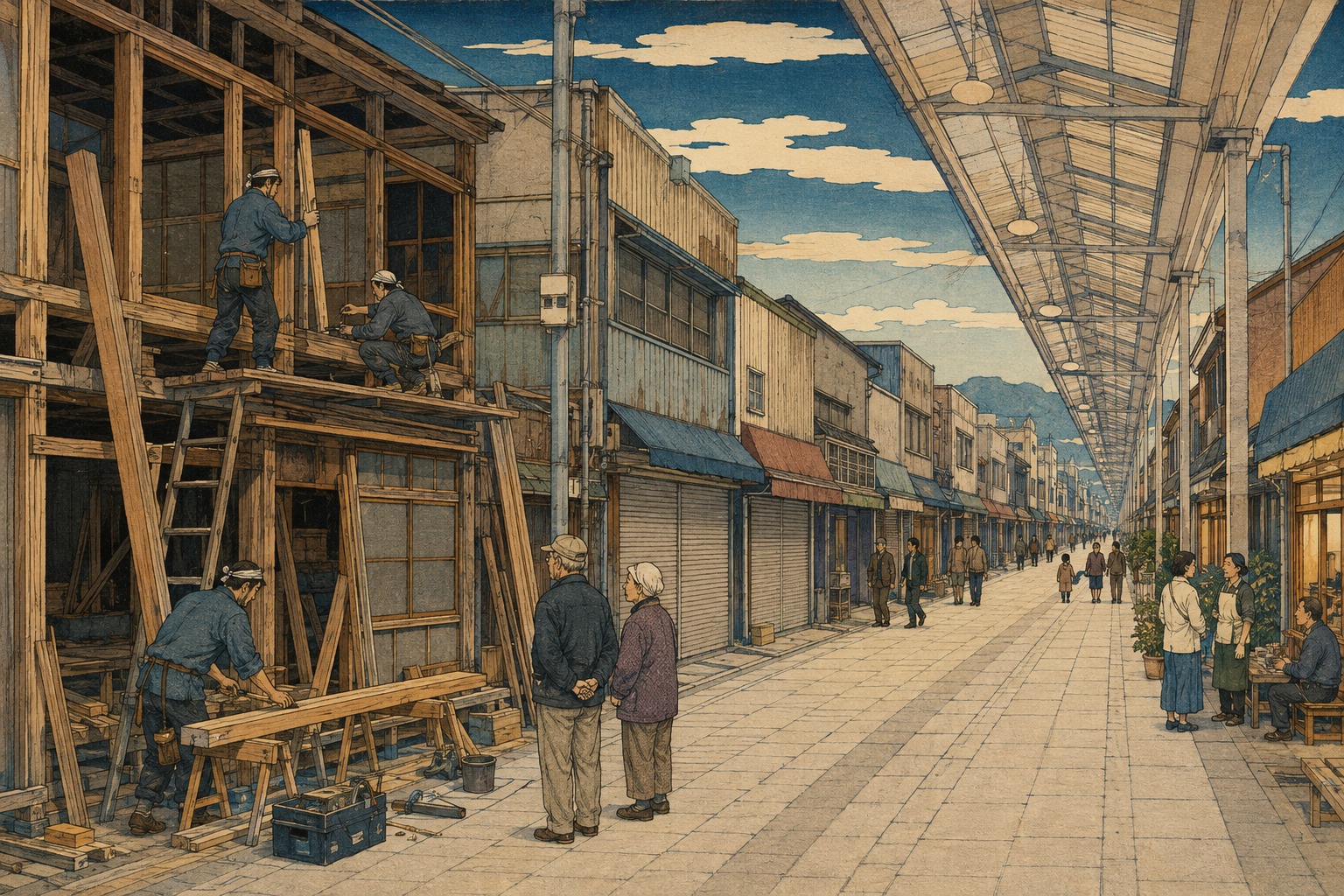
At nine in the morning, the first shop is open. Crates from the greengrocer reach the pavement and a customer pauses. The next shop is shut. Beyond it, a faded awning, leaflets spilling from a mailbox and a broken sign. A café may be serving two doors farther on, but the pedestrian has already received a message: there is probably nothing ahead.
A vacant shop is not merely a missing dot. It breaks a shopping street's promise that one destination will lead to another. Foot traffic falls, sales next door weaken, maintenance is postponed and another tenant leaves. The feedback can run the other way, too. One restored light can tell a hesitant owner or a prospective operator that this street may have a next chapter. The national government is trying to reverse the direction of that chain.
Many existing programs help a new tenant pay rent or fit-out costs. That can open one door. It is much less effective when an owner does not want to rent, heirs cannot agree, an old row building needs expensive structural and fire work, a retired proprietor still lives upstairs, or no one has a plan for the street as a whole. The 2026 framework addresses not only the shortage of tenants but the properties that are stuck before they can return to the market.
The new tool is more than a subsidy
The legal foundation is the Act Partially Amending the Act on Special Measures Concerning Urban Renaissance and related laws. The Diet passed it on May 20, 2026, and it was promulgated as Act No. 23 on May 27. The government's stated background was a familiar regional spiral: population decline and the departure of young people make daily services harder to maintain, while weak prospects hold back private investment. Part of the response was a change to the Landscape Act.
Under the previous system, general incorporated associations and foundations, nonprofit organizations and certain other bodies could become officially recognized landscape-improvement organizations. The amendment renamed the role keikan seibi suishin hōjin—landscape-improvement promotion corporation—and made private companies eligible for municipal designation. In an area written into a municipal landscape plan, a designated body can make an agreement with building owners and undertake renovation and reuse on their behalf as a landscape-regeneration project.
That is a technical but consequential shift. A conventional grant often ends at the relationship between one applicant and one property. A designated corporation can potentially show a plan for the street, negotiate with several owners, assemble design, financing and tenants, and remain responsible for management after construction. Municipal designation may give a private operator credibility. It does not confer a power to seize property, erase the need for owner consent or make an uneconomic project viable by decree.
Why a lower vacancy rate is not an all-clear
The latest full national survey, covering fiscal 2024 and published in 2025 by the National Federation of Shopping Street Promotion Associations, received 4,824 valid responses. The average vacancy rate was 11.30 percent, down from 13.59 percent in the fiscal 2021 survey. That sounds like recovery. The rest of the evidence is less reassuring. Vacancy was at least 10 percent on 36.5 percent of responding streets. Aging proprietors and succession problems were cited as a major issue by 64.9 percent, aging stores and shared facilities by 37.2 percent, and a declining trade-area population by 31.1 percent. For shops that had recently closed, 67.5 percent of streets cited old age and the absence of a successor.
An average also has a denominator problem. If a shop is converted into a residence, it may cease to be counted as a shop even if commercial continuity is gone. Demolish a dangerous building, and an empty shop can become a parking lot that improves the vacancy percentage. If a shopping-street organization dissolves, it may disappear from a later response pool. The 11.30 percent figure is therefore an aggregation of premises known to responding shopping streets, not a complete inventory rate for every piece of commercial real estate in Japan.
Nor is every closed shutter a shop available to rent. A fiscal 2018 survey cited by the Japan Chamber of Commerce and Industry found that respondents associated persistent vacancy with deteriorated buildings (40.0 percent), an owner unwilling to rent (39.2 percent) and disagreement over rent (29.0 percent). The figures are dated, but they expose barriers that a tenant-search website cannot solve: unregistered succession, heirs scattered around the country, belongings left inside and negotiations over who should pay for repairs. Behind a shutter with no “for rent” sign is often a family history, not a market listing.
- The 2023 Housing and Land Survey counted 9.002 million vacant dwellings, a record 13.8 percent of the housing stock.
- Those are housing statistics. The 11.30 percent figure concerns shops on responding shopping streets, with a different subject, denominator and method.
- Shop-houses can make the problems overlap, but the figures cannot be added, and nine million must not be reported as the number of vacant storefronts.
A shopping street was more than a group of shops
Japan's shōtengai did not suddenly appear after 1945. Commerce along highways, temple approaches, markets and station fronts accumulated over generations, then took recognizable form through Meiji-era urbanization, the railways and postwar reconstruction. Greengrocers, fishmongers, rice dealers, pharmacies, clothiers, restaurants, bathhouses and cinemas supported life on foot. Proprietors were merchants, but also festival organizers, informal guides, guardians of children and nodes in a neighborhood's information network.
High growth enriched those streets and changed the ground beneath them. Car ownership spread. Housing and arterial roads extended into suburbs. Supermarkets, mass retailers, convenience stores and shopping centers competed on price, range, parking and opening hours. Households became smaller, dual-income work more common, and shopping schedules less frequent and more compressed. E-commerce later reduced the need to visit a physical store at all.
Policy swung with the economy. The 1973 Large-Scale Retail Store Law regulated and adjusted the opening and expansion of large retailers. In 1998, Japan shifted toward the “three town-planning laws”: the Central City Revitalization Act, the Large-Scale Retail Store Location Act and a revised City Planning Act. When the location act took effect in 2000, the center of review moved away from economic protection of small retailers and toward effects on traffic, noise, waste and the surrounding living environment. The 2009 Regional Shopping Street Revitalization Act added support for projects serving local residents, and 2020 urban-renewal reform promoted comfortable, walkable city centers.
1973 Large-Scale Retail Store Law puts adjustment between large stores and local retail at the center.
1998–2000 The three town-planning laws combine central-city revival, land use and local environmental effects.
2009 Regional Shopping Street Revitalization Act supports work responsive to local demand.
2020 Urban-renewal reform creates a framework for comfortable, walkable city-center space.
2026 Landscape-regeneration projects allow designated companies and other bodies to coordinate area-wide renovation with owners.
Half a century cannot be reduced to “malls killed the shopping street.” Urban-planning case research suggests a large store in a city center can coexist with surrounding commerce, while a peripheral location is more likely to compete with and hollow out the center. Results still depend on population, public transport, housing, land values, tourism and succession. Decline came from no single villain. The geography of daily life changed faster than a generation of shops could be replaced.
What events and one-shop grants taught
Local governments and merchants did not stand idle. Arcades, street lamps, decorative paving, shared parking, premium vouchers, festivals, stamp rallies, challenge shops, rent support and renovation grants have accumulated for decades. Kyoto, Tokyo's Taito Ward and Hyogo Prefecture, among others, still operate locally tailored support for vacant-shop openings or community functions in fiscal 2026.
These programs are not pointless. Fit-out support can decide whether a young operator with no collateral opens at all. A temporary shop can test demand at small scale. A festival can help residents remember that the street belongs to them. But foot traffic on an event day is not gross profit next month. The number of openings is not the number of survivors three years later.
The structural weakness was treating the building and the business separately. A tenant appears, then withdraws after seeing the price of a leaking roof, weak structure, obsolete wiring, plumbing, asbestos work, fire compliance or step-free access. An owner renovates, but no viable operator arrives. A municipality beautifies the pavement while property negotiations behind it remain frozen. The new framework tries to assemble the building, owner, user and streetscape as one project.
What two model cities will test
On July 1, the Kinki Regional Development Bureau selected the area around the approach to Hozanji Temple in Ikoma, Nara Prefecture, as a model city project. A temple town took shape there from the Taisho era, rising along a steep route toward the temple. Vacant inns and shops have increased, turning historic structures and dramatic views into both assets and expensive liabilities. The next steps are to find a private operator, negotiate agreements with owners, and assemble business and landscape plans.
On July 7, the infrastructure ministry selected Nagasaki's Nakashima River and Teramachi district. Megane Bridge, temples and traditional Nagasaki machiya survive there, but vacancies increased with the pandemic and aging ownership. The city's Machibura project has encouraged openings since fiscal 2013, and younger operators are already moving into the area. The new approach will test whether those openings can become more than isolated good fortune by connecting historic townscape and everyday commerce across a district.
The settings are not interchangeable. Hozanji has a steep temple approach and a pilgrimage narrative. Nagasaki has the circulation of an international tourism city and a surviving stock of townhouses. Even if both succeed, their prescriptions cannot simply be copied to a lightly populated, flat station district or a car-dependent suburban arcade. The value of a model is not that every town opens the same shop. It is that owner coordination, construction cost, use and management are made transparent enough for other places to compare their own conditions.
Marugamemachi and Kurokabe—the part after “success”
Takamatsu's Marugamemachi shopping street is repeatedly cited in discussions of area-wide regeneration. Its approach separated land ownership from building use. Landowners supplied sites to joint projects through fixed-term lease arrangements while a town-management company combined housing, retail, health care and public space block by block. The A block completed in 2006 sought to return “living and gathering,” not just shopping, to the center. Its most transferable feature was not an impressive arcade. It was the ability of landowners to pool control beyond the optimization of each narrow lot.
Kurokabe in Nagahama, Shiga Prefecture, carries a different lesson. When demolition threatened the old bank known as the “Black Wall,” local firms and the municipality established a company in 1988. Glass culture and historic townscape brought visitors and turned Kurokabe into a national revival story. In June 2026, however, Nagahama announced a fundamental restructuring that included special liquidation and debt treatment for the old company and a transfer of operations to a new one.
That does not erase nearly four decades of achievement. It shows that even a celebrated tourism project must renew its earnings, finances, governance and leadership. A building does not finish needing care when renovation ends. Companies and streets need reserves, succession and the ability to withstand recession, disasters and changing fashions. Creating an opening ceremony with a grant is easier than deciding who pays for repairs in year ten.
Diagnose the building instead of choosing “preserve” or “demolish”
Saving every old building is not regeneration. A leaning frame, fire-spread risk, falling sign, hazardous material or inadequate escape route cannot be excused as “Showa retro.” Yet uniform demolition into parking lots can erase narrow frontages, living above the shop and the detail visible at walking speed—the physical assets that distinguish a shopping street.
The answer is triage, property by property. Survey the structure. Price seismic, fire, insulation, wiring, plumbing and accessibility work. Compare that with heritage value, future rent and a use the district actually needs. Preserve, partially renovate, convert, reduce or demolish accordingly. Temporary occupation may test demand before major construction. Because the ministry has not published eligible subsidy costs, these are practical questions for program design, not a claim that the government has announced a particular menu.
| Stage | Where public support could unlock work | Condition that guards against failure |
|---|---|---|
| Before a property opens | Owner search, inheritance and title coordination, building surveys, feasibility work | Do not rush consent; protect private information and property rights |
| Design and construction | Seismic and fire safety, asbestos, utilities, façade, access and energy efficiency | Judge safety and operating economics, not appearance alone |
| Finding a user | Tenant search, temporary trials, business planning and combinations with local services | Prioritize real local demand and a viable operator over filling a unit |
| Running the street | Shared management, cleaning, deliveries, promotion, data and repair planning | Identify post-subsidy revenue and responsibility before building |
A subsidy that does not stop at “looks better”
When a grant is announced, attention usually settles on its rate and ceiling. Public-policy design asks harder questions. Would this project have proceeded without public money? Where is the line between additional work in the public interest and routine maintenance an owner should pay for? How should the private gain in property value be balanced against the interest of taxpayers? Will operators be chosen competitively? How will conflicts of interest be managed? If a project fails, who retains the building and the debt?
Choosing districts is equally difficult. A focus on “conspicuous” vacancies can channel money to station fronts and visitor districts that are easy to see. A less photogenic street may matter more to residents because it needs a grocer, clinic or place for children to study. Yet distributing small sums evenly to places with almost no demand may scatter the budget across renovations that become vacant again. Concentrating support requires evidence, resident participation and an explanation to places not selected.
Revival can also raise land values and rents enough to displace longtime businesses and low-income residents. Excessively uniform design can replace a messy, lived-in district with a marketable version of “the past.” The revenue of the designated corporation, owner benefits, tenant costs and use of public space should be visible. Affordable units and essential local services may need explicit protection. Improving the landscape must not remove residents from it.
- What are the national budget, subsidy rate, ceiling and local/private shares?
- Does support cover only exteriors, or also structure, safety, utilities, title coordination and operating preparation?
- How is an area selected instead of one favored property?
- What happens when owners disagree, heirs are unknown or a participant withdraws?
- How are designated corporations selected and conflicts disclosed?
- How are housing, health care, child care and food access valued?
- Who pays for future repairs and operating losses after the grant?
- Will authorities publish three- and five-year survival, vacancy, rent and resident-use data—not only openings?
Put the measure of success in place before construction
The number of renovated buildings is the easiest outcome to count and the easiest to mistake for success. Of ten completed properties, are eight occupied three years later, or two? Can the new operators pay themselves a living income? Did rents rise? Are more people simply walking through, or are they using local businesses? Did residents return to upper floors? Did effective vacancy fall when off-market and unsafe properties are included?
Evaluation should compare the district before and after with a place facing similar conditions. A tourism boom or broad economic improvement must not be credited to construction. Disclosed evidence should include failed negotiations, businesses that closed and cost overruns, not only showcase properties. That is how the next municipality avoids the same error. A model city should be a learning system, not a showroom.
There is no single finished form for Japan's shopping streets. A visitor district may support inns and studios. A residential neighborhood may need food, medicine, care, after-school space and shared workplaces. A station center may need housing that restores a nighttime population. A rural street may work as a base for mobile sales and delivery. Revival does not mean bringing every old shop back. It means making a small center that fits the population and daily life now.
Beyond the shutter, a new agreement
Shopping-street decline is not a failure of effort by proprietors or loyalty by consumers. It is where population, transport, housing, inheritance, building safety, finance and generational change have collided. No single grant cures that. The new framework nevertheless matters because it recognizes private companies as public-facing landscape actors and moves the unit of action from one property to an area linked by owner agreements.
Its value will depend less on the size of a headline number than on precision. Pay for owner coordination before construction. Put structural safety ahead of cosmetics. Recruit businesses the district needs. Contract for management after the subsidy ends. Publish results, including failure. Use private speed and expertise without surrendering public accountability.
Return to the street at nine in the morning. Opening one shutter looks like a small event. If it connects a shop to residents, workers, a place to rest, the next investment and repairs ten years away, it becomes an entrance to the town's future. The government's task is not to paint the door gold. It is to create the conditions in which life on the other side can support itself.
Sources and reporting basis
- Ministry of Land, Infrastructure, Transport and Tourism: 2026 amendment to the Urban Renaissance Act and related laws (Act No. 23)
- MLIT: Cabinet decision on the amendment bill (March 10, 2026)
- Kinki Regional Development Bureau: Hozanji approach selected as a model project (July 1, 2026)
- Ikoma City: Hozanji area selected as a landscape-regeneration model
- MLIT: Nagasaki's Nakashima River and Teramachi selected as a model project (July 7, 2026)
- National Federation of Shopping Street Promotion Associations: Fiscal 2024 Shopping Street Survey
- Small and Medium Enterprise Agency: national shopping-street survey archive
- SME Agency: new possibilities for shopping streets and sustainable regional development
- Statistics Bureau of Japan: 2023 Housing and Land Survey
- Kanto Bureau of Economy, Trade and Industry: Large-Scale Retail Store Location Act
- SME Agency: Central City Revitalization
- SME Agency: Regional Shopping Street Revitalization Act
- MLIT: comfortable and walkable city centers
- SME Agency case study: Takamatsu Marugamemachi Shopping Street
- Nagahama City: restructuring and renewal of Kurokabe (June 2026)
- Ministry of Finance, Finance magazine: the history of Nagahama and Kurokabe (February 2022)
- Japan Chamber of Commerce and Industry: summary of the fiscal 2018 Shopping Street Survey (June 2019)
- City Planning Institute of Japan: case research on large-store closure and city centers
Editor's note: This report does not invent a subsidy rate, ceiling, eligible cost or start year that has not been publicly announced. Percentages from the fiscal 2024 shopping-street survey are based on responding streets and are not a complete inventory of all Japanese commercial real estate. Vacant-home figures from the Housing and Land Survey measure dwellings, not storefronts. Recommendations about program design are Japan.co.jp analysis based on published materials and earlier projects, not announced government policy. Research was current to 3:14 a.m. Japan Standard Time on August 15, 2026.