A melody leaves Europe and spends three centuries changing passports. It becomes a children’s song in Japan and South Korea. Its words alter; its social use alters; the hierarchy that once carried Western music into East Asian classrooms remains audible beneath the innocence of the tune. In the hands of Korean artist and composer Gang Donghoon, listening becomes a form of historical excavation.
Elsewhere in the same exhibition, an earthquake is not represented by broken buildings. It lives in a body that has learned to anticipate motion. A former landfill outside Helsinki is not treated as dead ground. Plants, animals, maintenance workers, a geologist and walkers make it into a layered archive. The changing lanes of Sumida become ceramic memory and circulating water. Living plants produce signals beyond ordinary human perception. A video game carries a viewer toward writers who worked in secret and watched their books burn.
These are the six paths in Part 2 of Tokyo Arts and Space’s Creator-in-Residence 2026 Exhibition, Walking Barefoot, which opened Saturday at TOKAS Hongo and continues through September 20. They do not share a style, a medium or even a country of production. What joins them is a method: leaving the conditions in which one’s categories normally feel natural, then paying attention before those categories settle again.
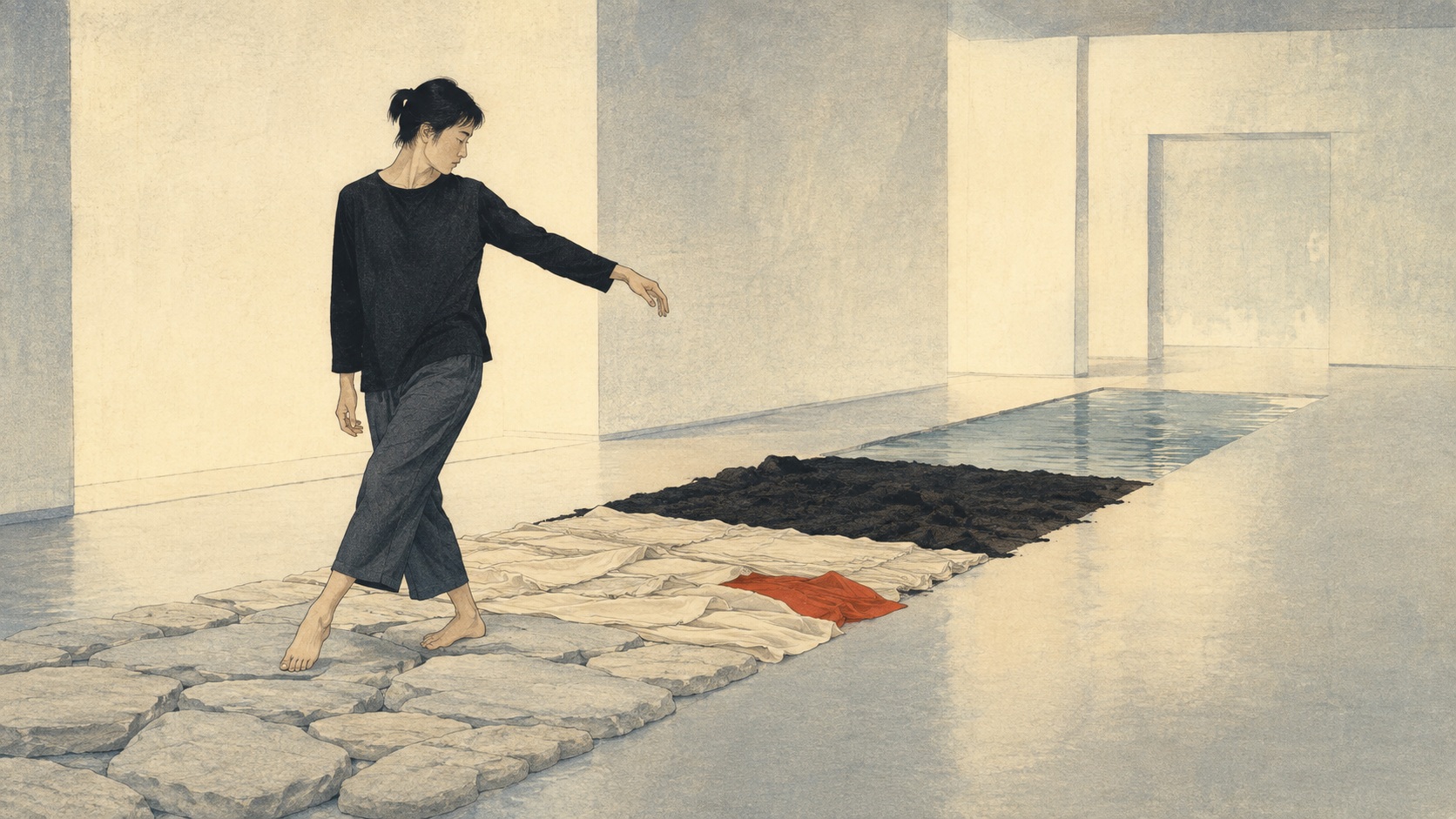
TOKAS describes social belonging as a pair of shoes. Group identities, institutions and habits protect people and help them move through the world. They also insert a sole between skin and ground. The exhibition’s artists temporarily remove that insulation—sometimes willingly, sometimes because history, disaster or exile makes the choice for them—and try to feel the world without pretending they stand outside it.
Six ways to touch a place
The residency is often imagined as a gift of empty time: a room, a studio and relief from ordinary duties. Walking Barefoot shows a more demanding version. Place is not scenery supplied to a visiting artist. It is a resistance—linguistic, historical, material, ecological—that can interrupt the work the artist expected to make.
Gang stayed at TOKAS Residency from January through March. His practice examines how music has been consumed, circulated and misused. In Tokyo he studied the musical hierarchies created as Western music entered East Asia during modernization, including the role of education. His exhibition work turns to a melody that began in the West roughly 300 years ago and became widely familiar in Japan and Korea. The tune’s mobility complicates any clean claim of ownership. A song can cross borders with affection and coercion at the same time.
Hala Saori traveled in the other direction, from Tokyo to Treasure Hill Artist Village in Taipei between September and November 2025. Her ongoing P wave takes its name from the primary wave that arrives before the more damaging seismic motion. Hala has traced the work to a lifetime of earthquakes and to the 2011 Great East Japan Earthquake in particular. In Taipei, the field widened: physical shaking overlapped with military tension, information warfare and the choreography of nationwide disaster drills. Her body does not perform a disaster after the fact. It asks how memory trains a person to brace before the ground moves.
Mizuno Nagisa’s residency at HIAP in Helsinki began on apparently ruined land. Vuosaari Hill was formed from a former landfill and has become a flourishing habitat. Mizuno spoke with soil specialists and people who maintain the hill, then invited participants to walk it with a geologist and gather sensory fragments into sound poetry. The project refuses two easy stories: that human damage is permanent sterility, or that new greenery erases what was buried. Care begins by holding both histories in the same place.
For Mexican artist Diego Pérez, research meant walking out the door of the TOKAS residence in Sumida with a camera. He recorded old houses disappearing into apartment construction, visited craftspeople and museums, made paintings and ceramics, and collaborated with a local watering-can artisan on a copper fountain. His Sumida fountain I brings circulating water into a sculpture informed by Japanese gardens. It is not a souvenir of “Japan.” It is the material residue of repeated routes, conversations and making with another person’s skill.
Taiwan-based collective Synphysica—Fang Chih Hsuan and Chou Chiao Chi for this TOKAS project—worked in Tokyo from January through March. They researched Japanese gardens, bonsai and nearby forest ecologies, asking where cultivation ends and ecological self-regulation begins. Their installations use living plants, sensors and computational systems to translate biological activity that human eyes and ears normally miss. The technology does not make the plant speak human language. At its best, it makes the limits of human hearing visible.
Usami Nao’s Berlin residency at Callie’s confronted a different limit of empathy. Visiting bunkers, concentration camps and other wartime sites, she researched physical and psychological oppression. Silence and Oblivion uses 3D computer graphics and the participatory grammar of a video game to approach writers who continued working in secret and were forced to witness the burning of their books. Usami’s associated performance, Inner murmur, combines her video with choreography and performance by Kobayashi Moe. The viewer is not offered mastery over history. Interaction becomes a test of how closely a mediated body can approach another body’s fear without claiming to possess it.
| Artist / residency | Encounter | The protective “shoe” put under pressure |
|---|---|---|
| GANG Donghoon Tokyo, Jan.–Mar. 2026 | A Western melody naturalized through East Asian childhood | The idea that familiar music has no politics or route of arrival |
| HALA Saori Taipei, Sep.–Nov. 2025 | Earthquakes, drills, military tension and anticipatory bodies | The separation of natural disaster from social choreography |
| MIZUNO Nagisa Helsinki, Aug.–Nov. 2025 | A landfill living a second ecological life | The labels “waste,” “nature” and “recovery” |
| Diego PÉREZ Tokyo, Sep.–Nov. 2025 | Sumida’s changing houses, crafts and everyday routes | The visitor’s appetite for a timeless, collectible Japan |
| Synphysica Tokyo, Jan.–Mar. 2026 | Plant signals and managed gardens | The human monopoly on perception and environmental control |
| USAMI Nao Berlin, Sep.–Nov. 2025 | Suppressed writers, burned books and embodied memory | The safe distance between historical knowledge and felt experience |
What the metaphor gets right—and what it risks
Shoes are technologies. They extend range, protect against heat and sharpness, signal occupation and status, and make some terrain traversable. They can also deaden information. TOKAS’s metaphor works because it refuses the childish claim that society is only a prison. Categories shelter as well as confine. Institutions provide money, visas, rooms, translation, contacts and permission to fail. A residency is itself an elaborate shoe.
That paradox matters. “Vulnerability” is one of contemporary art’s most overused virtues. It can turn real precarity into an aesthetic pose, especially when an institution celebrates exposure while someone else bears the cost. A person who crosses a border with funding and a return ticket is not vulnerable in the same way as a refugee, a banned writer or a worker whose home is being demolished. A visitor’s temporary uncertainty should not be confused with another person’s permanent danger.
Walking Barefoot is strongest when its artists treat sensation as responsibility rather than innocence. Hala does not claim that an earthquake and military threat are identical; she studies how both organize anticipation. Mizuno does not proclaim a healed landfill; she listens to the people and strata that complicate the word “nature.” Pérez does not extract a local craft as visual flavor; collaboration and daily repetition enter the object. Usami uses a game not to make persecution entertaining but to question whether agency inside a screen can intensify attention to agency denied in history.
There is an ethical difference between removing a category and pretending categories do not exist. The former can expose how a label works. The latter can erase the unequal power that made the label consequential. The artists’ difficult task is to approach an individual body, place or organism without losing the structures around it.
From retreat to encounter: a short history of the residency
The earliest modern artist residencies were built around withdrawal. Yaddo, founded in New York in 1900, promised uninterrupted time and space away from the market, city noise and economic pressure. MacDowell followed in New Hampshire in 1907, bringing artists from different disciplines together while protecting the solitude needed to work. The model treated distance as shelter: leave society long enough to create something that society’s demands would otherwise prevent.
A second model grew after the 1960s. Residencies became bases for social action, research and exchange. The artist no longer had to retreat to a rural sanctuary. A guest studio inside a city, a village or a contested landscape could put the work into contact with residents, politics and place. Today both genealogies survive. Some programs defend concentration; others demand public projects. Many promise both solitude and engagement, even when those desires pull in opposite directions.
Japan’s contemporary residency infrastructure developed later. ARCUS began a pilot in Moriya, Ibaraki, in 1994, when its organizers say artist-in-residence programs were still almost unknown in the country. It joined emerging international artists to local encounters inside a converted school. Akiyoshidai International Art Village opened in Yamaguchi in 1998 with a purpose-built cultural complex and made residency one of its core programs. These public and regional experiments treated visiting artists not only as recipients of support but as catalysts for encounters outside metropolitan museum culture.
Tokyo Wonder Site opened at Hongo in December 2001, initially focused on supporting young artists. A short-term residence pilot began in June 2006; TWS Aoyama: Creator-in-Residence opened that November. The residence moved to Sumida in 2014, into a 758-square-meter facility with 12 guest rooms, two studios, a library and lounge. In 2017, Tokyo Wonder Site became Tokyo Arts and Space.
That institutional timeline is more than a sequence of names. It records a change in what public art support was expected to do. Exhibition space was no longer enough. Artists needed living space, research time, exchange partners and staff able to connect a proposal to a city. The artwork’s public debut moved to the end of a longer, largely invisible process.
1900 Yaddo formalizes the residency as protected time and space for artists.
1907 MacDowell brings multiple creative disciplines into a shared retreat.
1960s onward Urban and community-based residencies expand the model from retreat toward social encounter.
1994 ARCUS launches a pilot in Moriya when the model is still rare in Japan.
1998 Akiyoshidai International Art Village opens with residency at its core.
2001 Tokyo Wonder Site Hongo opens.
2006 TWS begins its residency program and opens the Aoyama facility.
2014 The residence moves to Sumida; Hongo remains the presentation site.
2017 Tokyo Wonder Site is renamed Tokyo Arts and Space.
2026 Walking Barefoot marks 20 years of the Creator-in-Residence program.
Two buildings, one artistic metabolism
TOKAS has split the residency’s metabolism across Tokyo. In Sumida, creators sleep, research, meet, test materials and show unfinished work during open studios. In Hongo, a compact 2001 facility with three exhibition rooms, the results are edited into a public argument. The trip between the two is also a transformation: private uncertainty becomes an exhibition that must communicate without flattening the process that made it.
The current program is not a single competition. International creators may receive airfare, living expenses, a project fee, a single room and shared studio for approximately three months. Exchange residencies send Japan-based artists to affiliated organizations and bring overseas creators to Tokyo. Curators, emerging Japan-based creators and research-focused applicants enter through other tracks with different support. TOKAS’s 2026 exchange network includes Basel, Berlin, Brussels, Dublin, Helsinki, Montreal, Seoul and Taipei.
This machinery explains why the six Part 2 works differ so radically yet remain connected. Gang, Pérez and Synphysica were invited into Tokyo. Hala, Mizuno and Usami were sent outward through reciprocal partnerships. Each route changes who arrives as a guest and who returns home as a translator. A strong exchange program does not simply export “Japanese artists” and import “foreign artists.” It destabilizes both labels by giving the work time to become more specific.
Part 1, which ran from June 27 through August 2, demonstrated the same system under a shared theme, “Technology and the future of humanity.” Alexia Achilleos made a collaborative card game that rewrote Big Tech’s utopian fairy tales. Anais-karenin put ancestral and plant knowledge against colonial systems of classification. Eduardo Castillo-Vinuesa researched Japan’s weather-control ambitions. Nogami Katsuki let AI write tomorrow’s diary and then adjusted his behavior to obey it. The exchange artists studied mental-health foster care in Geel, imagined “skin color” through mixed paint in Quebec, and made paper from Basel weeds.
Together, the two periods reverse a familiar assumption. Technology is not disembodied, and bodily knowledge is not anti-technological. Forecasting models reorganize the atmosphere; music education reorganizes memory; a sensor makes plant activity available as data; a video game produces a bodily response to a burned book. The question is never whether mediation exists. It is who designed the interface and what it allows the body to notice.
Mobility is an opportunity distributed unevenly
Artist mobility is often presented as an uncomplicated good. UNESCO connects cross-border movement to cultural exchange and creativity. Residencies can provide money, time, professional networks and access to materials that an artist cannot secure at home. They can also create diplomatic relationships that survive shifts in formal politics. Walking Barefoot makes a persuasive case for what becomes possible when mobility is properly supported.
But the ability to leave for six weeks or three months is not evenly shared. European cultural-sector research—useful here as a diagnosis of a global problem, not a judgment on TOKAS—has called for mobility schemes that account for disability, family responsibilities, caregivers, geography, class and unequal access to information. Artists frequently work through temporary contracts and irregular income. Even a funded residency can require someone to suspend teaching, maintain two homes, arrange care, navigate a visa or absorb costs paid only after travel.
TOKAS publishes the broad support attached to each program, which is important. The next measure of equity is harder: who never applies because the structure of mobility already excludes them? A single room is a benefit for one artist and a barrier for an artist with a child or care partner. An English-language network connects some scenes while leaving others less visible. A three-month absence can liberate a freelancer and endanger someone with fixed local obligations.
There is also an ecological contradiction in international art’s dependence on aviation, especially when the resulting work addresses climate and non-human life. This does not make exchange fraudulent. It requires institutions to distinguish necessary embodied encounter from prestige travel, support slower or linked journeys when possible, and report enough about methods and outcomes for the public to judge the value created.
The point is not to put the shoes back on and stay home. It is to understand who receives shoes, who is asked to walk unprotected, and whose ground becomes material for someone else’s career.
- Time: Does the artist have enough of it to move beyond first impressions?
- Reciprocity: Do local collaborators receive credit, agency and a continuing relationship?
- Access: Can artists with care duties, disabilities and limited cash flow realistically participate?
- Process: Is uncertainty allowed, or must every stay manufacture a polished cultural souvenir?
- Afterlife: Does the work return knowledge to the place that helped produce it?
A visitor’s route through Part 2
Walking Barefoot Part 2 is open from 11:00 to 19:00, with last entry at 18:30, at Tokyo Arts and Space Hongo, 2-4-16 Hongo, Bunkyo-ku. Admission is free. The exhibition continues through Sunday, September 20, and is closed on Mondays. Visitors should verify the calendar before traveling.
A Japanese-English artist talk with Gang, Pérez and Synphysica is scheduled for Saturday, August 22, from 16:00 to 17:30. Hala’s 15-to-30-minute performances are scheduled three times each on August 29, September 12 and September 19; admission is free, but the capacity is 20 and numbered tickets are distributed from one hour before each performance. Inner murmur, with video by Usami and performance by Kobayashi, is scheduled again on September 19 and 20 at 15:00, without advance booking.
The useful way to visit is not to hunt for a single illustration of the title. Ask instead what each work treats as ground. For Gang it is a melody worn smooth by childhood. For Hala it is literal earth and the political atmosphere above it. For Mizuno it is buried waste and new habitat. For Pérez it is a neighborhood under redevelopment. For Synphysica it is a field of signals crossing species. For Usami it is the unstable surface between history and simulated experience.
Then ask what protects you from feeling that ground. Familiar songs can hide empire. Disaster preparedness can hide the politics of fear. “Nature” can hide maintenance and waste. A picturesque street can hide displacement. Data can make life legible while translating it into human terms. Interactive media can promise empathy too cheaply.
No exhibition can remove those contradictions. What art can do is make the sole visible.
Put the shoes beside the door, not in the trash
The title’s most interesting word may not be “barefoot.” It may be “walking.” To walk is to alternate imbalance and recovery. One foot leaves the ground before the other reaches it. Attention advances through repeated, controlled vulnerability.
That is also the structure of a worthwhile residency. The artist leaves a stable position, encounters resistance, revises a method and returns—not cleansed of identity, but more aware of how identity mediates perception. The work is evidence of that movement, not proof that the artist has mastered the place.
The old retreat model gave artists distance from society. The encounter model gives them distance from their own assumptions. TOKAS’s history contains both: a room in which to work and a city that refuses to remain background. Twenty years after its first residence pilot, the institution’s achievement is not merely that artists cross borders. It is that the crossing can become accountable research, reciprocal making and a public form.
At Hongo, the six current paths do not converge on one answer. The melody keeps traveling. The P wave arrives before certainty. Plants generate signals outside the human sensorium. Water circulates through copper. The landfill grows. A reader inside a game approaches a burning book but cannot save the past.
The shoes are still there: language, nation, profession, museum, technology, history. They are necessary. Walking Barefoot asks only that we remove them long enough to remember their shape—and to feel the world they have been standing on.
- Tokyo Arts and Space: Walking Barefoot. Official curatorial statement, artists, residency periods, works, dates, venue and related events.
- TOKAS press release for the Creator-in-Residence 2026 Exhibition (May 8, 2026). Full exhibition overview and artist notes.
- TOKAS institutional history. TWS founding, 2006 residency launch, 2014 move and 2017 renaming.
- About Tokyo Arts and Space. Mission, facilities and program structure.
- TOKAS: About Residency Programs. Program categories, support, exchange locations and open studios.
- Gang Donghoon: Binary Composition for Two Cellos. Artist’s documentation of the earlier work shown in the TOKAS materials.
- Performing Arts Network Japan: “The Potential of Saori Hala” (May 1, 2024). Hala on P wave, earthquake memory and the body.
- TOKAS residency archive: Mizuno Nagisa. Vuosaari Hill research, workshop and residency plan.
- TOKAS residency archive: Diego Pérez. Sumida walks, changing housing, craft visits, ceramics and copper collaboration.
- TOKAS residency archive: Synphysica. Garden, bonsai, forest and biosensing research.
- TOKAS creator profile: Usami Nao. Video-game, 3DCG, performance and embodied-sensation practice.
- TOKAS: Usami Nao × Kobayashi Moe, Inner murmur. Performance dates, duration, venue and admission.
- TOKAS: Hala Saori performance. Dates, capacity and ticket procedure.
- TOKAS: Part 2 Artist Talk 2. August 22 participants, language and admission.
- ARCUS Project history. The 1994 Moriya pilot and its place in the early Japanese residency field.
- Akiyoshidai International Art Village archive. The 1998 opening and residency history.
- Yaddo: mission and history. The 1900 retreat model of protected time and space.
- DutchCulture TransArtists: Artist-in-Residence History. The shift from early artists’ colonies toward socially engaged residency models after the 1960s.
- UNESCO-Aschberg Programme for Artists and Cultural Professionals. Artist mobility, cultural diversity and working-conditions framework.
- European Commission, Status and Working Conditions for Artists, Cultural and Creative Professionals (2021). Irregular work, environmentally sustainable mobility and unequal access related to geography, disability and care.
Editor’s note: Japan.co.jp did not attend the exhibition. Descriptions of the installations and residency activities are based on TOKAS’s official exhibition page, press release, residency archives and the artists’ published materials; they should not be read as firsthand reviews of installation details. Part 2 opened August 15, 2026. The Part 1 artists are discussed as the exhibition’s completed first period. Event schedules may change; readers should check the official TOKAS site. The discussion of residency equity and environmental impact is editorial analysis informed by the cited international reports, not an allegation of misconduct by TOKAS or the participating artists. Public information was checked through August 17, 2026 at 4:29 AM JST. The currency display is the editorially supplied value.