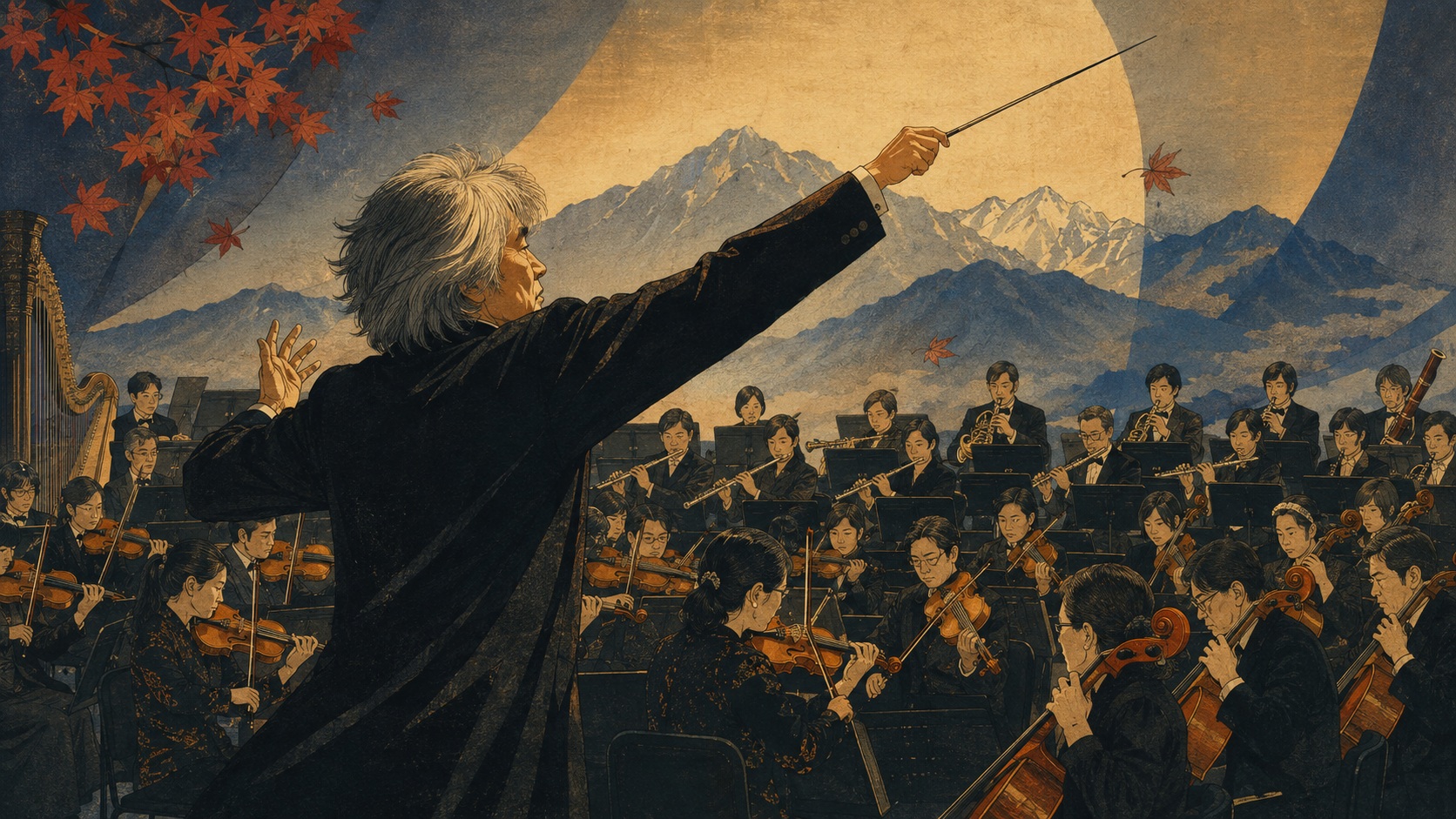
The first official concert of the 35th Seiji Ozawa Matsumoto Festival belonged to students. On Sunday afternoon, 16 young oboists, clarinetists, bassoonists and horn players were scheduled to step into the auditorium of Agata no Mori Bunka Kaikan after intensive residential coaching in Okushiga Kogen. Their program was Mozart: two wind serenades whose exposed lines leave nowhere for breath, balance or listening to hide.
That opening was not incidental. A festival bearing the name of one of the most famous conductors of the 20th century began its post-Obon season by showing what a musical inheritance looks like before it becomes history. A teacher demonstrates. A player tries. An ensemble learns to breathe as one. The result is offered to an audience for ¥1,000.
The official festival period runs for 18 days, from August 16 through September 2. It includes four performances by the Saito Kinen Orchestra across two programs, three chamber concerts, the woodwind masterclass, educational performances for elementary and junior-high students across Nagano Prefecture, and a web of free screenings, delivery concerts, exhibitions, a community parade and a “Seiji Ozawa Day.”
Anniversaries tempt institutions to turn backward. Matsumoto has archival film running on large screens this week, and memory is everywhere. But the strongest choices in the 2026 program do not merely replay Ozawa. They return to works and practices that shaped him, then place them in other hands.
Before the festival, a teacher’s memorial
The lineage begins with Hideo Saito, not with a summer festival. Saito was a cellist, conductor and exacting teacher whose postwar work helped shape the Toho Gakuen school and a generation of Japanese musicians. Ozawa studied conducting with him. So did Kazuyoshi Akiyama, while many of the players who later built international careers passed through the same demanding musical world.
In September 1984, ten years after Saito’s death, Ozawa and Akiyama assembled more than 100 of his former students for memorial concerts in Tokyo and Osaka. The event was supposed to honor a teacher. Its sound created something more durable: an orchestra made not by a permanent payroll or a single city, but by a shared education.
The ensemble became the Saito Kinen Orchestra. European tours followed in 1987, 1989 and 1990, including the Proms, Salzburg and Edinburgh. A 1991 world tour reached Amsterdam and Carnegie Hall. The orchestra could gather, achieve an unusually concentrated sound, then disperse again to leading ensembles around the world. Its temporary nature was not a weakness. Reunion was the source of its intensity.
In 1992, the 90th anniversary of Saito’s birth, that traveling fellowship acquired a home in Matsumoto. The first Saito Kinen Festival Matsumoto opened with Ceremonial, a new work commissioned from Tōru Takemitsu for shō and orchestra. Its major stage production was Stravinsky’s Oedipus Rex, with Ozawa conducting, Julie Taymor directing, and a cast that included Jessye Norman, Philip Langridge and Bryn Terfel.
This was never a provincial imitation of Salzburg or Tanglewood. It was an audacious Japanese answer to the international festival: a global orchestra formed by a teacher’s influence, contemporary Japanese music at the opening, difficult 20th-century opera at the center, and a regional city treated as a destination rather than a stop on a Tokyo tour.
1984 Ozawa and Akiyama gather Hideo Saito’s former students for memorial concerts.
1987–91 The Saito Kinen Orchestra establishes itself through European and world tours.
1992 The Matsumoto festival opens with Takemitsu’s commissioned Ceremonial.
1993 Local children in Jeanne d’Arc au bûcher help inspire the SK Matsumoto Junior Chorus.
2015 The festival is renamed for Seiji Ozawa.
2020–21 The pandemic cancels the festival, then cancels performances with audiences; one program streams online.
2024 Ozawa dies; the first festival without him presents a celebration of his life.
2026 The official 35th-year program begins with a woodwind masterclass.
How a city became part of the orchestra
Matsumoto did more than lend halls. In 1993, local children auditioned for Honegger’s Jeanne d’Arc au bûcher; that experience led to the SK Matsumoto Junior Chorus, which remains active. In 1999, a semi-staged La Damnation de Faust at the national-treasure castle grounds drew about 6,000 people. The opening of the Matsumoto Performing Arts Centre later expanded what the festival could stage, especially opera and youth work.
The city institutionalized the relationship. It created an international music festival office in 1992, co-presents OMF with Nagano Prefecture, and uses the festival as a central expression of “Gakuto Matsumoto”—the city of music within Matsumoto’s three-part identity as a place of mountains, music and learning. That slogan can sound like tourism copy until the supporting machinery becomes visible: school scheduling, hall operations, volunteer groups, street performances, transport, welfare-facility visits and public screenings.
The 2026 open program turns the anniversary into civic access. Archival performances from 1992 onward are screening free at the Matsumoto Performing Arts Centre on August 16, 17 and 18, then later at the city museum of art. Festival musicians are scheduled to visit hospitals, homes for older people and institutions serving people with disabilities. Local school wind ensembles and community groups will lead the August 30 welcome parade. On September 1, SKO musicians will perform with local choruses for Ozawa’s birthday.
This creates an important ladder of access. The main orchestra tickets range from ¥12,000 to ¥30,000, with a ¥10,000 U-39 ticket. Chamber concerts are ¥7,000, or ¥3,000 for U-39 buyers. The masterclass was ¥1,000. Screenings, street concerts, the parade and delivery events are free. The ladder does not eliminate the exclusivity of world-class classical music, but it prevents the festival from existing only behind its most expensive doors.
A symphony that carries Ozawa’s fingerprints
The most consequential handoff comes on August 22 and 23, when OMF Principal Guest Conductor Nodoka Okisawa leads the Saito Kinen Orchestra in Olivier Messiaen’s Turangalîla-Symphonie. Pianist Keigo Mukawa takes the ferociously demanding solo part. Takashi Harada plays the ondes Martenot, the early electronic instrument whose sliding, human-like voice can rise through the full orchestra; the festival says Harada has performed the work more than 350 times in 20 countries.
The piece is almost a map of Ozawa’s international life. Serge Koussevitzky’s foundation commissioned it in 1945 for the Boston Symphony Orchestra. Leonard Bernstein conducted the 1949 world premiere in Boston. The ten-movement work, roughly 90 minutes without an intermission, joins huge percussion forces, virtuoso piano and ondes Martenot in music concerned with love, joy, time and death.
Ozawa conducted its Japanese premiere with the NHK Symphony Orchestra in 1962 under Messiaen’s supervision. In 1967, he made a landmark recording with the Toronto Symphony Orchestra. By 1975, as Boston’s music director, he returned to the symphony with the BSO, pianist Yvonne Loriod and ondes Martenot player Jeanne Loriod, with Messiaen present. The composer’s inscription in Ozawa’s score treated the work almost as Ozawa’s own.
That history could make the 2026 concerts a trap: any new reading risks comparison with an interpretation the composer himself embraced. Okisawa’s task is therefore larger than technical command. She must respect a line of transmission without impersonating the man who transmitted it.
Ozawa himself chose her for this position. Shortly before his death in February 2024, he named Okisawa the first principal guest conductor in the festival’s history. She had already conducted Mozart’s Le nozze di Figaro in Matsumoto in 2022. Her 2024 Brahms performances with SKO became a Decca live recording; her 2025 A Midsummer Night’s Dream was part of a production that won the Music Pen Club Japan award. The succession is not nominal. It is being tested work by work.
Takemitsu returns as a living argument
The chamber concerts on August 25 and 28 mark 30 years since Takemitsu’s death. The anniversary reaches back to the festival’s first sound: Ceremonial in 1992. When Takemitsu died in 1996, the festival began a memorial-concert tradition. In 2026, however, it avoids isolating him as a national monument.
A Way a Lone and Entre-temps are placed beside Ravel. Air and And then I knew ’twas Wind sit among Debussy’s chamber works. The pairings reveal a composer who listened across borders—to French color, silence, gardens, literature and Western instruments—while making music no one else could have made. The third chamber concert, on September 2, returns the Harmony Hall organ to an OMF program for the first time in 18 years, since the 2008 Takemitsu memorial concert.
There is symmetry here, but not nostalgia. Takemitsu helped open the festival by writing something new. The honest way to honor him is to make listeners hear the familiar differently.
| Date | Program | What the choice carries forward |
|---|---|---|
| Aug. 16 | Woodwind masterclass concert: Mozart Serenades K.375 and K.388 | Teaching before celebrity; ensemble discipline before spectacle |
| Aug. 22–23 | Messiaen: Turangalîla-Symphonie, Okisawa / Mukawa / Harada / SKO | An Ozawa signature work entrusted to a conductor he selected |
| Aug. 25 & 28 | Takemitsu with Ravel and Debussy | Memory placed in conversation, not behind glass |
| Aug. 29–30 | Bruckner: Symphony No. 8, François-Xavier Roth / SKO | International guest leadership—and a test of institutional accountability |
| Sep. 2 | Trumpet, viola and organ at the Harmony Hall | A hall’s signature instrument returns after 18 years |
The education program is not a decorative appendix
The 16 players at Sunday’s masterclass concert were selected for an intensive woodwind-octet program in Okushiga. Four SKO musicians—Fumiaki Miyamoto, Masaharu Yamamoto, Masaru Yoshida and Masayuki Naoi—served as instructors for oboe, clarinet, bassoon and horn. The young players were not simply invited to watch professionals. They had to expose their own ensemble work in public.
Later in the festival, the Seiji Ozawa Music Academy Orchestra and conductor Carl St.Clair will take a combined symphonic and operetta program to Nagano, Matsumoto and Ina. Elementary and junior-high students are invited to eight closed school performances between August 24 and 28. Beethoven’s Eroica first movement introduces the scale of a symphony; excerpts from Johann Strauss II’s Die Fledermaus introduce voice, character and stage.
The scale is not trivial. In 2025, OMF reported that its Concert for Children and Opera for Children reached more than 10,000 pupils. Those students are not supporting characters in a prestige festival. They are the public for whom the institution makes its strongest long-term claim.
This also explains why the archival screenings matter. A child who cannot enter a ¥30,000 seat can encounter Ozawa conducting Beethoven on a free city screen, hear musicians at a school performance, or see a local band in the parade. Cultural inheritance becomes durable when it can be entered from more than one door.
After the founder, governance becomes visible
Ozawa died in Tokyo on February 6, 2024, at 88. He had led the Boston Symphony Orchestra for 29 years, conducted at the world’s major opera houses and built academies across Japan and Europe. Yet Matsumoto was unusually personal: a place where his teacher, his orchestra, his belief in young musicians and his appetite for ambitious theater met.
The first festival without him, in 2024, presented a “Celebration of Seiji’s Life.” But an annual institution cannot remain in memorial mode. Artistic decisions are now shaped by an advisory committee of SKO members and by Seira Ozawa, the orchestra foundation’s representative, while the Matsumoto-based executive structure handles public administration, sponsors and delivery.
The arrangement is still being clarified. In 2025, a planned SKO concert in Tokyo was canceled because sufficient funding could not be secured within the preparation period. Matsumoto Mayor Yoshinao Gaun later said the roles and communication among the artistic side, executive committee and funding board needed to become clearer. That episode was not the collapse of the festival. It was evidence that charisma once concealed work that institutions must now name, assign and finance.
A second governance test sits inside the 2026 program. Guest conductor François-Xavier Roth is scheduled to make his OMF debut with Bruckner’s Eighth on August 29 and 30. In 2024, allegations concerning sexually inappropriate communications with musicians led him to suspend conducting duties. Roth acknowledged inappropriate past behavior and apologized. The City of Cologne ended its collaboration with him a year early by mutual agreement.
SWR, which had appointed Roth to lead its symphony orchestra from the 2025–26 season, conducted an internal review of his periods working with its ensembles. It said it found no complaints under Germany’s Equal Treatment Act from SWR personnel, retained him, and announced structural safeguards and conduct rules; Roth again accepted responsibility for past mistakes. The OMF’s 2026 announcement describes his artistic credentials but does not address that history.
This is not peripheral gossip. A festival that places education at the center has a heightened duty to explain how it assesses conduct, power and workplace safety. Artistic excellence does not answer those questions. Transparent institutional standards do.
What should survive for the 36th season
The 35th-year program provides several answers. Keep the Saito Kinen Orchestra unusual: a gathering of musicians who bring the standards and habits of many ensembles into one concentrated summer sound. Keep commissioning, difficult repertoire and 20th-century opera close to the center. Keep the children’s program large enough to be structural, not ceremonial. Keep the city inside the festival, from the castle and concert halls to schools, welfare institutions and streets.
But survival will require more than repetition. Publish a clearer governance map. Explain how artistic appointments and safeguarding decisions are made. Report attendance and the public investment behind the festival, including the reach of free programs. Develop younger conductors, composers, stage directors and administrators rather than searching for a single replacement genius.
- Artistic risk: Does the festival still attempt works that require unusual forces, rehearsal and imagination?
- Transmission: Are young musicians coached, trusted with real responsibility and heard in public?
- Civic reach: Can residents encounter the festival outside its highest-priced seats?
- Accountability: Are leadership, funding and safeguarding decisions understandable from the outside?
- Renewal: Can successors interpret Ozawa’s repertoire differently without being treated as lesser copies?
The word “legacy” is often used as if it were an object placed safely in a case. Music refuses that treatment. A score remains silent until people assemble. A teacher’s idea survives only when another player changes breath, fingering or judgment. An orchestra exists only for the duration of its shared attention.
That is why Sunday’s young wind players were the right beginning. They were not reenacting 1992. They were practicing the same underlying proposition that joined Saito to Ozawa and Ozawa to Matsumoto: standards can be transmitted, but never mechanically; every generation must earn the ensemble again.
On August 22, Okisawa will raise her hands before Turangalîla, a work inseparable from Ozawa’s history. The meaningful question will not be whether the gesture resembles his. It will be whether the orchestra listens closely enough for something alive to pass through it.
The 35th season has opened. Its achievement will not be measured by how perfectly Matsumoto remembers Seiji Ozawa. It will be measured by whether the festival he made remains brave, teachable, local, international—and capable of changing after him.
- Seiji Ozawa Matsumoto Festival: 2026 full line-up announcement (March 25, 2026). Dates, programs, artists, duration and ticket prices.
- OMF Chamber Music Masterclass — Woodwind Ensemble. Instructors, 16 participants, repertoire and August 16 performance.
- OMF Concert for Children: Symphony and Opera Highlights. Dates, venues, invited students, repertoire and performers.
- OMF 2026 open events. Screenings, delivery concerts, parade, exhibitions and Seiji Ozawa Day.
- OMF: “35 Years of SKF & OMF on Screen” (August 16, 2026). Anniversary-screening purpose, venues and schedules.
- Saito Kinen Orchestra and festival history. The 1984 memorial concerts, tours, 1992 founding, productions, pandemic interruption and later seasons.
- About the Seiji Ozawa Matsumoto Festival. Institutional mission, SKO structure, education and civic setting.
- OMF biography of Seiji Ozawa. International career, academies, honors, recordings and death.
- Boston Symphony Orchestra: commissioning Turangalîla-Symphonie. 1945 commission, 1949 premiere, instrumentation and Ozawa’s 1975 performances.
- Boston Symphony Orchestra: In Memoriam, Seiji Ozawa (February 9, 2024). Death, age and 29-year Boston tenure.
- OMF: Nodoka Okisawa appointed first Principal Guest Conductor (February 22, 2024). Ozawa’s decision and the post-founder structure.
- OMF: 2025 opera receives the Music Pen Club Award (April 24, 2026). Recognition of Okisawa, the cast, SKO and production.
- OMF: close of the 2025 festival. More than 10,000 children reached and the preview of Turangalîla.
- OMF: cancellation of the planned 2025 Tokyo concert. Organizer’s statement that sufficient funding could not be secured.
- Matsumoto mayor’s press conference (May 21, 2025, Japanese). Post-Ozawa decision-making and the need to clarify governance and communication.
- Matsumoto International Music Festival Promotion Division (Japanese). Municipal role since 1992 and the “City of Music” strategy.
- The Violin Channel: allegations and Roth’s initial response (May 24, 2024). Summary of the original French and German reporting and the conductor’s statement.
- City of Cologne: collaboration with François-Xavier Roth ends early (July 5, 2024, German).
- German Music Information Centre: SWR retains François-Xavier Roth (republishing the SWR statement). Internal-review scope, safeguards and Roth’s acknowledgment.
Editor’s note: OMF calls 2026 its 35th year or 35th season, counting continuously from the 1992 founding; the 2020 festival was canceled and 2021 performances with audiences were canceled. Japan.co.jp did not attend the August 16 masterclass concert. The description of the opening reflects the official schedule, participant roster and ticket notices; the organizer had not published a detailed performance report by this article’s information cutoff. Program details may change, and readers should check the official festival site. Public information was checked through August 17, 2026 at 4:29 AM JST. The currency display is the editorially supplied value.