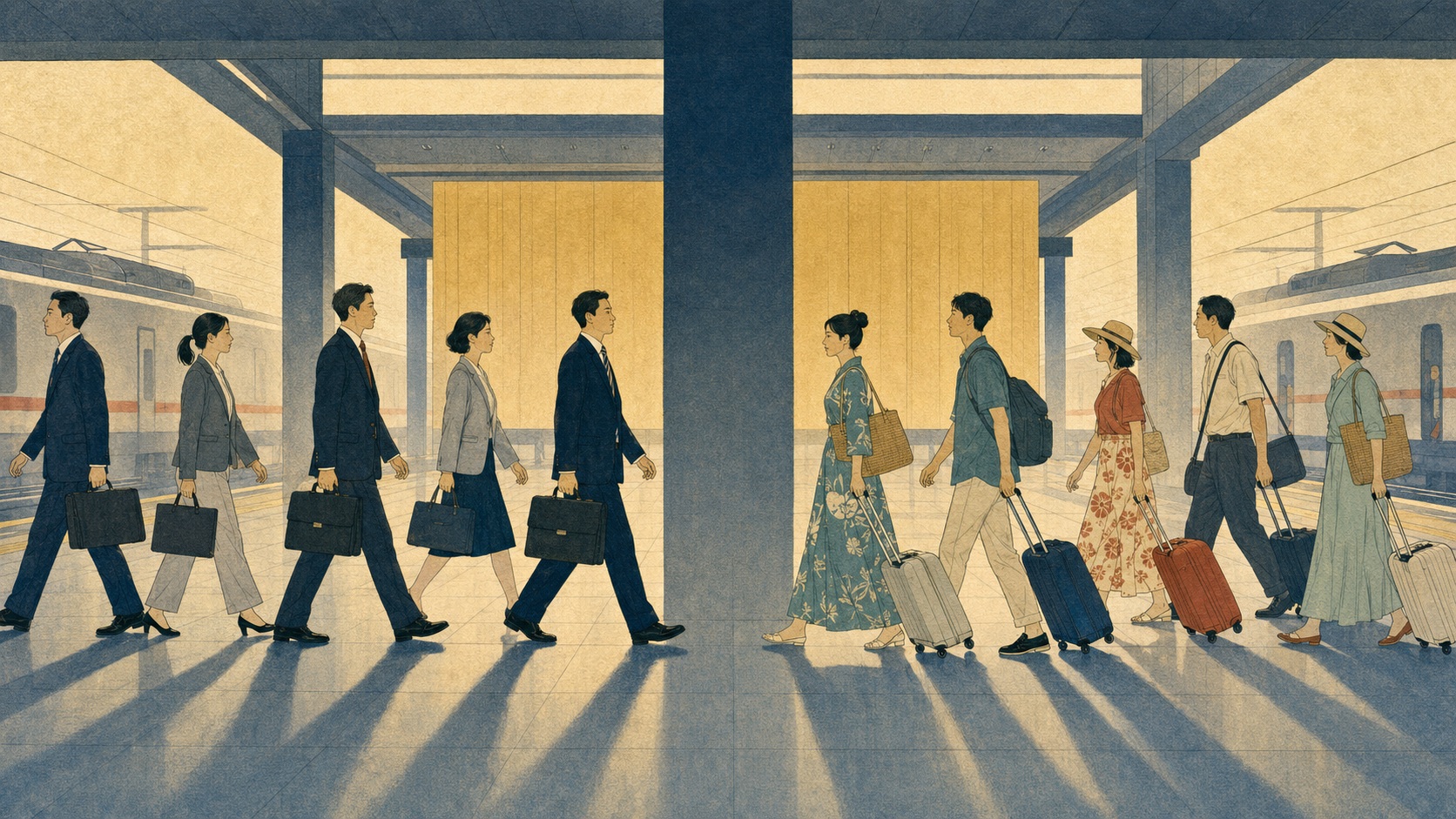
At a Tokyo station in the morning, dark suits and square briefcases move toward the gates. From the other direction come sun hats and small wheeled cases. One procession has finished Obon; the other is just beginning summer. The same Tuesday, August 18, is a return to work for one traveler and a departure day for the next.
The crossing does not mean Japan has abandoned its great mid-August migration. In a private survey of 500 working women conducted in June, 37.2 percent planned to take summer leave during the standard Obon period of August 13–16—still the largest single group. But more than six in ten selected another answer, including people taking leave at another time and 10.6 percent who said they would not, or could not, take summer leave. Another 8.8 percent chose the five-day Silver Week window of September 19–23. Among respondents planning trips of at least a week, the September share rose to 21.7 percent.
That survey requires a large caution label. It was commissioned by eBay Japan, which operates the Qoo10 marketplace, and conducted online among 125 women in each decade from their twenties through fifties. Every respondent was employed and already planning travel between June and October 2026. Men, people without travel plans and people outside the workforce were excluded. It is not a representative poll of all Japanese workers, and it cannot support the claim that 62.8 percent of Japan has “rejected Obon.”
Even so, the survey becomes revealing when placed beside actual travel bookings, the official 2026 holiday calendar and national paid-leave data. Vacation is not disappearing. Instead, three clocks—the cultural clock of ancestors and family, the legal clock of paid leave, and the price-and-climate clock of travel—no longer strike at precisely the same time.
What one survey says—and what it cannot
| Supported by the survey | Not established by the survey |
|---|---|
| Leave dates were fragmented among working women who already planned to travel | The leave dates of all workers, or the national share of companies closing for Obon |
| Obon was the largest period at 37.2 percent, but not a majority | How much that share changed from 2025; there is no matched trend series |
| The September holiday particularly attracted people planning trips of a week or more | Whether employer policy, personal leave or some other arrangement enabled the trip |
| 10.6 percent reported no summer leave, or an inability to take it | How many did not want leave and how many were constrained by staffing or policy |
The 10.6 percent is as important as the 37.2 percent. Even in a sample selected for travel intentions, roughly one in ten reported no summer holiday. Staggering can mean welcome freedom from the peak. It can also mean exclusion from the collective shutdown that once made it socially easy to stop working.
Obon is not a national holiday—which makes it powerful and flexible
Obon is not a statutory national holiday. The Cabinet Office’s official 2026 list includes Mountain Day on August 11, but not August 13–16. The Japan National Tourism Organization nevertheless identifies Obon, along with New Year and Golden Week, as one of the country’s three major travel seasons. The week acquires the force of a holiday through a patchwork: special summer days granted by an employer, factory and supplier shutdowns, paid leave allocated under a labor-management agreement, and leave requested by individuals.
At its core, Obon is a Buddhist and folk season for welcoming, honoring and sending off ancestral spirits. August 13–16 is now the best-known schedule, but it was never entirely uniform. When Japan replaced the old lunisolar calendar with the Gregorian calendar at the turn of 1873, communities adapted in different ways. Some kept the date and observed Bon in July. Many delayed the new-calendar date by one month, producing the August observance. Others retained a lunar-calendar schedule.
Obon, then, began as a ritual whose timing could bend around regional calendars and agricultural life. The national wave in mid-August is also a modern product: postwar mass employment, synchronized factory calendars, the expansion of road and rail networks, and news reports about peak traffic. Sources cataloged by the National Diet Library’s Collaborative Reference Database identify a newspaper headline using the term “Obon rush” in August 1962. Older remembrance and the new logistics of high-growth Japan fused into the holiday season people recognize today.
1873 Japan adopts the Gregorian calendar; July, month-late August and lunar Bon schedules diverge.
1947 The Labor Standards Act establishes the modern basis for annual paid leave.
1960s Mass employment and mass transport turn the “Obon rush” into a national phenomenon.
2009–10 The government seriously studies regional staggering of major holiday periods.
2012 Electricity-saving guidance encourages summer shutdowns outside Obon.
2019 Employers must ensure five paid-leave days for workers entitled to at least ten.
2026 A five-day September holiday creates a second summer travel window.
Japan once considered moving public holidays by region
Staggered leave did not originate with remote work. Following a growth strategy adopted in December 2009, tourism officials examined regional scheduling of long holidays. A 2010 policy paper described resort economics as “100 profitable days and 265 loss-making days”: demand became so compressed that prices, employment and investment were distorted. Another government meeting heard that roughly 40 percent of travel demand fell into New Year, Golden Week and Obon.
The proposed answer was sweeping. Selected spring or autumn holidays would move among five regions, spreading highway traffic, hotel occupancy and sightseeing demand. But a holiday is a coordination system, not merely a blank square in one person’s diary. Parents and children need compatible days. Families separated by work need a common window. Headquarters, branches, banks, public services, factories and suppliers transact across regions. Government documents themselves warned of the burden on small businesses, supply chains, schools and families living apart. The regional redesign never became the national calendar.
After the 2011 earthquake and power crisis, the same problem returned through another door. Labor Ministry guidance in 2012 noted that electricity demand fell sharply when company closures concentrated around Obon. It suggested setting summer closures outside Obon, extending shutdown periods, using planned paid leave and shifting some activity into autumn. Vacation policy had become energy policy as well as tourism policy.
The ambition survived in smaller units. In the 2020s, Aichi Prefecture linked weekday school holidays, parental paid leave and off-peak travel under its “workstyle and holiday reform” initiative. The 2025 tourism white paper reported that about 36 percent of elementary pupils and 24 percent of middle-school pupils had used a “learcation” day for learning outside school. Between April 2024 and February 2025, 54,000 people booked weekday stays through incentive plans. Rather than moving national holidays, Aichi reduced the scale at which calendars had to coordinate.
In 2026, September becomes a second summer
This year, calendar arithmetic is doing more than legislation. September 19 is a Saturday and the 20th a Sunday. Respect for the Aged Day falls on Monday the 21st, and the Autumnal Equinox on Wednesday the 23rd. Under the Public Holiday Law, the day sandwiched between two national holidays becomes a holiday too. The Cabinet Office therefore lists Tuesday, September 22 as a legal day off, joining five consecutive days from Saturday through Wednesday.
HIS called it the first major Silver Week in 11 years. In a July 7 release based on its bookings as of June 23, the travel company said it could see customers sliding trips away from the expected heat and congestion of July and August. Its overseas booking count was 94.2 percent of the previous year for the summer period alone, but 102.5 percent when Silver Week was added. Domestic travel was 95.8 percent for summer and 98.3 percent for the combined periods.
Those are HIS customers, not the whole market, and the 2025 and 2026 holiday arrangements differ. The figures are evidence of movement, not a national census. They nevertheless support a measured conclusion: some demand has shifted rather than vanished.
A leave date is a household calculation. Crowds, hotel rates, airfares, school, elder care, typhoons and extreme heat all compete. In the Qoo10 survey, the average personal budget for one trip was ¥112,321; domestic travelers averaged ¥68,646 and overseas travelers ¥299,892. Moving a departure by several days is not merely a lifestyle statement. It can be a major financial decision.
| The vacation clock | Forces pulling toward Obon | Forces pulling away |
|---|---|---|
| Culture and family | Grave visits, memorial rites, relatives gathering, local Bon dances | Regional Bon dates, changing households, families living far apart |
| Work and law | Factory shutdowns, suppliers closing, planned leave | Selectable summer days, backup staffing, flexible or hourly leave |
| Travel and climate | School vacation, festivals, hometown visits | Price differences, crowds, heat and the September five-day break |
Having paid leave is not the same as choosing its date
Japan’s paid-leave law begins with the 1947 Labor Standards Act. As a rule, a worker employed continuously for six months with attendance on at least 80 percent of workdays becomes entitled to ten days of annual paid leave, rising with service to a maximum of 20. Since April 2019, employers have had to ensure that workers entitled to ten or more days actually take at least five each year. This did not create five statutory days of “summer vacation.” It strengthened the use of annual leave through the worker’s request, planned allocation or employer date designation.
The Labor Ministry’s 2025 General Survey on Working Conditions found that in 2024 employers granted an average 18.1 days and workers took 12.1. The resulting 66.9 percent use rate was the highest in the series beginning in 1984. Planned allocation systems existed at 40.8 percent of surveyed companies, and 41.5 percent provided special summer leave. The infrastructure for taking time off is gradually widening.
Yet averages conceal the power to choose. Workers at companies with at least 1,000 employees used 69.0 percent of their paid leave; at companies with 30–99 employees, the rate was 64.9 percent. Electricity, gas and water reached 75.2 percent. Lodging and food service—the people serving vacationers—stood at 50.7 percent, the lowest industry rate. Retail was 59.9 percent and transportation and postal work 65.3 percent. An office employee’s ability to avoid the peak often depends on someone else working through it.
The national survey has its own boundary. Its enterprise population is private employers with at least 30 regular workers, and its employee measures cover workers hired without a fixed term while excluding part-time workers. People most likely to have limited bargaining power are not necessarily fully represented by the reassuring national average.
Which is fairer: a shared shutdown or individual choice?
A collective shutdown has real advantages. A factory can stop without running expensive systems for a skeleton crew. When suppliers also close, fewer calls and messages break into leave. No single employee falls behind because everyone is absent. Relatives are more likely to be available at the same time. Synchronization reduces the guilt of stepping away.
Its costs are familiar: packed trains and highways, sold-out rooms, peak fares and intense pressure on transport and hospitality workers. The same dates are imposed on people without school-age children, without a hometown trip, or with medical and family needs elsewhere. Selectable leave can reduce congestion and respect different families.
But writing “take your holiday whenever you like” in a handbook does not create equality. A single-person function cannot easily stop. A small team may lock workers into an unspoken order. A manager who remains online teaches everyone that absence is unsafe. First-come allocation favors those who can plan early. Without operational design, flexibility flows to workers with the most bargaining power.
- Early notice: Publish peak periods, minimum staffing and request deadlines months ahead.
- Fair allocation: Rotate popular dates and consider caregiving, school and memorial obligations.
- Backup capability: Cross-train critical tasks and use a short, standard handover.
- No-contact design: Define emergencies and a substitute; do not assume replies during leave.
- Post-peak recovery: Guarantee consecutive later days for hospitality, logistics and care workers serving the holiday.
- Better measures: Track requested-date success, consecutive days and contact during leave—not only the use rate.
Does demand flatten, or does the mountain merely move?
For tourism regions, dispersion is attractive. More stable occupancy allows rooms, transport and staff to be used across the year. Businesses can reduce both extreme peak prices and off-season losses, and may be better able to invest in training and permanent jobs. Travelers gain uncrowded temples, shorter lines and a closer view of ordinary local life.
But if everyone moves to September 19, Japan has created a new mountain, not a plain. The 2026 five-day Silver Week is an unusually favorable arrangement, and bookings already cluster around it. Dynamic airline and hotel pricing can spread demand in fine increments, but it can also widen the gap between people able to move and people bound by school or shift schedules. Genuine dispersion means more small windows from July into October, not simply a choice between Obon and one September weekend.
The Labor Ministry’s summer campaign in 2026 again encourages employers to connect annual leave to summer breaks and use tools such as planned allocation and hourly leave. Each solves a different problem. Hourly leave helps with appointments and school events, but cannot replace the consecutive days needed for recovery or a trip. Collective planned leave guarantees time off but reduces date choice. Well-designed employers combine shared closure days, employee-selected blocks and smaller leave units.
Broaden summer without diminishing Obon
Staggering does not have to be read only as cultural decline. The same person can return for graveside rites during Obon and travel with family in September. A household in a July-Bon region may finish remembrance first and work through mid-August. Separating ritual time from leisure can even rescue Obon from being treated as nothing more than a congested travel product.
At the same time, the language of “take leave anytime” must not hide inequality. Moving a holiday requires a colleague who can cover, an employer that permits planning, a school or care schedule that can bend, and enough income to take the days. For someone required to find a replacement, someone who loses hourly pay, or someone serving customers while others rest, diversified vacation may remain freedom seen in an advertisement.
Return to the station on August 18. The suits and the suitcases pass at a pillar. That image now fits Japan better than a single photograph of a national exodus. The calendar is dividing. Whether that division represents freedom depends on whether workers can move into either procession.
Obon will remain: the welcoming fires, the graves, the train toward home. But summer leave no longer has to remain trapped inside four August days. Japan’s next vacation reform may depend less on inventing a holiday than on making an ordinary Tuesday safe to take off—without work collapsing, a career penalty appearing, or the burden falling on one unseen colleague.
- eBay Japan/Qoo10, “2026 Summer Vacation Survey of Working Women”, July 30, 2026. Online survey June 10–11; 125 respondents per decade from their twenties through fifties, 500 total; limited to working women planning travel from June through October.
- TV Asahi, “Working women’s summer leave disperses”, August 5, 2026. Reports the survey’s Obon response as 37.2 percent.
- HIS, “2026 Summer Vacation and Silver Week Travel Booking Trends”, July 7, 2026. Company bookings as of June 23 for departures July 17–August 31 and September 18–23.
- Cabinet Office, “National Holidays”. Official 2026 list, including September 22 as a holiday under Article 3(3); Obon is not listed as a national holiday.
- Japan National Tourism Organization, “Business Hours and Holidays”. Identifies Obon with New Year and Golden Week as Japan’s major travel seasons.
- Japan National Tourism Organization, “How much do you know about the summer traditions in Japan?”, 2019. Ancestor commemoration, the August 13–16 observance and regional variation.
- National Diet Library Collaborative Reference Database, “Why does Obon timing differ?”, 2025. Calendar reform, July/month-late/lunar Bon, and a 1962 usage of “Obon rush.”
- e-Gov Law Search, Labor Standards Act, Article 39. Legal basis for annual paid leave.
- Ministry of Health, Labour and Welfare, “Designation of the Timing of Annual Paid Leave”. The five-day requirement effective April 2019, eligibility and consultation rules.
- MHLW, 2025 General Survey on Working Conditions, December 19, 2025. Paid-leave grants, use and differences by employer size and industry for 2024.
- MHLW, Annual Paid Leave Promotion Portal. Planned allocation, the five days preserved for worker use and hourly leave.
- Kanagawa Labour Bureau, “Promoting annual paid leave, summer 2026”, June 12, 2026.
- Ministry of Land, Infrastructure, Transport and Tourism, Tourism Nation Promotion Headquarters material, 2010. The economic case for staggered leave, regional-holiday proposal and implementation barriers.
- MLIT Transport Policy Council material, 2010. Estimate that about 40 percent of travel demand concentrated in New Year, Golden Week and Obon.
- MHLW, electricity-saving guidance for employers and workers, 2012. Suggested summer closures outside Obon and planned paid leave.
- Japan Tourism Agency, 2025 White Paper on Tourism. Aichi holiday reform, “learcation” use and weekday-stay results.
Editor’s note: The 2026 leave-timing results come from a company-commissioned survey limited to travel-planning working women and are not representative of all workers. HIS data cover its own products, and holiday calendars differ between 2025 and 2026. The Labor Ministry’s 2025 survey reports 2024 results, uses private employers with at least 30 regular workers as its enterprise population and has limits on the employees represented. “Summer vacation” can mean an employer holiday, special leave or annual paid leave; this article distinguishes them where the evidence permits. The exchange rate is a reader-supplied figure whose UTC timestamp was converted to Japan time.