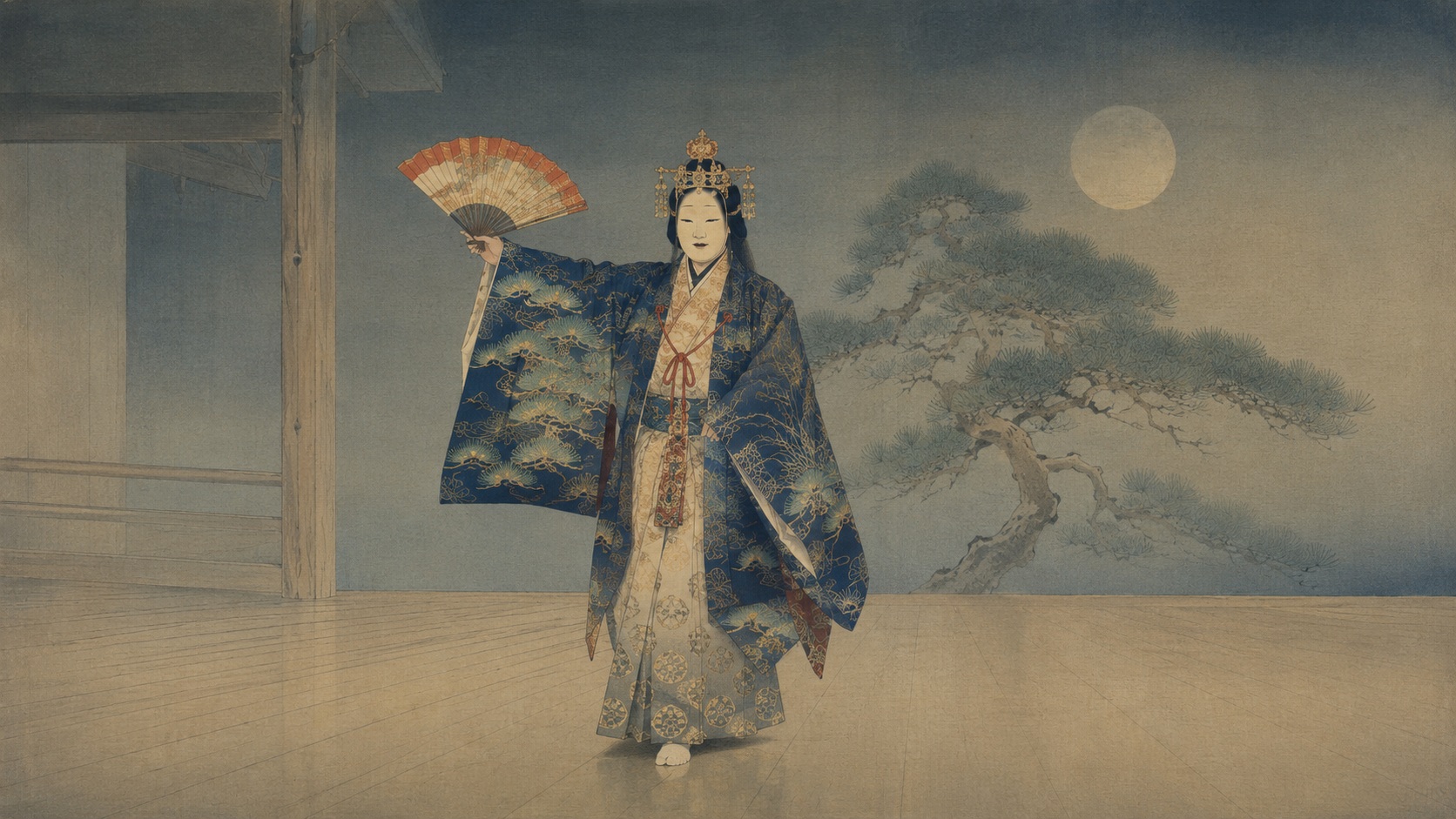
The performer appears not to move. The left foot is planted, the right nearly withdrawn. A sleeve falls in a broad plane. The fan is open but not flourishing; its diagonal has stopped just before display becomes decoration. The mask refuses the elastic expressions of a human face. Yet nothing in the image is inert.
The weight inside the costume is traveling downward. The hem records the path of the last step. The fan points toward the next. If the head rises by a few degrees, the mask catches light and seems to brighten; if it lowers, shadows gather and the face seems to cloud. Empty stage boards preserve the distance already crossed and the distance still to come. Stillness is not the absence of motion. It is motion held where an audience can feel its pressure.
That pressure made Tsukioka Kōgyo the great graphic interpreter of Noh at the turn of the twentieth century. Between the early 1890s and his death in 1927, he produced paintings, magazine illustrations, postcards and five major print sets devoted to Noh and its comic companion, kyōgen. University of Pittsburgh historian Richard J. Smethurst estimates roughly 700 individual theatre prints. Museums now separate many of them into single objects; Kōgyo often conceived them as sequences, albums and repeated encounters with an entire repertory.
His importance lies in more than quantity. Noh is made of chant, drums, flute, poetic language, mask, costume, spatial discipline and time. A print has none of the sounds and cannot unfold. Kōgyo did not solve that contradiction by pretending to be a camera. He chose the instant when form contains before and after—the body’s pause as a vessel of energy.
In a 1914 essay, he gave the idea its most exact phrase. Noh, he wrote, contains “movements that don’t move.” A painter had to reveal the beauty inside them.
A theatre built from controlled transformation
To understand Kōgyo’s sheets, it helps to forget the common description of Noh as simply “slow.” Noh is controlled transformation. A traveler reaches a famous place and meets a local stranger. The stranger’s knowledge becomes too intimate to be ordinary. In many plays, the figure returns in a second act as a god, warrior’s ghost, abandoned woman, tormented spirit or demon. Past enters present; landscape becomes memory; narration becomes dance.
The roots reach to performing arts brought from continental Asia during the Nara period and transformed through temple, shrine, comic and musical practices. In the fourteenth century, Kan’ami and his son Zeami raised sarugaku into a highly refined theatre under the patronage of the Muromachi shogunate. Zeami’s writing and plays joined dramatic action to dance, chant and poetry. The form that emerged did not pursue realistic illusion. A fan might become a cup, sword, moon or letter. A few turns could cross a province. A pine painted on the back wall could open onto sea, mountain, battlefield or afterlife.
Noh and kyōgen developed together. Noh moves through gods, ghosts, attachment and release; kyōgen brings servants, masters, husbands, wives, priests and fools into spoken comic life. During the Edo period, the shogunate formalized Noh as ceremonial art for the samurai class. A full program was organized around five categories—god, warrior, woman, miscellaneous and demon plays—with kyōgen between them. Chant books and abbreviated dance practice also carried parts of the repertoire beyond full performance.
Onstage, the smallest physical decision matters. Masked performers maintain a low center of gravity and slide over the floor. Their sight is severely restricted; knowledge of stage dimensions becomes embodied protection. A slight upward tilt of the mask is called teru, to brighten. A downward tilt is kumoru, to cloud. The wooden face does not change, but light, shadow and the spectator’s projection change it.
Kōgyo’s medium works by the same principle. The paper does not move. Perception does.
| Noh element | What happens in performance | Kōgyo’s graphic equivalent |
|---|---|---|
| Mask | A small change of angle turns light toward brightness or sorrow | Fine tonal gradients make an apparently fixed face emotionally unstable |
| Sliding walk | A low center of gravity keeps torso and mask controlled | Hem, foot and floor line reveal where weight has moved |
| Chant | Words build landscapes, memory and feeling beyond the bare stage | Calligraphy, mist, a branch or a single wave supplies a poetic field |
| Costume | Woven pattern identifies rank, gender, season and otherworldly status | Gold, silver, mica and layered color make textile carry narrative weight |
| Pause | Rhythm continues through a held pose or silence | Negative space preserves tension around the figure |
Born into the new Tokyo, trained through old lineages
Kōgyo was born Hanyū Bennosuke in 1869, the second son of a family that operated the Ōmiya inn in Nihonbashi. He was born one year after the political beginning of the Meiji era, in a district being remade as the commercial center of a modern capital. His own names trace the networks through which an artist was made.
After his mother, Taiko, returned to her Sakamaki family in 1880, Bennosuke took that surname. He apprenticed with an uncle who painted ceramics for export in Yokohama and briefly attended the Tokyo School of Fine Arts. As a teenager, he went to Fukushima to teach pottery painting. These were not marginal experiences. Export craft trained the eye to make Japanese visual languages travel, while ceramic design demanded an understanding of how pattern turns around a surface.
In 1887 he entered the studio of Tsukioka Yoshitoshi, whom his mother had married three years earlier. Yoshitoshi gave him the artist’s name Toshihisa. Yoshitoshi is often described as the last great ukiyo-e master, but “last” can conceal how experimental his late career was. His compositions made violent diagonals, weather, psychological suspense and empty space carry narrative. He also studied Noh chanting and dance with Umewaka Minoru, one of the performers central to the art’s Meiji revival. From his stepfather, the young artist received both print design and an appetite for Noh.
In 1889 he studied with Ogata Gekkō, who taught him flowers and birds, silk painting, shading and the tonal refinement that would become essential to his theatre scenes. Gekkō gave him the name Kōgyo, combining characters from the teacher’s own name with the image of fishing. Kōgyo also studied with the historical painter Matsumoto Fūko. Only in 1911, under his mother’s will, did he assume the Tsukioka surname and headship of Yoshitoshi’s school.
This training explains why his work refuses a simple label. He inherited ukiyo-e’s collaborative woodblock system but moved in the institutional world of modern Japanese painting and national exhibitions. He could design wartime news images, flowers and birds, refined silk paintings and mass-produced theatre sheets. He was neither a survivor sealed inside Edo nor a Westernizing modernist who discarded it. He stood where export, publishing, Nihonga, inherited schools and a rescued theatre met.
Noh almost lost its world
When Kōgyo was born, the institutional world that had supported Noh had collapsed. The 1868 overthrow of the Tokugawa shogunate dissolved stipends and ceremonial obligations that had maintained actors and schools. The new government defined progress through Western institutions and technologies. Noh had to compete with kabuki, puppet theatre and imported entertainments while its old patrons lost rank and income.
Its recovery was not a simple folk revival. Performers including Umewaka Minoru, Hōshō Kurō and Sakurama Banma worked with political aristocrats and former samurai. Statesman Iwakura Tomomi, who had seen European opera during the Iwakura Mission of 1871–73, recognized that Japan needed a stage art able to represent indigenous refinement before foreign dignitaries. In 1879, former U.S. president Ulysses S. Grant attended Noh performed for Emperor Meiji. Noh was being repositioned: once ceremonial culture of the shogunal elite, it could now serve imperial prestige and cultural diplomacy.
That rescue preserved performance lineages, but it also selected an image of Noh—elegant, ancient, disciplined, nationally representative. Kōgyo’s art participated in that reframing. His painting of the Meiji Empress viewing Noh was acquired by the Imperial Household. His albums offered masks, fans, robes, props and famous scenes to viewers who could identify themselves with cultivated patronage. The University of Pittsburgh’s study of Nōgaku zue notes that its luxurious presentation flattered the connoisseur by aligning ownership with the theatre’s noble historical audience.
Preservation is therefore never politically empty. Kōgyo helped save visual knowledge of Noh, but the Noh being saved was also made useful to a modern imperial state and a new bourgeois elite. His occasional Sino-Japanese War prints are a reminder that the same publishing culture circulated battlefield modernity and classical refinement. The gentle mist around a masked ghost did not exist outside the nation being constructed around it.
This does not diminish the art. It makes its achievement legible. Kōgyo did not copy an unchanging tradition. He helped tradition find a new public after its social foundation had broken.
14th–15th centuries Kan’ami and Zeami refine sarugaku into the dramatic, musical and poetic form now recognized as Noh.
Edo period Noh becomes ceremonial art of the Tokugawa shogunate and samurai houses.
1868 Shogunal patronage collapses in the Meiji Restoration.
1869 Hanyū Bennosuke, later Kōgyo, is born in Nihonbashi.
1879 Noh is performed before Emperor Meiji and former U.S. president Ulysses S. Grant.
1887 Kōgyo enters Yoshitoshi’s studio; in 1889 he begins study with Ogata Gekkō.
1897–1902 The 261-print Nōgaku zue is issued.
1911 Kōgyo takes the Tsukioka name and succeeds to Yoshitoshi’s school.
1922–26 Nōgaku hyakuban appears, interrupted for eleven months after the Great Kantō Earthquake.
1927 Kōgyo dies; students and family continue his theatre-image lineage.
1925–30 Nōga taikan is completed, with 24 first-volume designs by disciple Matsuno Sōfū.
2001 / 2008 Nōgaku is proclaimed by UNESCO, then inscribed on the Representative List of Intangible Cultural Heritage.
Three cycles, three theories of attention
Kōgyo’s major series are not repetitions of one successful formula. They show him revising the relationship among stage, actor and viewer.
Nōgaku zue, issued from 1897 to 1902 by Matsuki Heikichi’s Daikokuya, is encyclopedic. Its 261 multicolor woodblock prints include about 220 Noh plays, kyōgen, masks, costumes and related material. Architecture, audience, backstage preparation, poetic quotations, inset views and curling-paper illusions can all appear. The five volumes use heavy kōzo paper, water-based pigments, gold and silver mica and washes that can resemble hand-painted watercolor. In its accordion binding, facing sheets create conversations across a double opening.
This first great cycle teaches context. It invites a reader to recognize attributes, recall a poem, compare costumes and move through the repertory. Its object is not a stack of posters but a portable theatre archive.
Nōgaku hyakuban, published from 1922 to 1926, performs a radical subtraction. Across 122 sheets depicting 100 plays, Kōgyo usually isolates the shite, the principal actor. Stage architecture, secondary narratives and explanatory text recede. A cliff, three faint geese, a wave or monochrome field may be all that remains behind the figure. The Great Kantō Earthquake stopped publication for about eleven months, from September 1923 to August 1924; the sequence resumed in a city rebuilding itself.
The minimalism is not antiquarian. Smethurst compares its severe focus to contemporaneous modernist portraiture. Whether or not one accepts a direct Western influence, the prints are unmistakably of the 1920s: they use inherited ink-painting restraint to make concentration feel new. The luxurious printing—gold, silver, mica, embossing and repeated impressions—does not fill the emptiness. It sharpens it.
Nōga taikan, published between 1925 and 1930, turns toward stage accuracy. Two hundred prints show important dramatic moments with actors’ roles identified on translucent interleaves. Kōgyo may have sketched in theatres, recording black-ink structure and later reconstructing costume colors and props. The set combines carved blocks with modern movable type. Because Kōgyo died in 1927, his disciple Matsuno Sōfū designed 24 of the 40 images in the first volume. The monument to one artist is also evidence of a workshop lineage.
| Series | Publication | Visual argument | Material / historical note |
|---|---|---|---|
| Nōgaku zue Pictures of Noh | 1897–1902 261 prints | The play exists inside a world of stage, text, prop, costume and connoisseurship | Five accordion volumes; watercolor-like printing with gold and silver mica |
| Nōgaku hyakuban One Hundred Noh Plays | 1922–26 122 sheets / 100 plays | Remove almost everything until the principal actor bears the play’s pressure | Monthly envelopes; interruption after the 1923 earthquake; some English marketing |
| Nōga taikan Great Collection of Noh Pictures | 1925–30 200 prints | Return to the performed scene with closer attention to role and stage moment | Completed after Kōgyo’s death by Matsuno Sōfū; carved image plus typeset interleaves |
A print is not a performance—and that is its strength
Kōgyo understood that outward accuracy was insufficient. In his 1914 essay he warned that one could not learn Noh pictures in a morning and an evening; five or ten years of experience were needed to understand its attraction. Each of the five schools used related but distinct movement patterns. An artist had to watch beyond one school and beyond visible gesture to what Kōgyo called inner movement, centered in the abdomen.
That statement protects him from being reduced to an illustrator. An illustration delivers recognizable information: this character, this costume, this plot. Kōgyo wanted the image to carry bodily knowledge. The challenge was not simply to draw a sleeve correctly but to show what the sleeve is doing to time.
He also took liberties. In Sanemori, for example, the warrior sits on the front stage steps although the actor does not do so in the play. Some earlier series introduce symbolic backgrounds, multiple moments or compositional devices that a performance could not. The later Nōga taikan is more stage-faithful, but even it selects an instant and rearranges attention.
That difference is essential. A photograph can certify that a body occupied a position. Kōgyo’s print asks why the position matters. He may widen the emptiness, fade architecture, suspend a branch or let costume consume the figure. What he preserves is not an event’s optical surface but its dramatic concentration.
The limits of paper become artistic advantages. Silence can be made visible as unprinted space. Chant can become calligraphic rhythm. A drumbeat can be anticipated in the lifted heel. A mask’s restricted expression can become an invitation for the viewer to complete the emotion. The print does not reproduce performance. It rehearses the act of attending to it.
Color is not ornament; it is choreography
Kōgyo said that repeated viewing taught him the distribution of color in Noh and the essential role of costume schemes. This is where his study with Gekkō becomes decisive. Flowers, birds, silk painting and shading trained him to make pattern breathe rather than sit on the surface.
A Noh robe is architecture in motion. Its stiffness enlarges the actor’s body and delays the visual consequence of a turn. Gold clouds, roundels, grasses, waves and flowers identify season and status, but they also divide the sleeve into planes that appear and disappear as the arm moves. Kōgyo’s printers used separate blocks for separate colors, then mica, metallic effects, gradation and sometimes blind embossing to give paper a textile intelligence.
The achievement was collaborative. Kōgyo made the design, but carvers translated brush into blocks, printers registered impressions and publishers financed sequences whose material luxury was part of their meaning. Daikokuya, established in the eighteenth century, connected an Edo publishing lineage to Meiji and Taishō markets. Some Nōgaku hyakuban packaging carried English as well as Japanese information, suggesting a foreign audience; later Nōga taikan used Japanese-only interleaves and seems to have addressed the expanding urban Japanese audience taking Noh lessons.
The handmade surface and the reproducible series are not opposites. Repetition carried Noh outward; technical refinement made each repeated sheet feel like an encounter with silk, powder, wood and light.
Women continued the image, even when men occupied the stage
Noh’s professional performance system was historically male, and female characters were embodied through mask, wig, costume and codified movement. Kōgyo’s career nevertheless depended on women in ways that a simple master-to-disciple genealogy can obscure.
His mother Taiko was the hinge between the Sakamaki and Tsukioka names. After Yoshitoshi’s death, she became head of his school even though she was not an artist, and her will directed Kōgyo to take the Tsukioka surname. Kōgyo’s daughter, Tsukioka Gyokusei, became a Noh painter and print designer in her own right. In the Fifty Kyōgen Plays set, Kōgyo designed 16 prints; Gyokusei, then using the name Kōbun, made the remaining 34 and the contents sheet.
Those facts change the silhouette of “inheritance.” A school is not only a male line of genius. It is administration, property, naming, training, publishing and unfinished work. Taiko preserved institutional continuity; Gyokusei made new images; Matsuno Sōfū completed Nōga taikan and later illustrated Kanze-school chant books. Kōgyo’s archive survived because others treated it as a practice to continue, not a relic to seal.
How to look at a Kōgyo print
Begin with weight. Ignore the mask for a moment and find the point where the body meets the floor. Which foot bears the costume? Is the torso advancing, withdrawing or turning? Noh’s gliding step keeps the upper body controlled, so the hem may reveal more motion than the face.
Then follow the longest diagonal: fan, sword, staff, sleeve or gaze. Kōgyo often uses one oblique line to charge an otherwise stable composition. Do not ask only what the object represents. Ask where it sends the image’s energy.
Look at the empty area as carefully as the printed one. Negative space may be weather, memory, waiting or the psychological distance between a living traveler and the ghost speaking to him. A faint pine or receding wave is not incomplete scenery. It is the minimum needed to let chant build the rest.
Finally, imagine the sound that the print withholds. Where would the flute enter? Is the chorus narrating the character’s past? Does a drum call sit before the next step? The useful question is not “What happened in this play?” but “What has just finished—and what is about to begin?”
- Center: Where has the performer placed weight and breath?
- Angle: Does the mask brighten upward or cloud downward?
- Pattern: How does the robe turn a small gesture into a large visual event?
- Emptiness: What work is being done by mist, blank paper or an absent stage wall?
- Sequence: If the sheet came from an album, what is lost when it is viewed alone?
Why Kōgyo belongs to this edition
Today’s stories repeatedly ask when attention should intensify, how bodies learn protection, what experience stores, and how people coordinate through sport, music and dance. Kōgyo gives those questions a single visual language.
Attention in Noh is selective without being narrow. A masked actor sees little but knows the stage through repeated bodily mapping. Protection is not paralysis: the low center of gravity, sliding foot and fixed mask angle allow difficult movement to remain controlled. Athletic intelligence appears not as speed but as energy economy. Music is not decoration around action; chant, flute, drums and vocal calls produce the intervals through which action becomes meaningful. Dance is the negotiation between pattern and individual presence.
Kōgyo also offers an ethical warning about preservation. To protect a tradition is to change its conditions of life. Meiji patrons saved Noh by connecting it to imperial prestige, diplomacy, print markets and new urban elites. Museums and digital collections save Kōgyo’s sheets by separating, cataloging and displaying them—sometimes losing the album sequence and facing-page relationships in the process. Every rescue chooses a frame.
That makes his restraint feel contemporary rather than old-fashioned. In a culture of constant visual acceleration, he asks whether attention can remain with the nearly imperceptible. In an era that treats every pause as lost engagement, he shows the pause as where meaning gathers.
The stage returns to quiet
A Noh theatre has no proscenium curtain. The performer enters along the bridgeway. Stage attendants and musicians are visible. After the action ends, people and props leave, and the same polished boards return to stillness. The theatre does not hide the transition between ordinary space and imagined world. It asks the audience to perform that transition.
Kōgyo’s prints make a similar request. Paper, pigment and carved line remain plainly themselves. A few material signs—a mask, fan, patterned sleeve, pine, cloud—must become a jealous spirit, a dead warrior, a celestial dancer or a god appearing in an old man’s form. The viewer supplies duration.
This is why his best images do not feel like documentation from a vanished theatre. They do not close the past. They wait.
The foot is almost down. The fan has almost turned. The fixed face has almost changed expression. In that “almost,” Kōgyo found a graphic equivalent for Noh: not stillness against motion, but stillness as the most concentrated form of motion.
- British Museum: Tsukioka Kōgyo biography record. Dates, training under Tsukioka Yoshitoshi and specialization in Noh imagery.
- Mizuta Museum of Art: Tsukioka Kōgyo, a Modern Painter of Noh (2005). Kōgyo as Japan’s first specialist in painting Noh stages, his teachers and his position across woodblock publishing and modern exhibitions.
- University of Pittsburgh Library System: Kōgyo biography, researched by Richard J. Smethurst. Birth, names, training, Noh revival, publishing, series totals, Imperial Household acquisition and successors.
- University of Pittsburgh: “Kōgyo in His Own Words”. Translation of Sakamaki Kōgyo’s 1914 essay “Nō and Nō Pictures,” including his statements on color, years of observation, schools and “movements that don’t move.”
- University of Pittsburgh: Nōgaku zue. Content, print technique, album construction, publisher, dates and institutional holdings.
- University of Pittsburgh: Nōgaku hyakuban. 1922–26 publication, earthquake interruption, 122-sheet structure, visual subtraction and foreign-market evidence.
- University of Pittsburgh: Nōga taikan. 200-print structure, stage accuracy, interleaves, mixed printing technologies and Matsuno Sōfū’s completion work.
- Metropolitan Museum of Art: Noh Play Scene from Nōgaku zue. Museum record for Kōgyo’s 1897–1902 woodblock cycle.
- Art Institute of Chicago: Hagoromo. Collection record from Nōgaku hyakuban.
- Art Institute of Chicago: Dōjōji. Collection record and material details.
- Smithsonian National Museum of Asian Art: Dōjōji. Play context and collection record.
- Smithsonian National Museum of Asian Art: Shōjō. Collection record from One Hundred Prints of Noh.
- ColBase / Tokyo National Museum: Nōgaku hyakuban. Japanese national collection record.
- Japan Arts Council: history of Nōgaku. Continental roots, Kan’ami and Zeami, shogunal patronage and modern transformation.
- Nohgaku Performers’ Association: introduction to Noh. Repertoire, roles, performance conventions, musical structure and ritual-entertainment continuum.
- Nohgaku Performers’ Association: Noh masks. Carving, restricted vision, low center of gravity, teru/kumoru and movement.
- UNESCO Intangible Cultural Heritage: Nōgaku theatre. 2001 proclamation, 2008 inscription and influence on other Japanese theatres.
- Seattle Asian Art Museum: One Hundred Plays of the Noh Theater. Curatorial description of vivid color, costume, gold, silver and mica.
- Nakagawa-machi Batō Hiroshige Museum of Art: Noh Painter Kōgyo (2022). Japanese curatorial account of his inheritance and expansion of woodblock technique into a new Noh-painting genre.
Editor’s note: The hero image is contemporary editorial artwork inspired by Kōgyo’s visual vocabulary; it is not attributed to him and should not be used as a reproduction of his art. The article uses “Noh” for the lyric dance-drama and “Nōgaku” for the combined traditions of Noh and kyōgen where the distinction matters. Print totals vary by whether title sheets, diptychs, triptychs and later collaborators’ work are counted; individual series totals follow the University of Pittsburgh’s detailed catalog. Kōgyo’s 1914 recollection connects his early experience of Shakkyō to the Russian crown prince’s Japan visit but gives a date inconsistent with the documented 1891 Ōtsu Incident, so this article does not assign a year to that memory. Interpretations of his relation to modernism, imperial cultural policy and this edition’s themes are editorial analysis, clearly distinguished from collection records. Public information was checked through August 17, 2026 at 4:29 AM JST. The currency display is the editorially supplied value.