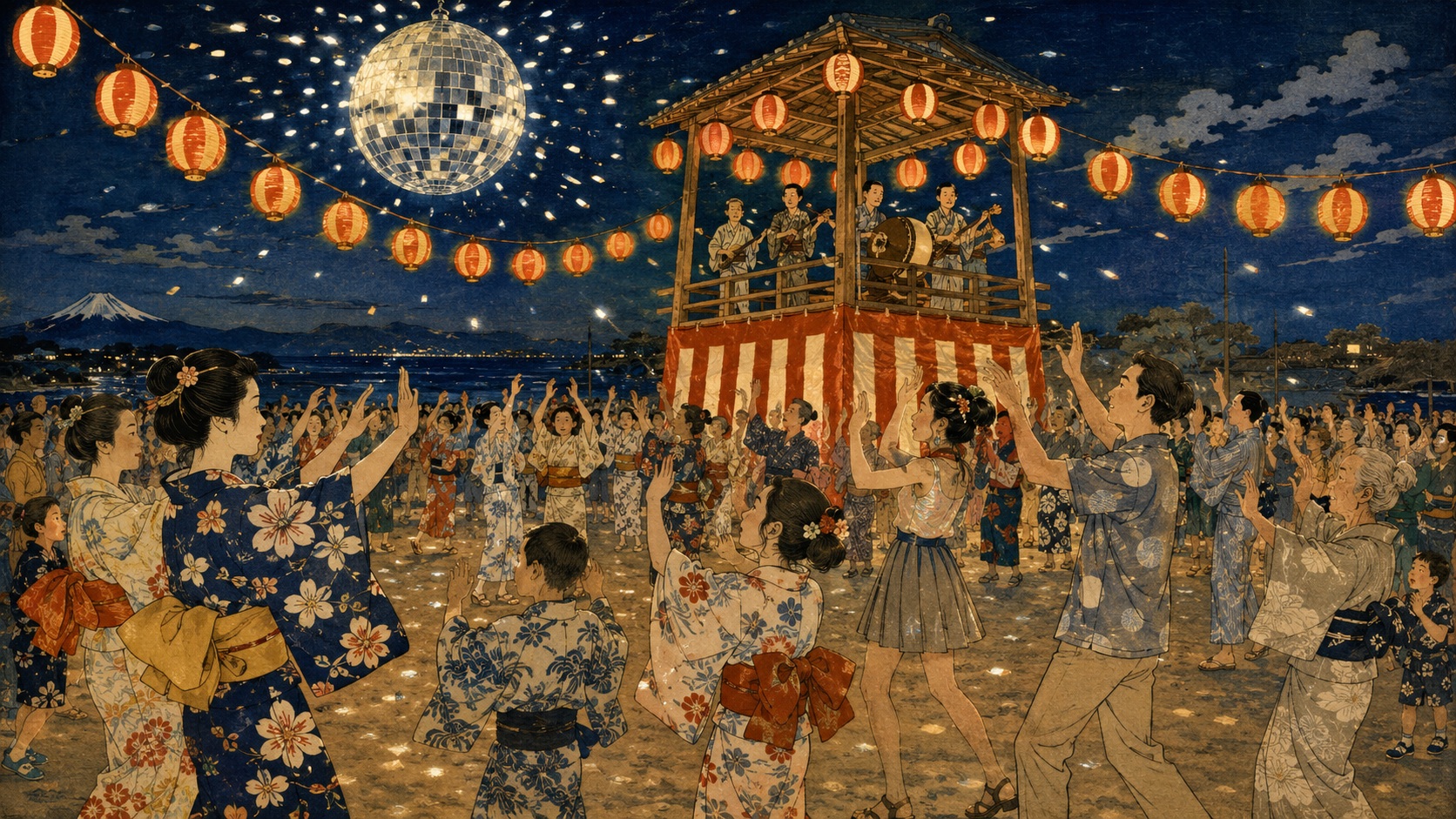
Picture the room as it has been announced, not yet as it has happened. It is Saturday, August 29, on the sixth floor of a railway shopping center in western Tokyo. Outside, late-summer heat hangs over Tama. Inside, a cooling towel is handed to an early arrival. A child carries a decorated fan. Someone’s borrowed Afro wig catches the light. A local hayashi ensemble waits beside a DJ console, and above the floor a mirrored ball turns a festival hall into a field of moving silver.
First comes instruction. One academy teaches the compact, repeatable grammar of bon odori. Another breaks down a disco step. Then the distinction is supposed to loosen. A familiar folk-dance rhythm may give way to “Dancing Hero,” “Y.M.C.A.,” “September,” “Hot Stuff” or “Can’t Take My Eyes Off You.” The announced finale is “Matsuken Samba II”: neither an ancestral dance nor a 1970s club record, but a gaudy Japanese pop spectacle that has itself become collective memory.
This is the plan for Seiseki Bon “Bon” Disco, a free two-day event at Keio Seiseki-Sakuragaoka Shopping Center’s Aura Hall. Its slogan promises that dancing will connect generations and make the town shine. The producer’s wordplay folds the Japanese bon, the English “bond,” and the upbeat sound of “good” into the title. That is branding, not etymology. But it points to the real experiment: can people whose cultural memories were formed in different decades inhabit one beat without being sorted into a children’s corner, a seniors’ class and an adult nostalgia night?
The event is scheduled eleven days after this article’s publication. No crowd has yet formed; no promised “three-generation” encounter can be reported as an outcome. What can already be examined is the design of the invitation—and the much longer history that makes the combination less improbable than the publicity suggests.
One hall, several centuries
The organizers have built the program as participation rather than concert viewing. On August 29, DJ KOUNO, G24 Dance Performance and the Japan Bon Dance Association are scheduled for both sessions. On August 30, DJ Haruhisa Kurihara, dancer Naruki Hirasawa and the association are joined at different times by the Musashi Ichinomiya Ono Shrine hayashi group, clover26 and LOICX cheer dancers. Miho Tamagawa is to serve as master of ceremonies.
The important programming choice is the pair of “Dance Academies.” A circle dance can look radically open—there is no ticketed front row and the choreography belongs to everybody—while still intimidating anyone who does not know the sequence. Disco promises expressive freedom but can produce a different anxiety: the fear that everybody else knows how to move. Teaching both forms before opening the floor makes participation a learned public skill, not a test of authenticity.
The announced music travels across the memories of at least three age groups. International disco titles are likely to register as the youth music of today’s older adults, while “Dancing Hero,” released in Japan by Yoko Oginome in 1985, belongs to late-Shōwa pop and to a much younger social-media rediscovery. “Matsuken Samba II,” released in 2004, carries Heisei television spectacle into the finale. Children encounter all of it as present-tense sound.
| Layer on the floor | What it carries | What a new dancer is asked to do |
|---|---|---|
| Bon and folk-dance practice | Ancestor remembrance, local festival calendars, repeatable group form | Enter the circle, watch the person ahead and learn by repetition |
| Hayashi performance | A local shrine sound world and the authority of live festival musicians | Hear rhythm as a neighborhood practice, not only a recording |
| 1970s–80s disco | Imported records, nightlife, fashion and the memory of mass prosperity | Claim individual movement inside a shared pulse |
| 1980s Japanese pop | Television, records and an existing regional bon-dance reinvention | Discover that “pop” can become tradition within one lifetime |
| Children’s and cheer dance | Reiwa performance culture, schools and family spectatorship | See children as contributors, not merely heirs |
Before the mirrored ball, a dance for the dead
Bon odori has no single, uncontested birth certificate. One major lineage runs through nembutsu odori, the Buddhist practice of chanting Amida Buddha’s name while dancing, which spread widely in the Kamakura period. Government cultural materials describe that practice as a root of bon dancing. Over centuries, Buddhist rites for returning ancestral spirits combined with local songs, harvest prayers, courtly and popular entertainments, and regional social customs. The result was not one national choreography but a family of dances.
That plurality matters. Some bon dances retain an explicit ritual sequence: spirits are welcomed, danced with and sent away. Others are secular neighborhood festivals held for community fellowship. Some move in a circle around a tower; others make lines or processions. Some rely on drums and flutes; some are sung without instruments. Any account that treats “bon odori” as a single timeless national folk dance erases the particular communities that kept its forms alive.
UNESCO’s 2022 inscription of Fūryū-odori makes the point visible. The inscription covers 41 designated folk performing arts—not every bon dance in Japan—and includes bon dances, nembutsu dances and other forms. Their costumes and instruments vary, but the practices carry prayers for repose of the dead, relief from disaster, rain, harvest and well-being. Japan’s Agency for Cultural Affairs emphasizes that people of different generations participate and that the dances reflect distinct local histories and environments.
Seiseki Bon Disco is not one of those protected ritual practices, and its late-August shopping-center setting should not be confused with an ancestral observance. Yet the deep history explains why a shared dance floor can hold more than entertainment. To move in time with neighbors is an old way of turning memory into a public act. The content of the memory changes. The social technology—the rhythm that lets people gather without first having to agree on words—endures.
Coal dust became a national summer gesture
For evidence that “traditional” bon repertoires have always been made through transformation, consider Tankō Bushi, one of the most familiar modern bon-dance songs. It began around the coalfields of present-day Tagawa, Fukuoka, as labor song. Tagawa City’s history traces the path from work to banquet room: songs used among coal workers were taken into entertainment districts, accompanied by shamisen and polished as zashiki-uta.
In 1932, Nagao Ino and other geisha recorded “Tankō Uta,” the first known record release in the song’s development. Radio moved it beyond the coalfield. After the war, when national reconstruction policy placed coal at the center of energy supply, the tune was broadcast repeatedly and became a countrywide bon-dance standard.
The choreography still performs an industrial archive. According to Tagawa City’s illustrated instructions, dancers scoop coal to the right and left, load it, shade their eyes to look into the distance, push a mine cart, tip open a coal box and clap. Interpretations vary, as the city notes, but the sequence lets people far from a mine repeat the gestures of labor with their bodies.
This history complicates the easy opposition between “authentic bon dance” and commercial popular music. Tankō Bushi was work song, nightlife repertoire, recorded commodity, radio content, reconstruction anthem and festival standard in succession. Its continuity lies precisely in those crossings. Every summer circle that performs it contains a buried media history alongside its coalfield memory.
The city learned to sell an ondo
The same year as the first Tankō Uta recording, merchants in Tokyo commissioned a song to dispel the gloom of the Shōwa Depression. Lyricist Saijō Yaso and composer Nakayama Shinpei wrote “Marunouchi Ondo,” which was presented at a bon dance in Hibiya Park in 1932. With new words, the melody became “Tokyo Ondo” the following year and entered national popular culture. Hibiya’s original was revived in 2003 after 71 years.
Here, civic ritual, marketing and mass music were not separate realms. Shopkeepers used a public dance to animate an urban district. Professional songwriters created a new “folk” object. Recording and broadcast allowed it to travel. The crowd, by dancing, turned a commissioned product into social memory.
Historian Hiromu Nagahara has argued more broadly that Japan’s early popular-record industry did not merely reflect a new mass society; it helped create one. From the late 1920s onward, records and broadcasting gave geographically dispersed listeners common songs and a shared consumer culture. Bon odori became one place where that mediated commonality was made bodily. The loudspeaker beside the tower was as consequential to modern festival culture as the drum above it.
Medieval period Dancing nembutsu becomes one important lineage behind later bon dances.
1932 “Tankō Uta” reaches record; “Marunouchi Ondo” is presented at Hibiya Park.
Postwar years Radio and coal-centered reconstruction help make Tankō Bushi a national bon standard.
Late 1970s–80s Disco, funk and soul feed Japan’s urban pop sound and club culture.
1986 “Dancing Hero” enters bon dancing in Ichinomiya; Seiseki’s A and B buildings open.
2003 Hibiya revives “Marunouchi Ondo” after 71 years.
2022 UNESCO inscribes 41 Fūryū-odori folk performing arts.
2026 Seiseki announces its first Bon Disco for August 29–30.
Disco was already inside the circle
The Seiseki publicity calls its event a surprising fusion. It is new to the shopping center, but the broader collision has precedents. The most useful one is already on the announced playlist.
“Dancing Hero,” Oginome’s Japanese cover of an Anglophone dance-pop song, became a hit in 1985. In Ichinomiya, Aichi Prefecture, it entered the bon-dance program the next year. Reporting by the Asahi Shimbun’s Withnews traces the choreography to the Nagoya-based Nihon Minyō Kenkyūkai, whose instructors distributed pop dances through their network. The group’s president said the aim was to give younger people something enjoyable to dance. By 2018, the song had more than three decades of local festival repetition behind it—long enough for a pop novelty to function as tradition.
Japan’s disco encounter was itself part of a longer process of importing and remaking sound. The Japan Foundation describes city pop as a late-1970s form that mixed disco, soul, R&B and funk, reaching a peak during the 1980s and becoming associated with affluent urban life, cassette players and cars. The Seiseki program’s American and European titles recall the original records, Japanese club floors, television and advertising all at once. They are “foreign” songs with Japanese listening histories.
Bon odori and disco do not become identical merely because both involve music and crowds. Bon choreography often subordinates individual display to a repeatable sequence and a spatial circle. Disco culture made the self-fashioning body—clothes, gesture, improvisation—central. One trains the newcomer by imitation; the other promises personal freedom while quietly rewarding confidence. Their productive friction is between synchronization and expression.
The planned academies turn that friction into method. Learn the shared pattern first. Try the individual step next. Then let a child’s cheer-dance vocabulary, a parent’s pop memory and a grandparent’s club or neighborhood memory coexist. The goal is not a perfect hybrid genre. It is the brief suspension of the embarrassment that keeps strangers from moving together.
A department-store hall becomes a town square
The venue is part of the meaning. Keio began integrated redevelopment around Seiseki-Sakuragaoka Station in February 1984. The company controlled a substantial tract near Tama New Town and saw the growth of nearby universities and schools. The A and B buildings and shopping center opened in March 1986; the C building followed in 1988. Across roughly 36,200 square meters, station, bus terminal and retail were designed as one complex.
In other words, the place and part of the music grew up together. The shopping center opened at the beginning of the same era that “Dancing Hero” was becoming a bon song in Aichi and disco-influenced pop was becoming an everyday soundtrack. People who entered Seiseki as young parents or commuters in 1986 can return in 2026 as older residents. The building is now old enough to contain several generations of personal history.
An indoor hall also answers the physical reality of an August festival. Organizers are offering 600 cooling towels, 150 at each session, and the program can proceed outside direct sun. The arrangement is commercially useful—families move through the shopping center, a receipt unlocks festival games, food and drink are sold, and a stamp rally circulates visitors through the building. “Free admission” describes the dance floor, not an escape from retail.
That does not disqualify the hall as civic space. Modern suburbs often lack the old street, temple precinct or village commons assumed by the classic festival image. Stations and shopping centers have become the places where people of different ages already cross paths. The sharper question is whether the host treats those people as a public or only as foot traffic. A participatory event can do both. Its social value depends on whether the encounter lasts longer than the promotion.
- Access: An indoor, station-linked, free dance floor lowers weather, travel and skill barriers.
- Transmission: Instructors and live hayashi musicians let children meet practices through doing.
- Recognition: Disco and 1980s pop treat older adults’ youth culture as living material, not a museum piece.
- Risk: “Bon” can be reduced to lanterns and costume if ancestor remembrance and local specificity vanish.
- Commercial limit: A retail event can create contact, but it cannot by itself build durable intergenerational institutions.
Why “three generations” matters in Tama
Tama had 148,612 residents and 77,350 households on June 1, 2026. Its mayor says roughly 30 percent of the population is 65 or older. The city also reports unusually strong healthy-life-expectancy results and emphasizes habits that let people walk naturally and connect with others. Those facts prevent a simplistic portrait of decline. Tama is aging, but older residents are not merely a problem to be solved; they are active keepers of place and memory.
The age structure has a particular history. Tama New Town’s first residents arrived in 1971. Large numbers of households at similar stages of life moved into newly built districts together. Decades later, city planning documents identify the consequence: generational imbalance, rapid aging in early districts, children leaving for education, work or marriage, and the need for a city in which generations circulate rather than arrive as one cohort and age in parallel.
The shopping-center event does not claim to be a demographic policy, and it would be unfair to present a weekend dance as a remedy for aging. But its “three-generation” language resonates with that urban history. A planned town needs more than appropriately mixed housing. It needs occasions on which ages do not merely occupy the same municipality but become visible to one another as participants.
Dance is well suited to this modest task because knowledge does not move in only one direction. An older participant may know the bon pattern. A middle-aged participant may recognize the disco break. A child may master the new step first. For a few minutes, authority can rotate around the circle. That is a small social event, but it is more reciprocal than an exhibition in which one generation performs its past for the others.
Celebration after Obon
The dates matter. Much of Japan observes Obon around August 13–16. Seiseki’s event comes nearly two weeks later, in a shopping center, under a disco ball, with costume rental, craft beer and a sponsor’s cooling towels. It is plainly framed as end-of-summer entertainment rather than a religious ceremony.
That distance allows invention but requires honesty. A mirrored ball should not be mistaken for evidence that ritual meaning no longer matters. Across Japan, specific communities maintain bon dances as acts of ancestral remembrance with rules, songs and responsibilities that cannot be reproduced by a generic festival package. UNESCO recognition protects precisely that local transmission.
At the same time, secular reinvention is not a recent corruption introduced by shopping centers. Merchants commissioned urban ondo in the Depression. Record companies standardized songs. Radio carried coalfield music nationwide. Pop choreographers brought chart hits into the ring. Public agencies and tourism campaigns revived forms that had lapsed. The boundary between inherited ritual and designed entertainment has been crossed repeatedly.
The most responsible version of Bon Disco therefore does not claim that all dances are interchangeable. It lets difference remain audible: live shrine hayashi alongside a DJ, taught bon patterns alongside freestyle disco, local performers alongside global records. Fusion is strongest when it does not pretend the ingredients had no histories before they met.
How the weekend is supposed to work
The event is scheduled for Saturday and Sunday, August 29 and 30, in Aura Hall on the sixth floor of Building A at Keio Seiseki-Sakuragaoka Shopping Center, 1-10-1 Sekido, Tama. Each day has two sessions, 11:30–14:00 and 15:00–18:00; doors open 30 minutes before each. Admission to the main program is free. The foyer opens from 11:00 with a fan-making workshop priced from ¥800, costume lending with a refundable ¥1,000 deposit, festival games, drinks and a stamp rally. Some activities require purchases or have limited supplies.
The shopping center calls this “Seiseki’s first” Bon Disco. That wording should be read locally. Bon–pop and bon–disco experiments have taken place elsewhere, and “Dancing Hero” alone provides a 40-year precedent. The newness is the particular assembly: this hall, these local performers, these two academies and this explicit invitation to three generations.
Schedules, products and performers can change. The organizer advises visitors to confirm the official page, and it warns that disruption or disaster could alter or cancel the program. That qualification is especially worth noticing at an event designed around heat-safe indoor participation: successful festival culture is not only expressive. It is logistical care.
The circle is not a timeline
It is tempting to arrange the event’s music as a neat march: old bon dance, 1970s disco, 1980s pop, contemporary children. But a circle has no front. On a living festival floor, medieval devotional inheritance can sit inside a recorded work song; a 1932 commercial ondo can feel older than a participant’s grandparents; a 1985 pop hit can become local tradition; a child can teach a step to someone who first heard the song forty years ago.
That is why the most revealing moment at Aura Hall may not be the advertised finale. It may be the small hesitation before a person joins—the instant when watching becomes copying, copying becomes confidence and the boundary between audience and event dissolves.
Producer Yasuhiko Fujikawa says skill is not the point; shared time is. The claim will be tested only when the doors open. A retailer can promise a three-generation floor. It cannot manufacture the trust required to fill it.
But the historical conditions are favorable. Bon odori has never depended on untouched purity. It has depended on a durable social form: a beat simple enough to enter, gestures visible enough to borrow, and a circle capacious enough to remember more than one past. If the disco ball works, it will not erase the lanterns. It will scatter their light.
- Keio Seiseki-Sakuragaoka Shopping Center: official Bon Disco event page. Dates, sessions, venue, performers, foyer activities, prices, participation conditions, giveaways and change/cancellation notice.
- Infiorata Associates / HANAE JAPAN event release (August 14, 2026). Concept, announced song list, Dance Academies, producer comment, cast, organizer and sponsor. This is promotional material and is identified as such in the story.
- UNESCO: Fūryū-odori. 2022 inscription and the dances’ ritual purposes and transmission.
- Agency for Cultural Affairs, Cultural Heritage Online: Fūryū-odori. Japanese description, regional variety and prayers carried by the practices.
- Agency for Cultural Affairs: inscription commemoration materials (2023). Confirmation of the 41 Important Intangible Folk Cultural Properties and intergenerational participation.
- Government of Japan: “Bon Odori: Symbol of the Japanese Summer” (2019). Dancing nembutsu as a major historical root.
- Tagawa City: birthplace and history of Tankō Bushi. Work-song origins, entertainment-district refinement, 1932 recording and radio diffusion.
- Tagawa City: how to dance Tankō Bushi. The mining gestures and the city’s note that interpretations vary.
- Fukuoka Prefecture Tourism Association: Tankō Bushi. Postwar coal policy, radio and its spread as a bon standard.
- Chiyoda City cultural heritage survey: bon dancing in Chiyoda. “Marunouchi Ondo,” the 1932 Depression context and the 2003 revival.
- MIT News: “Big in Japan” (2017). Hiromu Nagahara’s research on popular records, mass media and the formation of consumer culture.
- Withnews / Asahi Shimbun: “Dancing Hero” in Aichi bon dancing (2018). Ichinomiya’s 1986 adoption and the Nagoya-based folk-dance network that spread pop choreography.
- The Japan Foundation, Sydney: a brief history of city pop. Late-1970s emergence, 1980s peak and synthesis of disco, soul, R&B and funk.
- Keio Corporation history, 1969–1986. February 1984 redevelopment start and March 1986 A/B completion.
- Keio Corporation: commercial-property business. The 36,200-square-meter integrated station, bus-terminal and retail development; A/B, C and Sakura Gate opening years.
- Tama City: population and households. June 1, 2026 totals.
- Tama mayor’s policy statement (June 2026). Approximate aging rate, healthy-life-expectancy result and emphasis on walking and social connection.
- Tama City: New Town regeneration policy. 1971 first settlement and subsequent aging and infrastructure challenges.
- Tama New Town Regeneration Promotion Council materials. Same-generation mass settlement, generational imbalance and the goal of multi-generational circulation.
Editor’s note: Japan.co.jp did not attend this event; it is scheduled for August 29–30, 2026, after publication. All descriptions of the program are based on the organizer’s official listing and the producer’s August 14 promotional release, not firsthand observation. “Seiseki’s first” is the shopping center’s local claim and is not presented as the first bon–disco fusion in Japan. The links drawn between the event, Tama’s demographics and the shopping center’s 1986 opening are editorial analysis; organizers have not described the event as demographic policy. The article distinguishes the protected ritual folk arts grouped in UNESCO’s Fūryū-odori inscription from this commercial entertainment event. Song titles are included only to document the announced program; no lyrics are reproduced. Public information was checked through August 17, 2026 at 4:29 AM JST. The currency display is the editorially supplied value.