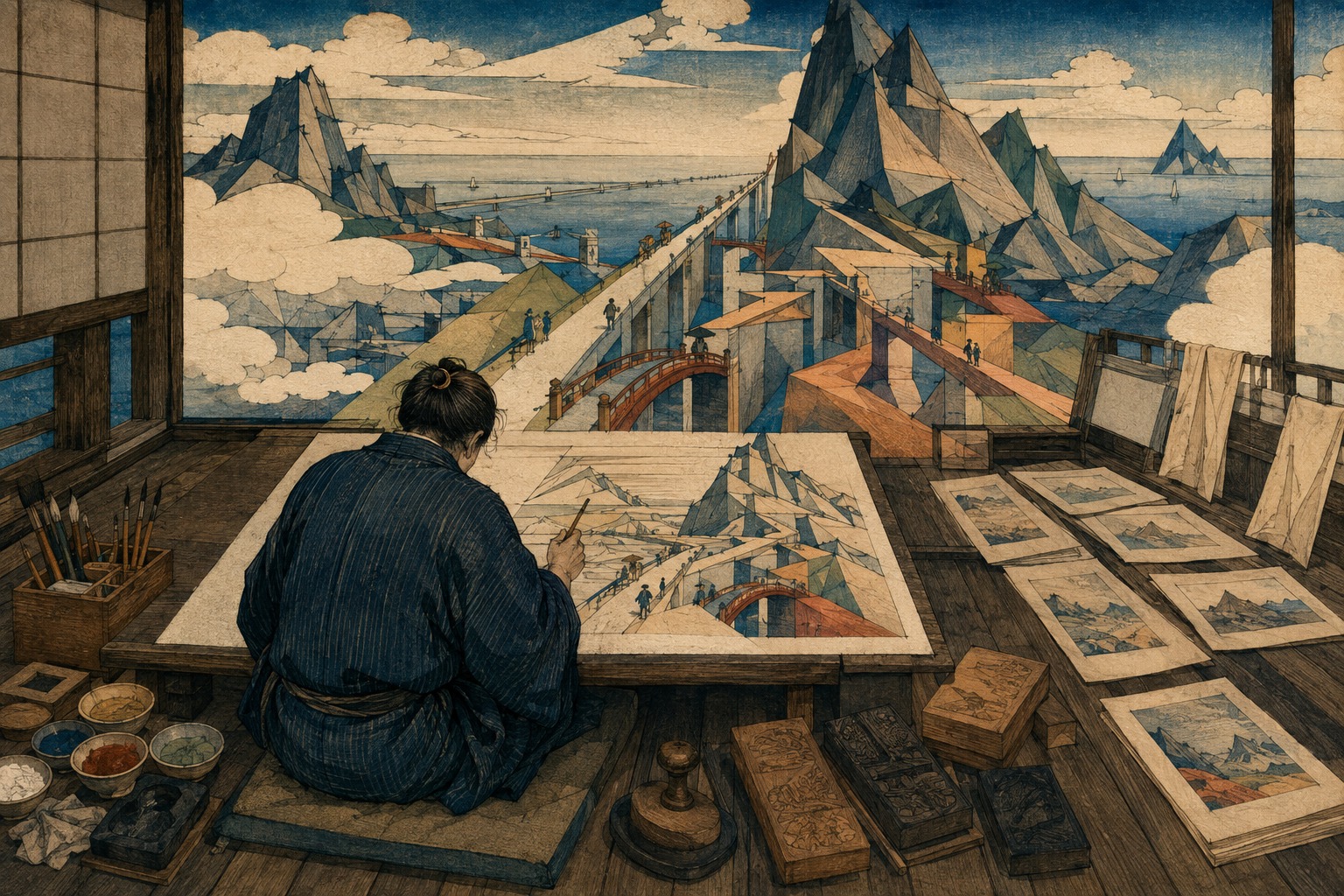
Stand before the bridge and the world abruptly narrows. Shops, people on the quay and bearers of goods diminish while the road drives straight into the distance. Above them, the sky is unnaturally expansive. Clouds behave less like vapor than white islands, walls or a second terrain. Mountain slopes do not roll continuously; blue, green and ochre planes fold against one another and push forward.
That is the sensation of entering a Shōtei Hokuju landscape. The places have names—Nihonbashi, Ryōgoku, Ochanomizu, Shinagawa, Ise, Bōsō and Awaji. People travel, boats work and a daimyo procession crosses a bridge. Yet the whole is not a view copied faithfully through a window. Lines for measuring distance, signs for remembering a place and an imagination for constructing nature occupy the same sheet.
Hokuju can look “modern” because he does more than anticipate perspective. He uses a system intended to unify space around one correct viewpoint without discarding other ways of seeing. A road advances toward a Western-derived vanishing point. Land opens from above like a map. Mountains and clouds retain the hard contour of forms lying on the paper. Depth and flatness struggle without either winning. That tension remains active two centuries later.
We know the work and barely know the person
Hokuju's biography becomes more fragile the more neatly it is arranged. Art Platform Japan's record from the Tokyo National Museum and the National Gallery of Victoria give 1763–1824. The Art Institute of Chicago and the British Museum generally use an active range around 1789–1818. The Metropolitan Museum of Art uses 1790–1820. The Library of Congress expands his activity to 1800–1840.
An active range does not inherently contradict a birth and death date. But the Library of Congress upper boundary extends beyond the 1824 death given elsewhere, revealing that institutions are not applying a single biographical standard. The public catalog pages consulted for this article do not reproduce birth or death documents supporting 1763 and 1824. We therefore use “active around 1790–1820,” following the Met's practical range, without pretending that it is a complete life chronology.
The works and the artistic lineage are firmer. Josai International University's Mizuta Museum of Art and the Karuizawa New Art Museum identify Hokuju as a student of Katsushika Hokusai. He designed large-format color woodblock views of Edo, Chōshi, Kujūkuri, locations around the highways, Ise and Awaji. The British Museum also holds a small privately commissioned surimono. It would be unsafe to claim that he made landscapes alone, but surviving landscape prints unmistakably carry his present reputation.
| Institution | Catalog label | How this report uses it |
|---|---|---|
| Tokyo National Museum-derived data / National Gallery of Victoria | 1763–1824 | Current birth and death dates in those catalogs; no underlying document is shown on the public pages. |
| Art Institute of Chicago / British Museum | Active c. 1789–1818 | A practical range associated with estimated object dates. |
| Metropolitan Museum of Art | Active 1790–1820 | The concise range adopted in this introduction. |
| Library of Congress | Active 1800–1840 | Broader than other institutions; evidence that catalog biography remains unsettled. |
Collection data can change as scholarship advances. A date printed in a museum catalog and a life documented from primary records are not the same level of evidence.
A landscape specialist before landscape became the star
Landscape did not begin with Hokuju. The British Museum identifies small, upright series of “pure landscape” prints as early as about 1724–36. During the 18th century, uki-e—perspective pictures making theaters, festivals, shrines, interiors and famous places appear deeply recessed—became fashionable. From the late 1760s, Utagawa Toyoharu developed European-derived perspective into a major pictorial language.
But the series now treated as decisive monuments of ukiyo-e landscape still lay ahead. Hokusai's Thirty-six Views of Mount Fuji dates to about 1830–32; Hiroshige's Hōeidō Tōkaidō to about 1833–34. Hokuju's principal designs are broadly a generation earlier. The Mizuta Museum places him in the Kyōwa and Bunka-era moment when landscape had not yet become an established ukiyo-e genre, working professionally in Western-style views that employed linear perspective and shading.
Chronology changes the relationship. If we imagine Hokuju as a pupil arriving after the master's famous landscapes, history runs backward. Hokusai was already a restless, innovative artist, but the landscape series supporting his worldwide wave-and-Fuji image did not yet exist. Hokuju was giving roads, bays, bridges and low horizons primary billing in a market that could not know what was coming.
Domestic travel, pilgrimage, commerce, the movement of daimyo processions and interest in guidebooks created an audience for images of place. A landscape print could preserve a visit, simulate a journey for someone who could not travel or let a city inspect itself. Hokuju's tiny figures are more than scale markers. Because they walk, cross, fish and row, a “view” becomes a route.
One-point perspective did not suddenly penetrate a sealed country
It is too crude to say that isolated Japan suddenly discovered Western science. External exchange was tightly controlled, but pictures and knowledge did not stop. Imported prints and books, images traveling through China, Western-style techniques associated with Nagasaki, and experiments by artists including Maruyama Ōkyo in Kyoto entered visual culture by different routes. Edo designers did not receive one complete textbook. They observed fragments and translated them into saleable pictures.
The British Museum's Utagawa Toyoharu print Perspective Picture: A Port in the South-East of Holland, from about 1770, turns canals, buildings, work and leisure in a Dutch town into an Edo color woodblock print. For another Toyoharu design, the museum traces European-derived spatial experiments in Edo to the 1740s and notes the possible context of Ōkyo's vanishing-point views. Perspective became more than imitation. It was a commercial device for making a foreign port, theater, battle, festival or familiar Edo site look newly astonishing.
Hokuju inherited this experiment. The Art Institute's title identifies Susaki as part of a series called New Perspective Pictures (Shin uki-e). The Tokyo National Museum holds Newly Published Perspective Print of Nihonbashi in the Eastern Capital. Words such as “new” and “perspective picture” advertise that recession was not an invisible, neutral method of copying nature. It was a visual effect worth selling.
1740s Early Edo experiments with European-derived perspective.
Late 1760s–1770s Utagawa Toyoharu develops vanishing-point spaces for Dutch ports, theaters, festivals and famous places in Japan.
c. 1801–1818 Hokuju turns perspective and shading toward Edo, Bōsō, roads and coasts, creating his own landscape system.
c. 1830–32 Hokusai's Thirty-six Views of Mount Fuji; imported Prussian blue gives landscape printing new chromatic and commercial power.
c. 1833–34 Hiroshige's Hōeidō Tōkaidō establishes an enduring synthesis of weather, travel, labor and place.
He did not “fail” at perspective; he used several spaces at once
It is easy to look at Hokuju's streets and bridges and complain that the vanishing points are inconsistent or that he never mastered Western perspective. That judgment begins by assuming every print should behave like a European window. The British Museum describes one Hokuju view of Ryōgoku Bridge as using an “original perspective.” The spatial structure can be read as reassembled for different work, not merely broken.
One-point perspective fixes a spectator and gathers parallel lines at a vanishing point. Hokuju uses that force in roads and buildings to carry the eye away. Yet water surfaces are tipped upward like maps; distant land opens at an angle that makes it legible; the front and side of architecture may be available together. Scale can follow not only optical distance but the importance of a landmark and the job it performs in the composition.
In View of Nihonbashi in the Eastern Capital, a bridge, daimyo procession, boats and Mount Fuji are organized as one route. Nihonbashi was the starting point of the national highways, binding commerce and government. As the bridge drives inward, the image becomes more than a prospect: Edo and the domains, ordinary traffic and power, road and river appear as one network. In the Ryōgoku views, the bridge, quays, stalls and people open in different directions, allowing the eye to walk through activity along the water.
The print carries more information because it is not photographic. In present terms it resembles a street view, an oblique aerial image, a wayfinding diagram and stage scenery laid over one another. That does not mean Hokuju predicted satellite maps or architectural axonometric drawing. We recognize a family resemblance between later visual technologies and an Edo image already comfortable with plural viewpoints.
Mountains fold; clouds stand up
Vanishing roads are not what make Hokuju unforgettable. His mountains are exceptionally hard. Slopes become structures of triangles and trapezoids rather than continuous masses of earth. Shading separates planes; contour cuts rock. This is the visual feature that tempts later viewers to call his relief “Cubist.”
But the Cubism of Picasso and Braque belongs to a separate early-20th-century history. No evidence connects it to Hokuju. Calling him “a Cubist a century early” reduces Edo experimentation to an unfinished staircase toward Western modernism. His achievement lies within his own materials: he reconciled perspective recession, East Asian overhead viewpoints, contour suited to carved wood, shading and the need to compress a famous place into a legible sign.
The clouds are stranger still. The Mizuta Museum calls Hokuju a “painter of clouds” and explains that in his Chōshi bonito-fishing print, a low horizon leaves more than half of the sheet to expansive sky and banked cloud. These forms do not merely report weather or veil a distant object. They cover the seam between foreground and distance, turn blank paper into mass, receive the hard edges of mountains and regulate traffic across the composition. They can become horizontal strata or rounded volumes—an architecture of atmosphere.
The Chōshi image also demonstrates Hokuju's editorial geography. The museum notes that Inuwaka rock and a sea cave, actually found in separate places, were moved into one view. This is not necessarily a mistaken survey. It is the logic of a famous-place print compressing the experience of touring a coast. Hokuju is not a camera at a fixed location. He relocates attractions to design a landscape the viewer can read at once.
Blue before Prussian blue: color changes with time
On today's screens, Hokuju's landscapes often appear in restrained blue, green, ochre and pale red. It would be a mistake to call this an eternal minimalist palette chosen by the artist alone. Pigment is material, publishing cost, printing skill and conservation history. Early and later impressions from the same blocks can differ. Colors vulnerable to light can fade across two centuries.
The Mizuta Museum's Chōshi print, dated around 1804–09, predates the broad ukiyo-e use of Prussian blue, known in Japan as bero-ai. Its sea and sky preserve fugitive blue from the dayflower. The museum's 2016 Hokuju exhibition emphasized dayflower and true indigo, the gradated printing of layered cloud and mist, and differences between early and later impressions. As the Met explains in its study of Hokusai's Great Wave, brilliant, stable Prussian blue helped make landscape printing both possible on a new scale and commercially popular in the 1830s.
Hokuju inhabits the chromatic world immediately before that transformation. Blue need not remain heavily saturated; it can dissolve into the warm paper and blur the division between water and air. Greens and ochres subdivide topography. Gradation keeps the sky from becoming a flat fill and produces atmospheric layers. A pale blue in a surviving sheet poses a historical question: was it light from the beginning, did exposure weaken it, or are we looking at a different printing state?
Digital images from separate museums should therefore not be compared as if they were standardized paint samples. Photography, color management, paper condition, printing date and conservation differ. The blue-green-ochre language used across today's Japan.co.jp edition is not a reproduction of one Hokuju print. It is a contemporary editorial translation of his color and compositional habits.
Not a solitary genius: a system of publishers, carvers and printers
Our imagined hero shows a Hokuju-like figure drawing at a desk with blocks and finished sheets around him. The picture is legible, but it must not imply that a color print was completed by one person. As the Sumida Hokusai Museum explains, commercial ukiyo-e required a publisher responsible for concept and distribution, a designer who supplied the image, carvers who cut key and color blocks, and printers who layered color onto paper.
The publisher did more than provide money. He interpreted fashion, selected a subject and format, hired the artist, directed carvers and printers, and organized sales—effectively the production's executive producer. Hokuju's Chōshi view was published by Nishimuraya Yohachi. The same publisher later made Hokusai's Thirty-six Views of Mount Fuji a success. That alone does not prove one continuous campaign from Hokuju to Hokusai, but it shows experiments in selling landscape accumulating inside the same publishing network.
Hokuju's sharp ridge is the designer's idea and a line that a carver must translate into a woodblock. A sky gradation is the printer's hand. Slight misregistration of separate colors generates a new rhythm around an outline. A later impression that omits a block or substitutes a pigment gives the same “work” different weather. Hokuju's signature is singular; the visible landscape is a synthesis of skills.
- Road: Which lines reach the vanishing point, and where do they depart from it?
- Horizon: How does placing it low give sky and cloud a dominant role?
- Mountain: Is terrain modeled continuously, or assembled as planes of color and shade?
- Cloud: Does it merely show weather, or does it join and divide spatial zones?
- People: How do tiny travelers, fishers and processions carry both the scale and story of a place?
A Hokusai pupil—but not merely a footnote to Hokusai
“Hokusai's pupil” is the most useful entrance to Hokuju and a well-supported relationship. It should not become the exit. The Karuizawa New Art Museum says Hokuju inherited Hokusai's Western-style landscape approach and continued developing it even after Hokusai moved into other kinds of work. He narrowed what he received into a specialization and made it deeper.
The difference from Hokusai is not a ranking but a use of landscape. Hokusai endlessly transformed the shape of things—wave, Fuji, human movement, comic observation. Hokuju appears obsessed with building city and country into one spatial machine. A bridge is a bridge and a ruler carrying vision. A cloud is weather and a movable wall dividing the page. A mountain is a famous object and a device forcing flatness against depth.
Later Hiroshige clarifies another distinction. Hiroshige became a master at turning rain, snow, evening, seasons and a traveler's fatigue into the mood of a place. Hokuju has light and atmosphere too, but structural space often reaches us before emotional weather. His road pulls the eye inward before it invites nostalgia for travel.
This research found no decisive source establishing how directly Hokuju influenced the mature landscapes of Hokusai or Hiroshige. It would be excessive to announce that he prepared the two masters' inventions. A more accurate claim is that his prints make visible a prehistory: the later landscape boom did not appear from nowhere but accumulated through many artists, publishers, experiments in perspective and growing demand for famous places.
Why did an artist this strange become difficult to see?
First, there is almost no life story to repeat. Hokusai offers longevity, changing names, incessant moves, Fuji and one enormous wave. Hiroshige offers highways and famous-place series. Hokuju's name does not immediately produce a person, and even his working dates vary by institution.
Second, his reputation does not converge on one blockbuster series or global icon. The Met's Hokuju prints may be digitally accessible but are generally listed as not on view; the Art Institute's Susaki is also normally off view. Existence in a collection and encounter on a gallery wall are different. Digitization shortens the distance, but variant spellings, conflicting dates and translated titles disperse the search.
Third, “Shotei” summons another artist. Takahashi Shōtei, also known as Takahashi Hiroaki, was born in 1870 or 1871 and died in 1945. He made 20th-century shin-hanga landscapes and figure prints for the publisher Watanabe Shōzaburō. Both the Art Institute and Smithsonian catalog Takahashi under Shōtei. If search results fill with nocturnes and snow-covered temples, the artist may be Takahashi rather than Shōtei Hokuju.
Hokuju was never wholly forgotten. In 2016, the Mizuta Museum assembled his rarely shown multicolor prints in what it described as the first attempt to investigate changes in his style and differences between early and later impressions at this scale. The Tokyo National Museum, Nara Prefectural Museum of Art, Met, British Museum, Art Institute, Library of Congress and National Gallery of Victoria now expose works digitally. The task is not to market another breathless “unknown genius.” It is to reunite dispersed objects around a serious visual question.
Why Hokuju became the visual language of the August 16, 2026 edition
Many of today's 15 reports ask readers to understand space. In flooded Chiba, water severs the relationships among roads, railways, homes and an airport. Off Minamitorishima, the rare-earth story requires imagining a vertical descent six kilometers beneath the Pacific. In Misasa, mountain roads and distance from specialist medicine matter. In the vacant-store proposal, a continuous shopping street closes one frontage at a time and may be rebuilt one frontage at a time.
Hokuju's format can hold these relationships in one frame. A raised viewpoint reveals the whole. A receding road makes distance palpable. A bridge expresses separation and connection at once. Small figures restore human scale inside enormous terrain or systems. Clouds can become weather, neural networks or layers of memory. Restrained blue, green and ochre bind 16 images into one edition.
These are not historical reconstructions pretending that Hokuju pictured a 2026 flood or deep-sea mining. They are contemporary Japan.co.jp illustrations using his surviving work as an art-historical reference. They should not carry his signature, circulate as his originals or appear without a disclosure that they are non-documentary. Respect requires more than borrowing clouds and mountains; it requires keeping authorship and invention visible.
The road goes away; the mountain comes back
Much about Shōtei Hokuju remains unknowable from current public evidence. Was he born in 1763 and dead by 1824? Where did he live, who formed his family, and when and how did he study with Hokusai? Why did he specialize in landscape, and why does the record of activity end? We should not fill those gaps with colorful anecdotes merely because a profile feels incomplete.
The images are not silent. A procession advances over Nihonbashi, Ryōgoku Bridge partitions the riverbanks, and a Chōshi boat pulls into the waves. Ochanomizu opens deep terrain inside the city; Futami's coast places devotion and travel along one horizon. People are small but not absent. Their smallness reveals the road's length, the mountain's weight and the sky's breadth.
His modern-looking mountains are not prophecies of modernity. They are the result of combining the lines, wood, pigments, imported images, famous-place memory and publishing market available in his own time by a method no one else quite shared. His space is neither a successful nor a failed Westernization. It is where different ways of seeing refuse to reconcile and nevertheless form one landscape.
The road runs toward the vanishing point. The mountain, however, refuses to retreat; it returns toward us as a sharp plane. Clouds fill holes in the sky and insist on the paper's surface. We travel into the distance while being reminded that a print is flat. This round trip is Hokuju's strange geometry.
We may not know his face, but we can see how he assembled a world. The biography remains an opening. Across it, one road still runs a very long way.
Principal sources and reporting basis
- Josai International University Mizuta Museum of Art, Bōsō landscape: Bonito Fishing Boats off Chōshi in Shimōsa: Hokusai pupil, Western-style landscapes in the Kyōwa–Bunka years, perspective and shading, c. 1804–09, Nishimuraya Yohachi, low horizon, clouds, dayflower blue and the combination of geographically separate sights.
- Mizuta Museum's 2016 exhibition, “Hokusai's Pupil Shōtei Hokuju”: specialization before landscape became established, early and later impressions, dayflower and indigo, gradation, and the exhibition's stated first attempt to trace Hokuju's stylistic development.
- Art Institute of Chicago, Susaki, from New Perspective Pictures: c. 1810s, color woodblock, format and active range c. 1789–1818.
- Metropolitan Museum of Art, Shore Scene Showing European Influence: c. 1810–20, active 1790–1820, woodblock print in ink and color.
- Metropolitan Museum of Art, View of Ryogoku Bridge in the Eastern Capital: c. 1810–20, dimensions and public-domain collection record.
- Metropolitan Museum of Art, View of Ochanomizu in the Eastern Capital, and View of Futami Beach at Ise: Hokuju's urban and coastal famous-place subjects in horizontal large format.
- British Museum, View of Nihonbashi in the Eastern Capital: uki-e, Nihonbashi, daimyo procession, Fuji, boats and the 1789–1818 active range.
- British Museum, View of Ryogoku: quays, stalls, bridge and the museum's description of an “original perspective.”
- British Museum, Dragnet Fishing at Kujūkuri Beach in Kazusa: Bōsō seascape, fishers and color woodblock production.
- Art Platform Japan / Tokyo National Museum, Newly Published Perspective Print of Nihonbashi in the Eastern Capital, Tsukuda Island, and Shichirigahama Beach by Enoshima: Japanese public collection data and the 1763–1824 dates.
- Library of Congress, Perspective View of Mount Dōkan from Shinagawa: c. 1804–30, color woodcut, people, shore and ships, and active range 1800–1840.
- National Gallery of Victoria, View of Awaji Island: 1811–15, dimensions, inscription and 1763–1824 catalog dates.
- Karuizawa New Art Museum, “Encountering Different Cultures”: Hokuju as Hokusai's pupil and his distinct development of Western landscape perspective and shading.
- British Museum, Utagawa Toyoharu's Perspective Picture: A Port in the South-East of Holland: c. 1770 translation of Dutch urban and canal space into Edo color woodblock.
- British Museum, Utagawa Toyoharu's Battle at Nine-Hermit Mountain in China: experiments with European-derived perspective since the 1740s, possible Ōkyo context and reconstruction of foreign space.
- Sumida Hokusai Museum, “Hokusai × Producers”: division of labor among publisher, designer, carver and printer; the publisher's creative-commercial direction; Nishimuraya Yohachi and Thirty-six Views of Mount Fuji.
- Metropolitan Museum of Art, “The Great Wave: Anatomy of an Icon”: Prussian blue's effect on 1830s landscape printing and the anonymous contributions of carvers and printers.
- Art Institute of Chicago, Takahashi Hiroaki (Shōtei), and Smithsonian National Museum of Asian Art, Shinagawa: identification of the separate 20th-century artist called Shōtei.
- British Museum, Hiroshige: Artist of the Open Road large-print guide: domestic travel, famous places, imaginative travel and the later development of landscape printmaking.
Editor's note: This report prioritizes museum and library collection records and exhibition research. Because institutions disagree on Hokuju's birth, death and active dates, it does not treat 1763–1824 as unconditionally settled and describes him primarily as active around 1790–1820. It does not invent an address, family, training date, itinerary, personality or intention absent from the public evidence. “Cubist,” “map-like” and “architectural” are modern formal comparisons, not claims of influence or prophecy. The Japan.co.jp image is neither a reproduction of Hokuju nor a portrait. Research current through August 15, 2026 at 3:14 AM JST.