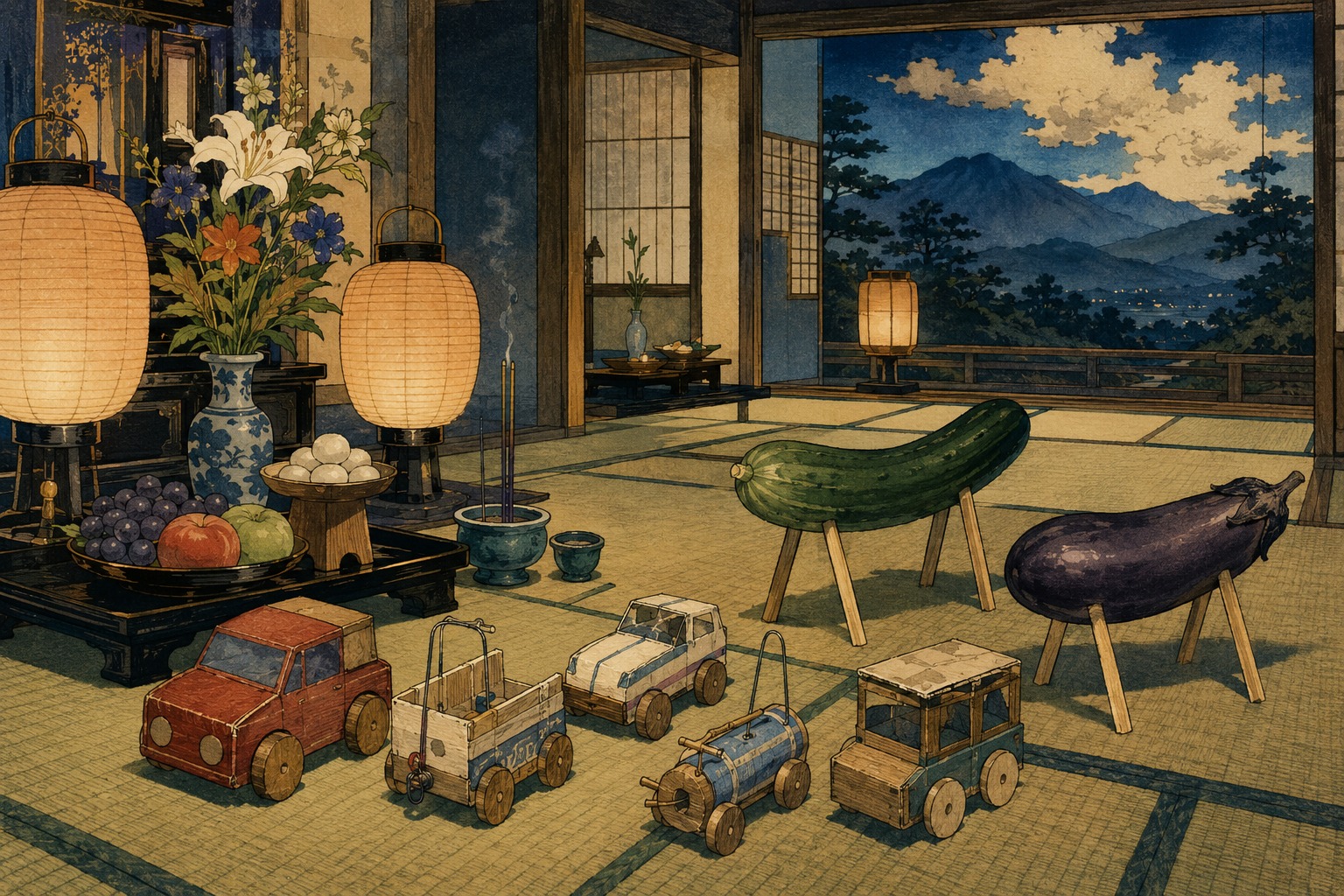
Wind from the Sea of Japan crosses the northern end of the Shōnai Plain. In Mizukami, a settlement in Yuza near the foot of Mount Chōkai and the Akita border, small shadows move beneath the eaves during Obon: a four-wheel-drive car, a double-decker bus, an old railway carriage. Some families use aircraft. This is not children's play interrupted halfway through. The wheels do not touch the road. String holds each vehicle between the house and the sky.
Local residents call them shōryōsha, spirit vehicles for the ancestors. In an August 13, 2025 field report by Television-U Yamagata, people in Mizukami explained the wish plainly: they want their ancestors to return “more quickly and comfortably.” Once home, the spirits are hosted at an oshore-dana, the local term reported for an elaborately prepared shelf bearing rice cakes and other offerings. After spending Obon with the family, the ancestors are said to leave in the same vehicle.
At first glance it can resemble a gentle joke—modern toys inserted into an old rite. A car selected by a household, kept carefully and hung again each summer, however, is not merely decoration. A 2017 report described a home in Yuza's Toyooka district that had used a model of a second-generation Toyopet Crown as its spirit vehicle for about half a century. The miniature “fine car” offered to the ancestors has lived a life closer to a ritual object than to the contents of a toy box.
Do not turn it into “Yamagata's bizarre custom”
Stories about unusual traditions have a habit of making their geography too large. “Yamagata welcomes the dead by car” is an easy headline. Public evidence supports something smaller. The most detailed television report walked through Mizukami. Older newspaper coverage and a photographic project recorded multiple homes in Yuza, including Toyooka. No complete survey was located that maps where in town the same name, timing, direction and altar arrangement are shared.
The sound formulation is therefore “a household- and settlement-level Obon practice documented in Yuza.” It needs no claim to represent an entire prefecture. Its smallness is part of its meaning. In a district of 23 households, decisions made inside a home—who assembles the shelf, what car would suit the deceased, how the procedure is taught to a child—overlap with neighbors' decisions until they form a local way of doing things.
Mizukami also preserves a more specific observance. When a relative dies, a household suspends an elaborate horse ornament for three years beginning in the year of death, according to the 2025 report. The automobile has not simply banished the horse. A newer vehicle and an older form appear beneath the same roof according to the age of the loss. That layering is invisible in a simple national story of “horse versus car.”
Obon did not come from one source
Why are the ancestors expected home in summer? It is inadequate to describe Japanese Obon as a practice that moved intact out of one Buddhist scripture. There is a Buddhist genealogy of Urabon-e services and teachings. There is also a folk complex in which households receive ancestral spirits, offer food, show them the way with fire or light, and send them out again. The Japanese observance took shape where those histories met.
Japan's Agency for Cultural Affairs classifies Bon observances, together with New Year, among the most important turning points of the annual cycle. It notes that they bear strong Buddhist influence while retaining the character of an indigenous ancestor and spirit festival in their actual folk practice. That double description matters. Obon is neither only a temple service nor an unchanged survival from a pre-Buddhist past. Over a long history, work performed at temples, graves, homes and within settlements was connected.
The National Diet Library's account of the seasonal calendar explains that Tanabata once marked the beginning of Bon preparations and helped welcome ancestral spirits. It identifies the evening welcoming fire on the 13th, the send-off fire on the night of the 16th, and Bon dances that comfort the spirits. Today a July Obon, a “month-late” August Obon and dates tied more closely to an old lunar calendar coexist. What travels nationally is not a single procedural manual. It is the structure of receiving the dead as guests for a limited stay.
| Work of Obon | Forms found widely | Forms reported in Yuza/Mizukami |
|---|---|---|
| Show the route | Welcoming fires, lanterns, grave visits | Spirit vehicles suspended under eaves |
| Provide transport | Cucumber horse, eggplant cow, animals made of straw or grass | Cars, buses, trains and aircraft; horse ornaments also remain |
| Host the stay | Bon or spirit shelf, flowers, food, sutra recitation | Rice cakes and other offerings on an oshore-dana |
| See the spirits off | Send-off fires, lanterns, spirit boats | Ancestors depart in the same spirit vehicle |
Names, dates, materials, orientation and sectarian interpretation vary by region and household. This table compares functions of movement and hospitality; it is not a national rulebook.
Cucumber horses and eggplant cows are not one national code
The most recognizable Obon vehicles today may be a cucumber and eggplant standing on legs made from hemp stalk, chopsticks or toothpicks. In the familiar explanation, the slender cucumber becomes a swift horse so ancestors can arrive quickly. The heavier eggplant becomes an ox, taking them home slowly with offerings and memories loaded on its back.
That explanation is widespread, not universal. Guidance from a major Buddhist altar company notes places where the meanings of cucumber and eggplant are reversed, multiple ways of pointing them, and sects or homes in which spirit animals are not displayed. Their materials are not limited to vegetables. Straw, makomo grass, aquatic plants and cloth can become horses. Coastal communities may use boats. In an Obama, Fukui, observance recorded by the Agency for Cultural Affairs, spirit boats built from bamboo and reeds carry the ancestors out to sea.
The convenient contrast—“the nation uses cucumber and eggplant; only Yuza uses cars”—is too coarse for history. The broad idea is that the dead are given a route and a vehicle. Its material answer is local. Yuza itself once had a practice of suspending horses woven from water plants in addition to vegetable offerings, according to photographer Taku Kuraya's research and the exhibition materials for his project.
When did the water-grass horse become a car?
There is no tidy date of invention. Residents interviewed in Mizukami in 2025 said the custom had existed before they were born; they did not know when it started. Community memory was stored in annual procedure, not on a monument naming a founder.
A separate record gives one approximate phase. In 2017, the Yuza-Chōkai Tourism Association was reported as saying that miniature cars began to spread around the Shōwa 40s—the late 1960s and early 1970s—as private automobiles reached farming households. The wish to give ancestors speed and comfort arose at the moment when a motorcar was becoming an ordinary rural tool rather than a distant aspiration.
The 2018 Nikon Salon description of Kuraya's photographic series, Ghost's Drive, reaches further back. It says people able to weave the water-grass horses became scarce during and after the war and that toy cars were adopted as substitutes. Reviewing the exhibition, photography critic Kōtarō Iizawa added another element: actual transportation had shifted from horse to automobile.
Those accounts do not have to be mutually exclusive. Substitutes could have appeared during or just after the war and become common as car ownership expanded a generation later. That is an inference, not a settled chronology. No primary record was found that permits “the custom began in the 1940s” or “it was invented in 1965.” Folk practice can emerge without one inventor: several households may choose similar answers where an old material is disappearing and a new object has entered daily life.
Wartime and postwar years Exhibition materials describe toy vehicles replacing water-grass horses as their makers became scarce.
Late 1960s–early 1970s A tourism-association account cited in 2017 places the spread of miniature cars as farm households acquired private automobiles.
From about 2015 Taku Kuraya photographs Yuza's spirit vehicles for more than three years.
2018 Ghost's Drive appears at Nikon Salons in Tokyo and Osaka.
2025 Television-U Yamagata reports from the 23-household Mizukami district.
2026 Re-publication and new features sustain outside interest. This article is not an independent household census.
Choosing the vehicle is a way of telling a life
Not every car is interchangeable. Accounts associated with the photography exhibition describe red models selected because the person had driven or longed for that car. Some homes chose a bus or train capable of carrying many ancestors together. Aircraft and helicopters appeared. Kuraya even photographed a model taxi with a ¥1,000 fare tucked inside.
Here the vehicle moves from a sign of speed to an object of biography: the car driven in life, the train used on a family trip, the sports model once desired. For a few days, the miniature body can become a condensed life story. When an adult explains the choice to a child, the color and shape introduce grandparents or great-grandparents whom that child may never have met.
An outsider is not wrong to find the sight charming or surreal. Kuraya's pictures deliberately recognize its visual wit. But if novelty is all that survives, private mourning becomes a roadside curiosity made for visitors. The eaves are not a display case. They remain part of a bereaved family's home. People should not enter property or treat photography as an entitlement; even a picture taken from the road deserves the resident's permission. That is a minimum ethic of looking at a living practice.
In Shōnai, the routes of the dead continue beyond Obon
The spirit vehicle should not be declared an expression of one grand Shōnai belief system; the evidence does not establish such a direct link. Official folklore records do show, however, that the region's relationship to the dead cannot be reduced to a single ornament. The Agency for Cultural Affairs documented Yamagata and Niigata Bon practices in 2004. In Shōnai, it also records mori kuyō: from around August 20, after Obon, people visit low hills or wooded groves where related and unrelated spirits were believed to remain for a time, bringing flowers and offerings for memorial rites.
This is not the origin of the toy car, and no source proves a direct causal relationship. It gives depth to a regional imagination in which the dead have locations among home, grave, road and grove. A welcoming fire illuminates a boundary. A vehicle shortens a distance. A shelf creates a temporary seat. A send-off gives parting a physical form. The ancestor is not merely an abstraction. Family members care for a guest who comes from somewhere, sits somewhere, eats something and must travel back.
Tradition preserves a way of changing
Yuza lies where water from Mount Chōkai becomes springs and rivers before reaching the Sea of Japan. At June 30, 2026, the town reported 11,642 residents in 4,787 households. In contemporary rural life, a car is deeply embedded in commuting, shopping, medical visits and movement through winter. Making the automobile a vehicle for spirits is better understood not as machinery destroying belief but as lived reality renewing ritual metaphor.
If transmission means using exactly the same object forever, the spirit car itself fails the test of “tradition.” When fewer people could weave a horse from aquatic grass, households did not necessarily abandon the observance; they entrusted its work to another material. From horse to automobile, and from car to bus or aircraft, substance and speed changed while the relationship—the wish to receive someone—remained.
Change alone does not guarantee survival. A Mizukami resident told the 2025 reporter that the custom was fading and that he wanted to teach it to his son. Population loss is an easy single explanation, but transmission depends on smaller conditions: a place to store the vehicle, someone who knows how to suspend it, relatives able to return for Obon, and time to tell the story of the deceased. Lose any one, and the eaves may be empty next summer.
- Extent: Which districts and homes observe it, on which days?
- Procedure: Where is the vehicle hung, how is it paired with the shelf, and when is it removed?
- Vocabulary: How do residents explain shōryōsha, oshore-dana and the special horse ornament?
- Selection: Why this vehicle, model or color? Whose memory does it carry?
- Change: Record each home's movement among water-grass horses, commercial toys and handmade models without declaring one authentic and the others corrupt.
Putting one toy car into a museum saves only half a custom. The future needs to know the height of the eaves, how the string was tied, what rice cake sat on the shelf, why a horse was used for three years after a death, and what one sentence a parent said to a child. Only then can someone understand why the object was a vehicle. Documentation, moreover, must not turn households into specimens. Residents should decide what remains private and what can be shared.
On August 16, the car starts back
The date of this edition, August 16, is a day of sending in many communities. In the calendar described by the National Diet Library, the welcoming fire of the evening of the 13th is answered by a send-off fire on the night of the 16th. Dates and practice are not uniform, but Obon does not end with reunion. Proper hospitality includes allowing the guest to depart.
Yuza's spirit car is not only a fast arrival vehicle. Mizukami residents say the ancestors travel away in the same car. That differs slightly from the familiar explanation of the cucumber horse and eggplant cow—come quickly, return slowly—yet the central care is shared. The living imagine the journey and provide for both directions.
Eventually the light is extinguished, the food removed and the vehicle taken down. Perhaps it returns to a box until next year. The little car that never drove on a road carried more than a spirit: family memory, the transformation of the postwar countryside, lost skill in weaving aquatic grass, and a wish spoken in the present tense—please come home this year, too.
Tradition is not only the protection of an old object against movement. It is also the repeated decision about what may change and what a community does not wish to lose when life changes. The miniature car moving beneath the eaves in Yuza makes that decision visible. The horse became a car; the road home did not disappear.
Principal sources and reporting basis
- Television-U Yamagata, feature on miniature vehicles hung during Obon (republished August 13, 2025): Mizukami's 23 households; spirit cars, buses, trains and aircraft; speed and comfort; the oshore-dana; rice-cake offerings; the three-year horse ornament; and residents' concern about transmission. This is the main recent field report.
- Archived reproduction of a 2017 Yomiuri report, “Spirit vehicles hung at Obon”: the Yuza-Chōkai Tourism Association's late-1960s/early-1970s account and the Toyooka household using a second-generation Toyopet Crown for about 50 years. Used cautiously because the original article is no longer directly available.
- Nikon Salon, Taku Kuraya exhibition, Ghost's Drive (2018): water-grass horses, wartime/postwar loss of makers, substitution with toy cars and photographic work in Yuza.
- artscape, Kōtarō Iizawa review of Ghost's Drive (October 2, 2018): more than three years of photography, changing transport, cars associated with the dead, and examples involving buses, trains, taxis and aircraft.
- Agency for Cultural Affairs, Cultural Heritage Online, “Bon observances”: Bon and New Year as major annual junctures; Buddhist influence alongside folk ancestor and spirit worship; and the 2004 record Bon Observances V: Yamagata and Niigata.
- National Diet Library, “Fumizuki”: Tanabata and the beginning of Bon, the welcoming fire on the 13th, send-off fire on the 16th and Bon dance.
- Hasegawa, “What are the cucumber and eggplant spirit animals?” (July 30, 2026): the familiar horse-and-ox meanings and regional differences in meaning, direction, sect and material. As a commercial guide, it is used for a representative explanation, not a national rule.
- Agency for Cultural Affairs, Cultural Heritage Online, Nishi-Ogawa Bon send-off: the Obama, Fukui, example of spirit boats made with bamboo and reeds and sent to sea.
- Agency for Cultural Affairs, “Shōnai mori kuyō practices”: post-Obon memorial visits around August 20 to groves believed to hold related and unrelated spirits for a time.
- Yuza Town official site: geography at the foot of Mount Chōkai, with mountains, rivers, sea and springs; population of 11,642 and 4,787 households at June 30, 2026.
- Yuza-Chōkai Tourism Association, introduction to Yuza: the northern Shōnai Plain, Akita border, Mount Chōkai, Gakkō River and Sea of Japan winter winds.
- Kuruma no News, feature on Yuza's miniature-car welcoming Obon (August 13, 2024): a recent secondary account used to cross-check vehicle variety and outside interest.
Editor's note: This report triangulates Television-U Yamagata's 2025 field reporting in Mizukami, an archived 2017 report, 2018 exhibition materials and official records of Bon observances. Japan.co.jp did not conduct a 2026 door-to-door survey. It therefore does not assert a 2026 household count, number of displayed vehicles or complete town distribution. Sources offer different time ranges for the custom's emergence: wartime/postwar substitution and spread during the Shōwa 40s. This article identifies a possible staged transition but does not settle an origin. The horse-and-ox explanation for cucumber and eggplant is familiar, not uniform across Japan. The hero is an imagined illustration. Research current through August 15, 2026 at 3:14 AM JST.