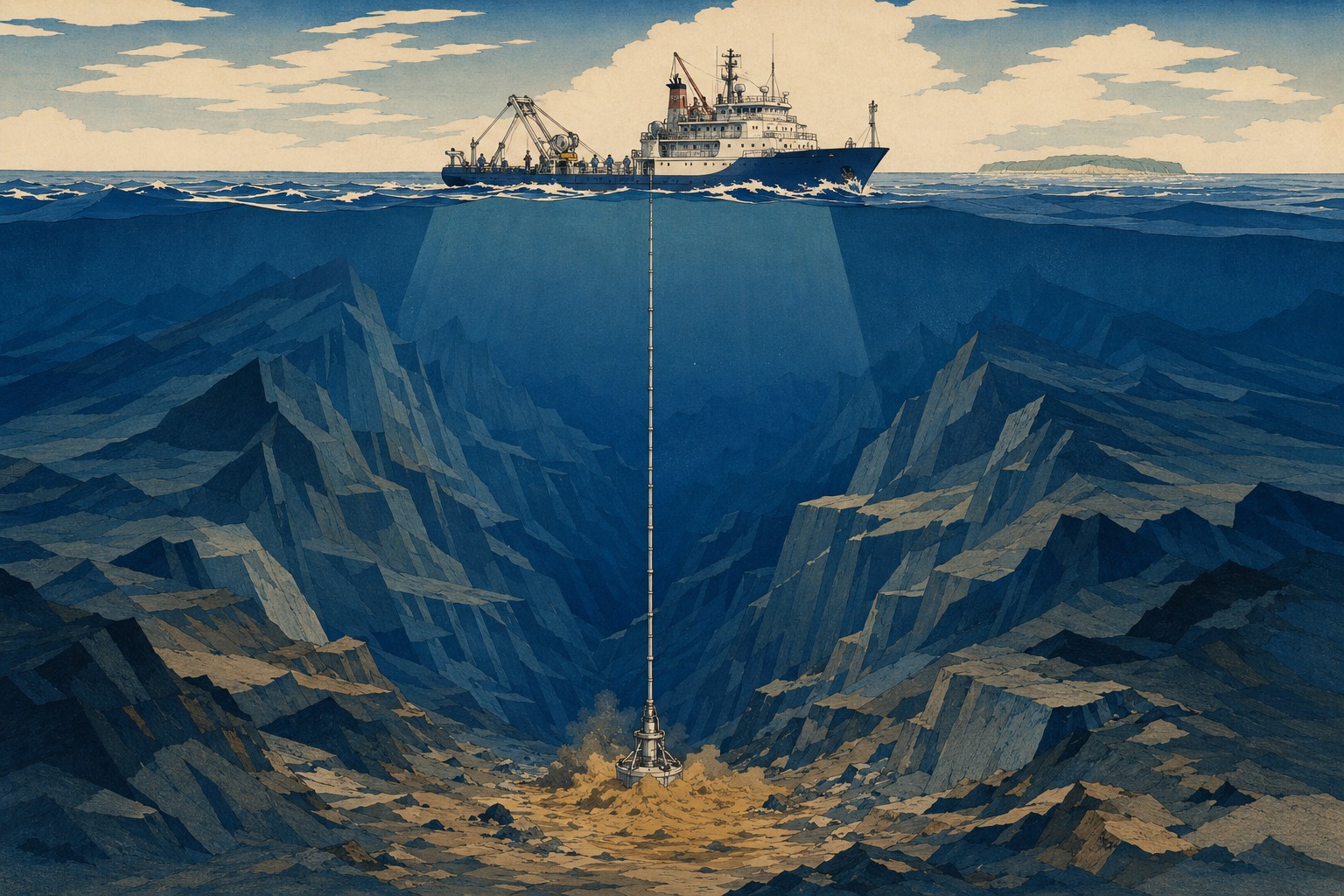
Just after 12:30 in the morning, gray mud that had begun its journey on the dark Pacific floor appeared on the deck of the scientific drilling vessel Chikyu. It was February 1, 2026. Roughly 1,950 kilometers southeast of central Tokyo, near Japan’s easternmost island, an engineering boundary had been crossed.
It is often said that Japan “drilled six kilometers down.” That is not quite right. Nearly six kilometers is the water column separating ship from seabed, not the depth penetrated into rock. A collector entered mud close beneath the seafloor, and a 5,569-meter lifting pipe carried slurry—a mixture of seawater and fine sediment—continuously upward. On land, a pipe that long would stretch from Tokyo Station almost to Shinagawa. Here it hung close to vertically from a vessel moving in the open ocean.
Over three days, the system recovered mud from three rare-earth-bearing layers. After subtracting the seawater added to loosen it, JAMSTEC calculated the recovered mud at about 50 metric tons. The agency said the system operated stably and called it the world’s first continuous lifting of seabed mud from beneath 5,569 meters of water. Japan had moved from geology—showing that the mud exists—to engineering—showing that an integrated machine can bring it up.
Beneath seven-meter waves
The clean numbers make the mission sound linear. The ocean was not. Chikyu left Shimizu on January 12 and reached the test area on January 17. The expedition encountered waves approaching seven meters and winds of roughly 20 meters per second. Lowering the collector and pipe, planned as a seven-day operation, took 12 days.
The mud-loosening unit reached bottom on January 30. Mining ran from January 31 through February 2. Recovering the drill pipe, collector and lifting system took until February 9; the ship returned to Shimizu on February 14. Those 50 tons required more than a month at sea, an enormous drilling vessel, thousands of meters of pipe, remotely operated equipment, dynamic positioning, weather judgment and simultaneous environmental observation.
| What the 2026 test demonstrated | What it did not demonstrate |
|---|---|
| The full system could be connected and lowered safely through the water column | Year-round availability and long-duration reliability in severe weather |
| Sub-seafloor mud could be loosened and lifted continuously to the ship | Unit cost at commercial scale or the capital required for dedicated vessels and facilities |
| About 50 tons from three layers could be recovered and analyzed | Average deposit grade, economically recoverable tonnage, total recovery rate or product value |
| Seafloor and shipboard environmental monitoring could operate during collection | Cumulative effects of large, long-term extraction and the recovery time of abyssal ecosystems |
| The collector and lifting pipe ran stably for three days | An integrated chain from mining through separation, refining, metalmaking and magnets |
A deposit made by fish 34.5 million years ago
Rare earths are not all exceptionally rare in Earth’s crust. The hard part is finding them concentrated enough to recover economically, then separating 17 elements whose chemical behavior is remarkably similar.
The history of the Minamitorishima mud begins with life. Rare-earth elements in seawater adhered to iron oxides and settled. Over immense periods, they became concentrated in apatite, the calcium-phosphate mineral that forms fish bones and teeth. JAMSTEC and University of Tokyo researchers date the exceptionally rich mud to about 34.5 million years ago, when global cooling strengthened ocean circulation. Bottom currents striking seamounts may have driven nutrient-rich upwelling, increased fish abundance, and sent vast numbers of microscopic skeletal fragments to the abyss. Material needed in today’s EV motors and MRI equipment accumulated inside the remains of ancient fish.
In 2011, a team led by University of Tokyo geologist Yasuhiro Kato analyzed more than 2,000 sediment samples from 78 Pacific sites. Their Nature Geoscience paper showed that mud rich in rare-earth elements and yttrium was widely distributed across parts of the ocean. In 2013, the vessel Kairei took cores at depths of 5,600 to 5,800 meters around Minamitorishima. One interval roughly three meters below the seafloor contained about 6,500 to 6,600 parts per million total rare earths—a remarkably rich layer lying within easy geological reach of the seabed, if not easy engineering reach from the surface.
2010 Rare-earth deliveries from China were sharply disrupted; Japan recognized the risk of dependence and expanded investment in overseas supply, stockpiles, recycling and substitution.
2011 Researchers report widespread rare-earth-rich mud across parts of the Pacific.
2013 Exceptionally rich mud is confirmed inside Japan’s exclusive economic zone around Minamitorishima; JOGMEC begins broader surveys.
2018 An academic team publishes an initial estimate of more than 16 million tons of rare-earth oxides across 2,500 square kilometers.
2022 Japan lifts seabed sediment and tests environmental monitoring at 2,470 meters off Ibaraki.
February 2026 About 50 tons are continuously recovered from 5,569 meters near Minamitorishima.
March 2026 Japan and the United States sign a memorandum on deep-sea mineral development.
February 2027, planned A monthlong trial at up to 350 tons a day, including transport, dewatering and processing.
By March 2028 A comprehensive industrial assessment, including economics.
“Sixteen million tons” is a starting point, not a reserve
Two phrases follow Minamitorishima through headlines: “centuries of global demand” and “16 million tons.” The latter comes from a peer-reviewed 2018 estimate of rare-earth oxides across a 2,500-square-kilometer research area. It was an important scientific calculation. The current government program does not treat it as a bankable commercial reserve.
JAMSTEC’s own 2025 history explains why. The early estimate relied on relatively wide sample spacing; the lateral shape of the mud layers remained uncertain; and an extraction system had not yet been proven. The figure is not included in the U.S. Geological Survey’s global rare-earth reserve assessment. Later, higher-resolution acoustic work showed the deposit was not a smooth, even blanket. Layers change in depth and thickness, and some are eroded. The project now combines autonomous underwater vehicles, closely spaced cores and three-dimensional geostatistical models. Officials say enough material exists for industrial-scale development, but they withhold specific location, grade and resource figures for economic-security reasons.
- Resource: material estimated to exist geologically.
- Reserve: the portion judged economically recoverable under defined technical, price, legal and environmental assumptions.
- Production: what equipment actually recovers and processes over time.
A huge geological resource does not become a mine unless weather, machinery, recovery, processing, price and environmental conditions all work together.
From 50 tons to 350 tons every day
The next test is scheduled for about one month from February 2027 in the same area. Its planned lifting capacity is 350 tons a day. If it ran continuously for 30 days, that would equal about 10,500 tons—more than 200 times the entire 2026 recovery. That is an illustrative calculation, not a forecast: actual operating days and tonnage will depend on weather and equipment.
The test will not end when slurry reaches a ship. A carrier is to move it to Minamitorishima, where it will be landed and dewatered into compact “mud cake.” The cake will then travel to mainland Japan for trials in separation, refining and smelting. Personnel movement by fixed-wing aircraft and helicopter is part of the plan. The experiment therefore joins a mining system to island unloading, power, water, dewatering, marine transport, chemical processing and safety management.
That chain contains the economic difficulty. Most of every ton of mud is not a saleable rare earth. Transporting water is expensive. Rare-earth elements are chemically similar, so separating them requires reagents, specialized equipment, energy and wastewater control. Costs and value change sharply depending on whether the final output is mixed concentrate, separated oxide, metal alloy or a finished magnet material.
Government spending on the project since 2018 was about ¥40 billion as of late 2025, according to its program director, but there is no commercial investment decision. The official target is a comprehensive assessment by March 2028 that includes economics. Until grade, recovery, uptime and downstream cost are known, a price tag for a future supply chain is a scenario, not a project budget.
U.S.–Japan cooperation is not yet a jointly operated mine
The bilateral structure emerged in two steps. An October 2025 critical-minerals framework covered investment across mining, separation and processing, with tools including loans, guarantees, equity, offtake, stockpiles, geological mapping and mechanisms to support fair pricing. On March 19, 2026, Japan’s Ministry of Economy, Trade and Industry and the U.S. Department of Commerce signed a memorandum focused specifically on deep-sea mineral development.
The memorandum establishes an intended working group led by METI and the U.S. National Oceanic and Atmospheric Administration. It calls for information sharing on Minamitorishima rare-earth mud and polymetallic nodules; technical exchanges, site visits and engagement with researchers and industry; discussion of regulation and best practices; and exploration of mutual use of relevant assets. It could connect American ocean science, mapping, equipment, capital and regulatory experience with Japan’s full-depth lifting technology.
Its limits are equally important. The document is not legally binding, commits neither participant to spend money and provides for meetings as needed. It does not say an American company will operate the 2027 trial, take equity in the resource or finance the project. Calling it U.S.–Japan development is fair as a strategic direction. At this stage, it is more accurately an entry point for shared science, technology, standards and future industrial partnerships than a jointly owned mine.
Diversifying from China does not mean escaping the market
After the 2010 supply disruption, Japan supported Australia’s Lynas, diversified imports, expanded stockpiling and recycling, and reduced rare-earth use in some products. Yet dependence remains high for heavy rare-earth separation and refining, especially dysprosium and terbium. In April 2025, China introduced export licensing for seven heavy rare earths and related compounds, metals and magnets. JOGMEC reports that exports temporarily fell sharply and procurement shortages stopped production at some vehicle plants.
The U.S. Geological Survey identifies samarium, lutetium, terbium, dysprosium, gadolinium and yttrium among the mineral supply chains facing the highest risk. That is why the composition of the 2026 sample matters: the 54% medium-and-heavy share included yttrium, gadolinium and dysprosium, elements used in magnets, medical imaging, aerospace, semiconductors and other high-performance applications.
But a new source cannot escape the price-setting influence of the existing market. Material produced 1,950 kilometers from Tokyo under high environmental standards may not defeat lower-priced supply without policy support. The March 2026 action plan therefore discusses price floors, offtake, financing and trade measures. A resilient supply chain can cost more than the cheapest supply chain. The political question is who pays the insurance premium.
Can a “closed” system contain the environmental question?
The Minamitorishima design differs from a broad surface crawler collecting polymetallic nodules. It adapts drilling-fluid circulation from offshore oil and gas: material is loosened below the seafloor and sent upward inside a closed pipe. The goal is to suppress the leakage and spread of suspended sediment plumes.
During the 2026 test, seabed instruments included the Edokko No. 1 COEDO lander, an automated environmental-DNA sampler, hydrophones and ROV cameras. Shipboard scientists used methods under ISO 23730, 23731 and 23734 to monitor biological communities in surface water and slurry. JAMSTEC’s preliminary onboard bioassay indicated a low risk of mineral-derived pollution from the test. The agency also said analysis of the observational data and samples was continuing.
The boundary of that finding matters. Low mineral toxicity during a three-day, 50-ton test does not establish low impact for a month at 350 tons a day, much less years of commercial work. Organisms in and around collection holes, minute plume leakage, noise and light, accidental releases, cumulative alteration, and the disposal of water and residue from island dewatering each require separate evidence.
In the Peru Basin, the DISCOL experiment mechanically disturbed abyssal sediment to simulate aspects of nodule mining. Faunal carbon flow remained depressed 26 years later. It is not a direct analogue for Minamitorishima’s closed-loop sub-seafloor system, and the article should not pretend it is. Its lesson is narrower: change and recovery in the deep sea can be extraordinarily slow, so a short experiment cannot answer a long-term ecological question.
Whose seabed, and who decides?
The target area lies inside Japan’s exclusive economic zone. Article 56 of the United Nations Convention on the Law of the Sea gives a coastal state sovereign rights to explore, exploit, conserve and manage nonliving resources of the seabed and subsoil in its EEZ. The project therefore differs legally from mining in “the Area” beyond national jurisdiction, where the International Seabed Authority administers mineral resources as the common heritage of humankind.
Possessing the right to develop a resource does not automatically confer public legitimacy. Baseline data, observations before, during and after extraction, accident scenarios, waste handling, independent review and meaningful disclosure still determine whether the process can be trusted. The bilateral memorandum itself says cooperation must proceed under each country’s applicable laws.
Seven questions the 2028 assessment must answer
- Grade: Across the development area, how many kilograms of recoverable rare earths exist in each ton of mud?
- Recovery: What percentage survives collection, dewatering, separation and refining to become a saleable product?
- Uptime: After weather and maintenance, how many days a year can the system sustain 350 tons a day?
- Full cost: What is the product cost after vessels, pipes, island facilities, transport, chemicals, energy, waste and environmental monitoring?
- Market design: Will government procurement, a price floor or long-term offtake be required when market prices fall?
- Environment: For how long—and by whom independently—will biodiversity and sediment change be tracked before and after extraction?
- Downstream chain: Which steps in separation, refining, metalmaking and magnet production will occur in Japan, the United States or allied countries?
Minamitorishima is a tiny island closed to ordinary visitors, occupied in rotation by government personnel. It is Japan’s easternmost point and the country’s only island on the Pacific Plate. Long confined to the edge of maps, its surrounding seabed has moved to the center of Japanese industrial policy.
The 50-ton recovery was a genuine achievement. The medium-and-heavy rare-earth composition matters. The best way to protect that promise, however, is not to exaggerate it. The 2027 mission is not a ceremony confirming a treasure. It is an experiment in whether Japan can operate through severe weather, move mud to an island, remove water, separate elements, monitor the environment and add every cost—then still produce a strategically useful material.
Japan has lifted mud through 5,569 meters of ocean. What it must lift next is proof: of economics, of transparency and of an ability to develop the deep sea without sacrificing what it barely understands.
Sources and reporting notes
- JAMSTEC, results of the Minamitorishima rare-earth mud mining-system integration test (July 24, 2026)
- JAMSTEC, plan for the Minamitorishima integration test (December 23, 2025)
- JAMSTEC, successful sediment lifting from 2,470 meters (October 18, 2022)
- JAMSTEC/SIP, formation, exploration history and challenges of rare-earth mud (December 12, 2025)
- JAMSTEC, why high-grade rare-earth mud exists near Japan (July 8, 2026)
- Cabinet Office, progress of the SIP ocean program (February 2026)
- Ministry of Foreign Affairs of Japan, U.S.–Japan summit summary (March 19, 2026)
- Memorandum of Cooperation on Deep-Sea Mineral Resource Development between METI and the U.S. Department of Commerce (March 19, 2026)
- United States–Japan Action Plan for Critical Minerals Supply Chain Resilience (March 19, 2026)
- White House, U.S.–Japan Critical Minerals and Rare Earths Framework (October 28, 2025)
- Kato et al., “Deep-sea mud in the Pacific Ocean as a potential resource for rare-earth elements,” Nature Geoscience (2011)
- Takaya et al., “The tremendous potential of deep-sea mud as a source of rare-earth elements,” Scientific Reports (2018)
- JOGMEC, 2025 trends in metallic mineral resources (January 2026)
- U.S. Geological Survey, 2025 List of Critical Minerals
- United Nations Convention on the Law of the Sea, Part V: Exclusive Economic Zone
- Stratmann et al., “Abyssal plain faunal carbon flows remain depressed 26 years after a disturbance,” Biogeosciences (2018)
- Reuters, “Japan to test mine rare-earth mud from deep seabed” (December 23, 2025)
- Reuters, “Japan identifies large share of rare earths in deep-sea mud” (July 24, 2026)
Editor’s note: The 2027 recovery target and the March 2028 industrial assessment are plans and may change with test results. This article reflects information public by 3:14 a.m. Japan Standard Time on August 15, 2026.