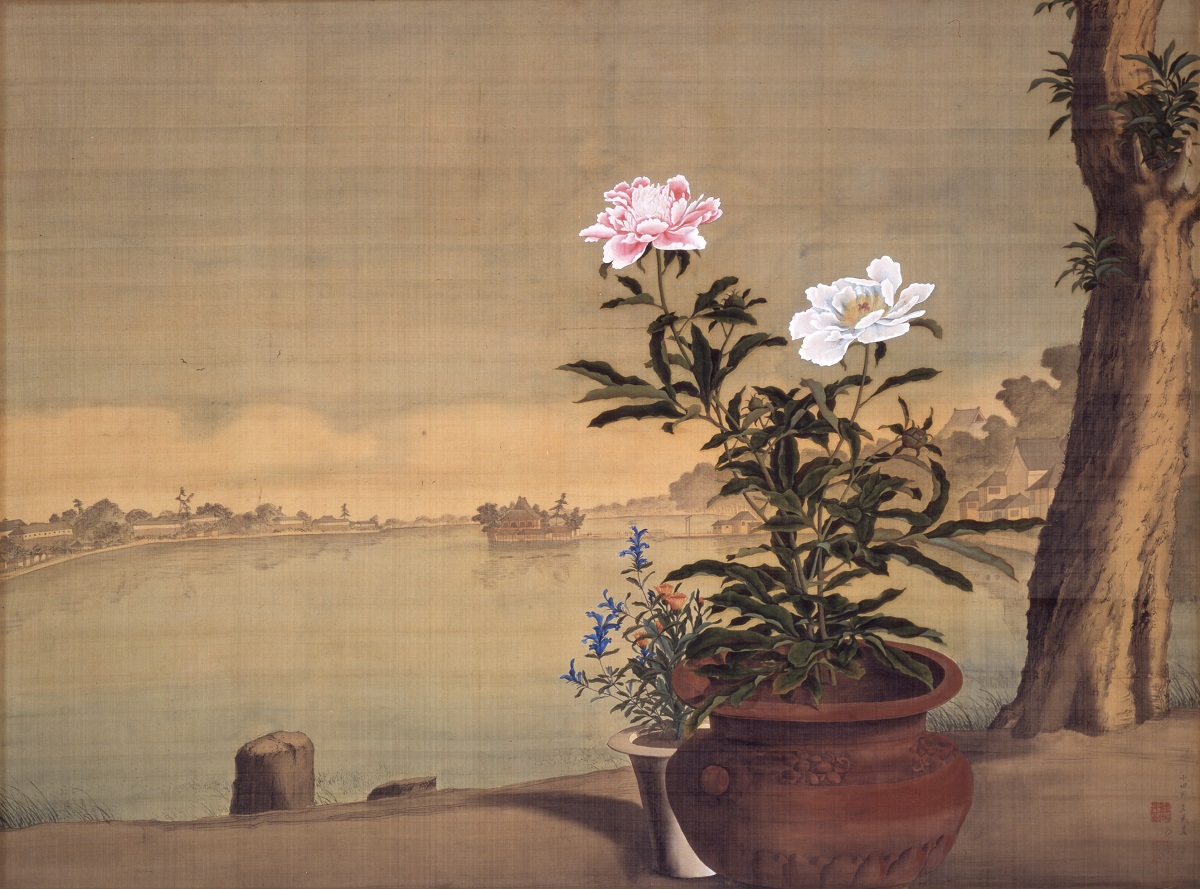
A painting of Edo might seem an unexpected choice for an edition devoted to Akita. In Odano Naotake’s Shinobazu Pond, however, the connection is the artist: a samurai from Kakunodate whose work brought different traditions of knowledge and image-making into contact. The pond belongs to what is now Tokyo. The story of the person looking at it belongs deeply to Akita.[1][8]
Naotake (1749–1780) was a central figure in Akita ranga. His painting, dated to the 1770s by the Akita Museum of Modern Art, is an Important Cultural Property in that museum’s collection.[4] There is also a timely reason to look closely: the museum in Yokote lists it for display from August 14 through September 23, 2026, encompassing this Sunday’s edition.[10]
A picture that changes the distance between things
In the museum’s reproduction, the flowering plants command the foreground. Their pots sit near the lower edge; a substantial tree trunk rises along the right. Across the water, buildings become small and subdued. Much of the left side remains open to water and sky. The composition gives the viewer both an intimate encounter with objects and a far-reaching view.[9]
Look first at the pot. Light and dark give it volume, while the shadow on the ground makes it seem to occupy a particular place. Then look beyond it. The eye travels much farther than the few inches between those parts of the picture might suggest. The painting makes distance something the viewer actively experiences.
Its spaciousness does not depend on a neatly staged procession from foreground through middle ground to background. The leap is part of its force. The flowers seem almost close enough to interrupt the view, yet they also provide the point from which the landscape opens.
The holding museum identifies perspective and shading as essential to Naotake’s achievement.[4] Those techniques offer a useful starting point, but the painting need not be judged as an exercise awaiting a geometry teacher’s approval. Its arrangement directs attention. It asks us to notice how strongly a small nearby object can occupy our field of vision, and how an extensive landscape can become quiet behind it.
The skills he carried out of Kakunodate
Naotake came from a family serving Kakunodate’s samurai administration. Suntory Museum of Art’s introductory feature describes the young artist developing his abilities by copying earlier paintings.[3] His later experiments rested on practiced skills: handling a brush, studying a model and translating what he saw into marks.
The decisive change in his circumstances came in 1773, the year Hiraga Gennai visited the Akita domain in connection with mining. Naotake subsequently went to Edo.[1] Suntory’s historical account is careful about the familiar story that Gennai personally taught him Western painting during the Kakunodate visit: the encounter’s details are uncertain. It instead records Naotake’s dispatch to Edo on domain business later that year.[2]
That qualification makes the history more interesting. An artist’s development need not be reduced to one revelatory lesson. Work created routes to people; people provided access to books and pictures; repeated study offered opportunities to experiment. The movement of knowledge was also a movement through institutions and personal relationships.
Akita ranga had more than two ingredients
The name refers to Dutch-style painting associated with samurai of the Akita domain. Alongside Naotake, its practitioners included the domain lord Satake Shōzan and Kakunodate’s administrator Satake Yoshimi.[1] “Akita” describes an important community of makers, rather than a rule that every scene had to depict Akita.
Suntory’s account places Chinese Nanpin-school flower-and-bird painting alongside Western pictorial methods as a source for the movement.[2] That matters when looking at the prominence and careful treatment of plants. A simple narrative in which Japan discovered Europe leaves out another substantial part of the exchange.
The object itself also complicates that narrative. Shinobazu Pond is color on silk, not an oil painting on canvas.[8] Adopting a way of suggesting depth did not require replacing every material and inherited practice. Naotake’s achievement lay in the decisions he made among available possibilities.
This is a productive way to understand artistic experimentation: as selection and recombination, demanding judgment rather than passive imitation. What should become more solid? Which details should remain delicate? How much empty space can a composition sustain? Those questions are still available to a viewer standing before the work.
How the world arrived in books
Tokugawa controls on foreign contact did not prevent all intellectual exchange. The National Diet Library records that in 1720, Tokugawa Yoshimune relaxed restrictions to allow imports of books unrelated to Christianity. Dutch-language works became important vehicles for learning about Western subjects.[5]
The library’s account of Gennai offers a revealing distinction: he understood little Dutch, yet collected illustrated works of natural history. Books about plants, shells and insects formed part of this visual and scholarly world.[7]
A picture could communicate something even when its accompanying text remained difficult. It could also provoke questions that required translators, collectors or other readers. An illustration was therefore both a source of information and an invitation to further inquiry.
For an artist, the subject was only one thing to study. A printed image could suggest ways of making an object appear rounded, separating one surface from another or arranging a specimen so that its features could be compared. Books carried habits of looking as well as descriptions of unfamiliar things.
The anatomical image as a form of knowledge
Naotake supplied illustrations for Kaitai Shinsho, published in 1774.[1] The National Diet Library identifies the translation associated with Maeno Ryōtaku, Sugita Genpaku and Nakagawa Jun’an as a major event in the growth of Dutch studies. It describes that field as encompassing medicine and other sciences, rather than language learning alone.[6]
An anatomical illustration has a different task from a landscape. It must help a reader distinguish structures and understand relationships. A striking image that obscures those relationships would fail its purpose, however accomplished its execution.
That gives Naotake’s participation particular significance for an edition also concerned with scientific research. The illustrator was not the translator, and visual skill was not a substitute for medical expertise. But a book needed its images to work alongside its words. Communicating knowledge required different kinds of labor to meet on the page.
Our contemporary story about the preparation of pathology tissue sections raises a related editorial question: how is a subject made available for reliable observation? The connection is thematic, not a claim that a modern device descends directly from Naotake’s work. In both contexts, what can be seen depends partly on skilled preparation.
A short life, and a longer history of attention
Naotake died in 1780. Suntory’s account leaves the reasons for his enforced withdrawal the previous year, and the details of his death, unresolved. It also identifies Hirafuku Hyakusui’s 1930 book Nihon Yōga Shokō as important to the later reassessment of Akita ranga.[2]
The gaps in the biography should remain gaps. They do not need a dramatic solution to make the paintings worth looking at. More useful is the recognition that a work’s history continues through the people who locate it, study it, describe it and make it available to new audiences.
A local artistic inheritance is sustained through those decisions. Preserving a painting protects an object; research makes its relationships more legible. Exhibition gives viewers a chance to test descriptions against their own experience. None of those activities makes the work speak in only one voice.
Seeing the original—and reading the edition
The Suntory material cited here belongs to its exhibition held from November 16, 2016, to January 9, 2017.[1] It is a valuable historical resource, not a notice of a 2026 Suntory exhibition. For this September, the relevant display announcement comes from the Akita Museum of Modern Art: its published schedule lists Shinobazu Pond through September 23. Check the museum’s latest information before visiting.[10]
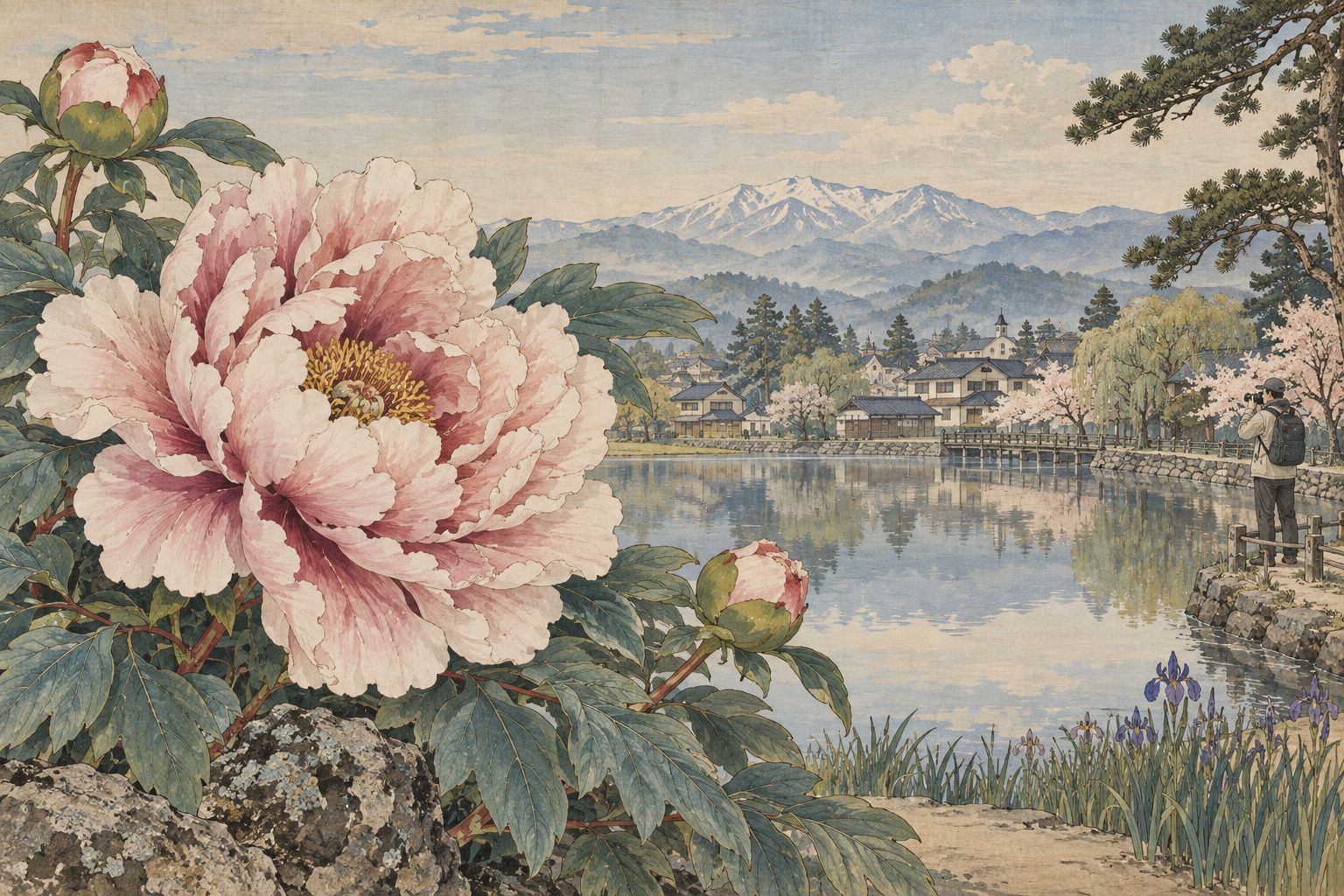
The illustration at the top of this page is a contemporary editorial homage, not a reproduction of Naotake’s painting. To examine the actual composition, follow the holding museum’s collection page. Begin with the whole image, move toward the foreground objects, then return to the far shore. Notice how that change of attention alters the apparent scale of the scene.
Read alongside our Kakunodate heritage feature, Naotake offers another way to imagine a samurai town: as a place from which people carried skills into wider circles of work and learning. The fences and residences tell one part of that history; a painting of Edo tells another.
“Akita Opens a Window to the World” is our description of that possibility. The window offered more than a distant view. It allowed an artist to reconsider a flower, a vessel, a human body and a familiar stretch of water—and to give other people new ways of seeing them.
Sources and references
- Suntory Museum of Art: Odano Naotake and Akita Ranga, exhibition overview (2016–17)
- Suntory Museum of Art: exhibition sections and historical interpretation
- Suntory Museum of Art: Akita ranga special feature
- Akita Museum of Modern Art: Akita ranga collection
- National Diet Library: the rise of Dutch studies
- National Diet Library: the work of Dutch-studies scholars
- National Diet Library: Hiraga Gennai and Dutch studies
- artscape: Shinobazu Pond, work details based on an interview with the holding museum’s curator (2013)
- Akita Museum of Modern Art: reference image of the original Shinobazu Pond
- Akita Museum of Modern Art: fiscal 2026 Akita ranga display schedule