Rain has reduced Yotsubashi Bridge to tone. The roadway lies dark, the water below it darker, and the sky carries the soft dirt of an evening that never completely opens. Architecture remains exact enough to locate, yet nothing is brittle. Stone, timber, wet air and reflected light seem to have been rubbed into the same surface.
Oda Kazuma’s Yotsubashi Bridge in Rain, made in 1918 as part of his Views of Osaka, does not sell the city as a destination. It asks what a city feels like while it is changing. There is modern engineering in the bridge and an old landscape convention in the rain. There is civic order in the measured span and uncertainty in every grain of shadow.
That tension makes Oda unusually useful for seeing Osaka. His twenty-print portfolio, produced from 1917 through 1919, moves from Dotonbori and Nakanoshima to Tsumura Betsuin, Shitennoji, Sumiyoshi, Ajikawaguchi and the developing port. It watches pleasure districts and sacred precincts, canals and factories, moonlight and infrastructure. The city does not advance in a straight line. Different centuries occupy the same page.
A commercial technology becomes an artist’s language
Oda was born in Tokyo’s Shiba Park district on November 11, 1882, to parents whose livelihood involved making specimens and taxidermy. At 16 he learned lithography from his older brother. The process was then deeply associated with commercial reproduction—labels, advertisements, illustrations and other printed matter—not with the prestigious image of an individual artist before a singular canvas.
He worked in that practical world. He also made designs and watercolors and entered official exhibitions. His Nikko Mountains appeared in the first government-sponsored Bunten in 1907; two years later he submitted View of a Bamboo Grove and served as a judge of the Japan Watercolor Society. The record does not describe a young prodigy carried directly into fame. It describes a maker accumulating processes.
Lithography gave him a peculiar advantage. Woodblock printing typically depends on a raised carved surface; intaglio processes draw ink from recessed lines. Lithography is planographic. The surface remains essentially flat, and printing depends on the antipathy of oil and water. A drawing can retain the pressure, hesitation, smear and density of the hand. Fine grain allows fog, smoke, rain and dusk to exist not merely as subjects but as matter.
That technical character suited a city. Urban experience is rarely all line or all mass. It is an accumulation of masonry, signage, damp air, traffic, bodies and illumination. In Oda’s prints, black can carry the weight of a building, then dissolve into weather. An ochre glow can describe a lamp without turning night into day.
At 33, the city became his great subject
Oda’s decisive emergence as a lithographic artist came relatively late. The Kichijoji Art Museum dates his full commitment to the twenty-print Views of Tokyo, begun when he was 33 and completed in 1918. He sought neighborhoods where Meiji and even Edo remained legible beneath modernization: river landings, slopes, temple grounds, snow, rain and the low city seen from ordinary streets.
Osaka followed immediately. Official collection records date Dotonbori, Eitai Beach, Higashi Yokobori River and Dotonbori River at Night to 1917. In 1918 came Distant View of Tenjinbashi Bridge, Beside Tsumura Betsuin Temple, Yotsubashi in the Rain, Nakanoshima, Shitennoji East Gate in the Rain, Ajikawaguchi, Chausuyama, Ukiyo-koji in Moonlight and Sumiyoshi in Snow. The sequence continued into 1919 with port, bridge and shrine views.
This was a return charged with personal memory. Museum research notes that Oda had spent formative years in Osaka, where he absorbed interests in ukiyo-e, Bunraku and café culture. He came back not as a topographical surveyor making a comprehensive inventory, but as someone testing what his memory could still recognize.
The places he chose matter. Famous sites appear, but so do edges: beside a temple rather than only before its façade; a riverbank rather than a civic monument; an industrial mouth where river and sea meet. The preposition in Beside Tsumura Betsuin is almost an artistic method. Oda repeatedly chooses the oblique position from which a celebrated place becomes part of ordinary urban fabric.
The one lithographer inside the creative-print argument
Oda’s art also grew inside a debate about authorship. The magazine Hōsun, founded in 1907 by Ishii Hakutei, Morita Tsunetomo and Yamamoto Kanae, brought together visual art and literature. It printed self-cut woodblocks and artist-drawn lithographs beside writing by figures including Kitahara Hakushū, Kinoshita Mokutarō and Takamura Kōtarō. Oda joined its circle before the magazine ended in 1911.
The emerging sōsaku-hanga, or creative-print, movement insisted on jiga, jikoku, jizuri: the artist should draw, carve and print. It was a rejection of the older publishing division in which designer, carver and printer held separate roles under a publisher. In the Taishō era, making every stage oneself became an assertion of artistic individuality.
In 1918 Oda joined Yamamoto Kanae and others in founding the Japan Creative Print Association. Lithography complicated the movement’s famous formula because a lithographic image is drawn chemically on a flat surface rather than carved. Oda’s answer was the “self-drawn lithograph”: he controlled the image and the printing, using techniques including polished-stone lithography. His practice helped detach the medium from routine commercial printing and argue for it as fine art.
Yet his individual authorship did not lead him away from the public. The Kichijoji museum’s account of his outlook uses a compact phrase: prints were “people’s art.” Multiplicity mattered. A print could be materially intimate without adopting the exclusivity of a unique painting. Even a small edition proposed that an image should travel.
Osaka on the threshold of “Great Osaka”
The timing of Views of Osaka was extraordinary. Oda worked just before the city formally entered its “Great Osaka” era. Industrial growth and population expansion were transforming the region; streetcars had run in Osaka since 1903. Nakanoshima’s Central Public Hall was completed in 1918, the middle year of Oda’s portfolio. Around 1920, steel, concrete and glass would increasingly take over the city’s new business architecture.
In 1925 Osaka absorbed 44 surrounding municipalities. Its population reached approximately 2.259 million, exceeding Tokyo’s municipal population and ranking sixth among world cities in a contemporary Osaka statistical comparison. The title “Great Osaka” expressed industrial strength and metropolitan confidence. It also concealed severe housing shortages, poverty and other social costs of rapid growth.
Those contradictions were already visible in 1918. Wartime inflation and inequality helped produce the rice riots that spread nationwide; disturbances reached Osaka neighborhoods in August. Modernity did not arrive simply as a wider road, a brighter lamp or a grand public hall. It arrived as pressure.
Oda’s prints do not illustrate economic statistics or report unrest. Their value is different. They show the physical world in which modernization was experienced: bridges binding commerce together, waterways moving goods, religious grounds holding older rhythms, entertainment districts consuming electric night, and peripheral land awaiting its next function.
| Oda’s Osaka | What enters the image | What it reveals |
|---|---|---|
| Dotonbori, 1917 | Canal, theaters, shops and dense entertainment streets | Nightlife and inherited urban form were already interdependent |
| Yotsubashi in the Rain, 1918 | Bridge, water, weather and controlled tonal grain | Infrastructure could become atmosphere rather than spectacle |
| Beside Tsumura Betsuin, 1918 | A Buddhist precinct encountered from its urban edge | The sacred existed within commerce, streets and daily movement |
| Ajikawaguchi and Chikkō, 1918–19 | River mouth, port and industrial horizon | Osaka’s expansion depended on maritime and mechanical systems |
| Kyomachibashi at Night, 1919 | A dark bridge articulated by sparse light | Electric illumination reorganized how the city could be seen |
Water makes the city unstable
Osaka’s old identity as a city of water gives Oda’s portfolio its internal structure. Dotonbori, Higashi Yokobori, Tosabori, the Ajikawa mouth, Nakanoshima, the port and multiple bridges make water nearly unavoidable. The city is not placed securely on land. It is cut, reflected and doubled.
Lithography is particularly responsive to that instability. A line on a bridge can be firm while its reflection breaks into grain. Buildings lose authority when the river carries their light away. Rain joins the printed surface to the represented weather: both are fields of tiny marks.
This is where Oda differs from the triumphal urban panorama. He rarely needs a commanding aerial view that masters the whole metropolis. His city is encountered at walking height, from an embankment, across a bridge or down a narrow side street. The viewer does not possess Osaka. The viewer enters it.
Water also creates memory. A building can be demolished, a canal filled and a bridge replaced, yet the old route can continue to organize movement invisibly. Oda’s later 1934 portfolio Osaka Riverbanks: Meiji and Taishō Eras returned to the city’s waters after many original scenes had altered. Six plates included views from Yotsubashi’s willows, Hashikurabashi and Senshūbashi. He was not finished with Osaka when the first portfolio ended.
Night was not darkness; it was a new subject
Oda’s night views complicate the idea that he opposed old Osaka to new Osaka. He was drawn to cafés, bars, cinemas, food stalls and illuminated riverbanks—the sensory infrastructure of modern leisure. The British Museum describes him as a leading twentieth-century Japanese color lithographer whose work carries the cosmopolitan atmosphere of the late Taishō and early Shōwa eras.
His 1919 portfolio Night in the City was issued in an edition of 45. Its four places cross three cities: a food stall in Asakusa, the Kamo River in Kyoto, a small restaurant in Osaka’s Hōzenji area and the riverbank at Matsushima in Osaka. The Matsushima sheet sets bright interiors and distant fireworks against a dark canal.
The electric or gas-lit opening in an Oda print is never merely white. It glows because darkness has been built around it. That is as much social as optical. A lighted room promises customers, conversation, performance and money. The street outside holds labor, solitude and waiting. Modern pleasure appears as a fragile pocket inside the larger night.
His later Ginza and Shinjuku portfolios would turn toward cinemas, café districts and reconstructed Tokyo. In 1930 he even sent a lithograph titled Cement Factory to the Imperial Art Exhibition. The artist who mourned disappearing streets was also fascinated by what replaced them. Nostalgia and modern appetite were not opposite camps; they met inside him.
A temple beside the road—not Mitsutera, but a revealing parallel
For this August 19 edition, Oda was chosen partly because his Osaka vision speaks to our lead story on Mitsutera Temple. The factual boundary must be precise: the temple named in Oda’s documented Views of Osaka is Hongwanji Tsumura Betsuin, commonly called Kita-Midō. It is not Mitsutera, and available collection records do not establish that Oda made a Mitsutera print.
The parallel is nonetheless meaningful. Oda’s Beside Tsumura Betsuin, dated 1918, places a Buddhist precinct inside the working city. Kita-Midō and Minami-Midō gave Midosuji its name. When Oda made his print, the old road was still narrow; construction of the broad modern boulevard began in 1926. The print therefore preserves a temple-city relationship before the road was rebuilt around it.
History then split the two temples sharply. Kita-Midō’s wooden complex was destroyed in the 1945 Osaka air raids and replaced in the 1960s by Hidetō Kishida’s monumental reinforced-concrete structure. Osaka City now describes that building as a major example of living faith adopting a boldly modern form.
Mitsutera’s 1808 main hall survived the bombing. Its present redevelopment preserved the timber hall while a contemporary hotel-and-commercial complex rose around it. One temple survived and was enveloped; the other was lost and reimagined in concrete. Both make the same proposition visible in different ways: urban Buddhism does not exist outside development. It negotiates with it.
Oda is therefore an apt visual companion, not because he illustrated Mitsutera, but because he understood adjacency. He looked at what stood beside a temple, what crossed in front of it and how a sacred roof entered the changing city’s silhouette. For him, continuity was a spatial relationship before it became an abstract value.
He looked backward through Hokusai to see the present
Oda’s modern cityscapes were supported by an intense study of Edo-period print culture. The Tokyo National Research Institute for Cultural Properties says he especially admired Hokusai, collected illustrated books associated with him, consulted them during his own work and published research on ukiyo-e and illustration.
That collection outlived him. In 1970 the institute acquired Oda’s illustrated books. A later collaboration with the Getty Research Institute opened 318 volumes representing 135 titles to digital access. The archive turns the artist into a bridge of another kind: a modern lithographer preserved the printed past that taught him how to organize the modern street.
Hokusai’s influence should not be reduced to a borrowed wave or contour. It is a way of thinking serially. A portfolio lets a city emerge through differences among many views rather than through one definitive monument. It can place workers and passersby before famous scenery. It can use bridges and water as devices for directing the eye. It can make weather an event.
Oda transferred that intelligence into a Western-origin printing method and a twentieth-century metropolis. His achievement was not to choose between Japanese tradition and imported technology. It was to make the choice unnecessary.
How to look at an Oda cityscape
Oda rewards slow looking because his drama is often distributed across tone rather than concentrated in a central figure. Five questions help open the image.
- Where is the brightest point? A lamp, window, reflection or patch of sky often organizes the emotional route.
- What occupies the edge? Temple walls, bridge rails, shop fronts and embankments turn famous places into lived neighborhoods.
- How does water interrupt architecture? Reflection prevents the city from becoming a stable diagram.
- Where are the people? Small figures establish scale and use. Their apparent insignificance is the measure of metropolitan size.
- What has Oda refused to clarify? Grain, smoke and darkness protect ambiguity. The city remains partly unavailable.
Color should also be read structurally. Oda did not need a wide palette. Charcoal black gives timber and night their mass; gray softens stone; aged ochre carries artificial light; blue-gray lets distance recede. Restraint makes each warm opening consequential.
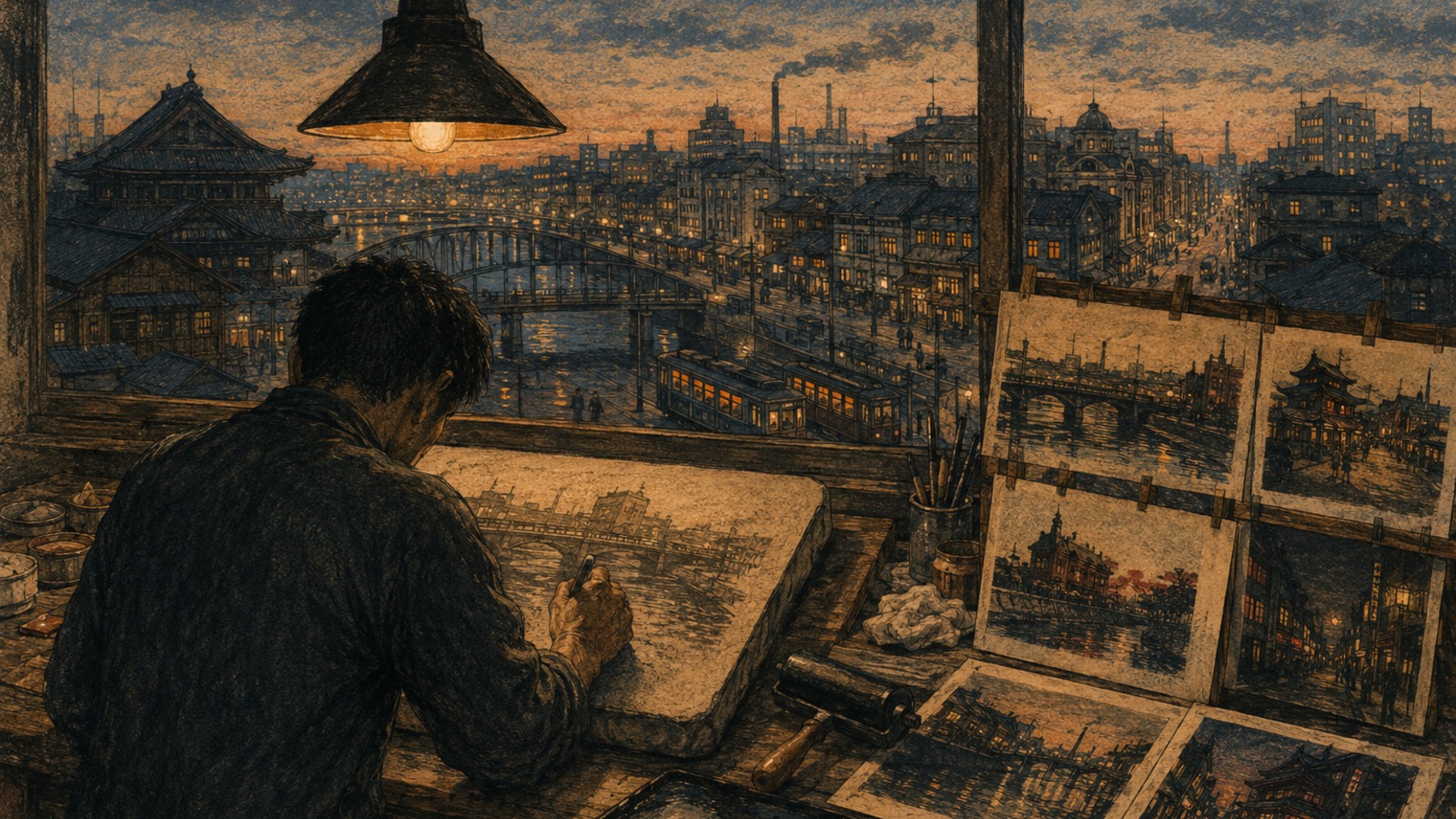
This is the logic behind today’s Japan.co.jp illustration. The image uses a charcoal-and-ochre lithographic vocabulary to imagine an anonymous printmaker at work while an impossible composite Osaka spreads beyond the studio. Temple, bridge, streetcar, canal and factory have been brought together for editorial interpretation. The artist figure is not a documented likeness of Oda, and the city is not a reconstruction of one date or vantage point.
What survived beyond the city he knew
Oda’s career continued through landscape series, theoretical writing, institutional advocacy and teaching. In 1925 he established a print research institute in Matsue. In 1930 he joined lithographers and copperplate artists in forming the Western-Style Print Art Association and published both a Shinjuku portfolio and a book on ukiyo-e. He moved to Kichijoji in 1931 and worked there until his death from a heart attack on March 18, 1956.
In 1949 he donated 216 of his own lithographs to the Museum of Fine Arts, Boston, according to the Tokyo cultural-properties institute’s chronology. Other works entered collections in Japan and abroad. Today the same Osaka motifs appear across the National Museum of Modern Art system, the Museum of Contemporary Art Tokyo, the Nakanoshima Museum of Art, the British Museum and the Cleveland Museum of Art.
That dispersal is appropriate for a printmaker. No single institution owns the only Oda city. Impressions exist in more than one place, each with its own paper, condition and history of looking. Reproducibility becomes a form of survival.
Yet Oda remains less internationally familiar than artists associated with the woodblock-centered stories of shin-hanga and sōsaku-hanga. Lithography occupies an awkward position in popular accounts of Japanese printmaking: imported, industrial and flat, without the romantic theater of carving cherry wood. Oda’s work exposes that bias. A medium born as technology can become a vessel for memory precisely because it belongs to modern life.
Osaka is still standing between tenses
More than a century after Views of Osaka, many of Oda’s subjects have changed beyond recognition. Bridges were rebuilt, waterways altered, entertainment districts intensified, temples burned or redeveloped, and the narrow Midosuji became a 43.6-meter boulevard. The city Oda printed is not recoverable as a whole.
But his central observation remains. Osaka is not modern after it ceases to be old. It is modern because incompatible times remain active together. A commercial avenue takes its name from Buddhist halls. A wooden sanctuary occupies the base of a hotel. A nineteenth-century printing technology records electric light. A collector of Hokusai makes images of cafés and cement.
Look again at Yotsubashi Bridge in Rain. The bridge does its practical work. Rain obscures it. Water breaks its image. The stone retains both the structure and its dissolution. Nothing in the scene declares itself permanent, yet Oda’s act of looking has lasted.
That may be the deepest form of urban memory: not freezing a city before change, but giving change a surface on which it can be felt.
- Tokyo National Research Institute for Cultural Properties: Oda Kazuma chronology — life dates, principal series, associations, publications, donation and the later Oda Library.
- Tokyo National Research Institute for Cultural Properties: Oda Collection digital access — 318 volumes representing 135 titles and the Getty collaboration.
- Kichijoji Art Museum: Oda Kazuma—Cityscapes Drawn on Stone — early training, commercial printing, urban subjects, self-drawn lithography and creative-print advocacy.
- National Diet Library Image Bank: Oda Kazuma’s lithographs — Osaka and urban-night portfolio images.
- National Diet Library: creative prints and new prints and the magazine Hōsun — movement, production system and Oda’s participation.
- Cultural Heritage Online: Dotonbori from Views of Osaka — portfolio scope, dates and interpretation of Oda’s nostalgic urban gaze.
- Tokyo Museum Collection: Yotsubashi Bridge in Rain and Kyomachibashi Bridge at Night — dates, medium and dimensions.
- Art Platform Japan: Beside Tsumura Betsuin Temple — 1918 lithograph and Nakanoshima Museum of Art collection record.
- British Museum: Matsushima riverbank from Night in the City and Bar Bacchus — small editions, urban nightlife and color lithography.
- Osaka Municipal Library: modern Osaka and the “Great Osaka” era — 1925 expansion and contemporary population comparison.
- Osaka Museum of History: Osaka Central Public Hall, glass and modern architecture and the 1918 rice riots.
- Osaka City: Tsumura Betsuin as living architecture and Mitsutera Temple: official history — the two temples’ distinct wartime and architectural histories.
Method note: Dates, dimensions, titles and institutional histories follow the linked museum, library and government records. Interpretive passages are Japan.co.jp analysis. Where collection databases disagree on secondary spellings or biographical shorthand, the Tokyo National Research Institute of Cultural Properties chronology is used as the principal authority.