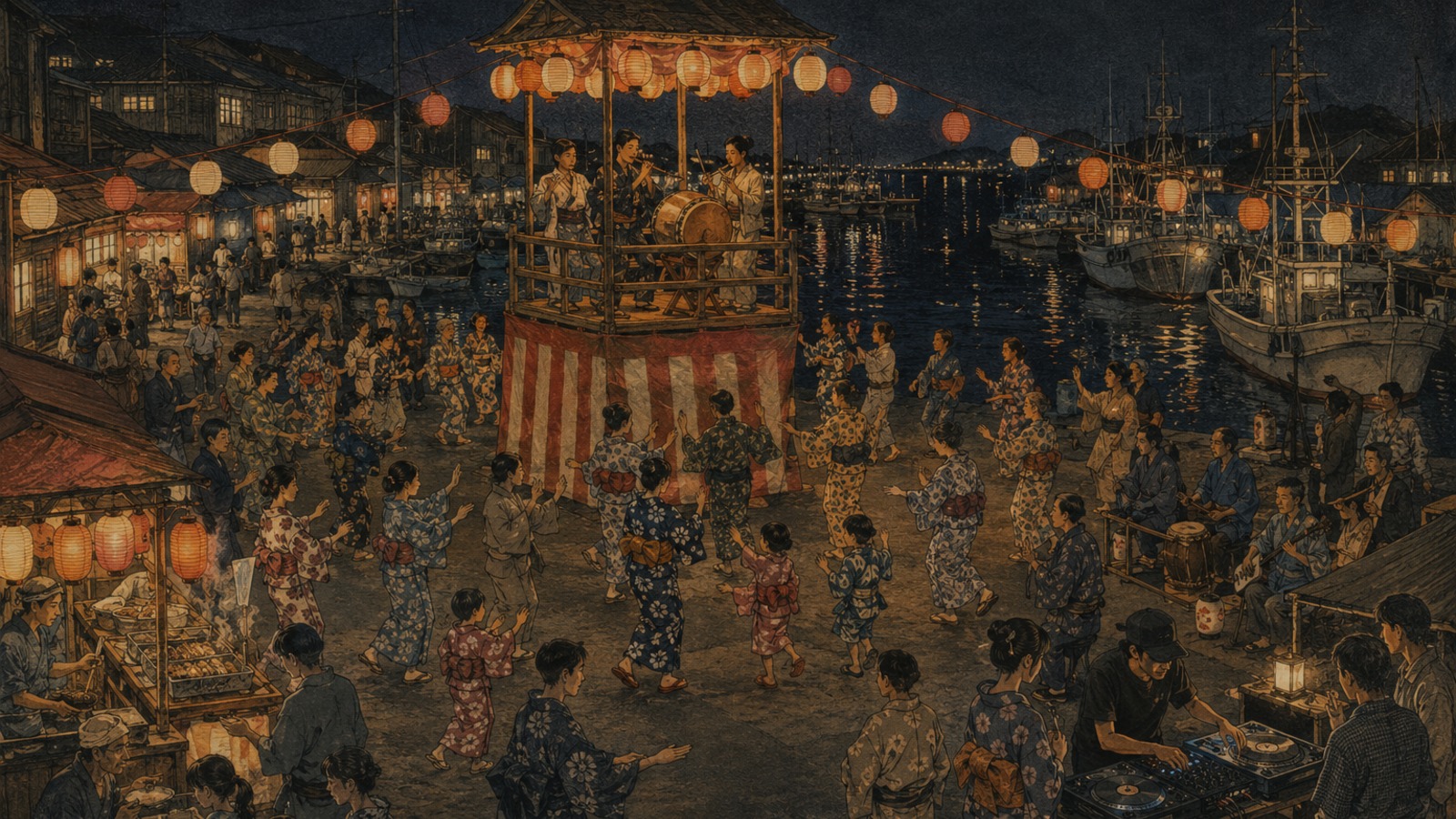
At 4 p.m. Saturday, if the plan holds, Kiyomida Park will begin changing functions. A public green beside Yaizu’s cultural center will acquire a live stage, a food market, a retro-games alley and a yagura—the raised tower around which a Bon-dance circle forms. Forty minutes after the opening act begins, a DJ is scheduled to take that tower and turn familiar Bon music into a new beat.
The sequence will repeat across two evenings. A band plays. The yagura answers with 20 minutes of DJ-led dancing. Tsugaru shamisen gives way to reggae; another dance interval opens; a global-minded folk ensemble or seaside pop unit closes the main stage. At 8:30 p.m., tethered LED lanterns are scheduled to rise, remain controlled rather than float away, and be recovered.
BON BON BON 2026 calls itself a “Bon party”—Bonpa—and uses the slogan “Relight the summer festival.” It will run August 22 and 23 from 4 to 9 p.m. This is its first year, not the latest edition of an inherited Yaizu rite. Organizer nonii projects about 13,000 visits across two days and more than 40 food, retail and workshop stalls. Those are plans and targets; the event had not occurred at Japan.co.jp’s reporting deadline.
Bon dancing was never a museum piece
The modern picture of Bon dancing is familiar: lanterns glow, recorded music carries across a schoolyard or park, and people move in a circle around a drummer or sound system. Some know every gesture. Others copy the person in front of them. Children cut across the ring. Older dancers preserve the tempo. The boundary between performer and audience remains porous.
Under that festive surface lies a complex religious and social inheritance. Obon brings together Buddhist practices, ideas about returning ancestral spirits and local customs that vary greatly by region. Dance can console the dead, welcome and send spirits, pray against calamity or simply gather neighbors during the heat of summer. It has never meant precisely the same thing everywhere.
UNESCO’s 2022 inscription of Japan’s Furyu-odori—41 representative ritual folk dances, not a blanket designation for every Bon dance—emphasized that such dances can pray for the repose of the dead, good harvests and safety from disasters. Just as importantly, UNESCO described performance as a reason for former residents to return and as a way to create belonging across generations.
That is the deeper technology of the circle. A stage points attention toward specialists. A circle distributes attention. Each dancer looks inward, sideways and ahead; the experienced teach without stopping the event. Repetition lowers the price of entry. You can join late, learn badly and still contribute to the shape.
This is why adding a DJ is less radical than it first appears. Bon dancing has long absorbed locally written ondo, popular songs, amplification, vinyl records and changing choreography. The question is not whether a mixer violates an untouched past. The question is whether new sound preserves the social function that made the old form valuable.
Yaizu already speaks three languages of summer
BON BON BON enters a crowded calendar. It does not need to replace Yaizu’s existing festivals, and it should not be judged as though it does.
On July 19, the city held the 25th Odorakkasai at Oigawa Port. Its motto translates roughly as “Dance moves the city; dance changes the city.” Teams perform different genres, residents join a mass dance, and a lantern tower supports a large “Bon dance.” In the city’s 75th-anniversary year, the accompanying port fireworks were scheduled to launch 750 shells. Admission was free, and the city describes the event as citizen-made.
On August 12 and 13 came Aramatsuri, the grand festival of Yaizu Shrine. The shrine is said to have been founded more than 1,600 years ago and is closely revered by fishing families as well as the wider city. The first day includes kami-korogashi, a rite praying for infants’ healthy growth. On the second, white-clad bearers carry two mikoshi through approximately 6.5 kilometers of city streets, calling “An-et-ton” as sacred presence moves through the neighborhoods.
Then, after the main Obon interval, BON BON BON arrives on August 22 and 23. It is neither team dance competition nor shrine procession. It sells entry to a produced environment: artists, sound, food, nostalgia, games, water play and a nightly visual climax. Its organizers are not claiming centuries of local continuity; they are proposing that a designed event can become a recurring place to meet.
| Yaizu summer form | Core structure | Source of continuity |
|---|---|---|
| Odorakkasai | Citizen dance teams, mass participation, Bon dance and port fireworks | Twenty-five editions and local organizing |
| Aramatsuri | Shrine rites, infant blessing and mikoshi procession | Sacred obligation and neighborhood transmission |
| BON BON BON | Ticketed music festival, DJ dancing, market, retro play and LED lanterns | Unproven; 2026 is the first edition |
These forms need not compete for authenticity. They answer different needs. A shrine festival connects neighborhoods to deity, route and inherited duty. A citizen dance festival gives practiced teams and residents a public stage. A commercial festival can bring professional production, touring performers and a reason for visitors to remain into the evening. Trouble begins only when the newest form borrows the emotional authority of the older ones without creating its own reciprocal obligations.
A fishing city knows that rhythm is work
Yaizu’s identity is inseparable from the sea even when a festival takes place inland. The city has three ports. Yaizu Port handles primarily bonito and tuna; Kogawa receives coastal and near-shore species such as mackerel and horse mackerel; Oigawa lands whitebait and sakura shrimp from Suruga Bay. Large overseas purse-seine vessels enter Yaizu’s harbor, while processing, cold storage, wholesale and food manufacturing spread the maritime economy far beyond the waterfront.
In 2025, Yaizu and Kogawa together landed 117,214 metric tons of seafood. The value was approximately ¥46.9 billion, highest among Japan’s major fishing ports in the city’s published comparison; volume ranked fourth. Those numbers explain why fish is not a decorative mascot here. Ship schedules, auction mornings, factories and freezers structure daily life.
Fishing cities also understand collective timing. Hauling, sorting, unloading and processing depend on bodies entering a shared rhythm. Folk song itself often emerged from work, travel and local memory. A dance festival beside a fishing economy therefore has an opportunity deeper than placing bonito on a poster: it can connect contemporary leisure to the coordinated labor that built the city.
The need for shared space is growing as the population changes. Yaizu’s resident-register population fell from 140,861 in March 2017 to 133,542 in March 2026. In June 2026, the city counted 133,196 residents: 41,171 were 65 or older and 14,133 were under 15. Households increased over the decade even while total population declined, suggesting smaller household units.
A weekend event cannot reverse demography, and an attendance target is not “regional revitalization.” It can perform a smaller, more credible task. It can give teenagers, families, older residents, recent arrivals, returning former residents and visitors a low-risk way to occupy the same place. Whether they merely consume a show or begin recognizing one another is the consequential difference.
The lineup makes an argument about living folk music
Saturday’s program offers the clearest version of the festival’s thesis. D.W. Nicols opens with approachable pop. Two Tsugaru-shamisen players, Otsuka Haruya and Shibata Masato, place virtuoso strings on the stage. Shizuoka-rooted reggae veteran PAPA U-Gee follows. Minyo Crusaders closes the live program before the lantern sequence.
Minyo Crusaders is an unusually precise booking for a festival that promises not to trace tradition or destroy it, but to relight it. The band takes regional Japanese folk songs and rearranges them through salsa, cumbia, Afrobeat and other global rhythms. Its 2026 album From Japan with Love includes “Hokkai Bon Uta,” “Hanagasa Ondo,” “Shigesa Bushi” and “Iyo Manzai.” The melodies retain named places and inherited words while their rhythmic frame travels across oceans.
This is not preservation in the archival sense. It is use. A song survives because musicians find something they need inside it and listeners discover movement they can inhabit. Purists may reasonably ask what is lost when regional context is detached from a melody. The counterargument is audible: music treated only as evidence may remain safe while ceasing to be social.
Sunday replaces the folk ensemble and reggae set with comedy from Bambino, a second shamisen appearance and Blue Vintage, whose soul, R&B, reggae and funk vocabulary suits the organizer’s coastal mood. D.W. Nicols appears both days. The result is less a coherent concert genre than an intergenerational bridge—something for a child, a local radio listener, a folk-music devotee and a dance-floor adult within the same five-hour span.
The DJ intervals are the hinge. They are scheduled at 4:40, 5:40 and 7 p.m., for 20 minutes each. If participants enter the ring, the live stage and the community festival will alternate. If most people wait passively for the next act, the yagura risks becoming scenery and “Bon” becomes branding.
- Participation: Do newcomers, children and older residents actually enter the dance circle?
- Instruction: Can a first-time dancer learn by following, or is the remix legible only to a prepared crowd?
- Local voice: Are Yaizu performers, merchants and residents visible as makers, not merely customers?
- Flow: Can a 400-space parking plan and free station shuttle safely serve the projected demand?
- Return: Does the organizer publish results, listen locally and commit to another year?
Lanterns carry meaning—and marketing
The evening finale is carefully designed for photographs. Participants can write a wish, message of gratitude or words for someone important on a lantern. At the appointed moment, many lights rise together. On Sunday, illuminated bubbles and a finale called “Okuribi” are planned.
The imagery draws from Obon’s vocabulary of welcoming and sending light. But BON BON BON takes place after Yaizu’s main Obon rites, and its lantern sequence should not be presented as an ancient Yaizu funerary custom without evidence. It is a contemporary experience using inherited symbols.
That does not make the feeling false. People frequently need a physical action for thoughts that resist ordinary conversation. Writing a name, holding a light and releasing it upward—while remaining tethered—can create a temporary public language for gratitude and memory. The ethical task is to state clearly what the action is: designed symbolism, not recovered ritual.
The organizer says the lanterns use LEDs, will not be released into the open sky and will all be collected. General viewing in the free BON PARK zone costs nothing, but launching a lantern requires a separate ticket, listed at ¥5,980 per unit for up to four people. This combination of shared spectacle and sold participation is central to the festival’s economics.
So is admission. Advance general entry is ¥2,000 per day; the door price is ¥2,500. Yaizu residents can buy a lower-priced local ticket, students receive a larger discount, elementary-school children and younger enter free, and the water-play and lantern-viewing park remains free. Ticketing pays for artists, staging, security and sanitation, but it also changes the social contract. A neighborhood matsuri commonly permits casual entry; a ticketed festival asks residents to decide in advance whether the common circle is worth buying.
The 13,000-person promise must remain a target
The organizer’s most recent release projects about 13,000 visits across the two days. That is close to one-tenth of Yaizu’s population, although many visitors may come from outside the city and a two-day total can count different patterns of attendance. It is an ambitious commercial target, not evidence of existing demand.
Earlier promotional material cited approximately 10,000; later releases raised the goal to 13,000. The venue also changed in June from Ishizu Nishi Park to Kiyomida Park. Neither fact is necessarily alarming in a first-year production, but both show why plans should not be reported as results.
Kiyomida Park is approximately 1.6 kilometers from Yaizu Station. The official plan lists about 400 parking spaces and a free shuttle from the station’s north exit, with departures from 3:15 p.m. and final return from the venue at 9:25 p.m. The site is divided between a paid main area and the free park area. Actual queues, heat management, rain response, accessibility, waste, noise and neighborhood impact can be assessed only during and after the event.
A credible post-festival account would publish tickets sold, unique entrants by day, shuttle use, medical incidents, waste collected, vendor experience and the share of attendees from Yaizu. “13,000” alone would say little about whether the evening generated lasting local value.
How a designed festival becomes remembered
The organizer’s strongest phrase is not “new” but “meet again.” One of its three stated “Bon” ideas is a good space where people can return every year. Repetition is the difference between an event and a calendar.
But repetition alone is insufficient. A touring package can repeat without belonging anywhere. To become Yaizu’s festival, BON BON BON would need to accumulate local particulars: a song that only makes sense here, a merchant whom children recognize, a dance taught in advance, volunteers who acquire authority, a memory of weather survived, a mistake corrected the next year. Tradition is sediment.
The commercial producer’s role may gradually change if the festival succeeds. In year one, it owns the concept and bears the production risk. In later years, the question is whether knowledge and decision-making spread—toward residents, performers, neighborhood groups and local businesses—or remain concentrated in a branded weekend delivered to consumers.
Yaizu does not lack traditions. Its shrine procession already carries sacred history through streets; its citizen dance festival already claims that movement can change a city. BON BON BON therefore faces a higher standard than novelty. It must show what only this format can add.
Perhaps the answer will appear in the small transition at 4:40 p.m. The opening band finishes. Technicians clear the stage. A beat begins from the yagura. Someone who came for food recognizes a phrase. An experienced dancer raises both hands; a child copies the motion half a count late. The circle gains another body.
If that happens often enough, the DJ will not have modernized a relic. The people in the park will have performed the old work of festival culture: turning separate lives toward a common center. Two nights can stage the possibility. Only the years can decide whether Yaizu remembers it.
- BON BON BON official site — concept, complete schedule, performers, zones, current ticket prices, lantern policy, access and shuttle timetable.
- nonii’s August 3 event release and August 5 lantern release — organizer projection, vendor count, child performance and first-year production details.
- nonii corporate site — organizer background and other produced regional events.
- Yaizu City: 25th Odorakkasai — citizen dance festival, Bon dance and Oigawa Port fireworks.
- Yaizu Tourism Association: Aramatsuri report and Yaizu Shrine guide — dates, rites, procession and shrine history.
- Yaizu City: the city’s three ports and 2025 fish-landing statistics.
- Yaizu City: June 2026 population, 10-year population series and age breakdown.
- UNESCO: Furyu-odori — ritual purpose, transmission and community return. The designation does not apply to BON BON BON.
- Universal Music Japan: Minyo Crusaders’ 2026 album and the band’s official profile — folk repertoire and global arrangements.
Editorial note: This article was published before the first BON BON BON took place. Attendance, vendor numbers, program delivery and operational performance are organizer plans or targets unless explicitly stated otherwise. BON BON BON is not presented as a historic Yaizu ritual. The lead image is an editorial illustration at an imagined harbor setting; the actual venue is Kiyomida Park.