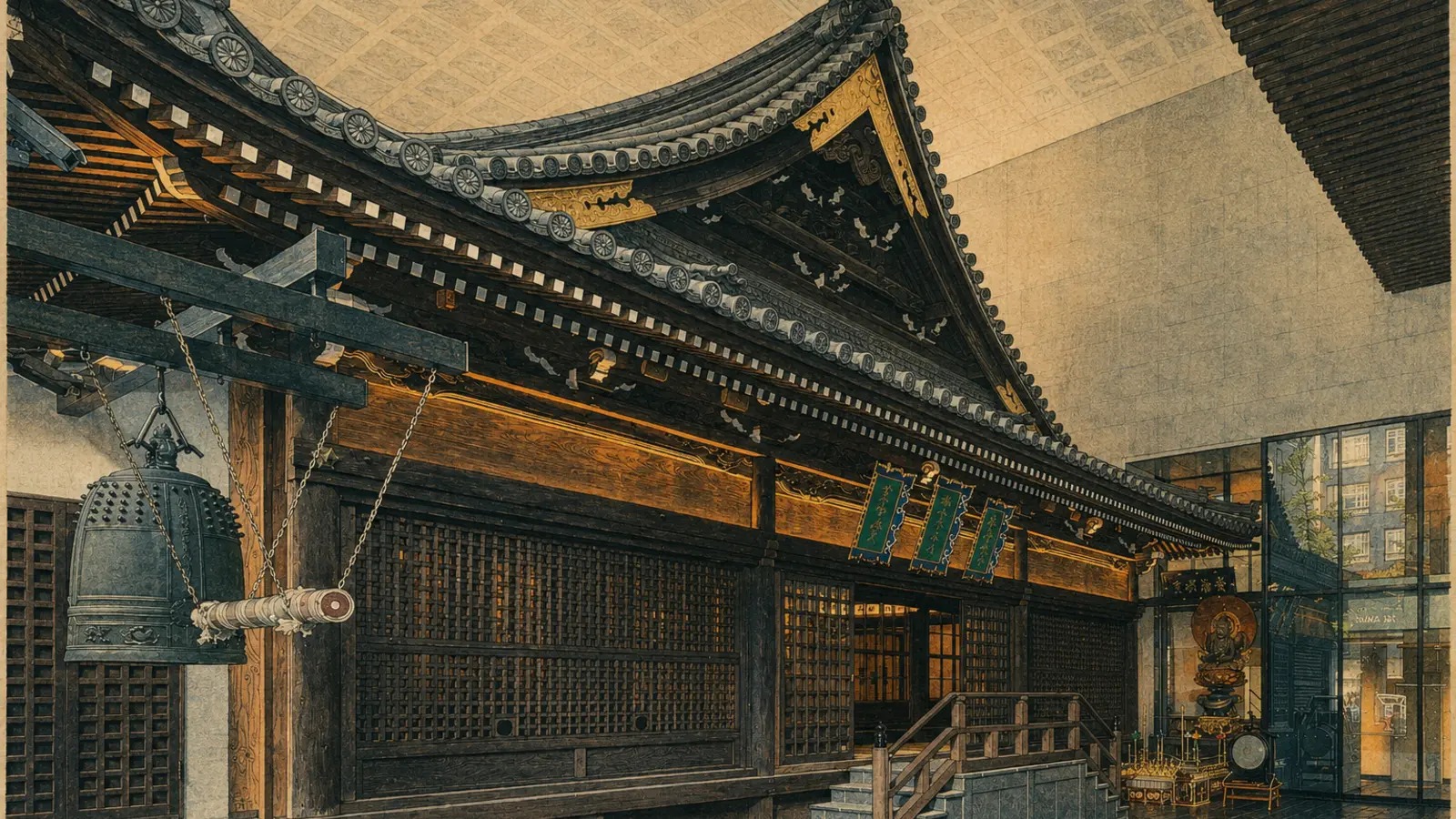
On Midosuji Avenue, where luxury storefronts, traffic and hotels announce the speed of modern Osaka, a wooden Buddhist temple appears in a place that seems architecturally impossible.
Mitsutera’s main hall stands under a contemporary tower. Its broad gray-tiled roof rises into a pale geometric ceiling; old timber latticework faces concrete, steel and glass; gilded fittings catch warm amber light. The hall occupies a three-story atrium at the base of the Tokyo Tatemono Mitsutera Building. Above it are shops and Candeo Hotels Osaka Shinsaibashi, a 15-story complex completed in 2023.
The temple is not a reconstruction, a lobby ornament or a preserved façade. It is the wooden hall rebuilt in 1808, moved intact during construction and still used as a place of worship. Buddhist images remain enshrined inside. Esoteric Shingon rites continue. Morning service begins every day at 7:30.
Hotel guests and worshippers approach through the same open precinct. In a single view, periods usually separated in a museum—Nara-period religious tradition, late Edo-period craftsmanship and 21st-century structural engineering—occupy the same frame.
A calling found off the expected path
Shunyu Kaga, born in 1986, grew up at Mitsutera. But he did not simply proceed from temple childhood to priesthood. He entered Kyoto University’s Faculty of Engineering and became involved in helping children with disabilities take part in mountain climbing.
The children’s determination made a deep impression. So did the contrast between their direct desire to challenge themselves and his own sensitivity to outside judgment.
“I began to feel that the way I was living—constantly conscious of how society viewed me—was itself a kind of limitation,” Kaga said.
That insight brought him back to the temple where he had been raised, but with a different question. Buddhism no longer appeared only as an institution he might inherit. He learned to see it as a path developed by the Buddha to help people live freely.
Kaga left university. In 2013 he spent a year in Buddhist training at Ninnaji, the great Shingon temple in Kyoto with which Mitsutera has long been connected. Afterward he became Mitsutera’s deputy head priest. When the new building was completed in 2023, he became head priest.
His own transition and the temple’s physical transformation therefore converged. Kaga inherited more than an office. He assumed responsibility for a religious institution whose architecture, financial base and relationship with the city had all been reconsidered at once.
From a port’s prayer to “Mittera-san”
Mitsutera’s formal name is Shippozan Daifuku-in Mitsutera. In Osaka it has long been called “Mittera-san” and “the Kannon of Minami”—nicknames that place it within the everyday language of the city rather than at a ceremonious distance.
According to the temple’s traditional account, the monk Gyoki established it in 744 under an order from Emperor Shomu, enshrining an Eleven-Headed Kannon. The district was developing through its relationship with waterways and port activity. Kannon, the bodhisattva of compassion, was venerated as a protector against danger, including danger from water.
In the 17th century, Mitsutera became Ninnaji’s Osaka outpost. It prayed for the country and local community and gained support among the merchants whose networks made Osaka Japan’s commercial center.
Those ties became decisive in 1808. After a great fire destroyed the former main hall, Osaka merchants pooled their resources to rebuild it. The result expressed the confidence of the late Edo-period city: a richly finished hall of carved wood, lacquer and gold, with a ceiling covered by more than a hundred flower paintings.
They were not making a museum of an earlier Osaka. They were creating a sacred place in the language of their own prosperous age—and entrusting it to people they would never meet.
The hall survived the B-29 incendiary raids of 1945 even as fire consumed much of central Osaka. That survival gave it a second role. It remained a religious building, but also became a material witness to the prewar city that had vanished around it.
744 · Traditional founding by Gyoki; the Eleven-Headed Kannon is enshrined.
17th century · Mitsutera becomes Ninnaji’s Osaka outpost and wins strong merchant support.
1808 · Osaka merchants rebuild the present main hall after a major fire.
1945 · The wooden hall survives the wartime firebombing of Osaka.
2019–2023 · Redevelopment preserves the hall within a new temple, hotel and retail complex.
2025–2026 · The project receives the Japan Association for Real Estate Sciences President’s Award and runner-up honors at the CJPF Award.
The problem created by survival
Survival carries a cost. The more elaborate the old wooden hall, the more difficult it was to maintain. The temple residence and support facilities were aging too. Outside the gate, meanwhile, Midosuji was turning into one of Japan’s most valuable retail corridors.
“Precisely because the building was so elaborate, the cost of maintaining it became increasingly difficult to sustain over time,” Kaga said.
The question was not whether the hall mattered. It was how a temple could preserve it for another 50 or 100 years without depending entirely on donations or sacrificing its religious work.
Mitsutera began exploring the property with Tokyo Tatemono. The answer eventually joined the temple, developer and Taisei Corporation in a project that used the valuable air space over the precinct while keeping the worship hall at its center. A general fixed-term leasehold structure helped separate ownership and long-term use within the complex. Hotel and retail income could support a sustainable future for the temple.
This was not preservation by freezing. It was preservation through a new economic relationship with the city.
Move the building in order to keep it
The project made one uncompromising choice: the 1808 hall itself would remain. Reassembling a look-alike after demolition might have been easier. It would not have retained the same timbers, tool marks, wear or accumulation of worship.
On the cramped site, engineers used hikiya, the Japanese practice of moving a structure without dismantling it. The hall was separated from its foundation, supported and shifted intact three times as excavation and construction advanced around it. It ultimately came to rest within the new building’s three-story atrium, still visibly and materially itself.
The tower does not simply sit on the hall. Long-span steel members bridge over the sacred structure. Because an old timber building and a modern steel frame respond differently to an earthquake, the design leaves calculated clearances so the two will not strike one another during moderate shaking. Under a major event, the new structure can receive roof loads and help avert collapse.
Fire rules presented another puzzle. Once the hall was enclosed by the new complex, sprinklers became necessary. But their placement intersected historic floral ceiling panels. The solution was conservation by substitution at those precise points: the affected paintings were copied onto replacement panels, allowing sprinkler openings to be made without drilling through the originals.
Adjustable lighting took the place of open candlelight where modern safety demanded it. A fire-resistant high-rise now surrounds the timber hall. Preservation was achieved not by rejecting every modern rule, but by resolving, detail by detail, the tensions among ritual, law, structure, art and finance.
| What remained | What changed around it |
|---|---|
| The 1808 wooden main hall, moved intact rather than dismantled | A 15-story, one-basement-level steel complex of temple, hotel and shops |
| Historic Buddhist images, ornament, timber and religious use | A three-story atrium, seismic separation and structural backup |
| Daily worship and the temple’s ties to Ninnaji | Sprinklers, safer lighting and a new financial model using the air above the hall |
| The precinct as a sacred place | A more open Midosuji entrance shared by visitors, worshippers and hotel guests |
Why the place still feels sacred
Architecture can protect a sacred place. It cannot, by itself, produce sacredness. For Kaga, the atmosphere around Mitsutera endures because the religious practice has not stopped.
“Inside the hall are Buddhist statues that have themselves been venerated for more than 1,000 years,” Kaga said. “Even today, Esoteric Buddhist rituals that have been practiced since the time of Kobo Daishi are performed there, with prayers for the peace and well-being of the people and the nation.”
The new design does not conceal that activity at the back of the property. The precinct opens directly toward Midosuji. People may enter during the day; hotel guests cross the same approach. Commerce and prayer sharing an entrance creates a tension, but also an encounter. The temple is harder to ignore than it was behind its former boundary.
Morning service is open to anyone, regardless of religious background. Mitsutera also offers e-shakyo, a practice combining illustrated copying with sutra devotion, and a personalized goshuin temple seal.
Kaga does not describe these only as tourist activities. Their common beginning, he said, is to calm the mind. When the mind is unsettled, people tend to see only the immediate pressures and relationships in front of them. Stillness can disclose a wider web of connection—what Buddhism calls goen, the meaningful relationships through which people and circumstances meet.
Osaka’s spirit of “OKAGE-san”
Kaga uses one phrase to capture the temperament that sustained Mitsutera: OKAGE-san.
Okage carries the sense that one’s life is possible thanks to others and to forces not always visible. Osaka adds the affectionate honorific -san, Kaga explained, not only to relatives and business partners but to relationships, circumstances and even the Buddha. Dependence is acknowledged with intimacy rather than abstraction.
“Mitsutera has been nurtured by this spirit of Osaka, and in turn, the temple has continued to nurture and pass that spirit on to the next generation,” Kaga said.
The phrase is also an explanation of the redevelopment. No single generation made the temple now visible on Midosuji. Gyoki anchors the founding tradition. Merchants built the 1808 hall. Unknown craftspeople repaired it. Parishioners kept worship alive. In the latest chapter, priests, developers, engineers, conservators, artists and construction workers found a way for the hall to remain.
Mitsutera is not important merely because it is old. It is important because inherited responsibility has taken physical form.
The question from a young visitor
Since reopening, the people crossing the precinct have come from more varied backgrounds. One encounter stayed with Kaga.
A young man from Britain joined morning service, then asked: “If the Buddha was an actual human being who really existed, why do Buddhists worship him?”
“In Buddhism, we certainly respect and revere Shakyamuni Buddha himself,” Kaga said. “But even more important are the teachings that the Buddha practiced and passed on.”
The question led the priest back to practice. Teachings cannot be conserved like beams or paintings. They remain alive only when someone acts on them. The visitor reminded Kaga that reverence for a teacher must become conduct in one’s own life.
It is the kind of meeting the new architecture can create. A traveler who did not set out to visit a temple may cross the precinct on the way to a hotel, hear morning prayer and ask a question that reaches the heart of Buddhism. The building’s commercial purpose does not automatically dilute the religious one; under the right conditions, proximity can bring an unexpected person to the threshold.
The next ring of a very old tree
The development received the Japan Association for Real Estate Sciences President’s Award in 2025. In 2026 it won runner-up honors in the Cool Japan Public-Private Partnership Platform’s awards, which recognized its combination of heritage, hospitality and cultural experience.
Those distinctions describe the project’s novelty. They cannot determine its ultimate success. That will depend on quieter tests: whether the hall remains sound, whether prayer continues, whether neighbors still call it “Mittera-san,” and whether visitors perceive more than an arresting contrast between timber and steel.
Kaga hopes those future visitors will value such connections and want to leave something for the generations after them. Under that view, the high-rise is not the conclusion of Mitsutera’s history. It is another ring.
The temple has already changed identities many times: a protective prayer associated with a port; Ninnaji’s Osaka outpost; an ornate hall supported by merchants; a survivor of wartime fire; and now an urban temple sharing ground with a hotel and shops.
Its latest form is the most visually startling, but the principle under it is ancient. People receive something they did not make. They preserve it by the means available in their own era. Then they pass it toward strangers in the future.
On Midosuji, that act is visible from the street. An old wooden hall stands beneath a modern tower, not sealed away from the city but opened toward it. Travelers sleep overhead. Prayers continue below.
- Morning Buddhist service: Daily, 7:30–8:00 a.m.; open regardless of religious background.
- Illustrated sutra copying and personalized goshuin: Daily, 9:00 a.m.–5:00 p.m.
- Address: 2-7-12 Shinsaibashi-suji, Chuo-ku, Osaka, between Shinsaibashi and Namba on Midosuji Avenue.
- Schedules and access can change; confirm with the temple before visiting.
- Interview with Head Priest Shunyu Kaga, supplied to Japan.co.jp through Mitsutera public relations in August 2026.
- Mitsutera official history and temple information.
- Taisei Design: Tokyo Tatemono Mitsutera Building — structure, seismic design, fire safety and project data.
- Tokyo Tatemono: Japan Association for Real Estate Sciences award — leasehold model, three intact moves and preservation strategy.
- Tokyo Tatemono: CJPF Award 2026 runner-up — completion date, project partners and ceiling-panel conservation.
- Candeo Hotels Osaka Shinsaibashi official site — current hotel access and temple-linked guest experiences.
- ArchDaily project profile — architectural context and the stated 50-to-100-year preservation goal.
Editorial note: Historical foundation accounts are identified as temple tradition. English quotations were provided by Mitsutera in a translation prepared to preserve the head priest’s meaning.