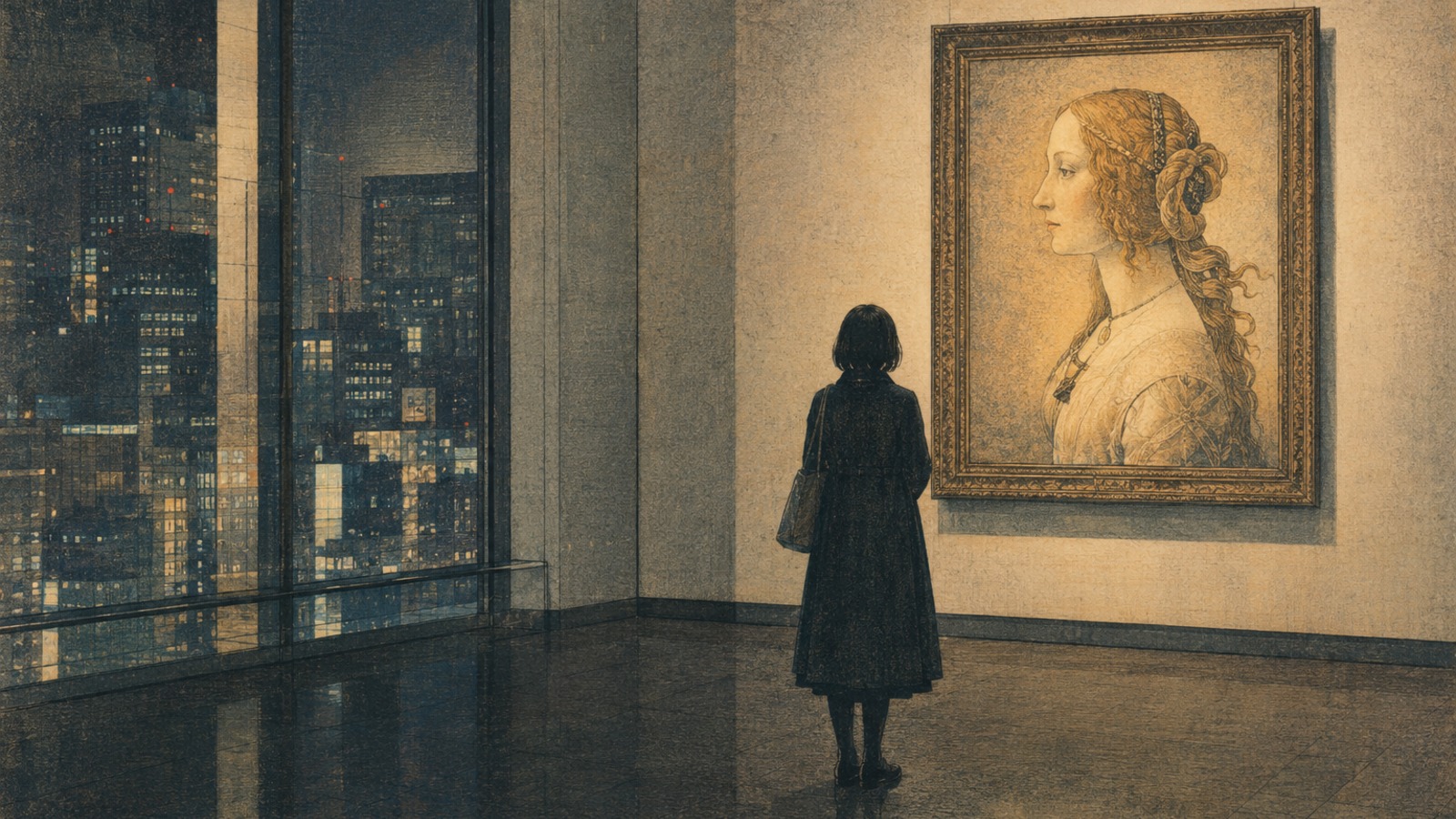
The woman looks to the left. Her high forehead and long neck are held in exact profile; pearls, ribbons and braided hair construct an architecture around her face. She does not meet the viewer. That withheld gaze is part of the attraction. Five and a half centuries after Simonetta Vespucci’s death, the picture permits closeness but denies certainty.
Marubeni Gallery in Tokyo is making Sandro Botticelli’s La Bella Simonetta the center of an exhibition running through September 30. The occasion joins two anniversaries that at first seem to belong to different histories: 550 years since Simonetta died in 1476, and 160 years since Japan and Italy signed their first Treaty of Amity and Commerce in 1866.
The exhibition’s more interesting achievement is not ceremonial. It places a painting beside two acts of literary reinvention: Angelo Poliziano’s unfinished Renaissance poem Stanze per la giostra, written around Giuliano de’ Medici’s 1475 joust, and Tsuji Kunio’s monumental 1977 historical novel Haru no Taikan, or The Coronation of Spring. In that triangle—Italian poem, Florentine painting, Japanese novel—Simonetta is repeatedly made present by people who could no longer reach her.
A woman enters Florence, then legend
Simonetta was born Simonetta Cattaneo in 1453 to a Genoese family. The archival record has not settled whether her birthplace was Genoa, Portovenere or nearby Fezzano. Around 1469 she married Marco Vespucci and entered the social world of Florence. The family name would later become globally familiar through Marco’s relative Amerigo Vespucci, but Simonetta’s celebrity came first and by another route.
Florence in the 1470s was a republic in form and a Medici power center in practice. Banking, diplomacy, guild wealth, classical scholarship, religious devotion and public spectacle occupied the same streets. A tournament was not merely sport. It displayed alliances, masculine prestige, household magnificence and political order before the city.
On January 29, 1475, Giuliano de’ Medici won a joust in Piazza Santa Croce. Simonetta was celebrated as his lady and the tournament’s queen of beauty. Such courtly language did not prove a physical affair; it offered an elaborate public script in which a married noblewoman could symbolize the virtue and beauty for which a knight competed. Later romance often hardened that performance into biography.
Poliziano, the brilliant humanist in Lorenzo de’ Medici’s circle, was commissioned to transform the event into poetry. His Giuliano became “Iulio,” a proud hunter drawn into love; Simonetta became a nymphic presence inside a landscape assembled from Ovid, Virgil and the Tuscan poetic tradition. The poem is not a newspaper account of two lovers. It is cultural machinery: a civic contest translated into classical myth, and Medici prestige translated into timeless beauty.
The machinery stopped. Simonetta died on April 26, 1476. Two years to the day later, assassins killed Giuliano during Mass in Florence Cathedral in the Pazzi conspiracy; Lorenzo survived. Poliziano’s poem remained unfinished. The interrupted text gave later readers an irresistible structure—beauty, love and political spring cut short before completion.
What killed her cannot be painted with certainty
For centuries, accounts described Simonetta’s death as consumption, the period’s broad language often associated with tuberculosis. Surviving correspondence about her final illness has encouraged retrospective diagnosis. A 2026 paper in the peer-reviewed journal Endocrinology, Diabetes & Metabolism revisited reports of severe headache, nosebleed, vomiting, fever, confusion and visual or neurological symptoms and proposed pituitary tumor apoplexy—a sudden hemorrhage or loss of blood supply in a pituitary tumor—as an alternative explanation.
The hypothesis is timely and medically interesting, but it is not a diagnosis. There is no body to examine, no imaging and no laboratory result. Fifteenth-century observers used different categories and recorded symptoms incompletely. “Consumption” may have been wrong; a modern reconstruction may also be wrong. The responsible conclusion is that Simonetta died after a severe illness at about 22 or 23, and the precise cause remains unknowable from available evidence.
That distinction matters because Simonetta has repeatedly been turned into evidence for stories others wanted to tell. To Renaissance poets she embodied an elevated beauty. To nineteenth-century admirers of Botticelli she became a muse whose features supposedly unified his female figures. To modern medical writers, painted details and letters can become diagnostic clues. Each approach may reveal something, but each can also reduce a life to a useful symbol.
The Tokyo panel: object, journey, argument
The painting in Tokyo is a modest object compared with Botticelli’s monumental mythologies. Marubeni records it as tempera on panel, 65 centimeters high and 44 wide, from the late fifteenth century. Its concentration is part of its force. There is no orange grove, sea or wind god—only a profile, costume, jewelry and the controlled movement of line for which Botticelli became renowned.
Marubeni describes the picture as the only Botticelli work permanently housed in Japan. The company says it was rediscovered in Bologna in the early eighteenth century, then passed through France, Britain, Germany and Britain again. Marubeni acquired it in the United Kingdom in 1969. An early copperplate reproduction and ownership documentation allow the gallery to follow its trail unusually far back for a work attributed to Botticelli.
The journey is more than provenance trivia. Botticelli’s reputation did not travel in a straight line. Admired in his lifetime, he was overshadowed for centuries before a nineteenth-century revival made his flowing contours and melancholy beauties central to the modern idea of the Renaissance. A painting’s chain of owners therefore records not only movement across borders but changes in taste: what one generation neglected, another needed.
The title La Bella Simonetta also has a history. Marubeni traces it to the work of Japanese art historian Yashiro Yukio. Studying in Britain and Italy, Yashiro published his major English-language Sandro Botticelli in 1925 and argued in its revised edition that the profile formerly in the Kappel collection and then owned by Dr. Noah was by Botticelli. That painting is now Marubeni’s.
Yashiro’s role reverses a simple East-receives-West story. A Japanese scholar did not merely popularize an Italian master at home. He entered international Botticelli scholarship in English, then returned to help build institutions for the study and display of Asian art. He later became the first director of the Museum Yamato Bunkakan. The panel in Tokyo is consequently linked not just to Italian art exported to Japan, but to a Japanese history of interpreting the Renaissance for the world.
| Layer | What the evidence supports | Where caution begins |
|---|---|---|
| The object | Late-15th-century tempera panel, 65 × 44 cm; in Marubeni’s collection since 1969 | Dating within the century and workshop practice remain matters of specialist study |
| The artist | Marubeni labels and exhibits the work as Sandro Botticelli | Attribution is an art-historical conclusion, not a signature displayed as proof |
| The sitter | Marubeni identifies the profile as Simonetta and explains the Yashiro scholarship behind the title | Several idealized female profiles have been called Simonetta; identification is not a contemporary civil record |
| The famous goddesses | Later viewers have perceived related facial types across Botticelli’s works | No document establishes Simonetta as the live model for Primavera or The Birth of Venus |
Was Simonetta Botticelli’s Venus?
The appealing answer is yes. It creates an artist, a muse and a tragic love story in one sentence. The responsible answer is more complicated.
The Uffizi dates Primavera to about 1480. Nine mythological figures move across an orange and laurel grove; the museum identifies Venus at the center, Zephyrus and Chloris to the right, Flora after her transformation, the Three Graces and Mercury. Its meaning remains debated, though love, peace and prosperity are central. Researchers have identified at least 42 plant species in its ground and canopy.
The Birth of Venus, dated by the Uffizi to about 1485, shows not the goddess’s birth but her arrival on shore. Classical sculpture informed her pose; gold catches in her long hair. The museum says Poliziano’s poetry may have suggested the subject and that a Medici commission is highly probable, while noting that no written record of the picture survives before 1550.
Both paintings were produced after Simonetta died. That does not make her influence impossible: painters work from drawings, remembered types and workshop formulas, and the dead can become more powerful symbols than the living. But the dates change the claim. If viewers see Simonetta in Venus or Flora, they are looking at posthumous idealization, not straightforward portrait sittings.
The repetition of a graceful facial type also need not indicate one woman. Botticelli used line to connect sacred and pagan beauty across Madonnas, nymphs and goddesses. The Uffizi’s newly installed Botticelli rooms deliberately place Primavera and The Birth of Venus in dialogue and point to resemblances between the Virgin and Venus within Renaissance ideas that sought concord between classical wisdom and Christian truth. A recurring face can therefore be a philosophical and workshop language, not a police lineup.
Frankfurt’s Städel Museum calls its own celebrated Botticelli image an “Idealised Portrait of a Lady (Portrait of Simonetta Vespucci as Nymph).” That title contains the whole problem. “Portrait” promises a person; “idealised” and “nymph” announce transformation. The more ornate and mythological the costume, the less the painting behaves like an ordinary likeness.
From Poliziano’s nymph to Tsuji’s “immutable primrose”
Marubeni’s 2026 exhibition does not attempt to solve Simonetta by comparing noses. It asks what literature enabled artists and readers to see.
Poliziano’s Stanze, composed from 1475 until the Pazzi crisis of 1478, is a storehouse of classical images. The Metropolitan Museum of Art describes its garden of Venus and mythological tales as a possible source for Renaissance visual invention. Poetry did not merely caption pictures after they existed; it supplied artists and patrons with a world in which desire, politics and antiquity could share a stage.
Five centuries later, Tsuji Kunio approached Florence from Japan. Born in 1925, trained in French literature and resident in France from 1957 to 1961, Tsuji built a career from historical novels set at moments of spiritual and political change. The Coronation of Spring was serialized from 1972 to 1976 and published in two volumes in 1977. It follows Botticelli’s life and the ascent and fracture of Medici Florence through an invented witness—an explicit reminder that historical fiction creates a viewpoint where documents leave silence.
The exhibition says Tsuji found in Simonetta’s likeness in Primavera the figure of an “immutable primrose.” The phrase is less a claim about anatomy than time. Spring returns, but a painted spring does not age. Florence’s political world decayed; Simonetta died; Botticelli’s reputation faded and revived. The image remained available for another language and another century to awaken it.
Tsuji’s novel is especially apt in Tokyo because it refuses the idea that Renaissance Italy belongs only to Italians. Historical imagination crosses borders differently from ownership. A Japanese writer can be distant from the archive and still ask a revealing question: what did beauty mean to people who feared that their city’s moment of harmony was ending?
1866 and 1969: two arrivals
The diplomatic anniversary gives the exhibition a second time scale. On August 25, 1866, representatives of the Tokugawa shogunate and the recently unified Kingdom of Italy signed a Treaty of Amity and Commerce aboard the Italian corvette Magenta. The agreement began formal relations between two states undergoing enormous political change. In 2026, their governments elevated ties to a Special Strategic Partnership as the 160th-anniversary program began.
Marubeni’s own history happens to begin nearby in time. Itoh Chubei started traveling to sell linen in 1858. Textiles remained foundational to the company’s collecting: kimono, Noh robes, fragments and design archives form two of the Marubeni Collection’s three pillars. The third is painting, including modern Japanese works and Western pictures acquired when Marubeni entered the international art business in the 1960s and 1970s.
La Bella Simonetta arrived in 1969, more than a century after the treaty. It is tempting to make that neat sequence inevitable—commerce leads to cultural exchange, then a masterpiece comes to Tokyo. Reality is less tidy. A corporate buyer, an art market, changing exchange conditions, connoisseurship and opportunity all mattered. Yet the outcome is concrete: a work once moving among private European collections is now periodically visible to the public in an Otemachi office tower.
The gallery, opened in 2021, describes itself as a place where the aesthetics of East and West, ancient and modern, resonate. Corporate ownership inevitably raises questions about access: the painting is not in a permanent national collection and the gallery has no permanent exhibition. Its rotating program means the work cannot be assumed to be on view at any time. During this exhibition, however, admission is ¥500, younger visitors and several other groups enter free, and Marubeni says all admission proceeds go to its foundation.
What survives a beautiful woman?
The phrase “beautiful Simonetta” is both an honor and a cage. It explains why her memory endured, while flattening the intelligence, choices, fears and relationships of a person for whom evidence is scarce. We know how men praised her more readily than what she thought of their praise.
That imbalance should not lead viewers to reject the painting. It should change how they look. Notice the work required to produce effortless beauty: hair arranged beyond ordinary convenience, pearls aligned, fabric patterned, profile disciplined into an unbroken contour. The image does not simply discover beauty in a young woman. It manufactures an ideal from body, fashion, classical reference, patronage and paint.
Then notice everything the image cannot settle. Was the sitter Simonetta? Was the likeness made during her life, from memory or through a type passed within a workshop? Did later viewers find her in Venus because Botticelli intended it, or because tragedy made the resemblance irresistible? The questions do not diminish the panel. They are part of its historical content.
The future of La Bella Simonetta in Japan depends on preserving both wood and uncertainty. Conservation stabilizes tempera, panel and frame. Scholarship stabilizes nothing so comfortably; it tests names, dates and stories against evidence and must sometimes leave labels open. Public display completes the work by allowing new viewers—including those who meet Botticelli first through Tsuji—to test inherited claims for themselves.
In the gallery, the woman continues to look away. Across the room, a visitor supplies the missing half of the encounter: curiosity, projection, perhaps recognition. Simonetta’s real voice does not return. What returns is the argument over who she was, why Florence needed her image and why Tokyo still does.
That is the deeper anniversary. Not that beauty defeats death. Paintings are vulnerable objects, names are unstable, and memory changes owners. What art can defeat, for a time, is indifference. Five hundred and fifty years after a young woman’s last spring, one small panel still makes strangers stop.
- Marubeni Corporation: 2026 exhibition announcement and Marubeni Gallery: exhibition essay — dates, concept, literary pairings and official description of the work.
- Marubeni Gallery collection record — medium, dimensions and collection label; 2022 Botticelli exhibition archive — provenance, title history and comparative research.
- Marubeni’s 2025 special exhibition announcement — scientific appraisal, Yashiro and Tsuji context, and collection history.
- Uffizi Galleries: Primavera and Uffizi Galleries: The Birth of Venus — dates, materials, iconography and documented ownership history.
- Metropolitan Museum of Art: Poliziano’s La Giostra and Cambridge University Press: Angelo Poliziano — the poem’s purpose and its interruption after 1478.
- Städel Museum: Idealised Portrait of a Lady — a comparative Simonetta identification and the category of the mythological ideal portrait.
- Museum Yamato Bunkakan: Yashiro Yukio — his Botticelli research and later institutional work; Shinchosha: Tsuji Kunio’s The Coronation of Spring — author and novel context.
- Embassy of Italy in Tokyo: 160 years of Italy–Japan friendship and Japan’s Ministry of Foreign Affairs: 1866 treaty anniversary.
- Nardelli and colleagues (2026), Endocrinology, Diabetes & Metabolism — retrospective pituitary-apoplexy hypothesis.
- Marubeni Gallery user guide — hours, admission, access and cashless-payment policy.
Editorial note: This article distinguishes Marubeni Gallery’s cataloguing and curatorial interpretation from independently established facts. The identity of idealized Renaissance sitters and the model theory for Botticelli’s mythological figures remain debated. A retrospective medical hypothesis cannot establish Simonetta’s cause of death. The lead image is an editorial illustration and is not the exhibited panel.