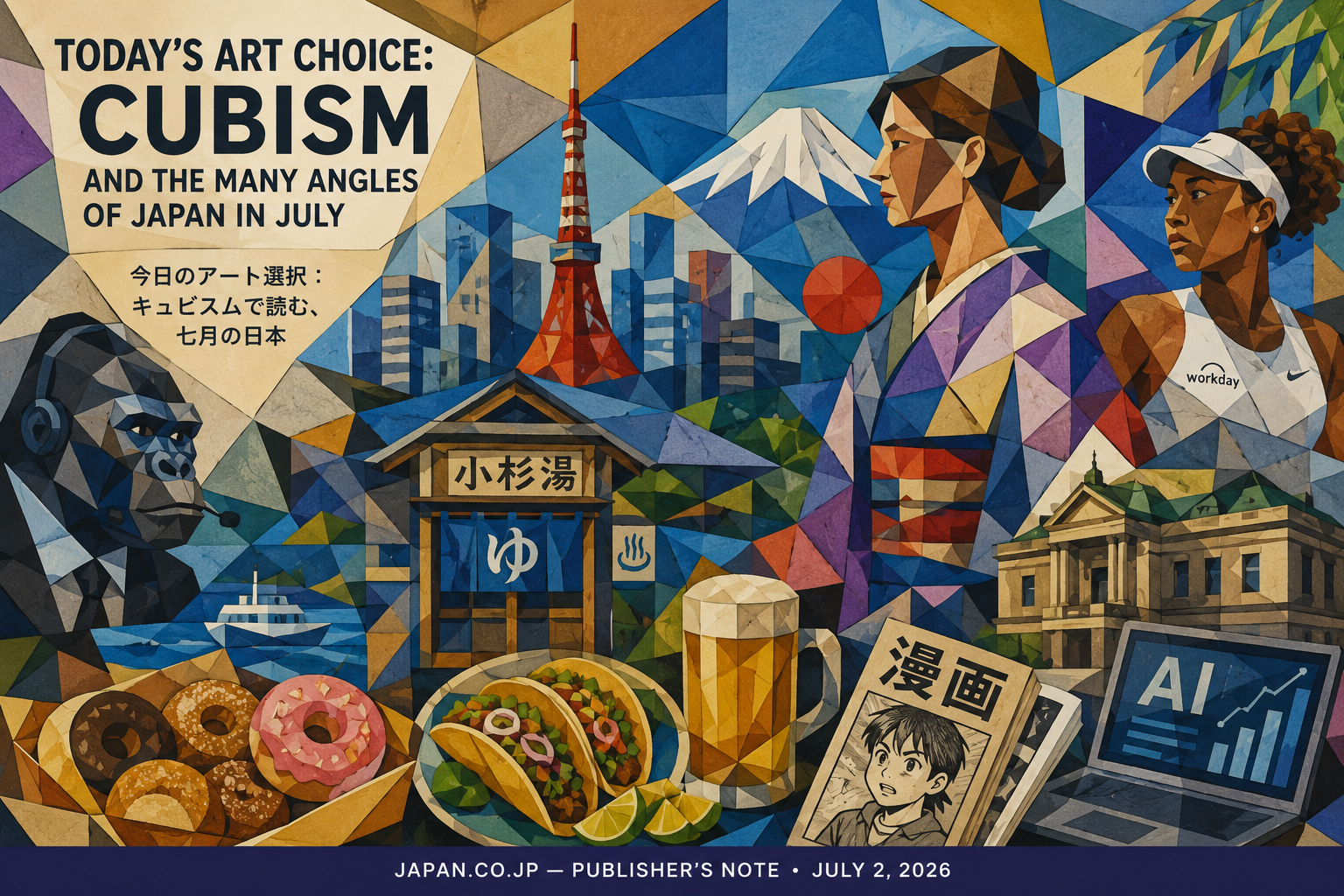
Today’s art choice for Japan.co.jp is Cubism. The reason is simple: the July 2, 2026 edition cannot be read from one angle. Japan’s emergency relief to earthquake-hit Venezuela, the Bank of Japan’s political and institutional rate path, manga and translation as export power, seniors using travel as work, a Mexican beer garden in Shinjuku, nama donuts, a sento revival, AI skills, AI sales agents, and Naomi Osaka bringing kimono memory onto Wimbledon grass. This is not one Japan. It is Japan seen from many planes at once.
Cubism was not an art of breaking the world for the sake of damage. It was an art of taking visible reality apart and reassembling it from multiple viewpoints. A newspaper does something similar. Reality is made from official statements, company announcements, street trends, regional changes, athletic moments, food textures, work anxieties and fashion memory. To choose Cubism for today’s issue is to say editorially: Japan will not fit into a single flat explanation.
What Cubism was
Cubism was born in Paris in the early twentieth century. It is usually described as a revolutionary approach developed around 1907–08 by Pablo Picasso and Georges Braque. Tate calls it a new approach to representing reality invented by Picasso and Braque. MoMA describes Cubism as a style invented in Paris during the first decade of the twentieth century and then adopted by an international network of artists.
Before Cubism, much Western painting used perspective and shading to create the illusion of depth, as though the canvas were a window. Cubism questioned the window. When we look at an object, do we truly see it from only one viewpoint? A glass, a guitar, a face, a city street: are they only their frontal appearance? We see from the side, from above, through memory and through touch.
Cubism made that question visible. It broke figures and objects into geometric planes and placed multiple perspectives on the same canvas. Natural depth became shallow. The picture surface stopped pretending it was not flat. Instead of copying what the eye sees in an instant, Cubism painted the process of knowing through sight. That is why Cubism is both a gateway to abstraction and a deeply intellectual form of realism.
Picasso, Braque and the shadow of Cézanne
Any history of Cubism begins near Picasso’s Les Demoiselles d’Avignon. MoMA identifies the painting as an oil on canvas made in Paris in June–July 1907. It is often described not as mature Cubism itself, but as the explosive prelude to Cubism. Bodies are not smoothly modeled. Faces become mask-like. Space is unstable. The viewer cannot simply enter the scene; the scene pushes outward.
But Cubism was not born from Picasso alone. Without Georges Braque, it would not have become a movement. Around 1908, Braque painted the houses of L’Estaque as geometric masses. The critical language of “cubes” helped give the movement its name. Between roughly 1908 and 1914, Picasso and Braque worked so closely that their paintings can sometimes be difficult to distinguish. They were less rivals than co-investigators of the same visual problem.
Behind them stood Paul Cézanne. Cézanne’s structural approach to nature—seeing forms through cylinders, spheres and cones—changed the logic of painting. After Impressionism pursued changing light, Cézanne pursued the bones of objects. Picasso and Braque pushed that structural inquiry further, turning things into planes and space into construction.
Analytic Cubism: taking vision apart
MoMA divides Cubism into two broad phases: Analytic Cubism beginning around 1910, and Synthetic Cubism beginning around 1912. In Analytic Cubism, Braque and Picasso represented objects and figures in shallow spaces using flat, overlapping planes. Color was often restrained: browns, grays, blacks and muted greens. The subjects were guitars, bottles, newspapers, tables and faces. Structure mattered more than spectacle.
Analytic Cubist paintings can look difficult at first. The subject is not immediately available. That difficulty is intentional. The artist refuses to turn the object into an instantly consumed image. The viewer must participate. The curve of a guitar, the neck of a bottle, the edge of a newspaper, a chair back, a face seen from both side and front: the eye begins to walk through the picture.
In that sense, Cubism resembles a newspaper. No single article explains society. Politics, markets, culture, food, travel, sport and daily life must be placed beside one another before the shape of the moment appears. Today’s Japan.co.jp issue is Cubist in that way. Each story is a fragment. Together they form a three-dimensional portrait of Japan in July.
Synthetic Cubism: paper, words, newspapers, fragments of reality
Around 1912, Cubism entered another phase: Synthetic Cubism. Here, fractured planes were joined by paper, newspaper, wallpaper, wood grain, letters and labels. Braque’s papier collé and Picasso’s collage brought real materials into painting. That was a radical turn.
The painting became not only a place to depict the world, but a place to assemble pieces of it. Newspaper type, bottle labels, printed patterns and street culture entered the museum canvas. Modern urban visual life became art.
This feels remarkably close to publishing now. A webpage is a collage of text, images, ads, links, metadata, headlines, mobile layout and search-engine structure. Japan.co.jp’s front page is not one oil painting. It is closer to a contemporary Synthetic Cubist composition: stories, art, exchange rates, ads, weather and horoscope all read as one surface.
The artists who defined the genre
Picasso and Braque were the founders, but Cubism was never only theirs. The Metropolitan Museum of Art explains that the new visual language was adopted and developed by many artists, including Fernand Léger, Robert and Sonia Delaunay, Juan Gris, Roger de la Fresnaye, Marcel Duchamp, Albert Gleizes, Jean Metzinger and even Diego Rivera.
Juan Gris gave Cubism clarity, architecture and color intelligence. Where Picasso and Braque could be dark and dense, Gris often feels like a beautifully reasoned structure. Fernand Léger created a machine-age Cubism of cylinders, metal, labor, city life and speed. Robert and Sonia Delaunay pushed Cubist structure toward color rhythm and Orphism.
Albert Gleizes and Jean Metzinger helped theorize the movement with their 1912 book Du Cubisme. Marcel Duchamp’s Nude Descending a Staircase, No. 2 became a scandalous intersection of Cubism, Futurism and motion analysis. Cubism was a short word for a large field: still life philosophy, urban speed, the machine age, print culture and the road toward abstraction.
Why Cubism changed twentieth-century art
The Cubist revolution was not merely that paintings became angular. Its deeper revolution was the collapse of single-point reality. Perspective had stabilized the world. Cubism showed that modern reality no longer felt stable. Cities moved faster. Print multiplied. Photography had arrived. Cinema captured movement. Railways and telegraphy compressed distance. The world was no longer a quiet window; it was a place where many forms of information arrived at once.
In that sense, Cubism is also an ancestor of modern media. Social timelines, news homepages, map apps, stock charts, translation tools and AI summaries ask us to read several viewpoints on one screen. Cubism was experimenting with that condition more than a century ago.
Its influence moved far beyond painting. The Metropolitan Museum notes that Cubism also exerted a profound influence on twentieth-century sculpture and architecture. It opened paths into Futurism, Constructivism, Dada, Surrealism and abstraction. Breaking and rebuilding the picture became a shared grammar of modern art.
Japan receives Cubism
Cubism’s history in Japan was not simple importation. From the Meiji era into the Taishō period, Japanese artists studied Western painting while asking what Japanese modernity could mean. Oil paint, perspective, figure drawing, exhibitions, art schools, magazines and criticism all became part of a new art world. To learn Western technique was also to reconsider Japanese expression.
One key figure was Yorozu Tetsugorō. Art Platform Japan records that Yorozu was born in 1885 in Tsuchizawa, now part of Hanamaki, Iwate Prefecture. He studied at the Tokyo Fine Arts School, and his 1912 graduation work Nude Beauty is now in the collection of the National Museum of Modern Art, Tokyo and designated an Important Cultural Property. MOMAT’s collection note points to the flame-like movement of the weeds and simplified forms in the painting.
The Iwate Museum of Art explains that after Yorozu returned to Tsuchizawa in 1914, he developed his own style through the language of Cubism, painting self-portraits, landscapes and still lifes. This matters. Japanese Cubism was not a replica of Paris. It was reshaped by region, body, soil, line, ink, oil paint and the anxiety of Japanese modernization.
Yorozu, Murayama and Japan’s avant-garde
Yorozu is often described as a painter who brought avant-garde force into Japanese yōga, or Western-style oil painting. His work mixes Cubism, Expressionism, Fauvism and Japanese line and bodily sensation. That is not a failure to be “properly Cubist.” It is evidence of Japanese modernity’s multiplicity. For Japanese painters, Western art was not one textbook. It was a toolkit for understanding the age.
By the 1920s, figures such as Murayama Tomoyoshi and the MAVO group pushed Japan’s avant-garde further. The National Museum of Modern Art, Kyoto describes Murayama as a forerunner of Japan’s avant-garde movement and highlights works such as Sadistic Space and the magazine MAVO. MAVO was not a Cubist group in the narrow sense. But in its use of collage, constructivism, print, theater and daily life, it belonged to the world after Cubism.
So in Japan, Cubism was not received merely as a method for making angular pictures. It arrived as avant-garde energy linking painting, magazines, stage, architecture, advertising and city life. Print and city, art and daily life, body and machine, tradition and the new: these are still problems for web publishing today.
Why Cubism fits July 2 Japan
Look across today’s ten Japan.co.jp stories and Cubism begins to feel inevitable. Venezuela earthquake relief is the plane of diplomacy and humanitarian response. The BOJ story is the plane of rates, politics, currency and corporate psychology. Manga translation is the plane of Japanese language moving abroad. Otetsutabi is the plane of travel, labor, regions and seniors. The Shinjuku beer garden and nama donuts are the plane of urban summer and food fashion. Kosugiyu is the plane where old community receives new form. AI skills and AI sales agents are the plane of future work. Naomi Osaka is the plane of sport, fashion, Japanese memory and global identity.
One headline cannot show today’s Japan. But ten planes together create a three-dimensional national face. Japan is, at the same time, a country that sends aid, debates monetary policy, exports manga, lets seniors work while traveling, eats tacos and nama donuts, protects sento culture, studies AI and wears kimono memory at Wimbledon.
Cubism can hold that simultaneity. Japan in July is not a single portrait. It is a mosaic of fragments, a collection of planes, a face shown from the front and the side at the same time.
Cubism in the age of AI
There is another reason for today’s art choice. In the age of AI-generated images, Cubism is newly suggestive. Generative AI does not assemble an image from a single camera viewpoint. It builds through language, memory, references, styles and statistical relationships. An AI image is not a Picasso or a Braque. But in its act of recombining multiple inputs into one surface, it revives a Cubist question.
At the same time, care matters. Cubism is not simply “triangles” or “geometric vibes.” Its history includes criticism of Western perspective, the experience of modern cities, print culture, colonial looking, the reception of African sculpture, and social change around the First World War. To use Cubist style in AI art responsibly, one should not flatten that history.
That is why this publisher’s note is not just a caption. It is a historical explanation. Today’s art is not decoration. It is an invitation to read Japan from more than one direction.
Japan.co.jp’s view
A newspaper tries every day to make the world into one page. But the world is not one page. So a good front page should not only simplify; it should preserve contradiction and simultaneity. Cubism is a good teacher for that. In a Cubist painting, a face can be frontal and profile at once. A city can hold wall, window, word and sound at once. Japan can hold tradition and AI, sento and sales agents, manga and monetary policy, donuts and diplomacy at once.
Today’s Cubism is a gesture of respect toward art history and also an editorial method for Japan.co.jp. Do not over-reduce. Place the planes side by side. Let the reader change angles. That is today’s art choice for reading Japan on July 2.
| Theme | How to read it |
|---|---|
| Today’s art | Cubism: multiple viewpoints, fragmentation, reconstruction and urban fragments. |
| Defining artists | Picasso, Braque, Gris, Léger, the Delaunays, Gleizes, Metzinger, Duchamp and others. |
| Japanese connection | Yorozu Tetsugorō, 1920s avant-garde, MAVO, modern yōga and urban print culture. |
| Connection to today’s issue | Diplomacy, finance, manga, travel, food, sento, AI and sports fashion seen at once. |
| Japan.co.jp view | Read Japan not as one story, but as a many-sided form. |
Sources and references
この記事は、Tate、MoMA、Metropolitan Museum of Art、東京国立近代美術館、Art Platform Japan、岩手県立美術館、京都国立近代美術館などの美術館・研究機関の資料を参考にしました。
- Tate: Cubism as a revolutionary approach invented around 1907–08 by Picasso and Braque.
- MoMA: Cubism in Paris and its international network.
- MoMA: Analytic and Synthetic Cubism.
- MoMA: Picasso, Les Demoiselles d’Avignon, 1907.
- The Metropolitan Museum of Art: Cubism and its wider circle of artists.
- The National Museum of Modern Art, Tokyo: Yorozu Tetsugoro, Nude Beauty.
- Art Platform Japan: Yorozu Tetsugorō biography.
- Iwate Museum of Art: Yorozu and the language of Cubism.
- The National Museum of Modern Art, Kyoto: Murayama Tomoyoshi and Japanese avant-garde.