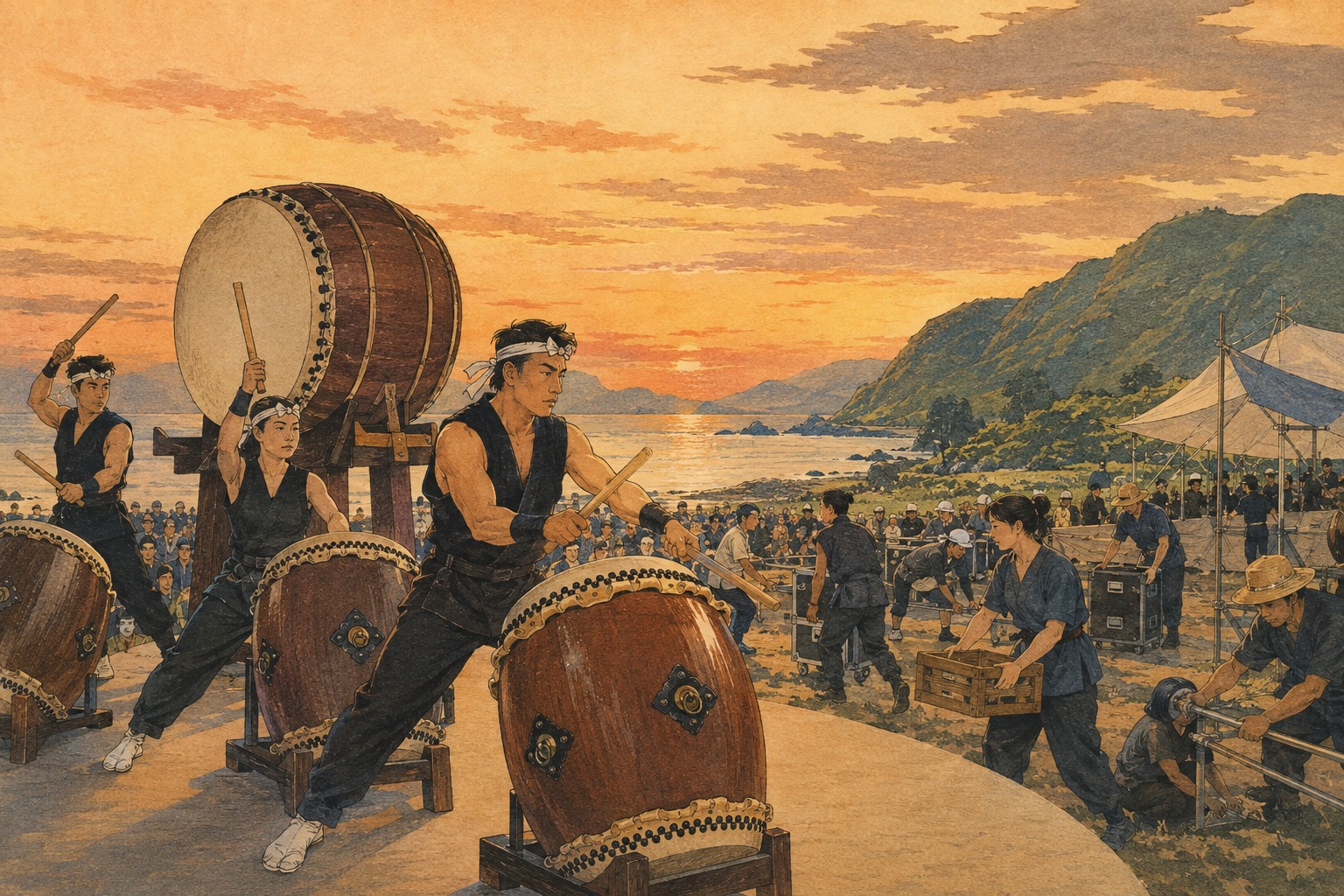
A festival is most revealing before it looks like one. On August 20, the day before Earth Celebration opened on Sado Island, the public saw a participant in a government-backed dual-residency pilot helping with site preparation. No concert had begun. The visible work was logistical: turning a place into somewhere music could happen.
NST Niigata reported that the participant had come through a program designed around two opposite calendars. The summer base is Sado, the large island off Niigata Prefecture’s coast. The winter base is Yuzawa, the mountain town whose ski areas and lodging sector become busiest in snow season. The proposal is to connect jobs as well as addresses—working and living on Sado when the island is busy, then moving inland to Yuzawa when winter demand rises.
The following three days offered an unusually vivid test site. Earth Celebration 2026 paired the Sado-based taiko ensemble Kodo with performers from Miyake Island and Mongolia, along with apprentices, local arts, workshops and markets around Ogi. NST/FNN’s headline said more than 3,000 people attended, although its report did not define whether that was paid concert admission, total visits across free and ticketed programs, or another measure. The figure is useful as a reported estimate, not as an audited festival total.
The more consequential number may be one that remains unpublished: how many pilot participants worked, under what terms, for how long. A single worker at setup proves that the matching system reached a real task. It does not prove that the system produced stable employment.
What the project actually is
Sado City’s July 24 announcement identifies the project by its official Japanese title, 「特定居住支援法人モデル構築実証調査」—rendered here as a Model-Building Pilot Survey for Specified-Residence Support Corporations because the reviewed source provides no official English title. The Ministry of Land, Infrastructure, Transport and Tourism selected the proposal submitted by 一般社団法人佐渡共生推進機構, rendered here as the Sado Coexistence Promotion Organization; no official English name was found in the reviewed sources. The ministry’s award list names Sado City and Yuzawa Town as the participating municipalities, FERM and HEIDI as related companies, and the Sado organization as the specified-residence support corporation.
Those distinctions matter. A municipality is not directly filling every shift. The support corporation is meant to stand between prospective dual residents and host communities, finding candidates, matching them with local businesses and helping turn temporary work into a sustainable livelihood. FERM and HEIDI are named in the national list, but the published sources reviewed for this article do not divide responsibility for recruitment, employment, housing, transport or supervision among the organizations.
Sado’s official description names Sea House Sawata, at 411 Kawaharada Honcho, as the island base. Its announced 2026 season ran from July 13 through August 23—the final day of Earth Celebration. The festival itself was centered farther south in Ogi. Neither the city announcement nor the national award sheet says how participants traveled between the base and work sites, whether they were reimbursed, or who bore that cost.
| Question | Verified in public sources | Not established in the reviewed record |
|---|---|---|
| Who leads it? | The Sado Coexistence Promotion Organization is the specified-residence support corporation; FERM and HEIDI are listed as related companies. | The detailed division of contractual and operational responsibility. |
| What is the aim? | Match people to work and collaboration on Sado in summer and Yuzawa in winter, while building local livelihoods. | Participant target, completion target and project-specific public budget. |
| What happened? | A participant helped with Earth Celebration site preparation on August 20, according to NST/FNN. | Hours, duties, pay, employer, legal form of the work and number of participants. |
| Where do people live? | Sea House Sawata is the named Sado base. | Rent, utilities, winter housing, commuting arrangements and family options. |
Two rural places, one labor calendar
Dual residency in Japan is often sold through an urban lens: retain a principal home in a city while building a second life in the countryside. Sado and Yuzawa invert that picture. Both are regional communities. Neither is a commuter suburb of the other. The pairing is based less on metropolitan convenience than on complementary demand.
Sado’s own account says tourism and related activity lift labor needs in summer. Yuzawa’s ski areas and lodging properties need more people in winter. A worker who moves between them could replace two disconnected temporary jobs with a predictable sequence. An employer could gain someone who returns with experience, instead of beginning recruitment and training from zero every season.
Yuzawa’s resident registry makes the seasonal scale visible, while requiring caution. The town recorded 8,388 residents at the end of January 2026 and 7,681 at the end of July, a difference of 707—about 9 percent of the July population. The table does not identify occupations or explain migration, so the increase cannot be labeled a count of ski workers. It does show that winter changes the town’s registered population, not merely its visitor traffic.
Sado faces a different arithmetic. It had 45,949 registered residents at the end of July, including 2,237 in the Ogi district. In the city’s 2024 survey, 71.5 percent of 130 responding businesses described their staffing as either “quite insufficient” or “somewhat insufficient.” Sado’s statutory plan says the island is losing roughly 1,300 residents a year and that only 56 percent of I-turn migrants—people who move there without family roots—remain after three years. Permanent migration alone cannot plausibly fill every seasonal gap.
The innovation is not simply having two homes. It is treating opposite peak seasons as two halves of an employment year—and asking institutions, not individual workers alone, to make the connection.
The older histories inside a new policy
Seasonal movement is not new in Japan. Rural workers have long traveled for temporary employment, and modern employment policy still recognizes seasonal work as a distinct category. The Ministry of Health, Labour and Welfare’s year-round employment subsidy supports employers in cold and snowy regions that keep seasonal workers employed, including through reassignment, dispatch or secondment to another workplace. Employment insurance also has special rules for short-term seasonal insured workers.
The Sado–Yuzawa model resembles that tradition but starts from a different ministry and a different promise. Labor programs focus on continuity of employment. Dual-residency policy adds housing, livelihood and community ties. It asks how someone lives in a place, not only where a payroll record sits.
Yuzawa’s own town history describes a twentieth-century transformation in which an isolated, snowbound geography became an asset for tourism and hydroelectric development. Its postwar economy grew around winter skiing, then sought year-round tourism. The landscape that creates jobs also concentrates them.
Sado’s cultural economy followed another route. The predecessor of Kodo, Sado no Kuni Ondekoza, began communal activity on the island in 1971. Kodo formed in 1981 and debuted at the Berlin Festival. After touring abroad, the ensemble helped create Earth Celebration in 1988 as a way to bring artists and encounters back to Sado rather than sending the island’s culture outward in only one direction.
1971 — Sado no Kuni Ondekoza, Kodo’s predecessor, begins activity on Sado.
1981 — Kodo forms and debuts at the Berlin Festival.
1988 — The first Earth Celebration is held on Sado.
November 2024 — Japan’s amended regional revitalization law takes effect, adding a planning and support-corporation framework for dual residency.
May–June 2025 — Sado publishes its statutory promotion plan and designates the Sado Coexistence Promotion Organization.
July 2026 — The Sado–Yuzawa demonstration begins, with Sea House Sawata named as its Sado base.
August 20, 2026 — A participant helps prepare the Earth Celebration site.
From lifestyle choice to public infrastructure
The legal architecture is recent. An amendment to the Act on Development of Infrastructures for Wide-Area Revitalization took effect on November 1, 2024. It allows municipalities to prepare specified-residence promotion plans and appoint private or nonprofit bodies to support people who keep a living base in another region. The national ministry defines dual residency as maintaining a home in a specified region separate from one’s main base.
Sado published its plan on May 16, 2025. It divides prospective residents by length of stay and explicitly names resort work, working holidays, tourism and agriculture as possible routes. For stays of one month to one year, it also proposes movement between regional communities whose busy seasons differ. The city designated the Sado Coexistence Promotion Organization on June 11, 2025, for a term running through June 10, 2028.
The 2026 national demonstration is therefore not an improvised festival staffing scheme. It is an implementation test of an idea already written into Sado’s statutory plan. That gives the experiment institutional legitimacy. It also raises the standard of proof. A publicly supported pilot should publish what private seasonal hiring often leaves opaque: who pays, who employs, what support is provided, what outcomes count, and what happens when a match fails.
Why a festival made the experiment visible
Earth Celebration has spent nearly four decades making movement part of its artistic method. Kodo’s official history describes an ensemble based on Sado that has performed more than 7,500 times in over 50 countries and regions. The festival reverses the touring route: musicians and audiences cross the sea to meet Sado’s arts, geography and residents.
The 2026 program filled three nights at Ogi Port Park. Kodo performed with Miyake-jima Geino Doshikai on Friday. Saturday joined Kodo with the Mongolian group Khusugtun. Sunday concluded with a Kodo program. Around those ticketed concerts were apprentices, free Fringe performances, local dance, workshops and three market areas.
That program depended on more than musicians. Temporary venues need installation, access control, information, transport, food service, cleaning and removal. The available report confirms participation in setup, not every one of those functions. But it briefly moved backstage labor into the public story.
Hirofumi Uenoyama, identified by NST as a member of the Earth Celebration Executive Committee and by Kodo’s official staff page as the Kodo Cultural Foundation’s secretary-general, told the broadcaster he was pleased to see Sado in summer and Yuzawa in winter connected within Niigata Prefecture. The remark is an aspiration, not an evaluation. It names the cultural value of the experiment while leaving its employment performance to be measured.
A worker can have two jobs and still be insecure
“Year-round work” sounds measurable until costs enter the calculation. Gross wages from a summer job and a winter job may still produce less security if the worker pays for two rooms, repeated moves, ferry and rail travel, vehicle costs, deposits, furnishings and gaps between contracts. A valid evaluation begins with disposable income after those expenses, not simply with months assigned.
Continuity of protection matters just as much. Does workers’ compensation apply at setup? Does health and pension coverage change between employers? Is employment insurance interrupted? Who is responsible for safety training, and does a record of acquired skills follow the worker? If housing is tied to employment, how much notice does someone receive before losing both a job and a room?
The language of community can obscure these questions. “Collaboration,” “livelihood” and “connection” describe real social goals. They cannot substitute for minimum wage, working-time rules, insurance or a clearly identified employer. Conversely, a technically compliant short contract is not enough if a participant is isolated, cannot commute, or has no safe place to stay between seasons.
- Net annual income after housing, utilities and interregional travel.
- Paid months, hours and the length of gaps between the two seasons.
- Continuous coverage for workplace injury, health, pension and employment insurance.
- Freedom to choose jobs, decline unsafe work and leave without immediately becoming homeless.
- The share of participants who freely choose to return for a second summer or winter.
Housing is not a side service
Sado has already built other short- and medium-stay infrastructure. In February 2026, the city publicized Dual Base nido, a shared house for people considering migration or dual residency. Its posted rates range from ¥25,000 for ten consecutive nights to ¥50,000 for one month and ¥45,000 per month for stays of at least two months. Residents cannot transfer their official registration there, and the operator warns that applicants without a car may be refused because daily life is difficult without one.
There is no public evidence that the Earth Celebration participant stayed at nido. The named base for this pilot is Sea House Sawata, and the two should not be conflated. Nido is useful for a different reason: its terms expose the material conditions beneath the phrase “live on Sado.” A bed, car, legal address, utilities and local mobility determine whether a residency is possible.
Equivalent questions await in Yuzawa. Is winter accommodation employer-provided or privately rented? Does a room last until the Sado season begins? Can a partner or child come? Who pays for the transition from island to snow country? A demonstration that matches jobs without joining the housing calendars has solved only half the problem.
The employers’ test is more than filling a shift
Host businesses need their own evidence. How many vacancies were matched? How many workdays were covered? How much recruitment and training cost compared with ordinary seasonal hiring? Did returning participants become more skilled? Did the program supplement stable local jobs, or replace them with short contracts?
For Earth Celebration, the public should also ask where the assignment began and ended. Site preparation is essential, but festivals also need removal, safety management and continuity after crowds depart. A model built around visible opening-day energy should not leave the least visible work—or its risk—to someone else.
There is an ethical trap in calling mobile workers a scarce resource shared by two places. The phrase is accurate from an employer’s perspective. People are not inventory. A sustainable system must increase the participant’s bargaining power as well as an organization’s access to labor. Experience should lead to better pay, more choice and predictable return offers, not merely make a worker easier to redeploy.
Community is a relationship, not a metric
Sado Mayor Ryugo Watanabe described dual residency during an August 18 visit by Vice Minister of Land, Infrastructure, Transport and Tourism Hajime Sasaki as a way to expand people’s ties to Sado, potentially leading from repeated visits to tourism or permanent settlement. Their names and official titles are confirmed in primary government sources; the comments were reported by NST/FNN.
That pathway is plausible, but it is not automatic. Two-region residents benefit from roads, ferry services, health care, community organizations and local knowledge. They may also contribute labor, spending, skills and long-term loyalty. The relationship becomes durable only when expectations and rights are explicit.
Ogi’s registered population was 2,237 at the end of July. A festival can insert thousands of visits into that community over a weekend, even when attendance counts overlap. Residents absorb traffic, waste, noise and pressure on accommodation. They also carry local arts that the festival presents. A dual-residency program should ask not only whether outsiders feel welcomed, but whether residents have a meaningful voice in the jobs offered, the culture shared and the burdens created.
| Perspective | Evidence of success | An inadequate shortcut |
|---|---|---|
| Participant | Higher net annual income, safety, continuity and voluntary return. | Counting two job placements as stability. |
| Employer | Lower vacancy and training costs without displacing stable local work. | Presenting one setup task as a solved shortage. |
| Community | Resident consent, manageable housing and transport effects, repeated contribution. | Equating visitor volume with local benefit. |
| Government | Published spending, contracts, targets and results—including failures. | Treating selection for a pilot as proof of impact. |
| Culture | Fairly treated performers, tradition bearers and production workers. | Using the language of exchange to replace paid work. |
What one festival did—and did not—prove
Earth Celebration provided a first, narrow proof of connection. A legal framework adopted in 2024, a city plan published in 2025, a designated support body, two named partner companies and a summer base led to a person performing a real festival task in August 2026. The arrow on the policy diagram reached the ground.
It has not yet reached the winter. The reviewed sources do not say how many people are in the pilot, what they earned, what contract governed the festival work, where they will work in Yuzawa, who pays for relocation, or how the program will measure a stable year. Those are not clerical details to add after a celebratory announcement. They are the experiment.
Earth Celebration began because Kodo, after traveling outward from Sado, wanted the world to travel back. This year another circuit appeared beneath the artistic one: a person moving not only for a concert, but between two seasonal economies. It makes sense that the route first became visible at a festival built around crossings.
A drum stroke is brief. The work that makes it possible stretches before and after the sound. If Sado and Yuzawa want to share scarce labor, they must also share the costs and responsibilities that allow a worker to move safely: contracts, housing, transport, insurance, time off and the right not to return. The pilot’s real result will not be known when the stage is cleared. It will be known after winter, when participants can decide whether the route is worth traveling again.
- Sado City — Dual-Residency Model Demonstration (lead organization, purpose and Sado base)
- Ministry of Land, Infrastructure, Transport and Tourism — Selected Model-Building Demonstration Surveys
- Sado City — Designated Residence Support Corporations
- Sado City — Publication of the Designated-Residence Promotion Plan
- Sado City — Designated-Residence Promotion Plan (staffing, retention and seasonal-work model)
- Ministry of Land, Infrastructure, Transport and Tourism — Dual-residency policy, law and demonstration programs
- Japanese Law Translation — Official English title of the Act on Development of Infrastructures for Wide-Area Revitalization
- Sado City — July 2026 population
- Yuzawa Town — Monthly 2026 population
- Yuzawa Town — Guide to the official town history
- Earth Celebration Executive Committee — Official 2026 program announcement
- Kodo — Official history and institutional overview
- Kodo — Mission, One Earth Tour and the origins of Earth Celebration
- Kodo Cultural Foundation — Official staff profiles
- Sado City — Dual Base nido rates and terms
- Ministry of Health, Labour and Welfare — Year-Round Employment Subsidy
- NST Niigata/FNN — Festival report, setup participation and reported attendance
- NST Niigata/FNN — Vice-ministerial visit and mayoral comments
- Sado City — Mayor Ryugo Watanabe’s official profile
- House of Representatives — Hajime Sasaki’s official profile
Editorial note: Japanese primary sources were used to verify the official names of institutions, legislation, programs, events, people and specialist terms. Setup participation, quoted remarks and the reported figure of more than 3,000 visitors come from NST/FNN; the report does not define the attendance measure. No employment status, participant count, wage, contract, housing arrangement or travel payment has been inferred where the public record is silent. The main image is editorial art, not documentary photography. The exchange rate is an edition reference converted from the supplied August 24, 2026, 7:47 p.m. UTC timestamp to August 25 at 4:47 a.m. JST; it is not used in the article’s yen figures.