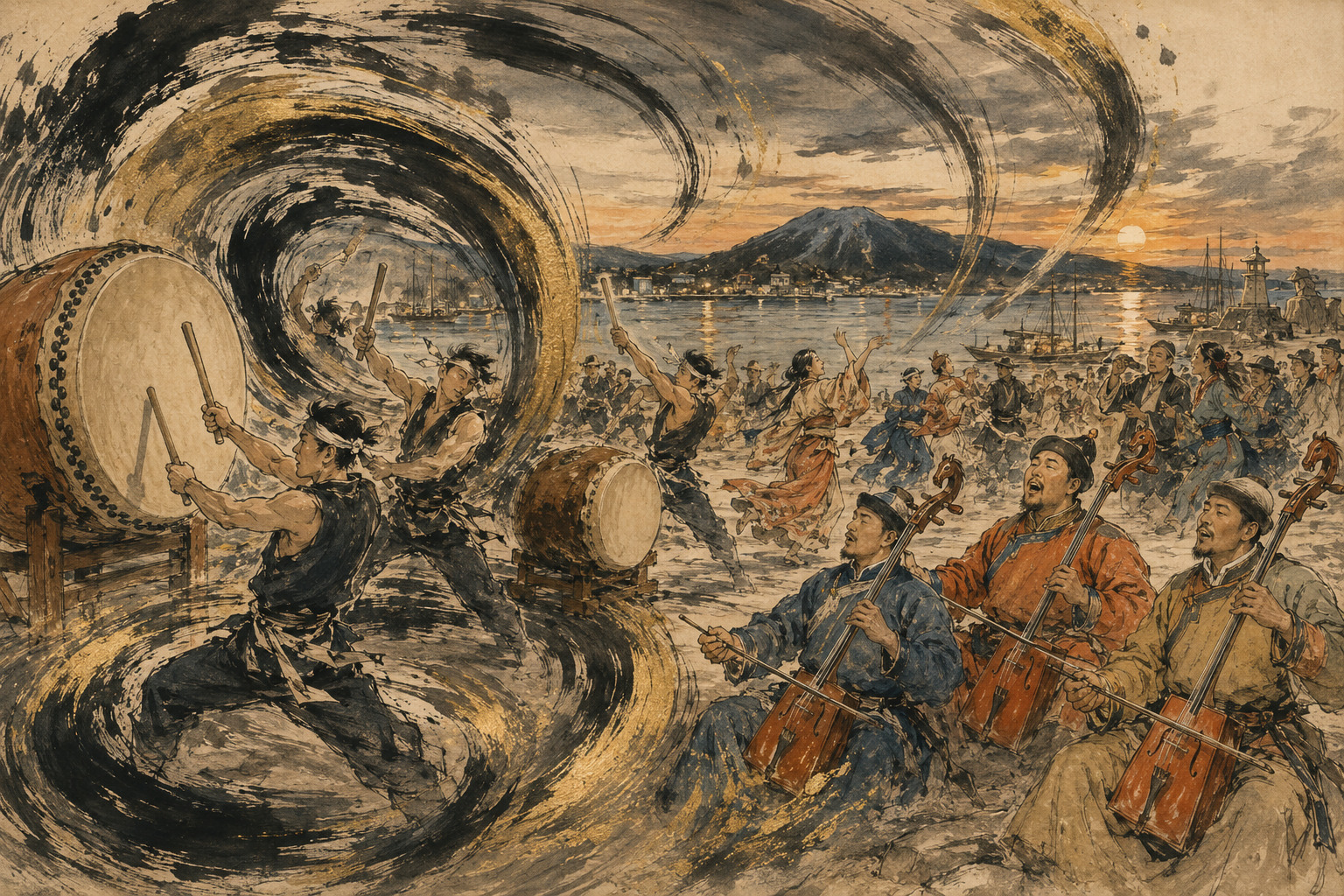
Before a visiting musician sounds a note in Ogi, Sado has already changed the way the meeting feels. Most guests have crossed the sea by car ferry or jetfoil. Schedules, waves and distance have replaced the frictionless arrival of a city train. The port is not a decorative image on a festival poster. It is the threshold through which instruments, audiences and expectations must pass.
That geography gives Earth Celebration its central idea. The festival Kodo and Sado City have held every year since 1988 does not simply put international acts on an outdoor stage. It brings the world to the ensemble's home, then lets the home answer. Taiko carries across Ogi Port Park. Wind and water remain audible possibilities. Local children dance Ogi Okesa. Sado performing arts move through the town. Visitors learn a rhythm with their own bodies, eat at temporary markets and wait for a ferry home.
The 2026 edition runs from Friday through Sunday. Its three ticketed Harbour Concerts begin at 6:30 p.m. and are scheduled for 90 minutes, rain or shine unless weather creates a safety risk. The stage capacity is 1,300. Around those concerts is a much wider field: ten workshops and experiences, free Fringe performances, late-night acoustic events, markets, children's activities and community arts. The official phrase “Earth Celebration” can sound immense. Its method is deliberately small-scale: put people in the same place, give them time, and make listening physical.
Three nights, three ways to cross a boundary
Friday's Matsurine — Summer Special pairs Kodo with Miyake-jima Geino Doshi-kai, a family group of a father and three sons from volcanic Miyake Island south of Tokyo. The style is played from an extraordinarily low stance, legs driving into the earth as the upper body strikes. Kodo and the group first created a Matsurine collaboration 15 years ago; the work has evolved through successive performances and reaches Earth Celebration's main stage for the first time.
Saturday turns west. Earth Echoes — Kodo x Khusugtun, directed by Kodo's Jumpei Nonaka, is advertised as a world premiere. Khusugtun's name refers to people who travel with a khusug, a traditional cart; the ensemble imagines itself carrying Mongolian instruments and heritage across the world. Its morin khuur, zither, a cappella harmony and khöömii throat singing will meet Kodo's drums. The precise result is not yet reportable. It is a new production scheduled for tonight's tomorrow, not a recording or performance we have reviewed.
Sunday's Shukusai — Onwards, directed by Yuta Kimura, belongs to Kodo alone. Its title looks ahead. Earth Celebration marks 39 years in 2026; organizers are explicitly pointing toward the 40th anniversary in 2027. That distinction matters. Anniversary arithmetic can flatten a living institution into a slogan. This year is the passage into the milestone, not the milestone itself.
| Night | Harbour Concert | The encounter |
|---|---|---|
| Friday, Aug. 21 6:30–8 p.m. | Matsurine — Summer Special | Kodo and Miyake-jima Geino Doshi-kai bring two island-based taiko practices into one production; Kenta Nakagome directs. |
| Saturday, Aug. 22 6:30–8 p.m. | Earth Echoes — Kodo x Khusugtun | A world-premiere collaboration between Kodo and the Mongolian ensemble; Jumpei Nonaka directs. |
| Sunday, Aug. 23 6:30–8 p.m. | Shukusai — Onwards | A Kodo finale looking from the 39th festival toward the 40th anniversary; Yuta Kimura directs. |
When one voice becomes two
Khöömii is often introduced through its most startling acoustic fact: one singer appears to produce a low drone and a separate, flute-like melody at once. The UNESCO description is more useful than the word “exotic.” It places the practice in western Mongolia's Altai region and explains that performers shape overtones above a fundamental note by changing the mouth cavity, lips and tongue. Deep kharkhiraa and whistled isgeree are two major approaches. The tradition moves through ceremonies, household celebrations, herding and lullabies, and is passed from bearer to learner or master to apprentice.
The morin khuur also carries more than a distinctive silhouette. The two-stringed fiddle's long neck ends in a carved horse head; its historical relationship to nomadic ritual, work and horse culture reaches well beyond concert display. UNESCO originally proclaimed its traditional music in 2003 and placed it on the Representative List of the Intangible Cultural Heritage of Humanity in 2008. Khöömii followed on that list in 2010.
Those designations do not freeze either form. UNESCO's own record notes the pressures created when pastoral communities move to cities and an instrument is retuned for louder concert halls. Khusugtun likewise presents a contemporary ensemble sound, not an untouched acoustic specimen transported from a timeless steppe. Kodo does the same from the Japanese side. Its stage work rearranges material, combines instruments and commissions or creates new compositions.
Saturday should not be heard as two ancient, sealed cultures finally colliding. It is a meeting between artists who already know tradition as a verb: learned, altered, rehearsed, carried and made present again.
That framing matters because “world music” festivals can turn difference into sonic color. A horse-head fiddle stands for all Mongolia; a giant drum stands for all Japan; landscape replaces history. The stronger possibility is dialogue at the level of rhythm, breath, register and responsibility. Who begins? Who yields space? Which material is jointly made? Whose language explains it? A premiere can answer such questions in sound, but the public materials available before the concert do not reveal rehearsal methods, credit negotiations, fees or what may continue after the final note.
Kodo had to leave Sado before it could invite the world back
The history begins before the name Kodo. Sado no Kuni Ondekoza, the predecessor group, was active from 1971 to 1981. Kodo formed in 1981 and made its debut at the Berlin Festival that year. After a six-month world tour in 1984, the ensemble launched what became its One Earth Tour. Kodo now reports more than 7,500 performances in over 50 countries and regions across five continents.
The name carries two ideas. In sound, kodo evokes the heartbeat, the first rhythm a person hears. Written as 鼓童, it can mean “children of the drum,” suggesting directness and play. Yet Kodo is neither the generic name for Japanese drumming nor a preservation society for Sado traditions. The ensemble states that distinction plainly. It learns folk arts at their sources, adapts some with permission, performs works by composers and creates pieces by its own members. Flute, shamisen, koto, metal percussion, dance and voice share its stage with taiko.
By the late 1980s, a question had formed around all that travel. If Kodo could carry Sado's energy outward, could it reverse the route? Earth Celebration and Kodo Village both opened in 1988. The festival's founding theme was tataku—to strike or beat a rhythm—understood as a basic human act. Concerts, lectures, workshops and a Fringe would bring international artists and audiences to the island rather than requiring the island always to export itself.
1971 — Predecessor Sado no Kuni Ondekoza begins activity.
1981 — Kodo forms and debuts at the Berlin Festival.
1984 — A six-month world tour leads into the One Earth Tour era.
1988 — Kodo Village opens and the first Earth Celebration is held on Sado.
1994 — The Japan Foundation gives the festival its Global Citizen Award.
2008 — Earth Celebration begins its EC+O environmental initiative.
2020 — The festival moves entirely online during the pandemic.
2026 — The 39th year brings Miyake taiko and Khusugtun to Ogi.
This is why “home” cannot mean retreat. Kodo's home is a workshop for international creation. Its apprenticeship system asks young people from Japan and abroad to live communally, learning taiko, dance, song and flute alongside agriculture and other practices. The Friday program includes a public stage by apprentices. The boundary between training and festival is briefly opened: the institution shows not only its finished stars but the labor of becoming.
Sado was never a sealed culture
The idea that global culture arrived on Sado in 1988 is historically false—and politically too comfortable. The island was inhabited thousands of years earlier. It became a place of exile for figures including Emperor Juntoku, the Buddhist teacher Nichiren and the Noh actor and playwright Zeami. Gold and silver mining brought shogunate officials, labor, merchants and technological exchange. Shipping routes carried sailors and townspeople through ports such as Ogi.
Sado tourism histories describe three broad cultural currents: court culture associated with exiled nobles and intellectuals; samurai and administrative culture connected to mine governance; and townspeople's culture brought by merchants and Kitamaebune shipping. The categories are tidy, but the result was not. Noh moved from elite performance into shrine stages maintained by communities. At one point the island reportedly had more than 200 Noh stages; more than 30 remain. Local performing arts accumulated through movement, authority, adaptation and memory.
Ogi itself was a medieval port and later a call point in the Kitamaebune network. Nearby Shukunegi prospered through shipping and shipbuilding; some houses reused ship planks. The Ogi Port Festival traces its origins to an offering of rice for safe passage when the harbor shipped gold and silver. Today lion dance, demon drumming, Ogi Okesa and fireworks occupy that maritime inheritance.
Not all arrivals were celebratory. Exile was coercion. Mining and state power reorganized lives. Commerce created winners and burdens. Earth Celebration does not erase those histories, but it can choose a different grammar of arrival: invitation instead of banishment, exchange instead of extraction, a guest who remains identifiable rather than material absorbed without credit.
The world did not discover Sado in 1988. Earth Celebration's achievement was to make an old port of difficult arrivals into a deliberate place of listening.
The festival is larger than the concert ticket
If Earth Celebration consisted only of three evening spectacles, Sado might become an atmospheric backdrop for imported sound. The daytime program resists that reduction. The free Fringe borrows its open structure from Edinburgh and gives applicant and invited performers stages at Triangle Park and Ayusu Hall. Ogi Okesa children, Wind Ensemble Sado and roving local performing arts appear beside visiting musicians. A public dance circle on Saturday night turns spectators into participants.
Workshops make the same argument through the body. Participants can study samba, composition, shinobue, taiko, carrying-style okedo-daiko or Kami-yokoyama Onidaiko. Eurhythmics sessions are designed for small children. Exadon connects taiko with healthy aging. On Sunday morning, Khusugtun offers a music encounter; elsewhere, visitors can enter Kodo Village's rehearsal hall on an organized visit. Late at night, Kodo plays acoustically on Shiroyama, and the final evening continues with bamboo instruments.
The markets matter too. Food, crafts and informal conversation create an economy and a social tempo not controlled entirely by stage time. Yet “community” should not become an automatic seal of virtue. Which vendors gain access, how money circulates, what residents endure in crowding and noise, and how temporary visitors understand local rules all shape whether a festival serves its host.
- Free performance: Fringe stages, Ogi Okesa, Sado ensembles, a dance circle and roaming arts.
- Learning: ten workshops and experiences spanning taiko, flute, movement, composition and listening.
- Night: acoustic and bamboo-centered performances after the main concerts.
- Exchange: daily harbor, Fringe and festival markets.
- Departure: a farewell taiko is scheduled at Ogi Port on Monday morning.
An island changes the economics of access
Sado's population stood at 45,949 at the end of July 2026. The Ogi district alone had 2,240 residents in the city's June table. A concert site that holds 1,300 is therefore not a negligible insertion into the district, even if many seats are occupied by island residents and no night necessarily sells out.
The same water that gives the festival meaning creates its largest access barrier. There is no road or railway to Sado. Travelers use the Niigata–Ryotsu or Naoetsu–Ogi sea routes, then depend on buses, cars, taxis or festival transport. Ogi Port is close to the central site, but Ryotsu is roughly an hour away by road. Ferry fares, accommodation and limited local movement sit on top of concert and workshop tickets.
Free Fringe events widen participation once someone is in Ogi. They do not make the journey free. Nor does the romance of distance distribute inconvenience equally. A family with small children, a wheelchair user, a low-income student, an older traveler and a touring artist carrying instruments experience the same sea crossing differently. “One Earth” is an aspiration; access remains materially uneven.
The festival's environmental program, EC+O, began in 2008. Organizers ask visitors to bring reusable chopsticks, cutlery and bags, separate waste and recycle contact-lens packaging; vendors are encouraged to avoid disposable plastic utensils and bags. These are sensible operating practices. They are not a carbon account. The public program does not quantify travel emissions, generator use, waste volume or reduction targets. A festival built around an island landscape should eventually make those larger costs as legible as its recycling bins.
What the online year proved—and could not replace
In 2020, when the pandemic made gathering unsafe, Earth Celebration moved entirely online. Kodo used livestreaming and reduced on-site staffing to a minimum. The decision kept a thread of continuity and allowed distant viewers to enter without a ferry, hotel or border crossing.
It also clarified what the festival normally asks of people. A stream can transmit a close microphone, a camera angle and a chat window. It cannot reproduce the pressure of a large drum through the chest, the time between ferry and concert, the chance encounter in a market or the collective uncertainty of an outdoor sky. Digital access expanded the audience while removing the island as co-performer.
That need not be a choice between pure presence and inferior technology. Archived conversations, captions, multilingual context and selected streams could extend access beyond the weekend. But the 2026 program is unapologetically embodied. Its deepest unit is not a video clip. It is a person learning how another person organizes time.
Listening is the real test
Earth Celebration's history has attracted recognition. The Japan Foundation's 1994 Global Citizen Award praised its international exchange and contribution to regional cultural activity. Later honors included a national furusato-event award and a Tiffany Foundation prize. Longevity itself is significant: an annual festival sustained by an island city and a resident ensemble has survived organizational change, demographic decline and a pandemic.
But longevity can harden into mythology. “Earth,” “tradition” and “community” are generous words; they can hide unequal authorship. The 2026 festival will be strongest if Khusugtun is heard not as Mongolia condensed into a guest slot, Miyake practice not as raw material for Kodo, and Sado not as picturesque proof that the event is authentic. Collaboration deserves named artists, visible agency and memory after the premiere.
The schedule offers encouraging structures: a jointly billed world premiere, an artist encounter, workshops, local forms on public stages and a finale that acknowledges institutional time. What is not available before opening is equally important: testimony from local residents, details of artistic decision-making, financial distribution, environmental measurement and an independent account of who the festival reaches. Those are questions for reporting after the drums stop.
For now, the first fact remains the simplest. To arrive as a guest, one crosses water. That crossing can produce humility if it is allowed to. It reminds the audience that the venue has a life before the ticket is scanned and after the last ferry departs.
On Monday morning, the schedule ends with farewell taiko at Ogi Port. The sound is not a conclusion so much as a handoff. Visitors carry a rhythm back across the sea; Sado keeps the labor, relationships and consequences of having hosted them. The best Earth Celebration would make both movements audible.
- Earth Celebration 2026 — official dates, host artists and program overview
- Earth Celebration — three Harbour Concert dates and times
- Earth Celebration — Matsurine program, Miyake-jima Geino Doshi-kai and production history
- Earth Celebration — Kodo–Khusugtun world premiere, artists, capacity and venue
- Earth Celebration — Shukusai finale and approach to the 40th anniversary
- Earth Celebration — full 2026 schedule
- Earth Celebration — workshops and experiences
- Earth Celebration — free Fringe and community events
- Earth Celebration — markets
- Earth Celebration — festival purpose and annual history since 1988
- Kodo — official ensemble chronology
- Kodo — stage history, One Earth Tour and the founding idea of Earth Celebration
- Kodo — distinctions among the ensemble, taiko and Sado folk arts
- Kodo Apprentice Centre — communal training and curriculum
- UNESCO — Mongolian traditional art of Khöömii
- UNESCO — traditional music of the morin khuur
- Sado Tourism Association — island history, exile and mining
- Sado Tourism Association — layered cultural traditions and Noh stages
- Sado Tourism Association — Shukunegi, shipping and shipbuilding
- Earth Celebration — sea access to Sado and Ogi
- Earth Celebration — local transportation during the festival
- Earth Celebration — EC+O environmental measures
- Kodo — 2020 online Earth Celebration and infection-control plan
- Japan Foundation — 1994 Global Citizen Award record
- Sado City — July 2026 population
- Sado City — June 2026 district population table
Editorial note: This article is a researched preview based on official programs, public records and institutional histories. It contains no independent interviews, rehearsal access or on-site observation, and does not describe the artistic result of concerts that had not occurred by publication. “World premiere,” “39 years” and artist descriptions are organizer statements. Schedule, transport and outdoor performances may change because of weather or operations; readers should check the festival website. The illustration is interpretive, not documentary. The exchange-rate strip is an editorial reference unrelated to the festival.